IPO Investor Allocation Excel Model
Capital Markets Financial Model (Excel Download)
Turn the final IPO order book into a fair allocation for each investor. The workbook applies eligibility, caps and round lots, tests other offer prices and releases only allocations the committee signed.



professionals from Deloitte






About this model
An allocation workbook for an initial public offering. It takes the final book of investor orders and recommends how many shares each investor receives. The fictional case is a 4 million share IPO for an instruments company at USD 10.50, with 16 investors in the book.
Orders count only if confirmed, KYC-cleared and priced at or above the offer price. Each order is capped at 25% of the deal. Shares are split pro rata across one common pool, rounded down to 100-share lots, and leftover lots go out by investor ID. Approved overrides must have a reason, an approver and must net to zero.
On the shipped case eligible demand is 7.7 million shares, so each investor gets about 52% of its capped order. All 4 million shares are placed for USD 42 million. At USD 10.75 or USD 11.00 the book would fall short. Only allocations that match the signed committee instruction are released.
What every model includes
Live formulas, no hardcoded values
Outputs are driven by live formulas, so the workbook updates from its assumptions instead of relying on hardcoded results.
All assumptions in one tab
Inputs are clearly marked in the Assumptions tab and separated from calculations, making it clear what to change and what to leave intact.
Statements always balancing
For integrated-statement models, the balance sheet, cash flow, and supporting schedules tie through properly.
Distinct schedules for clarity
Debt, working capital, taxes, and cash flow can get messy quickly. We group calculations in clear schedules, not across disconnected tabs.
No hidden macros or external links
There are no unexplained external workbook links or macros to undermine auditability or portability.
Changes flow through the model
Update a key driver and see the impact carry through the forecast, financing, and return outputs. We never use hardcoded numbers in formulas.
What's inside the IPO Investor Allocation Excel Model
- Final book with investor class, order size, limit price, confirmation and KYC
- Eligibility rules for confirmed, cleared orders at or above the offer price
- Investor cap as a share of the deal for every investor
- Capped pro rata allocation from one common pool
- Round-lot rounding with residual lots allocated in order
- Approved overrides with reason, approver and zero net transfer
- Allocation controls for deal size, order size, cap and lots
- Investor assessment rationale with committee reference



Formatted to IB standards
Named theme colors repaint the whole workbook in one click, on top of an investment-banking structure with clear input, output, and cross-sheet reference styling - brand-ready, institutional-grade, and fully auditable.

Created by ex-finance professionals
Hey, I’m Alex and I created Finamodel.
Over my years in the finance industry I kept building the same models over and over again. Same structure, same assumptions, different logo. So I started building frameworks to turn them into clean, reusable templates.
Every model here is one I’d actually use for a client, and I personally vet each one before it goes up.
I’m not an expert in every industry, but I’ve built enough models to know what belongs in one. And when something is completely foreign to me, I reach out to my network for experts to work on our models with us.
Having a template library on hand cuts a first build from hours to minutes.
Frequently asked
How are IPO shares allocated?+
When an IPO is oversubscribed, banks and the issuer decide how many shares each investor gets. This workbook uses capped pro rata: each eligible order is capped, then all orders get the same fill ratio, rounded to whole lots.
Which orders are eligible?+
Orders must be confirmed, KYC-cleared and have a limit price at or above the offer price. Withdrawn, unconfirmed, below-price and pending-KYC orders get zero.
How do overrides work?+
The committee can move shares between investors with a recorded reason and approver. Approved overrides must net to zero, and the final amount still cannot exceed the order or the cap.
What does the price capacity sheet show?+
It shows how many shares remain eligible at the approved price and two higher prices. In the shipped case the book covers the deal only at USD 10.50.
Can I use a bigger book?+
The sample has 16 investor rows. To add more, extend the book and committee ranges and the dependent formulas together.
Have more financial modelling questions? Contact us
Related templates
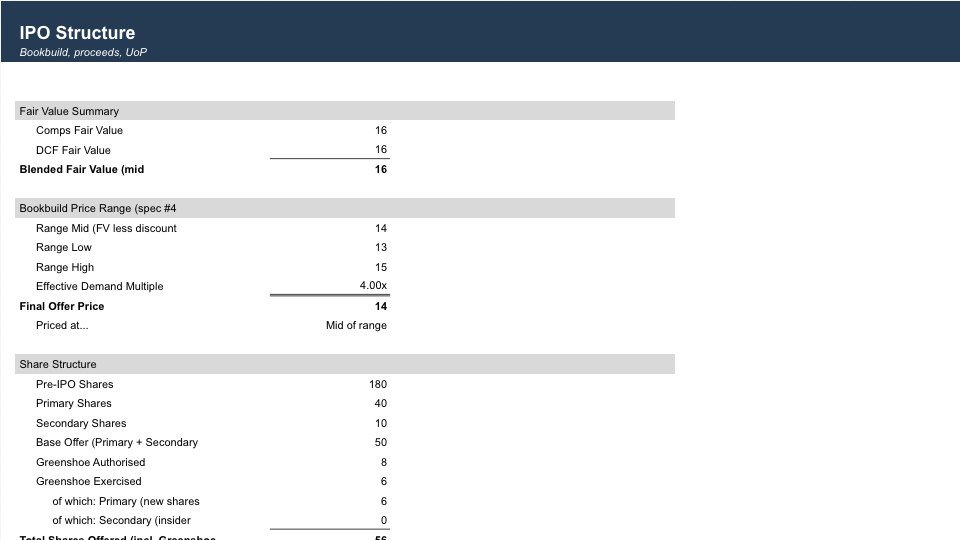
IPO Pricing and Waterfall Model
Pricing and equity distribution model for IPO transactions including valuation scenarios, dilution analysis, and founder/investor waterfalls.
Securities Bookbuilding Order Log
Log investor orders and amendments in a share placement, build final demand at the offer price and reconcile it to the syndicate book.
Issue Stabilization and Greenshoe Exercise Ledger
Track the over-allotment short, market buys and greenshoe exercise after an IPO, with share and cash settlement.
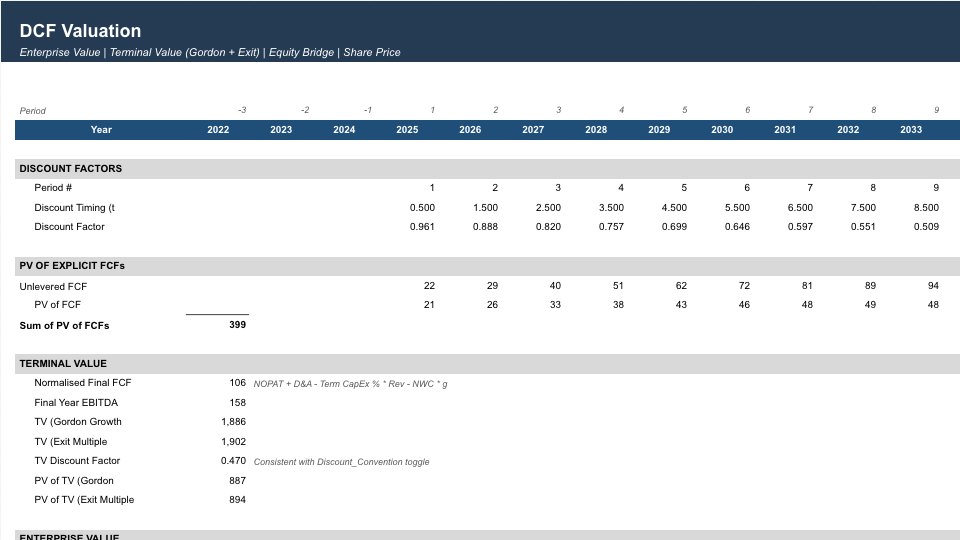
DCF Model
Discounted cash flow valuation model with explicit forecast, terminal value, and WACC.







