Bookbuilding Order Log Tracker
Capital Markets Financial Model (Excel Download)
Keep every investor order and amendment in one log while you build the book for a share offering. See final demand and cover at each price and tie the book to the signed syndicate confirmation.



professionals from Deloitte






About this model
An order log for bookbuilding in a share placement. It records each investor order and every amendment or cancellation, and turns them into final executable demand. The fictional case is a USD placement of 200,000 shares for a components maker, with nine investors and two bookrunners.
Each order version has a time, action, share amount and price limit. Only the latest version of each order counts. Orders with a limit below the final price, superseded versions, cancellations and duplicates are excluded, and each exclusion has an owner and evidence. Final demand is then compared by investor with an independent syndicate confirmation.
On the shipped case final demand at USD 24 is 700,000 shares, so the book is 3.5 times covered with USD 16.8 million of demand. All nine investors match the confirmation and the book is reconciled. A price table shows demand and cover from USD 22 to USD 26. The log measures demand only and does not allocate shares.
What every model includes
Live formulas, no hardcoded values
Outputs are driven by live formulas, so the workbook updates from its assumptions instead of relying on hardcoded results.
All assumptions in one tab
Inputs are clearly marked in the Assumptions tab and separated from calculations, making it clear what to change and what to leave intact.
Statements always balancing
For integrated-statement models, the balance sheet, cash flow, and supporting schedules tie through properly.
Distinct schedules for clarity
Debt, working capital, taxes, and cash flow can get messy quickly. We group calculations in clear schedules, not across disconnected tabs.
No hidden macros or external links
There are no unexplained external workbook links or macros to undermine auditability or portability.
Changes flow through the model
Update a key driver and see the impact carry through the forecast, financing, and return outputs. We never use hardcoded numbers in formulas.
What's inside the Bookbuilding Order Log Tracker
- Versioned order log with new, amend and cancel actions
- Price limits per order, with market orders allowed
- Investor master with KYC evidence and sales owner
- Final executable demand at the selected offer price
- Exclusion bridge for superseded, below-price, cancelled and duplicate orders
- Book cover and gross demand value
- Investor-level reconciliation to the signed syndicate confirmation
- Investor concentration as a share of final demand



Formatted to IB standards
Named theme colors repaint the whole workbook in one click, on top of an investment-banking structure with clear input, output, and cross-sheet reference styling - brand-ready, institutional-grade, and fully auditable.

Created by ex-finance professionals
Hey, I’m Alex and I created Finamodel.
Over my years in the finance industry I kept building the same models over and over again. Same structure, same assumptions, different logo. So I started building frameworks to turn them into clean, reusable templates.
Every model here is one I’d actually use for a client, and I personally vet each one before it goes up.
I’m not an expert in every industry, but I’ve built enough models to know what belongs in one. And when something is completely foreign to me, I reach out to my network for experts to work on our models with us.
Having a template library on hand cuts a first build from hours to minutes.
Frequently asked
What is bookbuilding?+
Bookbuilding is how banks gather investor orders for a new share offering. Investors say how many shares they want and at what highest price. The book of orders helps set the offer price and size.
How is final demand calculated?+
For each order, only the latest version counts. Orders with a price limit below the final price, cancelled orders and duplicates are excluded. The remaining shares are the executable demand at that price.
What does book cover mean?+
Book cover is executable demand divided by the shares on offer. In the shipped case 700,000 shares of demand for 200,000 shares on offer gives a cover of 3.5 times.
Does the log allocate shares?+
No. It measures demand only. Allocation to investors is a separate step with its own rules and approvals.
Can I add more investors and orders?+
Yes. Add rows to the investor, order and confirmation sheets and extend the dependent formulas together.
Have more financial modelling questions? Contact us
Related templates
IPO Investor Allocation Recommendation Workbook
Allocate IPO shares to investors with capped pro rata, round lots and approved overrides, then release only signed allocations.
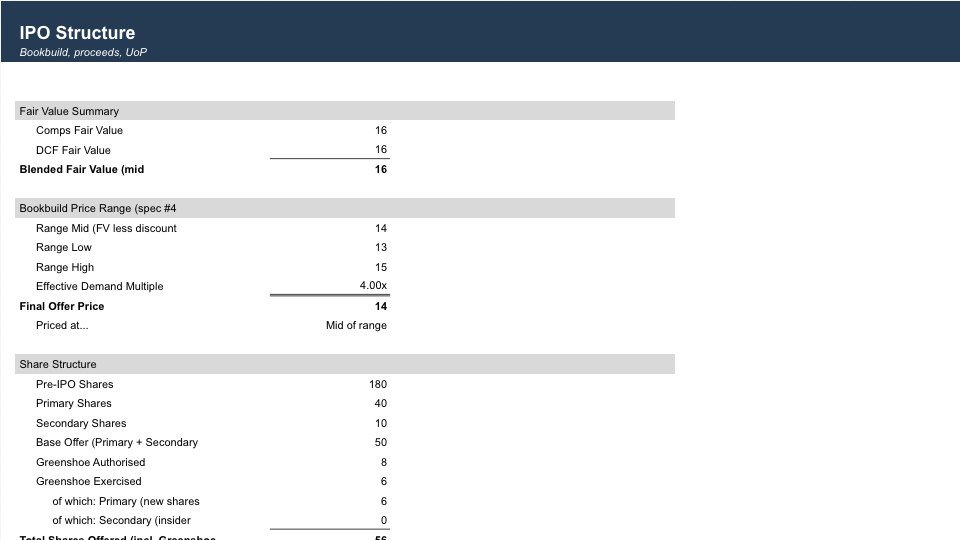
IPO Pricing and Waterfall Model
Pricing and equity distribution model for IPO transactions including valuation scenarios, dilution analysis, and founder/investor waterfalls.
Issue Stabilization and Greenshoe Exercise Ledger
Track the over-allotment short, market buys and greenshoe exercise after an IPO, with share and cash settlement.
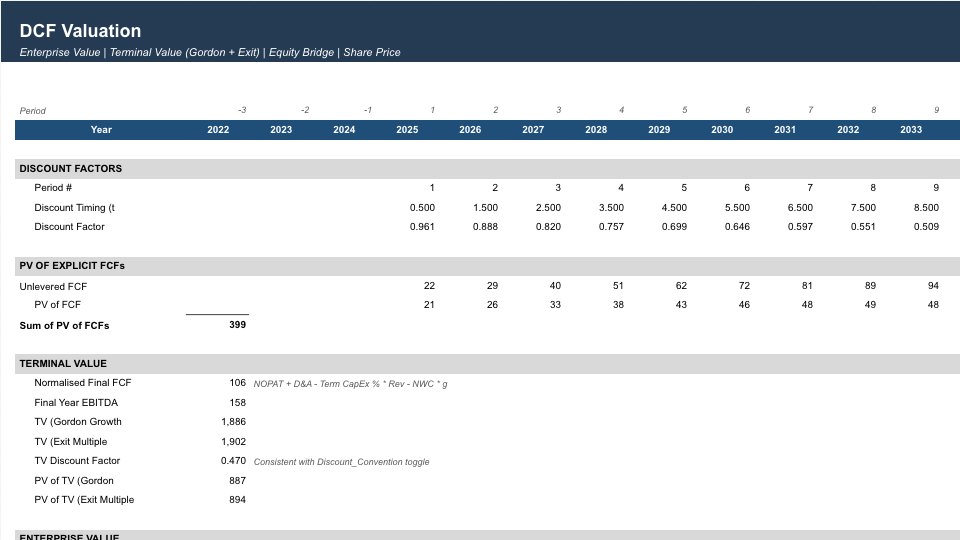
DCF Model
Discounted cash flow valuation model with explicit forecast, terminal value, and WACC.







