Leasing Model
Capital Markets Financial Model (Free Excel Download)
Model equipment lease payments, residual values, classifications, funding costs, and portfolio returns for lessors, fleet operators, and asset-finance teams.



professionals from Deloitte
Used by professionals from






About this model
An Equipment Leasing Model projects the cash generation and leverage profile of a mid-market equipment leasing portfolio ($100M+ originations annually). It forecasts lease income (gross contractual yield), origination fees, servicing fees, and residual gains on equipment sold at lease-end. A typical portfolio yields 9.5% on average earning assets, funded by warehouse debt at 7.0% all-in cost, producing a net interest margin (NIM) of 2.5-3.5% before credit losses. The model tracks portfolio roll-forward (originations, amortization, prepayments, charge-offs), debt repayment schedules, and equity returns through a 7-year projection.
The workbook separates portfolio mechanics (origination schedule, lease term, advance rate sizing) from financial results. The Portfolio_Build sheet calculates average earning assets and ending balances quarter-on-quarter. Revenue_Yield derives lease income, fees, and residual gains using actual cohort aging and standard recovery assumptions. Debt funding is sized mechanically at 80% advance rate against portfolio balance, with covenant tests on maximum 4.5x debt-to-equity and 85% maximum advance rate. The Income Statement captures net interest margin (NIM), credit loss provisions (0.75% default rate), and operating expenses (SG&A at 2.2% of assets), producing 12-14% ROE at maturity.
This model suits mid-market lessors, specialty finance lenders, and investors evaluating equipment leasing platform acquisitions or originations programs. Key metrics include portfolio yield (contractual rate on loans), cost of funds (SOFR + spread), net charge-off rates (typically 0.5-1.5% through the cycle), and covenant headroom (targeting 1.5-2.0x debt/equity cushion above limits).
What every model includes
Live formulas, no hardcoded values
Outputs are driven by live formulas, so the workbook updates from its assumptions instead of relying on hardcoded results.
All assumptions in one tab
Inputs are clearly marked in the Assumptions tab and separated from calculations, making it clear what to change and what to leave intact.
Statements always balancing
For integrated-statement models, the balance sheet, cash flow, and supporting schedules tie through properly.
Distinct schedules for clarity
Debt, working capital, taxes, and cash flow can get messy quickly. We group calculations in clear schedules, not across disconnected tabs.
No hidden macros or external links
There are no unexplained external workbook links or macros to undermine auditability or portability.
Changes flow through the model
Update a key driver and see the impact carry through the forecast, financing, and return outputs. We never use hardcoded numbers in formulas.
What's inside the Leasing Model
- Operating and finance lease classification logic
- Right-of-use asset and liability amortisation schedules
- Residual value and disposition sensitivity analysis
- Structured payment profiles with step-ups and balloon payments
- IRR and NPV yield calculations
- Lease portfolio composition and payment schedules
- Equipment depreciation and residual value assumptions
- Operating expense forecasts (maintenance, insurance, setup)
How the Equipment Leasing Model Projects Portfolio Performance and Leverage
This leasing model projects a mid-market equipment lessor's financials over seven years, driven by portfolio roll-forward, spread income, residual realisations and warehouse debt. It is built for lessors, fleet operators and asset finance teams evaluating how originations, funding structure and credit losses interact.
The specification is a values-only preview.
Portfolio Origins and Capital Deployment
Annual originations are the engine of the leasing model, equivalent to capital expenditure for a lessor.
- Each funded lease splits between a lease receivable and a capitalised residual asset, so the full equipment cost is not booked twice.
- The portfolio then rolls forward from opening receivables, adding funded amounts and subtracting scheduled amortisation, prepayments and charge-offs.
- Growth is set by an origination growth rate rather than a standalone revenue growth assumption, so lease income scales as the book seasons.
Revenue Spread and Residual Gains
Lease income accrues on average receivables plus the average residual asset, reflecting the full net investment. Servicing fees are charged on average earning assets, while origination fees are recognised in the year of funding under a management-account convention.
- Residual gains arise when equipment sells at lease expiry: proceeds less the carrying value released. If the realisation rate falls below the book rate, the model correctly books a loss.
- Cohort timing links off-lease equipment to the origination cohort from the matching lease term.
Funding and Balance Sheet Mechanics
Debt is a senior secured warehouse facility sized mechanically at a fixed advance rate against ending earning assets, which avoids circularity between debt, interest and equity. Interest expense is average debt multiplied by an all-in cost of funds, combining a base rate and borrowing spread.
- The balance sheet holds cash, net receivables and the residual asset as a balance-sheet item. Equity comprises sponsor capital, cumulative capital calls and retained earnings.
- Minimum cash is maintained as a proportion of net receivables and funded through equity when required.
Cash Flow, Covenants and Practical Use
The cash flow statement uses the indirect method. Residual gains recognised in the income statement are reversed out of operating cash flow, with residual proceeds shown as an investing inflow, ensuring the balance sheet balances.
- Originations are investing outflows, while amortisation and prepayments are inflows. The model checks leverage against a debt-to-equity covenant and advance rate against a covenant limit, alongside net interest margin, cash floor and portfolio roll checks.
- Scenarios are a reserved placeholder, so the template currently runs a base case with named-range inputs available for sensitising.
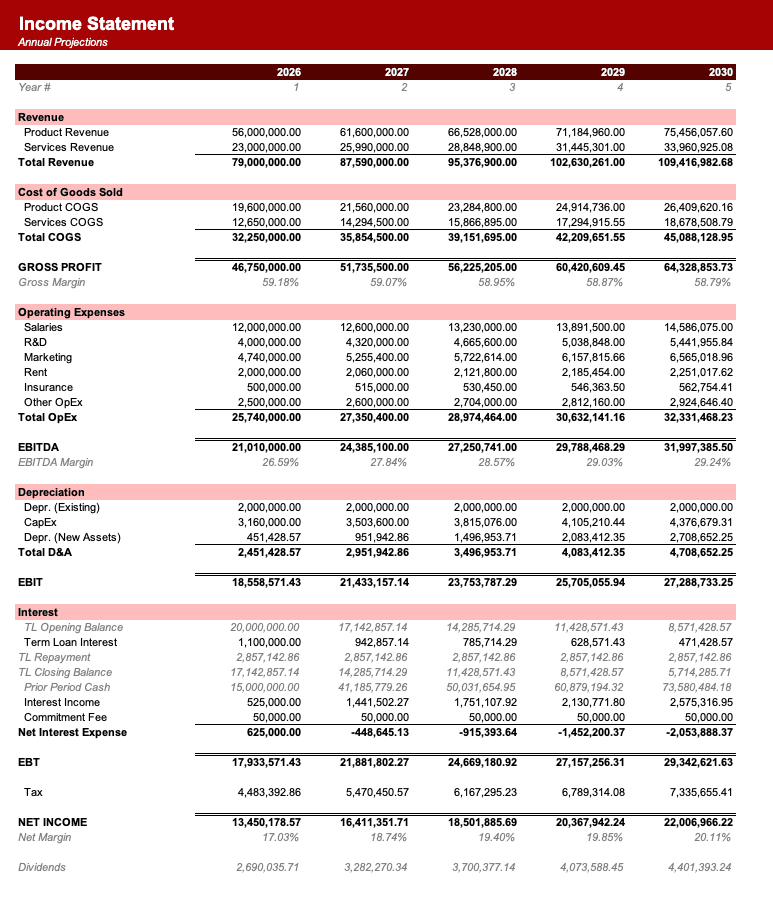
Formatted to IB standards
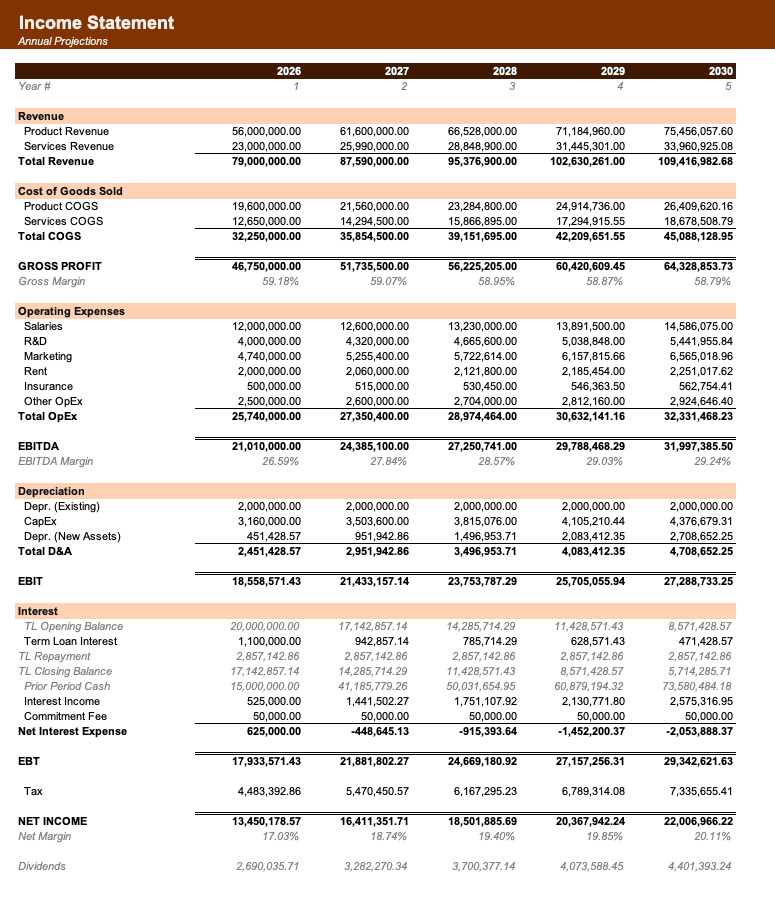
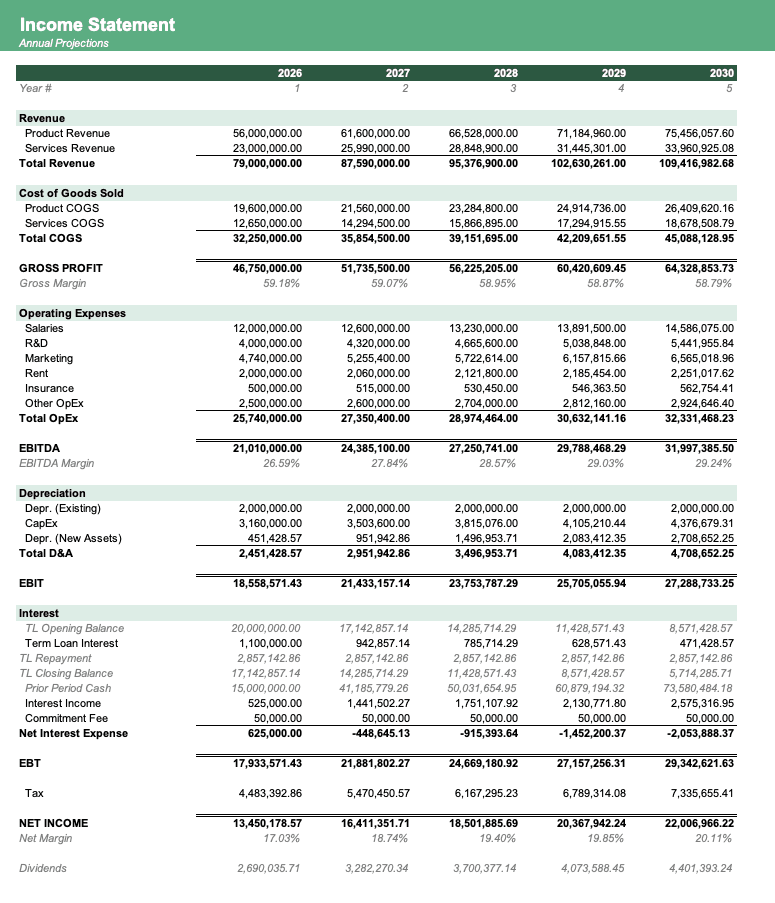
Named theme colors repaint the whole workbook in one click, on top of an investment-banking structure with clear input, output, and cross-sheet reference styling - brand-ready, institutional-grade, and fully auditable.

Created by ex-finance professionals
Hey, I’m Alex and I created Finamodel.
Over my years in the finance industry I kept building the same models over and over again. Same structure, same assumptions, different logo. So I started building frameworks to turn them into clean, reusable templates.
Every model here is one I’d actually use for a client, and I personally vet each one before it goes up.
I’m not an expert in every industry, but I’ve built enough models to know what belongs in one. And when something is completely foreign to me, I reach out to my network for experts to work on our models with us.
Having a template library on hand cuts a first build from hours to minutes.
Need help finding your model? You’ll find me in the Finamodel app!
Frequently asked
What is a leasing financial model?+
It is a model used to evaluate asset-backed leases, covering payment structures, accounting treatment, residual values, and investment returns for lessors and lessees.
What should a leasing model include?+
It should include lease classification logic, payment schedules, residual value assumptions, ROU asset and liability tracking, and yield calculations.
Who uses leasing models?+
Leasing companies, fleet operators, corporate finance teams, and project finance professionals use them for pricing, underwriting, and portfolio analysis.
Does it support IFRS 16 accounting?+
Yes. A proper leasing model should handle both operating and finance lease treatments under IFRS 16 and ASC 842 standards.
Can I model different payment structures?+
Yes. The model supports step-ups, seasonal holidays, balloon payments, and other structured rent profiles commonly used in asset finance.
Have more financial modelling questions? Contact us
Related templates
Sale-Leaseback Real Estate Model
Financing model for property owners selling real estate to investors and leasing it back, with lease terms, IRR, and tax deferral analysis.
DCF Model
Discounted cash flow valuation model with explicit forecast, terminal value, and WACC.
Comparable Companies Analysis
Pull trading multiples from peer companies and calculate implied valuation ranges.
Mortgage Portfolio Model
Mortgage loan portfolio analysis with prepayment speeds, default rates, and cash flow projections.