Make-or-Buy and Outsourcing Analysis
Budgeting Financial Model (Excel Download)
Decide whether to make a part in-house or buy it from a supplier. The workbook compares only avoidable costs, adds transition cost, freed capacity and risk, and finds the highest price you can accept.



professionals from Deloitte






About this model
A make-or-buy appraisal for FP&A and operations finance teams. It tests whether a fictional components maker should outsource a part with annual demand of 50,000 units to an outside supplier.
Internal costs are split into avoidable and stranded parts, so allocated overhead does not distort the result. Supplier price, freight, oversight and risk costs are escalated over five years. Released machine hours earn a capacity benefit only up to approved alternative demand. Transition spend is a cash outflow at the start, and cash flows are discounted at a pre-tax hurdle rate. A risk register lists release gates with owners.
On the shipped case avoidable internal cost is $850,000 a year and five-year NPV is about $423,000. The break-even first-year quote is $16.31 per unit, $2.11 above the $14.20 quote. A downside case turns NPV slightly negative.
What every model includes
Live formulas, no hardcoded values
Outputs are driven by live formulas, so the workbook updates from its assumptions instead of relying on hardcoded results.
All assumptions in one tab
Inputs are clearly marked in the Assumptions tab and separated from calculations, making it clear what to change and what to leave intact.
Statements always balancing
For integrated-statement models, the balance sheet, cash flow, and supporting schedules tie through properly.
Distinct schedules for clarity
Debt, working capital, taxes, and cash flow can get messy quickly. We group calculations in clear schedules, not across disconnected tabs.
No hidden macros or external links
There are no unexplained external workbook links or macros to undermine auditability or portability.
Changes flow through the model
Update a key driver and see the impact carry through the forecast, financing, and return outputs. We never use hardcoded numbers in formulas.
What's inside the Make-or-Buy and Outsourcing Analysis
- Avoidable and stranded internal cost bridge
- Supplier price, inbound freight, oversight and risk costs
- Separate supplier escalation and internal inflation
- Capacity benefit capped at alternative demand hours
- Transition spend as a cash outflow at inception
- Five-year pre-tax NPV of the outsourcing decision
- Break-even first-year supplier quote and headroom
- Risk register with mitigation, owner and release gate



Formatted to IB standards
Named theme colors repaint the whole workbook in one click, on top of an investment-banking structure with clear input, output, and cross-sheet reference styling - brand-ready, institutional-grade, and fully auditable.

Created by ex-finance professionals
Hey, I’m Alex and I created Finamodel.
Over my years in the finance industry I kept building the same models over and over again. Same structure, same assumptions, different logo. So I started building frameworks to turn them into clean, reusable templates.
Every model here is one I’d actually use for a client, and I personally vet each one before it goes up.
I’m not an expert in every industry, but I’ve built enough models to know what belongs in one. And when something is completely foreign to me, I reach out to my network for experts to work on our models with us.
Having a template library on hand cuts a first build from hours to minutes.
Frequently asked
What is a make-or-buy analysis?+
It compares the cost of making a product or part in-house with buying it from a supplier. A good analysis looks only at costs that change with the decision, plus one-off transition costs and risks.
Why split avoidable and stranded costs?+
Some costs, such as allocated central overhead, stay even if you outsource. Counting them as savings would overstate the benefit. Only avoidable costs are compared with the supplier cost.
How is the break-even supplier quote found?+
It is the first-year unit price that makes the five-year NPV zero. It uses the same escalation, discounted volumes, transition cost and capacity benefit as the main appraisal.
Does it include tax?+
No. The NPV is pre-tax, using end-of-year cash flows over five years. Add tax effects separately if they matter for your decision.
How do I use it for my own decision?+
Enter your demand, supplier quote, escalation, discount rate and transition spend in Assumptions. Then set the avoidable share of each internal cost and update the risk register.
Have more financial modelling questions? Contact us
Related templates
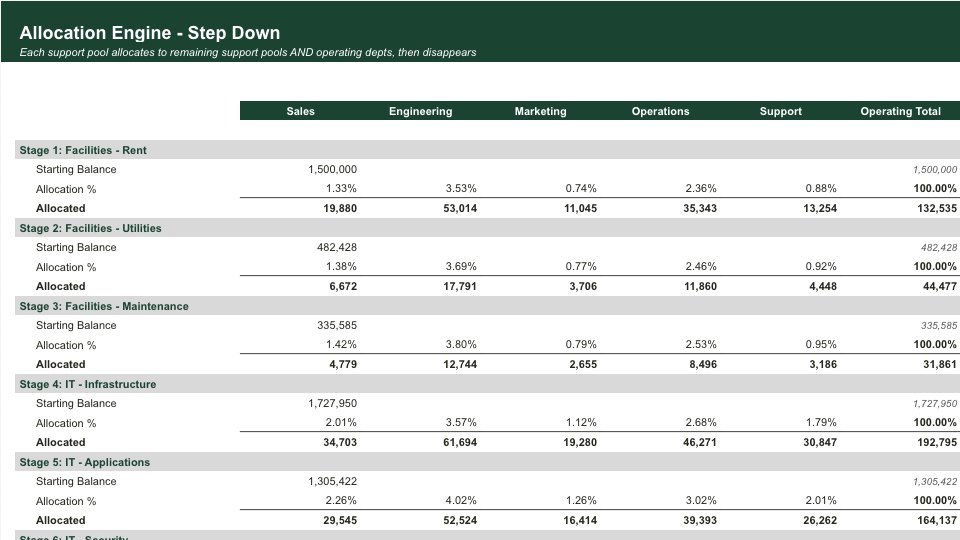
Cost Allocation Model
Allocate shared costs to business units or products using driver-based mechanics.
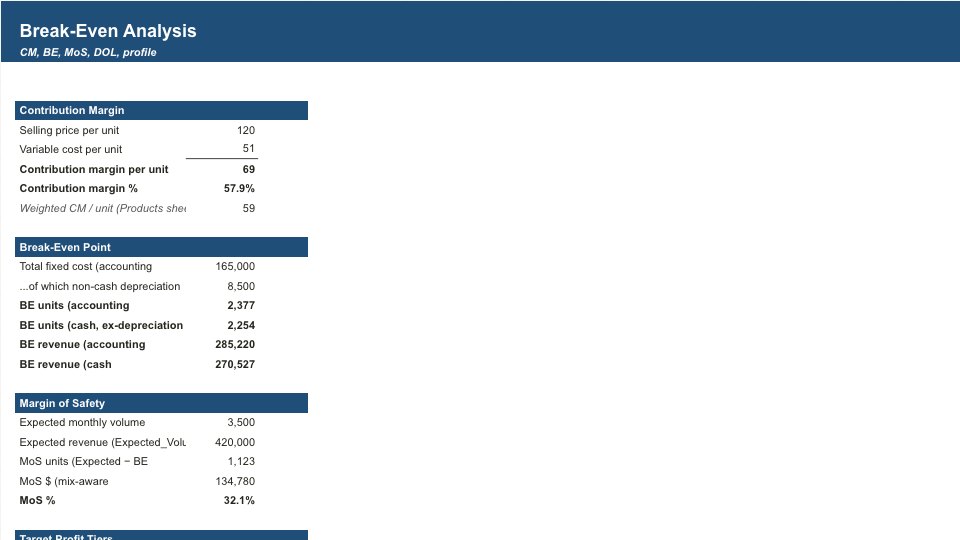
Break-Even Analysis
Contribution-margin break-even model with 2-way price and variable-cost sensitivity.
Special Order Incremental Profit Appraisal
Test a one-off customer order using spare capacity, incremental costs and the contribution lost from displaced work.
Capital Project Portfolio Optimizer
Pick the set of capital projects with the highest NPV within yearly capex, staff and risk limits, with exclusive and dependent projects.







