Special Order Incremental Profit Analysis
Budgeting Financial Model (Excel Download)
Decide whether a one-off customer order is worth taking. The workbook counts only the costs the order adds, plus the profit lost on regular work it pushes out, and compares an extra shift.



professionals from Deloitte






About this model
A special order appraisal for management accountants and FP&A reviewers. It tests a one-off order of 1,800 marine valve housings at $55 per unit for a fictional precision components maker, in one production cell.
Incremental revenue is set against material, labor, freight, commission and one-off setup. Allocated overhead is unchanged and left out. A capacity schedule compares order hours with spare hours, and any excess displaces regular work at its contribution. A quote ladder tests nine volume and price pairs. A shift sheet compares displacing regular work with buying extra shift hours. There is no discounting or tax.
On the shipped case the order adds $99,000 revenue and $52,560 variable cost. It needs 1,400 hours more than spare capacity, which costs $16,800 of lost contribution. Incremental profit is $24,640, or $27,840 with the extra shift.
What every model includes
Live formulas, no hardcoded values
Outputs are driven by live formulas, so the workbook updates from its assumptions instead of relying on hardcoded results.
All assumptions in one tab
Inputs are clearly marked in the Assumptions tab and separated from calculations, making it clear what to change and what to leave intact.
Statements always balancing
For integrated-statement models, the balance sheet, cash flow, and supporting schedules tie through properly.
Distinct schedules for clarity
Debt, working capital, taxes, and cash flow can get messy quickly. We group calculations in clear schedules, not across disconnected tabs.
No hidden macros or external links
There are no unexplained external workbook links or macros to undermine auditability or portability.
Changes flow through the model
Update a key driver and see the impact carry through the forecast, financing, and return outputs. We never use hardcoded numbers in formulas.
What's inside the Special Order Incremental Profit Analysis
- Order revenue and incremental variable costs
- Sales commission on order revenue only
- One-off setup and testing cost
- Allocated overhead excluded from the decision
- Capacity bridge from available to spare hours
- Displaced units and lost regular contribution
- Quote ladder of nine volume and price pairs
- Extra shift option with premium and mobilization cost



Formatted to IB standards
Named theme colors repaint the whole workbook in one click, on top of an investment-banking structure with clear input, output, and cross-sheet reference styling - brand-ready, institutional-grade, and fully auditable.

Created by ex-finance professionals
Hey, I’m Alex and I created Finamodel.
Over my years in the finance industry I kept building the same models over and over again. Same structure, same assumptions, different logo. So I started building frameworks to turn them into clean, reusable templates.
Every model here is one I’d actually use for a client, and I personally vet each one before it goes up.
I’m not an expert in every industry, but I’ve built enough models to know what belongs in one. And when something is completely foreign to me, I reach out to my network for experts to work on our models with us.
Having a template library on hand cuts a first build from hours to minutes.
Frequently asked
What is a special order decision?+
It is the choice to accept or reject a one-off order, often at a lower price than normal. The order is worth taking if its extra revenue covers the extra costs it causes, including any profit lost elsewhere.
Why is fixed overhead excluded?+
Allocated overhead does not change if you take the order. Including it would make a profitable order look like a loss. Only incremental costs count.
What is displaced contribution?+
If the order needs more hours than are spare, some regular production must stop. The contribution from those lost regular units is an opportunity cost of the order.
Does it include tax or discounting?+
No. It is a single-period, pre-tax test. Displaced units are treated as a divisible planning estimate.
How do I test my own order?+
Enter units, price, unit costs, commission, setup and capacity in Assumptions. Then read the profit on Order review and check the quote ladder and shift option.
Have more financial modelling questions? Contact us
Related templates
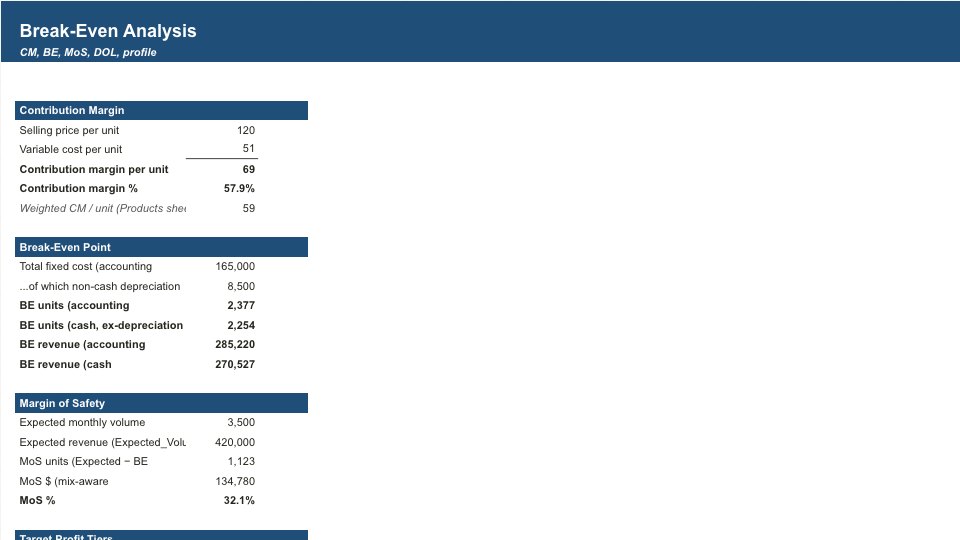
Break-Even Analysis
Contribution-margin break-even model with 2-way price and variable-cost sensitivity.
Make-or-Buy and Outsourcing Appraisal
Compare avoidable internal cost with supplier price, transition cost, freed capacity and risk to decide on outsourcing.
Constrained Product Mix Optimization
Find the product mix that earns the most contribution within machine and labor capacity, demand and commitments.
Capital Project Portfolio Optimizer
Pick the set of capital projects with the highest NPV within yearly capex, staff and risk limits, with exclusive and dependent projects.







