Merger Arbitrage Model
Capital Markets Financial Model (Free Excel Download)
Hold one announced deal and price what the market is already charging for it. The consideration is 34.00 in cash plus 0.2600 acquirer shares collared between 85.50 and 104.50, so at 92.40 the deal is worth 58.02 against a 54.80 target price - a 3.22 gross spread, 5.9 per cent, on a 30.4 per cent premium. Five closing conditions multiply to 90.6 per cent and an escalating monthly hazard resolves the deal in 9.20 expected months. Break value is 42.81 after a broken-process overhang and a probability-weighted termination fee, an 11.99 loss that puts downside to upside at 3.72 times. Expected profit is 2.14 a share, 11.4 per cent annualised on capital - against a 78.3 per cent completion probability implied by the price and a 78.5 per cent breakeven.



professionals from Deloitte
Used by professionals from






About this model
A risk-arbitrage position model on a single announced cash-and-stock deal: Vantage Analytics Group to acquire Halcyon Systems for 34.00 in cash plus 0.2600 acquirer shares, signed in March 2026. It is not a valuation model with a spread bolted on, and it exists for three mechanics no other archetype carries. The first is that the consideration is collared. The stock leg is fixed between 85.50 and 104.50 on the acquirer price, so inside the collar the exchange ratio is fixed and the deal value moves one for one with the acquirer, while outside it the value is fixed and the ratio moves instead - which means the number of acquirer shares the arb is short is the effective ratio, not the headline 0.2600, and the hedge has to be re-struck once either bound binds. The consideration build therefore runs twice, once at the market price and once across a nine-point grid from 20 per cent down to 20 per cent up, and the grid is what makes the kink visible: deal value pins at 56.23 at the bottom, tracks the acquirer through the middle, and pins again at 61.17 once the upper bound binds. On the shipped case the acquirer trades at 92.40, inside the collar, so the deal is worth 58.02 against a target price of 54.80 - a gross spread of 3.22, or 5.9 per cent, on a 30.4 per cent premium to the unaffected price. The second mechanic is that timing is a hazard curve rather than a date. Five conditions - antitrust, foreign investment, the sector regulator, the shareholder vote and financing - each carry a conditional clearance probability that multiplies down to a joint 90.6 per cent, with the marginal break contribution of each carried alongside so it is visible that antitrust is 4.5 of the 9.4 points of break risk and everything else together is under 5. Nothing can close before month 7; from there a conditional monthly hazard of 18 per cent escalates 35 per cent a month and is forced to one at the month-13 outside date, so the distribution is complete by construction and a check row proves the weights sum to one. The probability-weighted result is 9.20 months, which is the denominator behind every annualised figure in the workbook, and the row of position-open weights it also produces is what carry accrues against - carry in month 12 only counts for the 9 per cent of paths still open in month 12. The carry ledger itself is built on one share: long at 54.80, short 0.2600 acquirer shares worth 24.02, 78.82 of gross exposure against 23.65 of equity posted at a 30 per cent margin and 7.13 borrowed. Four monthly lines run against it - 0.073 of target dividend received, 0.035 of acquirer dividend owed away on the short, 0.012 of stock borrow and 0.030 of financing - netting to a drag of 0.004 a month. That the position is close to carry-neutral is the point, and it is one input away from not being: drop the margin requirement to 25 per cent and financing rises to 0.047 a month, five times the drag, for a position that is only marginally more levered. The ticking fee is deliberately kept out of that ledger, because it is an increment to the merger consideration of 0.14 per share for every month past month 9 paid at closing rather than accrued in cash; weighted across the timing distribution it is worth 0.107, a third of the carry drag and running the other way. The third mechanic is a downside built as a price rather than a haircut. The 44.50 unaffected price is rebased by the 2 per cent the sector has moved since signing, cut by a 10 per cent broken-process overhang, and credited with a 460 million reverse termination fee - 5.48 a share, but payable only on a regulatory failure and so weighted at 65 per cent to 3.56. Break value lands at 42.81, an 11.99 loss on the current price and minus 50.7 per cent of the equity posted, which puts downside to upside at 3.72 times and is why sizing is a sheet of its own. Three branches - completes at 84.6 per cent, a topping bid at 6 per cent worth an 8 per cent uplift, a regulatory break at 9.4 per cent - carry to an expected profit of 2.14 per share, 9.0 per cent on capital and 11.4 per cent annualised, and a bridge underneath decomposes that number exactly rather than by a plug because every outcome value is expressed as a gap to the base case: 3.22 of gross spread, plus 0.11 of ticking fee, less 0.03 of carry, plus 0.28 of topping-bid uplift, less 1.44 of break cost. Read that column and the trade is not a 5.9 per cent spread; it is a 5.9 per cent spread against 1.44 of expected break cost, with the ticking fee and the carry as rounding. The last block inverts the tree. Given a 42.81 downside and a 58.13 upside, the 54.80 market price is already charging a 78.3 per cent completion probability against the model's 90.6, and the breakeven probability at which expected profit is zero is 78.5 per cent - almost exactly the market's number, so the margin of safety is 12.1 points and no more. The same calculation is carried across nine target prices, so the implied probability can be read against the model's at any entry point rather than only at today's. Fund-level sizing then makes the consequence concrete: a 4 per cent weight of an 850 million book is 34 million of capital at 3.33 times gross leverage, 3.07 million of expected profit worth 0.36 per cent of net asset value, against a 17.3 million loss worth 2.04 per cent of it if the deal breaks - 5.6 completed deals to pay for one failure. Five named scenarios and a nine-row check block, all reconciling to zero, close the workbook.
What every model includes
Live formulas, no hardcoded values
Outputs are driven by live formulas, so the workbook updates from its assumptions instead of relying on hardcoded results.
All assumptions in one tab
Inputs are clearly marked in the Assumptions tab and separated from calculations, making it clear what to change and what to leave intact.
Statements always balancing
For integrated-statement models, the balance sheet, cash flow, and supporting schedules tie through properly.
Distinct schedules for clarity
Debt, working capital, taxes, and cash flow can get messy quickly. We group calculations in clear schedules, not across disconnected tabs.
No hidden macros or external links
There are no unexplained external workbook links or macros to undermine auditability or portability.
Changes flow through the model
Update a key driver and see the impact carry through the forecast, financing, and return outputs. We never use hardcoded numbers in formulas.
What's inside the Merger Arbitrage Model
- Deal terms: cash per share, exchange ratio, collar bounds, and the reference and current acquirer prices
- Target inputs: shares outstanding, unaffected price, current price, net debt and the ordinary dividend
- A collared consideration build - price capped, floored, valued at the exchange ratio, and split cash against stock
- An effective exchange ratio that moves once either collar bound binds, driving every short-leg row
- Transaction size: equity value, enterprise value, shares issued and target holders' pro forma ownership
- A nine-point acquirer price grid from 20 per cent down to 20 per cent up, showing where the collar bites
- Five conditions to closing with conditional clearance odds, a joint probability and a marginal break contribution each
- An escalating monthly close hazard from an earliest month, capped at one and forced to one at the outside date
Merger Arbitrage Model: Collared Consideration, Timing Hazard, and Probability-Weighted Payout
This merger arbitrage model prices a single announced cash-and-stock deal where the acquirer's share price determines deal value inside a collar. It models a five-condition closing probability, an escalating monthly hazard that yields expected months to close, a monthly carry ledger, a bottom-up break scenario, and a three-branch outcome tree.
The workbook also solves the market-implied completion probability and the breakeven completion probability.
How the Collared Consideration Shapes Deal Value and the Hedge
The model builds consideration as a fixed cash amount plus an exchange ratio applied to a collared acquirer share price. The collared reference takes the acquirer's market price, caps it at the collar's upper bound, and floors it at the lower bound.
- Deal value equals cash plus the stock value, which is the exchange ratio times that collared reference. Inside the collar, deal value moves one-for-one with the acquirer.
- Outside it, deal value is fixed and the effective ratio moves. The effective ratio equals stock value divided by the acquirer price, and it is the correct short-hedge count rather than the headline exchange ratio.
A nine-point grid across acquirer prices makes the collar kink visible, showing where deal value is flat, where it tracks, and where it pins.
Closing Conditions and the Hazard-Based Timing Distribution
Closing probability is handled in two stages. First, five conditions—antitrust, foreign investment, sector regulator, shareholder vote, and financing—each carry a conditional clearance probability, which multiply to a joint completion probability.
- The model also reports each condition's marginal break probability, making it clear which condition contributes the most failure risk. Second, the model distributes when the deal closes.
- A conditional monthly hazard begins after an earliest close month, escalates by a fixed ramp each month, and is forced to one at the outside date so the distribution sums to one. Multiplying surviving-pending probability by the hazard gives monthly resolution weights.
The probability-weighted result is an expected months to resolution figure, and the same weights are used to accrue carry only while the position remains open.
The Per-Share Carry Ledger and What It Means for Returns
The carry sheet builds the position on one target share: long the target, short a number of acquirer shares equal to the effective ratio, with the resulting net cash outlay and gross exposure. It then applies a margin requirement to derive equity posted, borrowings, and gross leverage.
- Four monthly lines run against the position: the target dividend received, the acquirer dividend paid on the short, stock borrow cost, and financing on borrowed cash. Net carry is the sum of these, and it can be negative or close to neutral depending on the inputs.
- Changing the margin requirement changes borrowings and financing, so margin and financing act as one lever. A ticking fee is deliberately excluded from the carry ledger because it is paid at closing on the consideration and only after a stated month.
Weighted across the timing distribution, it adds to expected value but runs opposite to carry.
The Downside Break Value and the Market-Implied Completion Probability
The break scenario builds the failed-deal price from the bottom up: an unaffected price rebased by a sector index move, reduced by a broken-process overhang, plus a reverse termination fee weighted by the probability that the fee is actually payable. This produces a break value per share and a loss versus the current price.
- The ratio of that loss to the gross spread is the downside-to-upside multiple, which drives position sizing. The expected value tree then runs three branches—completes as announced, a topping bid, and a regulatory break—using the completion probability derived from the closing conditions.
- A profit bridge decomposes expected profit into the gross spread plus the expected ticking fee, expected net carry, topping bid uplift, and break outcome, and it reconciles exactly because each line is expressed as a gap to the base case.
- Finally, the model inverts the tree to solve the completion probability implied by the current market price and calculates a breakeven completion probability where expected profit is zero. Comparing the model's completion probability with the market-implied one shows the gap that represents the thesis, while the breakeven level shows the margin of safety.
The same implied calculation is available across a range of target prices, so the comparison can be made at any entry point rather than only at the current price.
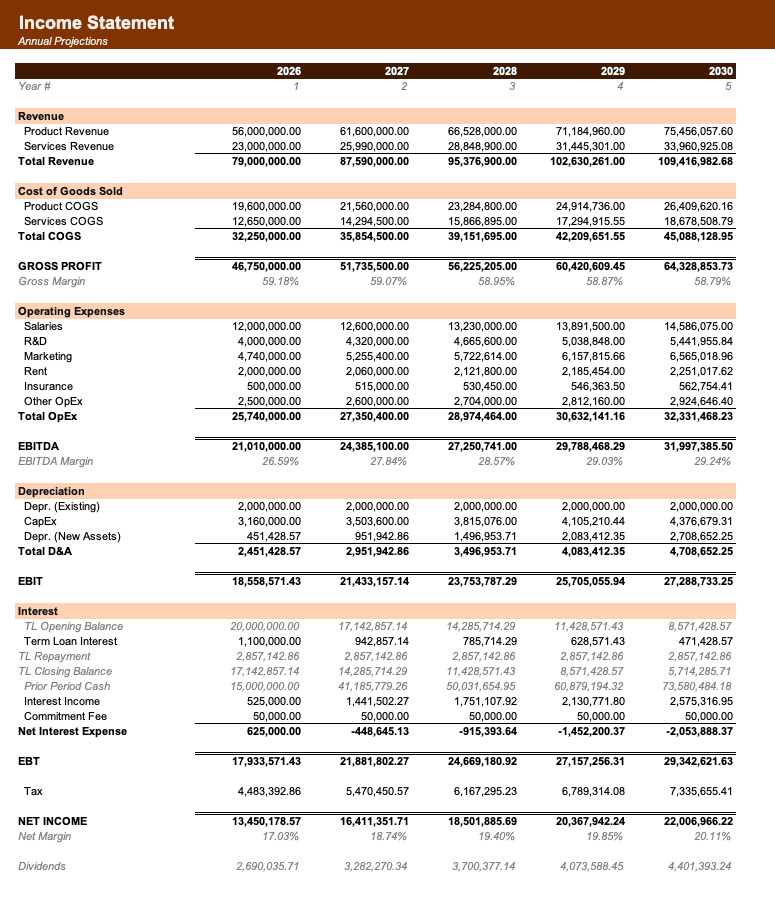
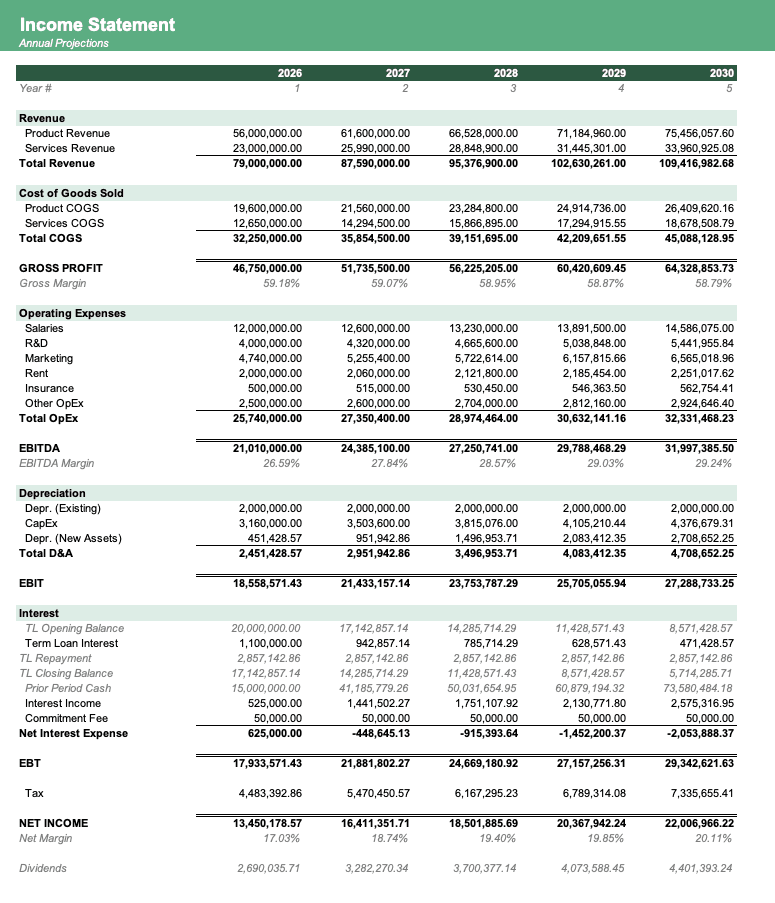
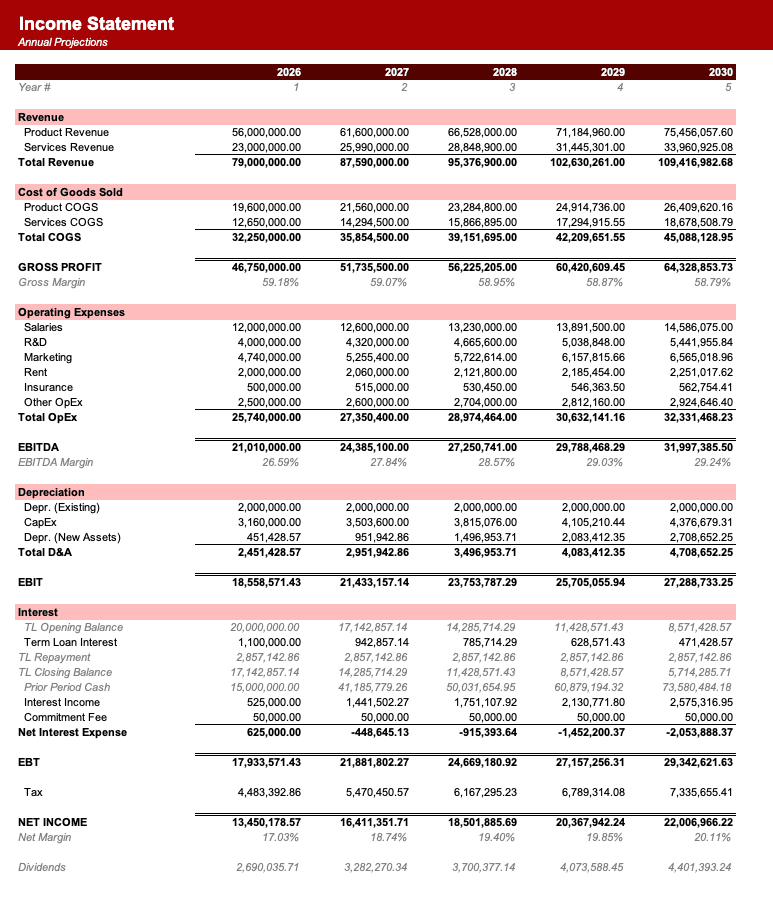
Formatted to IB standards
Named theme colors repaint the whole workbook in one click, on top of an investment-banking structure with clear input, output, and cross-sheet reference styling - brand-ready, institutional-grade, and fully auditable.

Created by ex-finance professionals
Hey, I’m Alex and I created Finamodel.
Over my years in the finance industry I kept building the same models over and over again. Same structure, same assumptions, different logo. So I started building frameworks to turn them into clean, reusable templates.
Every model here is one I’d actually use for a client, and I personally vet each one before it goes up.
I’m not an expert in every industry, but I’ve built enough models to know what belongs in one. And when something is completely foreign to me, I reach out to my network for experts to work on our models with us.
Having a template library on hand cuts a first build from hours to minutes.
Need help finding your model? You’ll find me in the Finamodel app!
Frequently asked
What is a merger arbitrage model?+
It is the position model behind a risk-arbitrage trade: buy the target of an announced deal below the offer, hedge the stock component by shorting the acquirer, and earn the spread if the deal closes. What it has to get right is not the valuation of either company but three other things - what the consideration is actually worth today, when and whether the deal closes, and what the target is worth if it does not.
Why does the collar change the hedge ratio?+
A collar fixes the value of the stock leg outside a band on the acquirer price. Inside the band the exchange ratio is fixed at 0.2600 and the deal value moves one for one with the acquirer. Outside it the value is fixed instead, so the ratio has to move to deliver it - to 0.3007 at the bottom of the grid and 0.2450 at the top. Since the short leg is sized on the shares actually delivered, hedging on the headline ratio leaves the position mis-hedged exactly when the acquirer has moved most.
Why model the closing date as a distribution rather than a date?+
Because every annualised figure divides by it, and because carry accrues only while the position is open. A single expected date gives the first but not the second. The hazard curve here gives both: a probability-weighted 9.20 months for the annualisation, and a row of position-open weights so that carry in a late month is charged only against the small share of paths that reach it.
Should the ticking fee be treated as carry?+
No. A ticking fee increases the merger consideration by a stated amount per share for each month the close slips past a date, and it is paid at closing. Putting it in the monthly carry ledger overstates cash received and understates the consideration. Here it is accrued to the consideration and weighted across the timing distribution, where it is worth 0.107 a share against a carry drag of 0.03.
How is the break value estimated?+
From the bottom up rather than as a haircut. The unaffected price is rebased by the peer index move since signing, cut by a broken-process overhang, and credited with the reverse termination fee - which is weighted at the probability it is actually payable, since a regulatory failure triggers it and a failed shareholder vote or financing does not.
What is the market implied completion probability?+
The probability that makes the current price fair given the two outcomes: price less break value, over deal value less break value. At 54.80 against a 42.81 downside and a 58.13 upside that is 78.3 per cent. The model's conditions multiply to 90.6 per cent, and the breakeven probability at which expected profit is zero is 78.5 per cent - so the trade is the 12.1 point gap and nothing else.
How is this different from a merger model or a take-private model?+
A merger model is the acquirer's question: accretion, dilution, synergies and the pro forma capital structure. A take-private model is the sponsor's: entry multiple, leverage and exit returns. This is the arbitrageur's, which is a different problem entirely - a two-outcome bet with a fixed upside, an unfixed date and an asymmetric downside, priced against what the market is already charging.
Have more financial modelling questions? Contact us
Related templates
M&A Modeling & Valuation
Comprehensive M&A valuation with DCF, comparable companies, and precedent transactions analysis.
Take-Private Model
LBO take-private model with premium to unaffected share price, debt financing flex, and rollover equity mechanics.
Corporate Spin-Off Financial Model
Standalone pro forma model for a business being spun off from a parent company, including revenue, cost allocation, and standalone viability.
DCF Model
Discounted cash flow valuation model with explicit forecast, terminal value, and WACC.