Take-Private Model
Private Equity Financial Model (Free Excel Download)
See whether the bid can actually be announced. A 28.0 per cent premium to an unaffected 11.20 puts the offer at 14.34 a share - 37.8 per cent over the three-month VWAP but only 13.8 per cent over the 52-week high - and values 151.3m diluted shares at 2,170, or 2,525 of enterprise value at 9.60x LTM EBITDA. Certain funds are then tested on the maximum cash case rather than the expected one: a 1,450 equity commitment letter covers 1,295 with no flex and still covers 1,425 when the arrangers take 200bps of discount, 150bps of margin and cut the senior loan by a tenth. Elections for the stub come in at 31.7 per cent of the register against a 25 per cent cap, scale back to 0.47, and leave the sponsor with 971 against 324 of continuing paper. On the base case the sponsor makes 2.21x and 17.2 per cent; the stub makes 2.19x, and its 31.43 a share beats the cash offer reinvested at nine per cent by 42.5 per cent.



professionals from Deloitte
Used by professionals from






About this model
A sponsor take-private of a listed mid-cap, modelled from the offer outwards rather than from an entry multiple. The offer price is an output: a 28.0 per cent premium struck against an unaffected share price of 11.20 puts the bid at 14.34 a share, and the same price is re-tested against four other reference points the board will look at - a 37.8 per cent premium to the three-month VWAP against only 13.8 per cent to the 52-week high, which is the whole argument in a public bid. Share count uses the treasury method, so in-the-money options are grossed in and the exercise proceeds buy shares back at the offer price, giving 151.3m diluted shares, 2,170 of offer equity value and 2,525 of enterprise value at 9.60x the 263 of LTM EBITDA. The financing is where the model does work most LBO templates skip. A bidder cannot announce unless it can confirm funds for the full cash consideration assuming nobody elects the rollover, so the certain funds sheet starts from maximum cash of 2,170 rather than the 1,846 the deal is expected to pay, and runs the committed stack across five market flex outcomes: pricing flex of 150bps, additional issue discount of 200bps, both together, and a full flex case that also cuts the senior commitment by a tenth. The 1,051 senior loan falls to 946, debt available falls from 1,380 to 1,275, the incremental discount cost lands as an extra use, and the equity commitment needed climbs from 1,295 to 1,425 against a 1,450 equity commitment letter - so the certain funds check reads one in every case, with 155 of headroom at best and 25 at worst, and pricing flex adds 20.7 a year to the cost of carrying the same deal. The rollover is a capped stub rather than a management rollover: an anchor holding 21 per cent and management holding 3.5 per cent elect in full, 12 per cent of institutions and 4 per cent of retail follow, and elections reach 31.7 per cent of the register against a 25 per cent cap on Bidco equity. Because Bidco's ordinary equity of 1,295 is struck before the split, the cap, the pro-rata scale-back at 0.47 and the sponsor's own 971 cheque all resolve without a circular reference, and the 364 that is scaled back is paid in cash. The trading plan runs two segments from 2,150 to 2,754 of revenue and 263 to 392 of EBITDA as delisting removes 12.5 of listed-company cost and margin walks from 12.2 to 14.3 per cent, while a 75 per cent cash sweep against a 4.00x senior loan and a 1.25x second lien bullet takes net leverage from 5.02x to 2.27x with covenant headroom never below 1.23x. Exiting the 392 of Year 5 EBITDA at 9.50x gives 2,839 of equity value: the sponsor's 971 returns 2.21x and 17.2 per cent including 20 of monitoring fees, and the stub's 324 returns 2.19x and 17.0 per cent - the two-tenths of a point between them being the monitoring fee itself, which every holder pays and one of them collects. For a shareholder choosing between the two, the stub is worth 31.43 a share at exit against 22.06 for the cash offer reinvested at nine per cent, a 42.5 per cent advantage on the base case that narrows to 13.0 per cent in the downside.
What every model includes
Live formulas, no hardcoded values
Outputs are driven by live formulas, so the workbook updates from its assumptions instead of relying on hardcoded results.
All assumptions in one tab
Inputs are clearly marked in the Assumptions tab and separated from calculations, making it clear what to change and what to leave intact.
Statements always balancing
For integrated-statement models, the balance sheet, cash flow, and supporting schedules tie through properly.
Distinct schedules for clarity
Debt, working capital, taxes, and cash flow can get messy quickly. We group calculations in clear schedules, not across disconnected tabs.
No hidden macros or external links
There are no unexplained external workbook links or macros to undermine auditability or portability.
Changes flow through the model
Update a key driver and see the impact carry through the forecast, financing, and return outputs. We never use hardcoded numbers in formulas.
What's inside the Take-Private Model
- Target inputs: basic shares, options and strike, restricted stock units, five market reference prices, existing gross debt and target cash
- Offer terms: the premium to the unaffected price, the acceptance level, the squeeze-out threshold and the reverse break fee
- Shareholder register split across an anchor holder, management, institutions and retail, each with its own stub election rate, plus the stub cap
- Financing structure: senior and second lien leverage, the revolver commitment, margins, fees, the base issue discount, amortisation, cash sweep and the equity commitment letter
- A five-case market flex ladder: additional issue discount, margin flex and a senior commitment reduction
- Operating plan: two revenue segments with their own growth and gross margins, an overhead base with an inflation floor and a revenue flex, the listed-company cost delisting removes, capex, depreciation and working capital intensity
- Five exit multiple cases spanning downside to upside, plus the reinvestment rate a cash-electing holder is assumed to earn
- A treasury-method diluted share count and the premium to five separate market references
How a Take-Private Model Tests Premiums, Financing and Stub Equity
This take private model works from the offer outwards rather than from an entry multiple. It starts with the unaffected share price, applies a chosen premium, and then tests financing certainty at the maximum cash case and models a capped stub equity election.
The result is a deal model structured around the three decisions a public-to-private bid depends on.
How the premium to the unaffected share price shapes the deal
In this take-private model, the offer price is not an assumption you type in. It is calculated from the unaffected price—usually the last close before any leak or approach—multiplied by one plus the chosen offer premium.
- That single input then drives the entire transaction: equity value, enterprise value, the entry multiple, the size of the equity cheque and the reverse break fee. The model also re-tests the same offer against other reference points, including one-month and three-month VWAP, six-month average and the 52-week high.
- A premium quoted against a depressed unaffected price can look generous but sit barely above the 52-week high, so the model shows both. The diluted share count applies the treasury method for options and adds RSUs in full, so the per-share offer value reflects all claims on equity.
Why certain funds are tested at the maximum cash case
A sponsor cannot announce a bid without confirming funds for the full cash consideration, assuming no shareholder elects the stub. The Certain_Funds sheet therefore starts from maximum cash consideration rather than the expected cash outflow from Sources_Uses.
- This is the critical financing mechanic. The committed debt stack is then stress-tested across five market flex outcomes: no flex, pricing flex with a higher margin, discount flex with a larger original issue discount, both combined, and full flex, which also reduces the senior commitment by ten per cent.
- Reduction shrinks the facility, while discount raises the cost of drawing it; both increase the required equity commitment letter draw. The model checks headroom in every flex case and isolates the annual incremental interest cost of flex.
When the equity commitment letter covers the worst-case requirement, the certain-funds check returns one, which is the answer a board needs before allowing the bid to be announced.
How stub equity elections are capped and scaled back
The stub equity option lets target shareholders elect unlisted Bidco stock instead of cash. The sponsor caps the stub at a percentage of Bidco's ordinary equity to avoid losing control of the register.
- When elections exceed that cap, they are scaled back pro rata. The model computes the scale-back factor as the lower of one and the cap value divided by value elected, then pays the excess in cash.
- Bidco's ordinary equity is calculated before the stub split—as total uses less debt less target cash—so the cap and scale-back resolve without circular references. The stub ranks pari passu with the sponsor's ordinary shares, so its money multiple tracks the sponsor's closely.
The small difference is the sponsor monitoring fee, which is an operating cost to Bidco and income to the sponsor alone. The Exit_Returns sheet quantifies this wedge as fee drag and directly compares the stub value per share at exit with the cash offer compounded at a reinvestment rate over the same holding period.
What the model produces and how to use it
The workbook contains ten sheets covering cover, dashboard, assumptions, operating plan, offer analysis, stub equity, sources and uses, certain funds, debt schedule and exit returns. The operating plan provides two segments, a contribution build, an overhead base that only partly follows revenue, and unlevered free cash flow.
- The debt schedule includes a revolver, second lien, senior term loan, cash sweep and covenant tests. Outputs include five exit cases and five flex outcomes.
- The dashboard summarises key metrics, while validation checks confirm sources equal uses, ownership balances, senior debt falls each year, covenant headroom stays positive and scale-back stays between zero and one. Practically, the model lets you evaluate whether a bid can be announced, how much flex costs, and how the stub compares with cash.
Formatted to IB standards
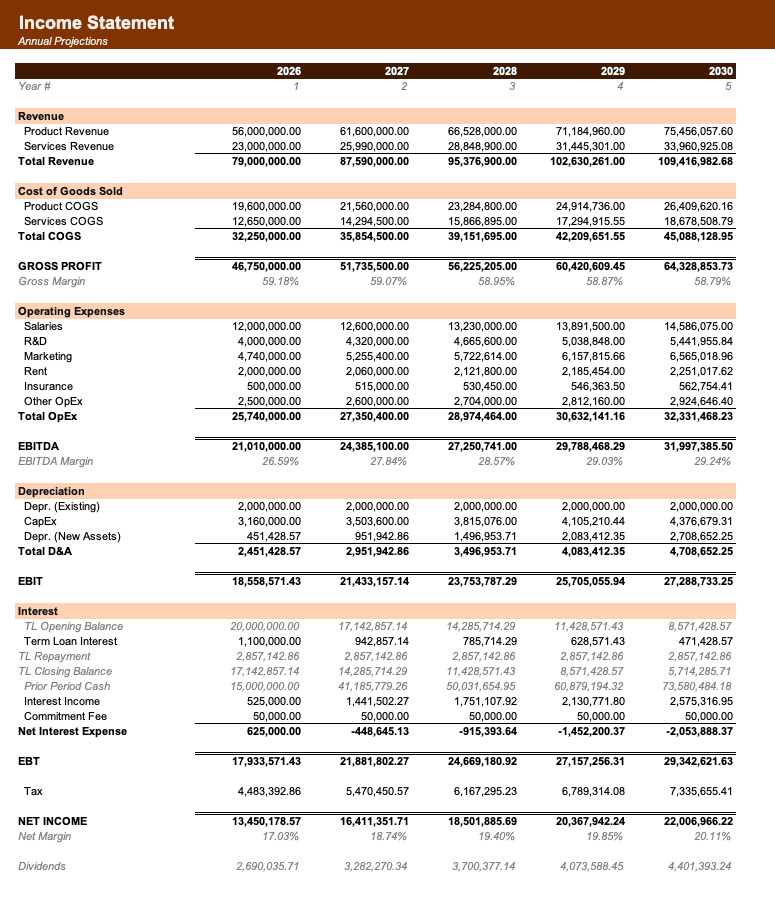
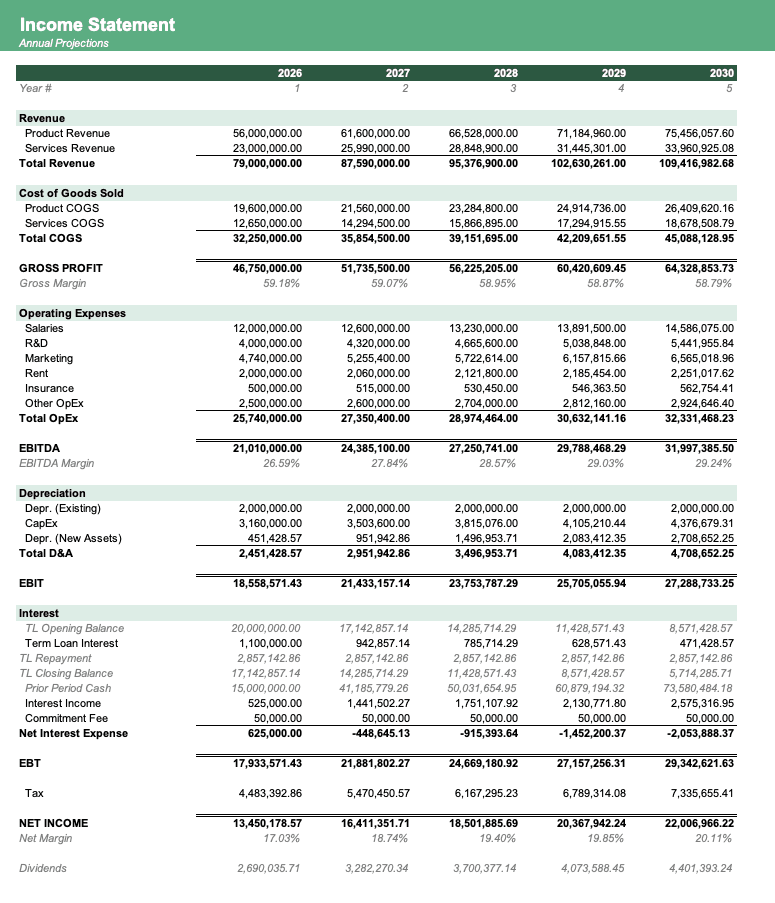
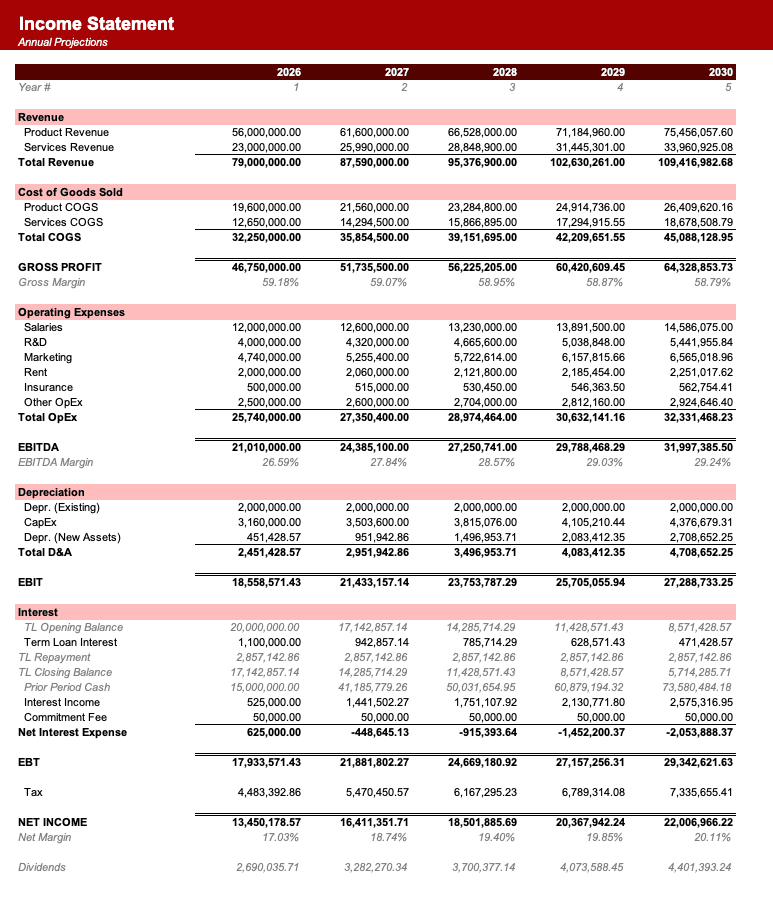
Named theme colors repaint the whole workbook in one click, on top of an investment-banking structure with clear input, output, and cross-sheet reference styling - brand-ready, institutional-grade, and fully auditable.

Created by ex-finance professionals
Hey, I’m Alex and I created Finamodel.
Over my years in the finance industry I kept building the same models over and over again. Same structure, same assumptions, different logo. So I started building frameworks to turn them into clean, reusable templates.
Every model here is one I’d actually use for a client, and I personally vet each one before it goes up.
I’m not an expert in every industry, but I’ve built enough models to know what belongs in one. And when something is completely foreign to me, I reach out to my network for experts to work on our models with us.
Having a template library on hand cuts a first build from hours to minutes.
Need help finding your model? You’ll find me in the Finamodel app!
Frequently asked
What is a take-private?+
A take-private is the acquisition of a listed company by a financial sponsor, after which the shares are delisted and the company is run as a private business. What makes it different from a normal buyout is that the price is set against an observable market price rather than negotiated from a multiple, the bidder has to demonstrate committed funds before it can announce, and the shareholders being bought out are a public register rather than a handful of vendors.
What is the unaffected share price, and why does the premium reference it?+
The unaffected price is the last close before the market knew a bid was coming - typically the day before a leak, an approach announcement or a strategic review. Referencing it is meant to strip out the run-up the rumour itself caused. It is also the reference most easily flattered: if a stock has fallen, a large premium to the unaffected price can still be a small premium to where holders bought, which is why this model tests the offer against four further references.
What does financing certainty or certain funds mean?+
Before a cash offer can be announced, the bidder's adviser has to confirm that the bidder has resources available to satisfy full acceptance of the offer. In practice that means signed commitment papers - debt commitment letters from arrangers and an equity commitment letter from the fund - covering the whole cash consideration on the assumption that every shareholder takes cash. It is a real constraint on deal size, and it is why this model sizes commitments on maximum cash rather than expected cash.
What is market flex?+
A commitment letter is a commitment to arrange the debt, not a commitment to price it. Market flex is the arrangers' right to change the terms if syndication requires it: raising the margin, adding original issue discount, and in the harshest case reducing the size of the facility. This model runs five flex outcomes because the certain funds test has to hold under the worst of them, not just the base case.
What is stub equity?+
Stub equity is unlisted stock in the bidder's acquisition vehicle, offered to target shareholders as an alternative to cash. It lets holders who believe in the plan stay invested, and it reduces the cash the sponsor has to fund. Because too large a stub costs the sponsor control of the register and complicates the exit, the offer almost always caps it - which is what makes the scale-back mechanic in this model necessary.
Why are elections scaled back?+
If shareholders elect for more stub than the cap allows, every election is cut by the same factor and the excess is paid in cash. Here elections come in at 31.7 per cent of the register against a 25 per cent cap, so the scale-back factor is 0.47 and 364 of elected value is paid out in cash instead. Pro-rata scale-back is used because it treats every electing holder identically.
What is a squeeze-out threshold?+
Above a statutory acceptance level - commonly 90 per cent - a bidder can compulsorily acquire the shares of holders who did not accept, which is what allows a full delisting. Below it a residual minority survives, with all the governance and exit complications that brings. The model shows the acceptance level against the threshold and flags whether compulsory acquisition is available.
Why does the stub return less than the sponsor's?+
The stub is pari passu ordinary equity, so on the underlying shares it earns exactly what the sponsor earns. The difference in this model - 17.0 per cent against 17.2 per cent - is the sponsor monitoring fee, which Bidco pays out of EBITDA and the sponsor alone receives. It is a transfer, not value creation, and it is the single most common source of friction between a sponsor and a continuing minority.
How is this different from a standard LBO model?+
An LBO model starts from an entry multiple and a negotiated purchase price. This one starts from a market price, a premium and a diluted share count, and then spends most of its structure on the two things that decide whether a public bid can be announced and closed: whether committed funds cover the maximum cash consideration under the worst flex, and how much of the register rolls rather than cashes out.
Have more financial modelling questions? Contact us
Related templates
Leveraged Buyout Model
Complete LBO analysis with debt financing structures, sponsor returns, and sensitivity to exit scenarios.
Management Incentive Plan Model
Private equity MIP model with sweet equity ratchet, paired IRR and MOIC hurdle gates, and dilution waterfall.
Exit Waterfall Model
Waterfall analysis for M&A, IPO, or sale with proceeds distributed to shareholders and securities holders.
Venture Capital Fund Model
Model VC fund cash flows, distributed returns, and IRR by vintage year and exit scenario.