Pledge Receivable Valuation Tracker
Public Finance Financial Model (Excel Download)
Work out what your donor pledges are really worth on the balance sheet. The workpaper tests which pledges to recognize, discounts future installments and sets a credit allowance for each.



professionals from Deloitte






About this model
A valuation workpaper for a nonprofit's pledge receivables. It decides which donor promises to recognize and measures their net carrying value after discounting and a credit allowance. The shipped case is a fictional foundation with eight pledges at one review date.
A pledge is recognized only if it is executed, supported, unconditional or with conditions met, and approved by counsel. Others are held. Each installment's outstanding balance is discounted at the policy rate by years to cash. The credit allowance is the present value times one minus the evidenced collection probability. Installments are also grouped by maturity.
On the shipped case 585,000 USD of face value is outstanding, of which 395,000 USD is recognized and 190,000 USD is held. After an 18,776 USD discount and a 33,592 USD credit allowance, net carrying value is 342,633 USD. A joint sensitivity shows a higher rate and weak recovery would cut it by 61,912 USD.
What every model includes
Live formulas, no hardcoded values
Outputs are driven by live formulas, so the workbook updates from its assumptions instead of relying on hardcoded results.
All assumptions in one tab
Inputs are clearly marked in the Assumptions tab and separated from calculations, making it clear what to change and what to leave intact.
Statements always balancing
For integrated-statement models, the balance sheet, cash flow, and supporting schedules tie through properly.
Distinct schedules for clarity
Debt, working capital, taxes, and cash flow can get messy quickly. We group calculations in clear schedules, not across disconnected tabs.
No hidden macros or external links
There are no unexplained external workbook links or macros to undermine auditability or portability.
Changes flow through the model
Update a key driver and see the impact carry through the forecast, financing, and return outputs. We never use hardcoded numbers in formulas.
What's inside the Pledge Receivable Valuation Tracker
- Pledge register with promise type, conditions and counsel status
- Recognition gate that holds unsupported or conditional pledges
- Installment schedule with cash applied and years to cash
- Present value discount at the policy rate
- Credit allowance from evidenced collection probability
- Net carrying value by pledge
- Recognition bridge from gross promise to net value
- Maturity buckets for overdue and future installments



Formatted to IB standards
Named theme colors repaint the whole workbook in one click, on top of an investment-banking structure with clear input, output, and cross-sheet reference styling - brand-ready, institutional-grade, and fully auditable.

Created by ex-finance professionals
Hey, I’m Alex and I created Finamodel.
Over my years in the finance industry I kept building the same models over and over again. Same structure, same assumptions, different logo. So I started building frameworks to turn them into clean, reusable templates.
Every model here is one I’d actually use for a client, and I personally vet each one before it goes up.
I’m not an expert in every industry, but I’ve built enough models to know what belongs in one. And when something is completely foreign to me, I reach out to my network for experts to work on our models with us.
Having a template library on hand cuts a first build from hours to minutes.
Frequently asked
What is a pledge receivable?+
A pledge receivable is a donor's promise to give money in the future. A nonprofit may record it as an asset once the promise meets its recognition policy.
Why are some pledges held?+
A pledge is held if it is not executed, lacks support, has unmet conditions or does not have counsel approval. Held pledges are tracked but not recognized.
How is the credit allowance calculated?+
The allowance is the present value of the outstanding balance times one minus the evidenced collection probability for that pledge.
Does this follow a specific accounting standard?+
No. The policy is an illustrative internal one. Confirm the applicable accounting and legal requirements before you use the results.
How do I use it for my pledges?+
Enter your pledges, installments, evidence and collection probabilities, and set the discount rate and valuation date on the Policy sheet.
Have more financial modelling questions? Contact us
Related templates
Nonprofit Funding and Grant Budget Tracking
Track grant budgets against actual spend, ring-fenced award cash, restriction releases and unrestricted cash runway.
Trade Receivable Impairment Estimate
Estimate the bad debt allowance on trade receivables with a calibrated provision matrix, outlook overlays and specific debtors.
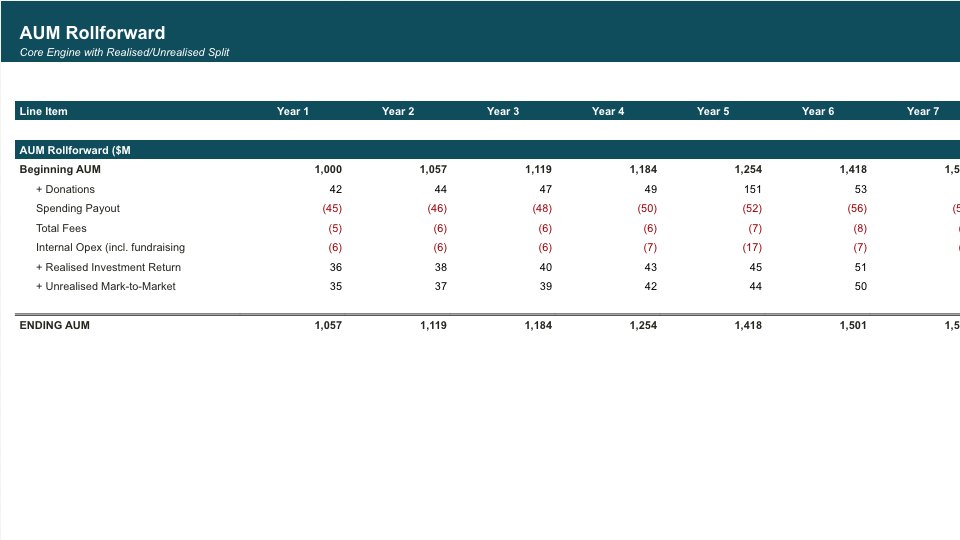
Endowment Fund Model
Multi-asset portfolio model for endowments with allocation, returns, spending, and perpetual sustainability.
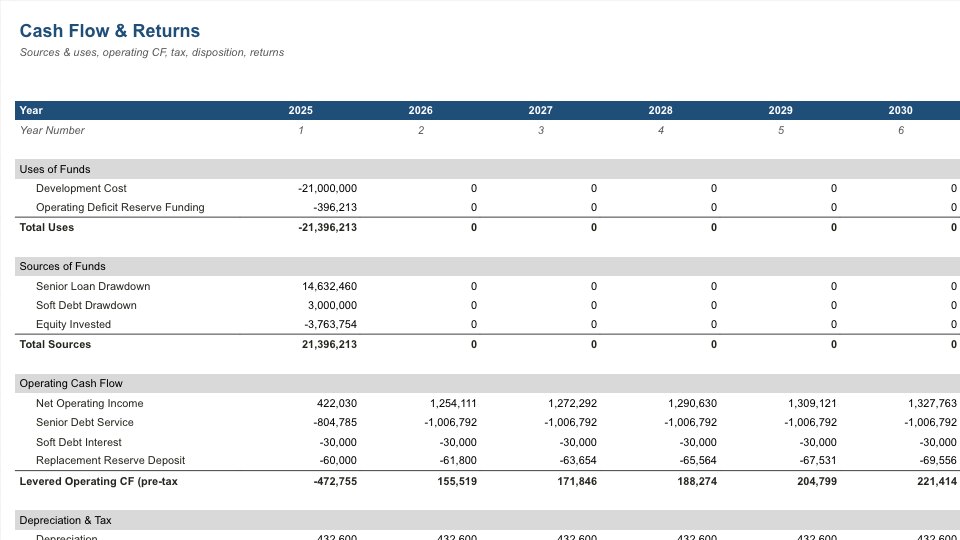
Public Housing Authority Operating Model
Unit mix, rent roll, operating expenses, and asset replacement reserve for public housing portfolios.







