Price Change Customer Impact Analysis
Operating Businesses Financial Model (Excel Download)
See what a price increase does to each customer's sales and gross profit before you send it. The workbook tests demand response, finds the break-even retention and releases only approved packages.



professionals from Deloitte






About this model
A repricing workbook for finance and commercial analysts. It applies proposed price uplifts to one month of actual invoices for a fictional components business, covering four customers and three products.
Each invoice line gets a proposed uplift and an elasticity. Linear elasticity, floored at zero, gives new units under a base and a stress case, with constant unit costs. Gross profit change splits into a price benefit and a demand effect. Break-even retention shows how much volume you can lose before profit falls. Release needs a signed uplift, a reference and a dated approval, and a signed cap waiver for uplifts above contract cap. Any held line blocks that customer.
On the shipped case gross profit rises from $143,680 to about $157,757 while sales dip slightly. Three customers are ready for release. One is held by a single line.
What every model includes
Live formulas, no hardcoded values
Outputs are driven by live formulas, so the workbook updates from its assumptions instead of relying on hardcoded results.
All assumptions in one tab
Inputs are clearly marked in the Assumptions tab and separated from calculations, making it clear what to change and what to leave intact.
Statements always balancing
For integrated-statement models, the balance sheet, cash flow, and supporting schedules tie through properly.
Distinct schedules for clarity
Debt, working capital, taxes, and cash flow can get messy quickly. We group calculations in clear schedules, not across disconnected tabs.
No hidden macros or external links
There are no unexplained external workbook links or macros to undermine auditability or portability.
Changes flow through the model
Update a key driver and see the impact carry through the forecast, financing, and return outputs. We never use hardcoded numbers in formulas.
What's inside the Price Change Customer Impact Analysis
- Invoice basket with units, net price, unit cost and proposed uplift
- Sales and gross profit by customer, current and proposed
- Linear demand elasticity floored at zero
- Base and stress demand cases
- Price benefit and demand effect bridge by invoice
- Break-even retention and headroom
- Signed uplift, reference and dated approval per line
- Cap waiver for uplifts above contract cap



Formatted to IB standards
Named theme colors repaint the whole workbook in one click, on top of an investment-banking structure with clear input, output, and cross-sheet reference styling - brand-ready, institutional-grade, and fully auditable.

Created by ex-finance professionals
Hey, I’m Alex and I created Finamodel.
Over my years in the finance industry I kept building the same models over and over again. Same structure, same assumptions, different logo. So I started building frameworks to turn them into clean, reusable templates.
Every model here is one I’d actually use for a client, and I personally vet each one before it goes up.
I’m not an expert in every industry, but I’ve built enough models to know what belongs in one. And when something is completely foreign to me, I reach out to my network for experts to work on our models with us.
Having a template library on hand cuts a first build from hours to minutes.
Frequently asked
What is a price change impact analysis?+
It estimates how a planned price change affects sales and gross profit for each customer. It weighs the gain from higher prices against the volume customers may stop buying.
How is demand response modeled?+
Each line has an elasticity. A linear response reduces units in proportion to the price change, floored at zero. A stress case applies a stronger response.
What is break-even retention?+
It is the share of current volume you must keep at the new price for gross profit to stay the same. If expected retention is above it, the price change adds profit.
Is the elasticity based on real data?+
No. The elasticities are illustrative inputs, not calibrated estimates. Approval in the workbook also does not replace legal contract review.
How do I use my own basket?+
Replace the invoice lines on Inputs with your own and set the uplift and elasticity for each. Extend the record ranges and formulas together when adding customers.
Have more financial modelling questions? Contact us
Related templates
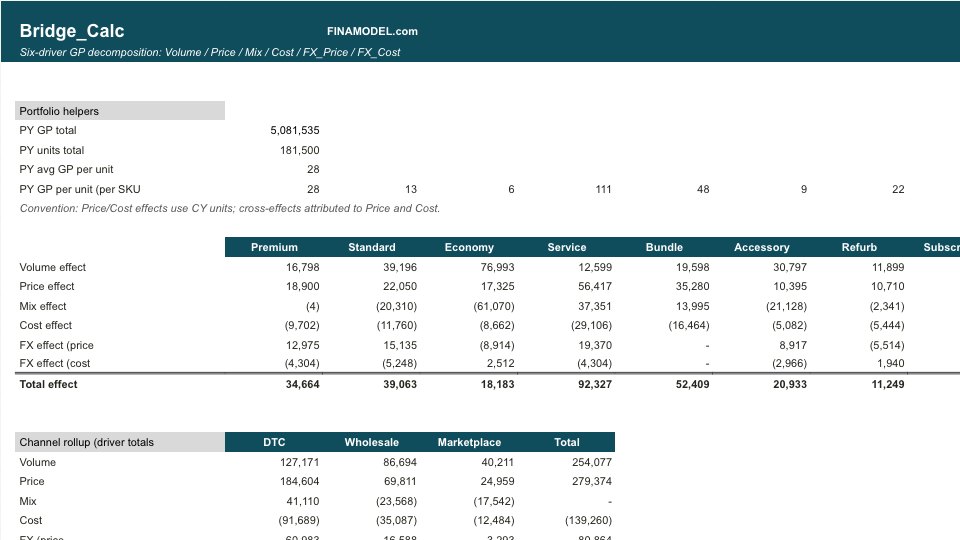
Gross Margin Bridge
PY to CY gross profit walk across Volume, Price, Mix, Cost, FX for a 5-SKU portfolio.
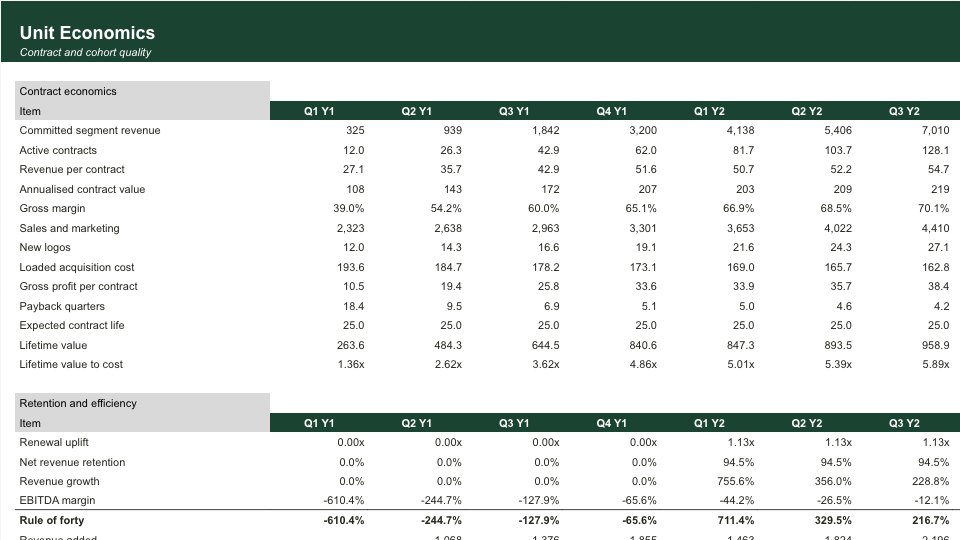
Usage-Based Pricing Model
Model consumption-based software pricing: prepaid credits, usage drawdowns, overage billing, and breakage revenue.
Customer and Product Rebate Accrual Settlement
Apply volume rebate tiers to eligible sales and purchases, true up accruals and settle approved claims by contract.
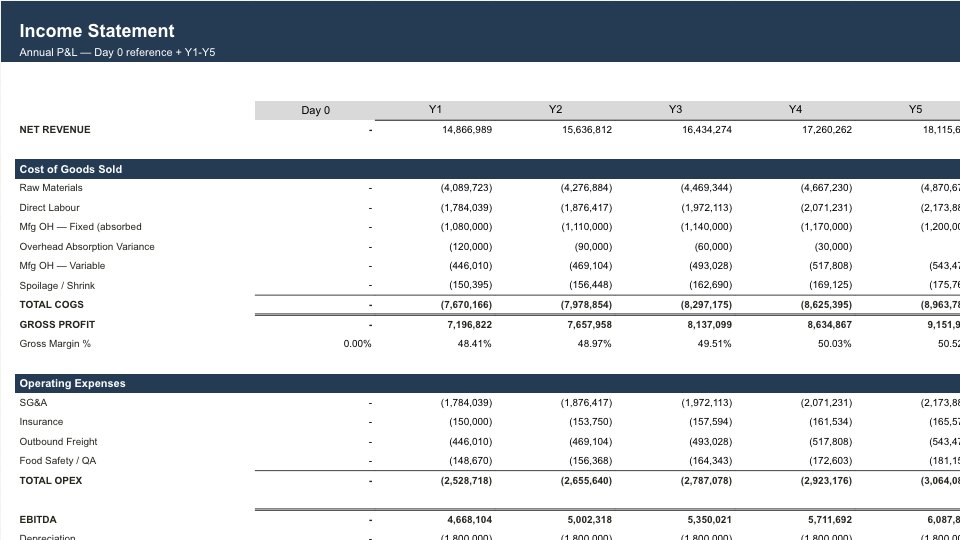
Food Manufacturing Model
Operating model for food production and processing businesses with ingredient sourcing, production scheduling, and margin analysis.







