Social Cost-Benefit Analysis
Public Finance Financial Model (Excel Download)
Test whether a public project creates more social value than it costs in real resources. The analysis values the benefits, prices costs at economic value and shows who gains and who pays.



professionals from Deloitte






About this model
A social cost-benefit appraisal for a public investment. It compares the value of a project's social benefits with the real resources it uses, apart from the public budget view. The shipped case is a fictional planning authority appraising a ten-year project.
Benefits for travel time, health, carbon, flood damage and habitat are valued from with and without project quantities and unit values. Capital costs use resource values: labor is shadow priced, land uses its next-best value, and taxes and grants are left out as transfers. Benefits ramp up and grow with demand, and everything is discounted at a social rate. A distribution sheet applies welfare weights by group.
On the shipped case social benefits are worth 43.5 million USD against 23.5 million USD of resource costs. The net present social value is 20.0 million USD and the benefit-cost ratio is 1.85. Switching values, a sensitivity grid and a slower adoption case test the result. Positive value alone is not an approval.
What every model includes
Live formulas, no hardcoded values
Outputs are driven by live formulas, so the workbook updates from its assumptions instead of relying on hardcoded results.
All assumptions in one tab
Inputs are clearly marked in the Assumptions tab and separated from calculations, making it clear what to change and what to leave intact.
Statements always balancing
For integrated-statement models, the balance sheet, cash flow, and supporting schedules tie through properly.
Distinct schedules for clarity
Debt, working capital, taxes, and cash flow can get messy quickly. We group calculations in clear schedules, not across disconnected tabs.
No hidden macros or external links
There are no unexplained external workbook links or macros to undermine auditability or portability.
Changes flow through the model
Update a key driver and see the impact carry through the forecast, financing, and return outputs. We never use hardcoded numbers in formulas.
What's inside the Social Cost-Benefit Analysis
- With and without project benefit quantities
- Valued travel time, health, carbon, flood and habitat benefits
- Shadow-priced labor and land opportunity cost
- Taxes and grants treated as transfers, not resource costs
- Benefit ramp-up and demand growth over ten years
- Net present social value and benefit-cost ratio
- Fiscal budget view kept apart from the social view
- Distribution by group with welfare weights



Formatted to IB standards
Named theme colors repaint the whole workbook in one click, on top of an investment-banking structure with clear input, output, and cross-sheet reference styling - brand-ready, institutional-grade, and fully auditable.

Created by ex-finance professionals
Hey, I’m Alex and I created Finamodel.
Over my years in the finance industry I kept building the same models over and over again. Same structure, same assumptions, different logo. So I started building frameworks to turn them into clean, reusable templates.
Every model here is one I’d actually use for a client, and I personally vet each one before it goes up.
I’m not an expert in every industry, but I’ve built enough models to know what belongs in one. And when something is completely foreign to me, I reach out to my network for experts to work on our models with us.
Having a template library on hand cuts a first build from hours to minutes.
Frequently asked
What is a social cost-benefit analysis?+
It compares the value of all the benefits a project gives society with the real resources it uses. If benefits are larger than costs in present value terms, the project adds social value.
Why are taxes and grants left out of social costs?+
Taxes and grants move money from one party to another but do not use up resources. They are shown in the fiscal budget view, not in the social result.
What is shadow pricing?+
Shadow pricing values an input at its real opportunity cost instead of its market price. Here labor uses a factor below its wage cost, and land uses the value of its next-best use.
What are the limits?+
The discount rate and unit values are fictional. Replace them with local policy rates and primary evidence. Some effects, such as access equity, are not monetized and need separate review.
How do I appraise my own project?+
Enter your capital costs, operating costs and benefit quantities with unit values. Set the discount rate, ramp-up and welfare weights to your local guidance.
Have more financial modelling questions? Contact us
Related templates
Public-Private Partnership Value-for-Money Comparator
Compare public delivery with a PPP on risk-adjusted present cost, break-even payment, affordability and stress cases.
Municipal Budget Model
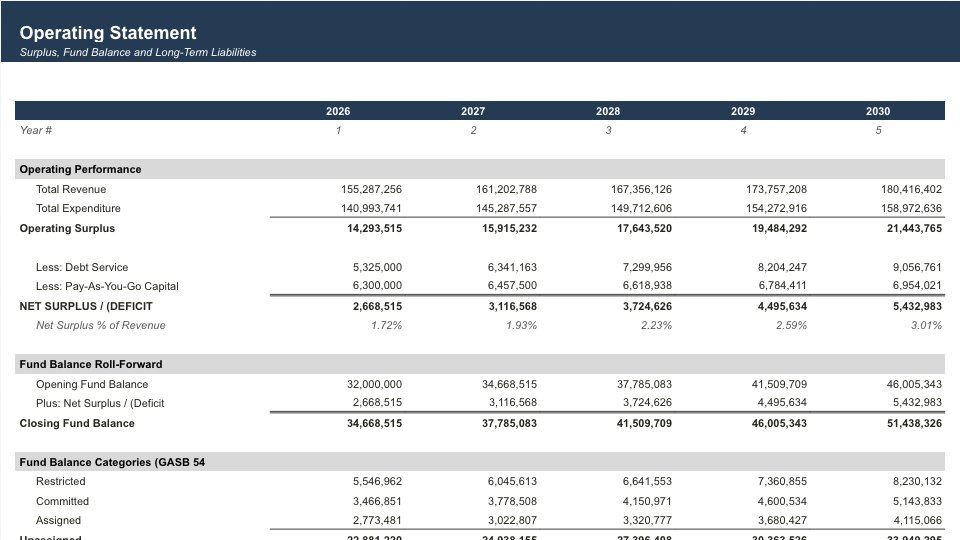
Financial model for municipal governments including revenue forecasts, expenditure planning, and debt capacity.
Infrastructure Concession and Toll Road Model
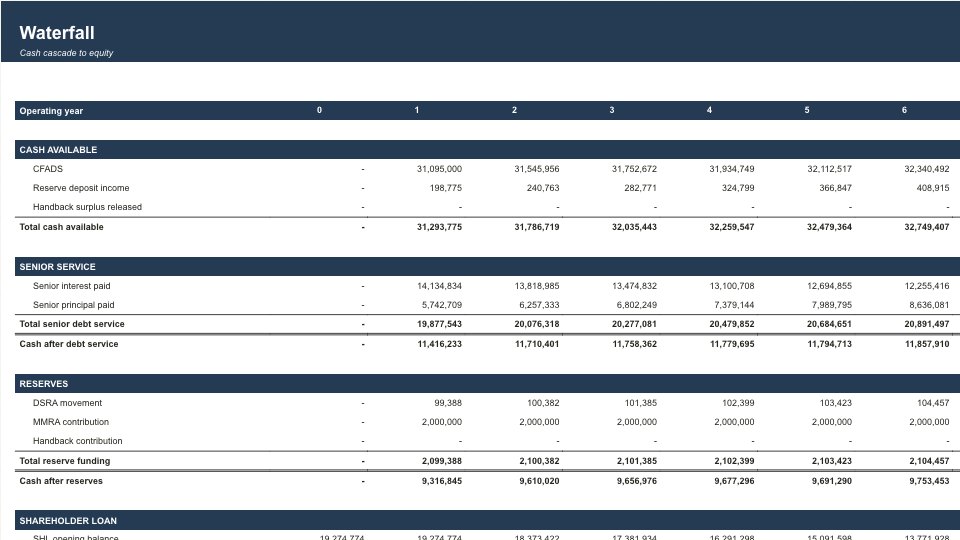
Concession agreement model for toll roads, airports, and ports including traffic/volume forecasts, tariff escalation, and equity returns.
Public Housing Authority Operating Model
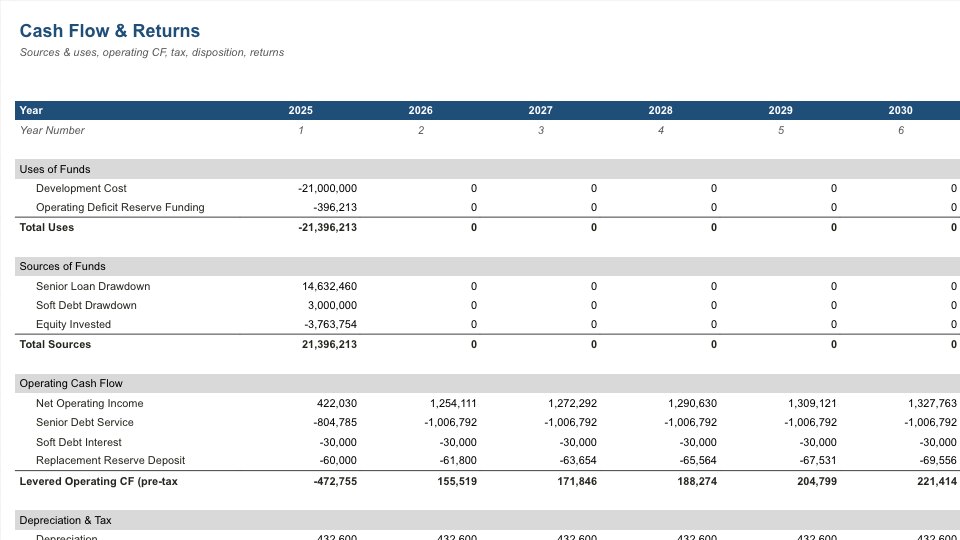
Unit mix, rent roll, operating expenses, and asset replacement reserve for public housing portfolios.







