PPP Value for Money Analysis
Public Finance Financial Model (Excel Download)
Find out whether a public-private partnership gives better value than public delivery. The analysis compares risk-adjusted lifetime costs on one basis and shows the highest payment worth accepting.



professionals from Deloitte






About this model
A value-for-money comparator for a public-private partnership. It compares the full lifetime cost of building and running an asset through public delivery with the cost of a PPP. The shipped case is a fictional water treatment plant with two construction years and 25 service years, in USD millions.
Public costs cover preparation, construction, operations, overhauls and a neutrality adjustment. PPP costs cover procurement, an upfront grant, indexed availability payments and oversight. Both use the same inflation, discount rate and residual value. Six risks are priced by probability and impact, and each route keeps its own share of expected risk.
On the shipped case the risk-adjusted cost is 211.6 for public delivery and 172.9 for the PPP, a value for money of 38.6, or 18.3% saving. The break-even payment is 12.68 a year against a 10.2 bid. One handback condition is still open. Stress cases and an alternate bid test the result.
What every model includes
Live formulas, no hardcoded values
Outputs are driven by live formulas, so the workbook updates from its assumptions instead of relying on hardcoded results.
All assumptions in one tab
Inputs are clearly marked in the Assumptions tab and separated from calculations, making it clear what to change and what to leave intact.
Statements always balancing
For integrated-statement models, the balance sheet, cash flow, and supporting schedules tie through properly.
Distinct schedules for clarity
Debt, working capital, taxes, and cash flow can get messy quickly. We group calculations in clear schedules, not across disconnected tabs.
No hidden macros or external links
There are no unexplained external workbook links or macros to undermine auditability or portability.
Changes flow through the model
Update a key driver and see the impact carry through the forecast, financing, and return outputs. We never use hardcoded numbers in formulas.
What's inside the PPP Value for Money Analysis
- Public sector comparator costs over 28 years
- PPP costs with grant, availability payments and oversight
- Common inflation and discount basis for both routes
- Priced risk register with probability, impact and shares
- Risk-adjusted present cost and value for money
- Break-even availability payment and payment headroom
- Service scope comparison for equivalent output
- Tender equivalence gates with evidence and owner



Formatted to IB standards
Named theme colors repaint the whole workbook in one click, on top of an investment-banking structure with clear input, output, and cross-sheet reference styling - brand-ready, institutional-grade, and fully auditable.

Created by ex-finance professionals
Hey, I’m Alex and I created Finamodel.
Over my years in the finance industry I kept building the same models over and over again. Same structure, same assumptions, different logo. So I started building frameworks to turn them into clean, reusable templates.
Every model here is one I’d actually use for a client, and I personally vet each one before it goes up.
I’m not an expert in every industry, but I’ve built enough models to know what belongs in one. And when something is completely foreign to me, I reach out to my network for experts to work on our models with us.
Having a template library on hand cuts a first build from hours to minutes.
Frequently asked
What is a PPP value-for-money analysis?+
It compares the full lifetime cost of delivering a public asset through a public-private partnership with the cost of public delivery. Both are adjusted for risk and expressed in present value terms.
How are risks included?+
Each risk has a probability, an impact and a year. Under public delivery the government keeps the full expected cost. Under the PPP it keeps only its retained share, and the rest is priced into the bid.
What is the break-even payment?+
It is the base annual availability payment at which the PPP costs the same as public delivery. A bid below it gives value for money, all else equal.
Does a positive result approve the PPP?+
No. The comparison is fiscal only. Service equivalence gates, qualitative conditions and board approval are still required.
How do I use it for my project?+
Enter your own capex, operating costs, PPP bid terms, risks and budget on the input sheets. The inflation and discount rate are illustrative and should follow your local policy.
Have more financial modelling questions? Contact us
Related templates
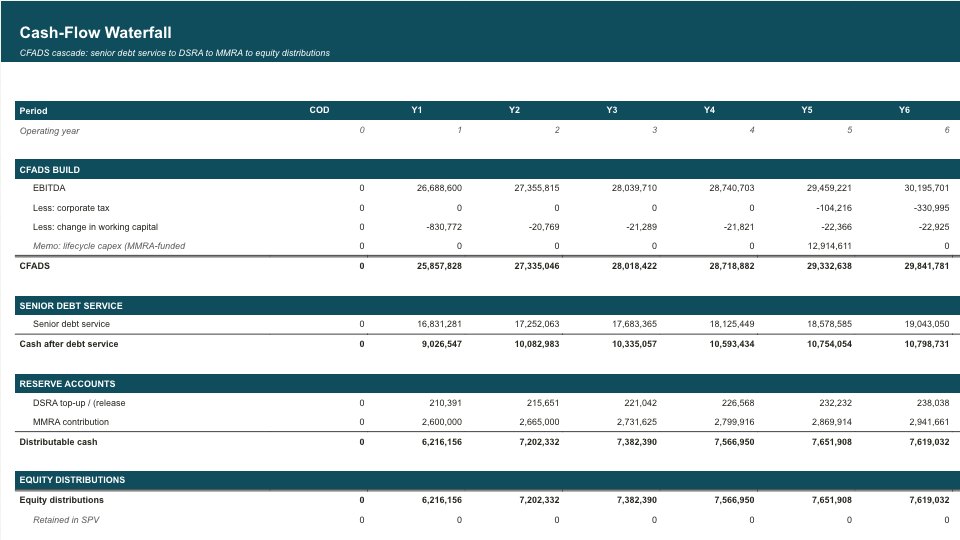
Public-Private Partnership Availability Model
Revenue availability model, unitary payments, debt service coverage, and equity IRR for PPP infrastructure projects.
Public Investment Social Cost-Benefit Appraisal
Appraise a public project's social value: monetized benefits, economic resource costs, NPSV, distribution and sensitivities.
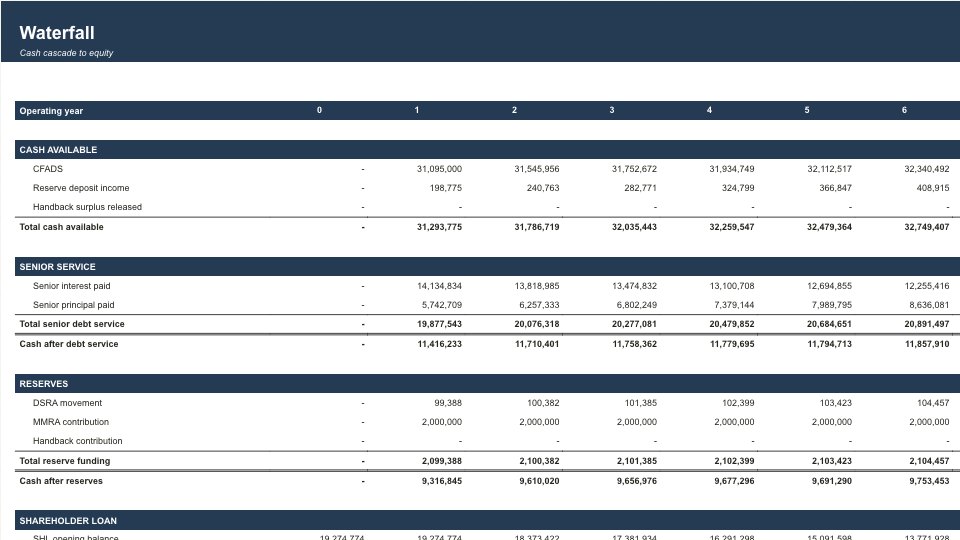
Infrastructure Concession and Toll Road Model
Concession agreement model for toll roads, airports, and ports including traffic/volume forecasts, tariff escalation, and equity returns.
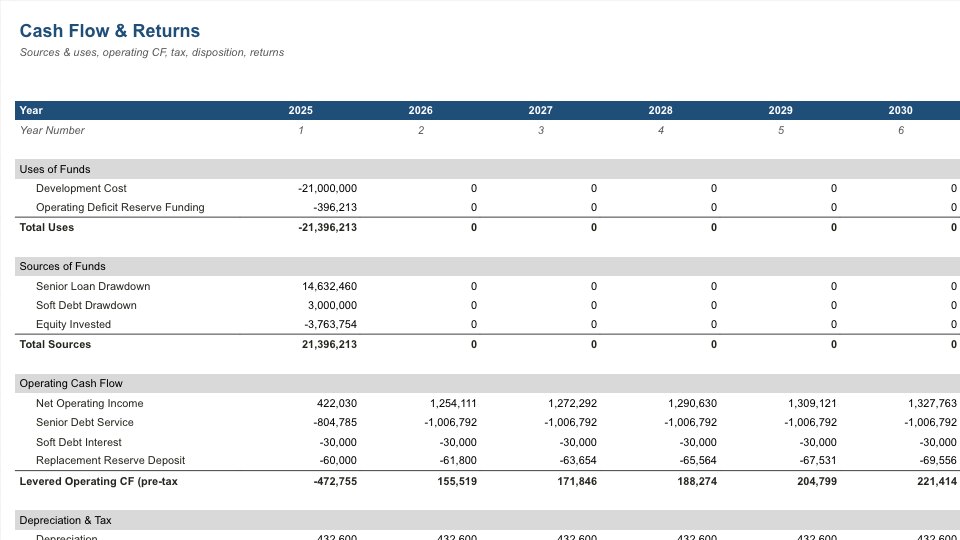
Public Housing Authority Operating Model
Unit mix, rent roll, operating expenses, and asset replacement reserve for public housing portfolios.







