Recording Studio Model
Operating Businesses Financial Model (Free Excel Download)
Model recording-studio revenue through booked hours, room utilization, engineer services, production packages, staffing, equipment costs, marketing, and operating cash flow.



professionals from Deloitte
Used by professionals from






About this model
A recording studio earns from a limited number of room days, so its booking mix matters as much as its headline day rate. This model brings together album projects, shorter sessions, mix work, deposits, and cancellations across two studio rooms.
Use it to plan the calendar, test pricing, or assess a studio acquisition. It helps show when committed projects protect revenue and when they crowd out higher-value work.
What every model includes
Live formulas, no hardcoded values
Outputs are driven by live formulas, so the workbook updates from its assumptions instead of relying on hardcoded results.
All assumptions in one tab
Inputs are clearly marked in the Assumptions tab and separated from calculations, making it clear what to change and what to leave intact.
Statements always balancing
For integrated-statement models, the balance sheet, cash flow, and supporting schedules tie through properly.
Distinct schedules for clarity
Debt, working capital, taxes, and cash flow can get messy quickly. We group calculations in clear schedules, not across disconnected tabs.
No hidden macros or external links
There are no unexplained external workbook links or macros to undermine auditability or portability.
Changes flow through the model
Update a key driver and see the impact carry through the forecast, financing, and return outputs. We never use hardcoded numbers in formulas.
What's inside the Recording Studio Model
- Capacity inputs: Room A & Room B annual day capacity, tracking/mix days per album
- Demand inputs: album demand and growth, single-day demand and growth, mix-only demand and growth
- Pricing inputs: Room A & Room B standard day rates and growth, block discount percent
- Mechanic inputs: cancellation rate (Year 1 & Year 7), deposit percent, deposit holding days
- Mastering inputs: tracks/album, attach rate (Year 1 & Year 7), price/track and growth
- Cost stack: in-house engineer headcount & capacity, freelance day-rate, media cost/day, mastering COGS percent, utilities, gear insurance, rent, admin, marketing, software, G&A - all with growth rates
- Capital and tax: gear-refresh capex percent, D&A life, tax rate; WACC, terminal growth, net debt, shares outstanding
- Operations sheet: Room A & Room B booking waterfalls, cancellation/forfeiture roll-forward, utilization
Recording Studio Financial Model: How the Two-Room Template Works
This recording studio financial model evaluates a two-room commercial studio over seven years. It captures album projects, day-rate sessions, mix-only work, and deposit forfeitures.
The model shows how committed album blocks crowd out higher-priced spot work, how cancellations destroy capacity, and how these effects flow to revenue, cash flow, and equity value.
Two-Room Capacity Pipeline and Booking Priority
The template models two physical rooms: Room A for live tracking and Room B for production and mixing. Room A has a fixed 280 bookable days per year, while Room B has 260.
- Album projects are block-booked months in advance and are served first in Room A, even though their day rate is discounted relative to standalone sessions. This means committed, lower-priced album work pushes out premium single-day bookings, the inverse of typical priority rules.
- Album demand grows at 11% annually, expanding confirmed Room A days and steadily reducing the calendar space left for singles, which are turned away once capacity is full. Because albums also need downstream mix days in Room B, album deliveries drive demand across both rooms.
Revenue, Cancellations, and Cost Flow
Revenue is built from delivered album tracking days and album mix days at discounted rates, plus standalone single-day and mix-only bookings at standard rates. An uncapped mastering upsell adds per-track revenue on delivered albums.
- Cancellations on confirmed album blocks trigger forfeited deposits, recognized as pure-margin fee revenue with no associated engineer or media cost. However, the tracking days reserved for those cancelled blocks are lost and cannot be resold, reducing remaining capacity for singles.
- Costs include engineer labor derived from total studio-day volume, media per studio-day, mastering cost as a percentage of mastering revenue, and fixed overheads. This derived labor stack means costs rise when combined room volume exceeds in-house engineer capacity, requiring freelance cover.
Outputs, Valuation, and Practical Use
The model produces a P&L, unlevered free cash flow, and a discounted cash flow valuation. Free cash flow is calculated from net operating profit after tax plus depreciation, less capital expenditure and changes in working capital.
- Working capital includes a booking-deposit liability and payables netted against receivables. The DCF discounts explicit free cash flows and a terminal value, yielding enterprise value, then equity value and value per share.
- A dashboard summarizes Room A and B utilization, album share of the calendar, singles turned away, revenue, EBITDA, margin, and valuation. Users can test pricing changes or assess acquisition scenarios by adjusting documented drivers such as album demand growth, cancellation rates, or day rates, without needing to rebuild the calculation flow.
Assumptions, Limitations, and What the Preview Contains
The template is pre-populated with illustrative assumptions, such as 18 album projects in Year 1 growing to 33.7 by Year 7, a Room A day rate starting at $1,500 with a 22% block discount, and a cancellation rate rising from 5% to 8%. These figures are illustrative only and are not market benchmarks.
- The public download is a values-only preview, so it does not contain live formulas or automatically recalculate. The model covers a single two-room studio with organically funded operations and does not include debt, expansion events, or additional revenue streams beyond those described.
- It is a tool for understanding business relationships, not a promise of future performance.
Formatted to IB standards
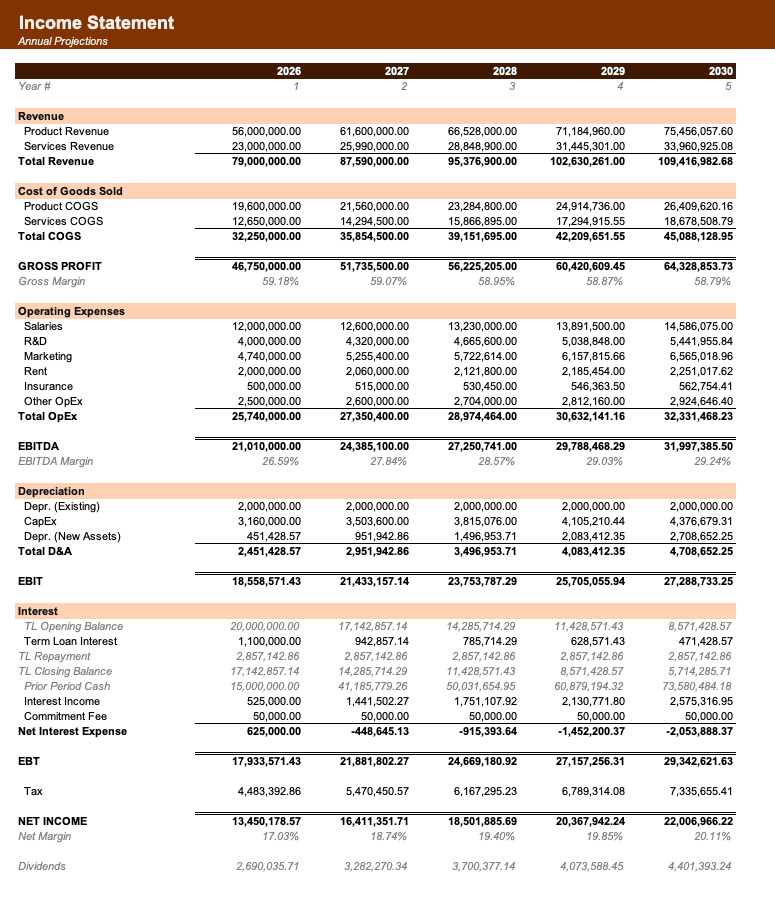
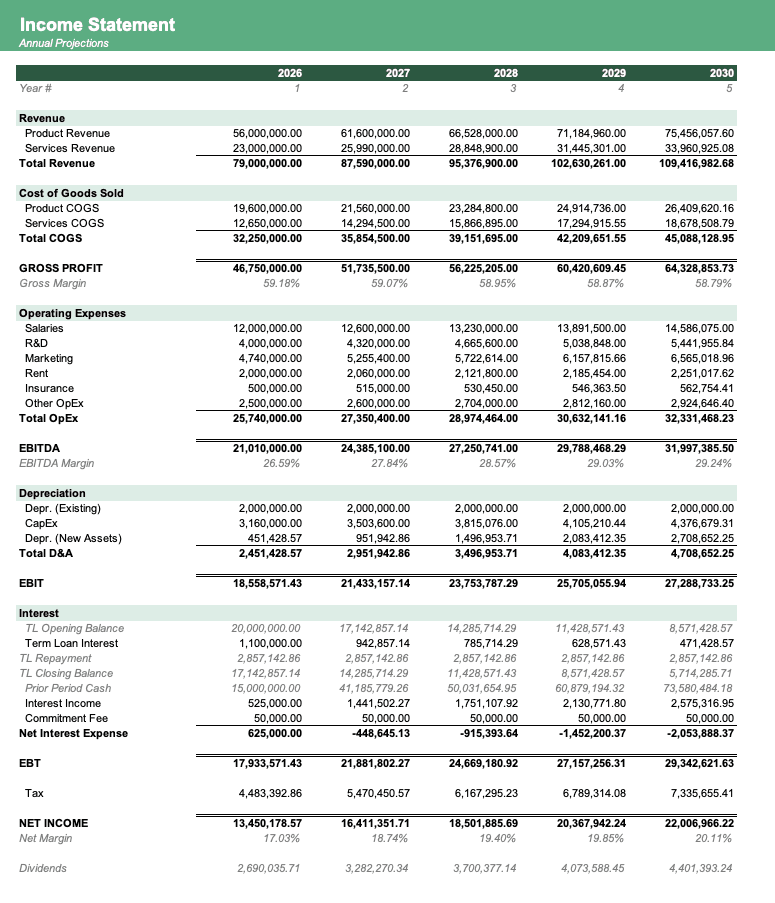
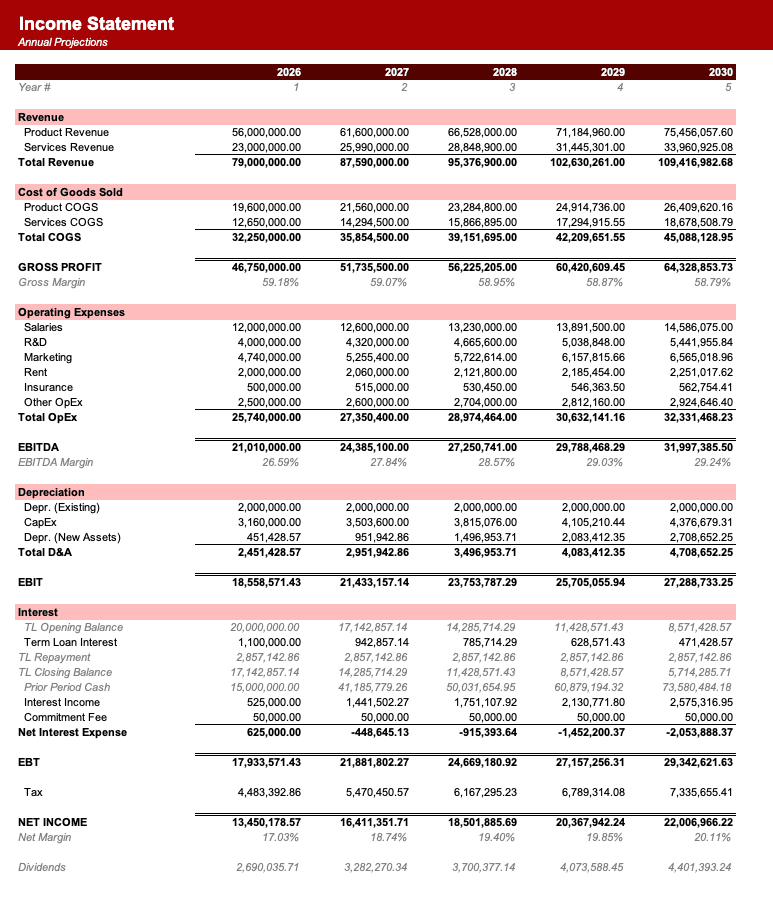
Named theme colors repaint the whole workbook in one click, on top of an investment-banking structure with clear input, output, and cross-sheet reference styling - brand-ready, institutional-grade, and fully auditable.

Created by ex-finance professionals
Hey, I’m Alex and I created Finamodel.
Over my years in the finance industry I kept building the same models over and over again. Same structure, same assumptions, different logo. So I started building frameworks to turn them into clean, reusable templates.
Every model here is one I’d actually use for a client, and I personally vet each one before it goes up.
I’m not an expert in every industry, but I’ve built enough models to know what belongs in one. And when something is completely foreign to me, I reach out to my network for experts to work on our models with us.
Having a template library on hand cuts a first build from hours to minutes.
Need help finding your model? You’ll find me in the Finamodel app!
Frequently asked
What is a recording studio financial model?+
A recording studio financial model captures the seven-year operating economics and intrinsic value of a two-room commercial recording studio. It resolves album and single-day demand against fixed room-day capacity in each of two rooms, builds a cancellation-forfeiture mechanic into both revenue and capacity, and discounts an unlevered free-cash-flow stream to enterprise value, equity value and value per share.
Why are lower-priced album bookings served before higher-priced single-day bookings?+
Album blocks are booked and deposited months ahead through ongoing label and artist relationships the studio always wants to protect, so they are treated as a standing commitment rather than spot-market demand. Single-day bookings are opportunistic and walk-up by comparison, so they are the channel that absorbs the squeeze once the calendar fills - the reverse of the usual "protect the premium channel" assumption.
How can a cancelled booking be good for revenue and bad for capacity at the same time?+
The non-refundable deposit on a cancelled album block is recognized as fee revenue the moment the cancellation happens, with no offsetting cost since no session was ever delivered. But the tracking days that were reserved for that block were blocked out on the calendar months in advance and cannot be resold on short notice, so they are lost capacity even though the studio still keeps the deposit - both effects are real and the model reports both.
Have more financial modelling questions? Contact us
Related templates
Photography Studio Model
Plan and value a wedding photography studio using booking capacity, package tiers, associate photographer margins, and a DCF.
Marketing Agency Model
Plan and value a digital marketing agency using retainer client retention, staff utilization, billable rates, and a DCF.
Consulting Firm
Five-year pyramid model: headcount, utilization, billable rate, comp, and margins.
Food Manufacturing Model
Operating model for food production and processing businesses with ingredient sourcing, production scheduling, and margin analysis.