Photography Studio Model
Operating Businesses Financial Model (Free Excel Download)
Plan photography-studio performance through sessions, packages, bookings, average revenue, photographer capacity, editing costs, equipment, marketing, and cash flow.



professionals from Deloitte
Used by professionals from






About this model
This model helps a photography studio plan wedding bookings, capacity, pricing, and the use of associate photographers when demand exceeds the core team's availability. It also shows how deposits and cancellations affect cash flow.
Use it to test demand, staffing, package pricing, and booking assumptions. The summary makes the impact on revenue, margin, cash flow, and value clear.
What every model includes
Live formulas, no hardcoded values
Outputs are driven by live formulas, so the workbook updates from its assumptions instead of relying on hardcoded results.
All assumptions in one tab
Inputs are clearly marked in the Assumptions tab and separated from calculations, making it clear what to change and what to leave intact.
Statements always balancing
For integrated-statement models, the balance sheet, cash flow, and supporting schedules tie through properly.
Distinct schedules for clarity
Debt, working capital, taxes, and cash flow can get messy quickly. We group calculations in clear schedules, not across disconnected tabs.
No hidden macros or external links
There are no unexplained external workbook links or macros to undermine auditability or portability.
Changes flow through the model
Update a key driver and see the impact carry through the forecast, financing, and return outputs. We never use hardcoded numbers in formulas.
What's inside the Photography Studio Model
- Capacity inputs: lead photographer headcount and hiring schedule, wedding-season Saturdays/lead, wedding demand growth
- Pricing inputs: lead and associate package prices and escalation, portrait session price, upsell attach rate and average spend
- Deposit inputs: retainer percentage, forward-booked share, Year-8 extrapolation assumptions
- Cost stack: per-wedding production cost, associate day-rate, portrait materials, album cost, lead salaries, admin, marketing, software, rent, G&A
- Capital and working capital: equipment capex per lead, maintenance capex, AR/AP days, Year-0 NWC seed
- Valuation: WACC, terminal growth, net debt, shares outstanding
- Operations sheet: lead roll-forward, wedding demand/capacity split, portrait/upsell volumes, forward-booked deposit liability, working capital, capex and depreciation
- Revenue sheet: lead and associate wedding revenue, portrait and upsell revenue, blended pricing KPIs
Photography Studio Financial Model: Capacity, Pricing And Cash Flow Explained
This photography studio financial model is a seven-year operating and valuation template for a boutique wedding photography studio. It captures how a small team of lead photographers, backed by contract associates, handles demand that exceeds Saturday shooting capacity.
The model also shows how forward-booked deposits affect cash flow and enterprise value.
Discrete Saturday-Slot Capacity And Internal Overflow
The studio’s wedding capacity is constrained by the number of lead photographers and available Saturdays. Each lead can shoot at most one wedding per Saturday, so annual lead capacity equals headcount multiplied by wedding-season Saturdays.
- When wedding demand exceeds that capacity, the overflow is served by contract associate photographers. This internal valve keeps every couple in-house, though associates shoot at a lower package price.
- Because lead hiring occurs in discrete steps while demand compounds continuously, the associate share of weddings traces a squeeze-relief-squeeze-relief arc rather than a smooth trend. Portrait sessions are scheduled on weekdays and remain uncapped, providing a separate growth line unaffected by the Saturday limit.
Demand Drivers And Package Pricing
Wedding demand grows organically each year, independent of studio staffing, as brand awareness brings new inquiries. Portrait demand grows as well.
- Package pricing differs by channel: lead photographers command a higher starting price with slightly faster annual escalation, while associate weddings are priced lower with slower escalation. The blended package price reflects the mix of lead and associate weddings, so it compresses when associate share rises and recovers as lead capacity expands.
- The album and print upsell, priced off an attach rate applied to all delivered weddings, adds another revenue layer that scales with total wedding volume.
Forward-Booked Deposit Liability And Working Capital
Unlike typical deferred revenue that rolls forward from prior periods, the deposit liability here references next year’s weddings. Couples often book many months ahead, so a substantial portion of a year’s weddings is already reserved and partially paid by the end of the prior year.
- The model assumes a retainer percentage of the package price and a booking-window convention that determines the deferred balance. This liability represents cash already received, reducing working capital in the free-cash-flow bridge.
- Accounts receivable is sized only on the remaining balance due at delivery, since the deposit already moved most of the cash forward, keeping AR structurally small relative to revenue.
Outputs, Dashboard And Valuation
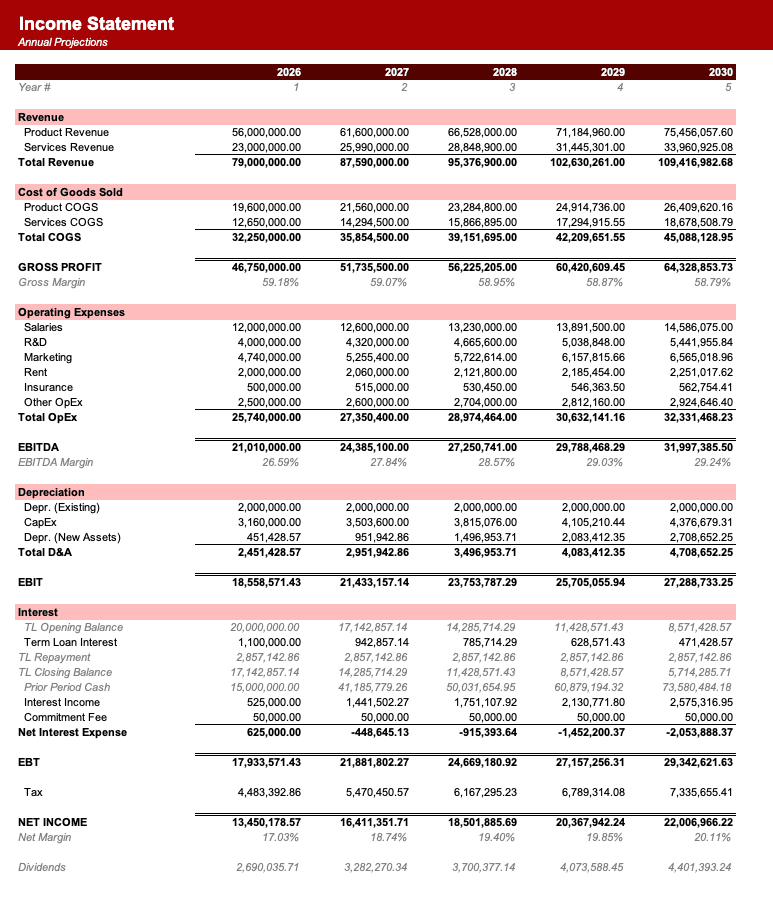
The model produces a full P&L, an unlevered free-cash-flow bridge, and a discounted cash flow valuation. Costs are mostly volume-driven, including per-wedding production costs, associate day rates, and portrait materials, alongside fixed salaries, rent, and marketing.
- The dashboard highlights lead photographer counts, associate share of weddings, blended package price, forward-booked deposit liability, revenue, EBITDA, EBITDA margin, enterprise value, and value per share. The DCF discounts explicit free cash flows and adds a Gordon-growth terminal value, then subtracts net debt to arrive at equity value.
- A revenue-to-net-income waterfall and trend charts help users see how capacity decisions and deposit timing affect cash flow and value.
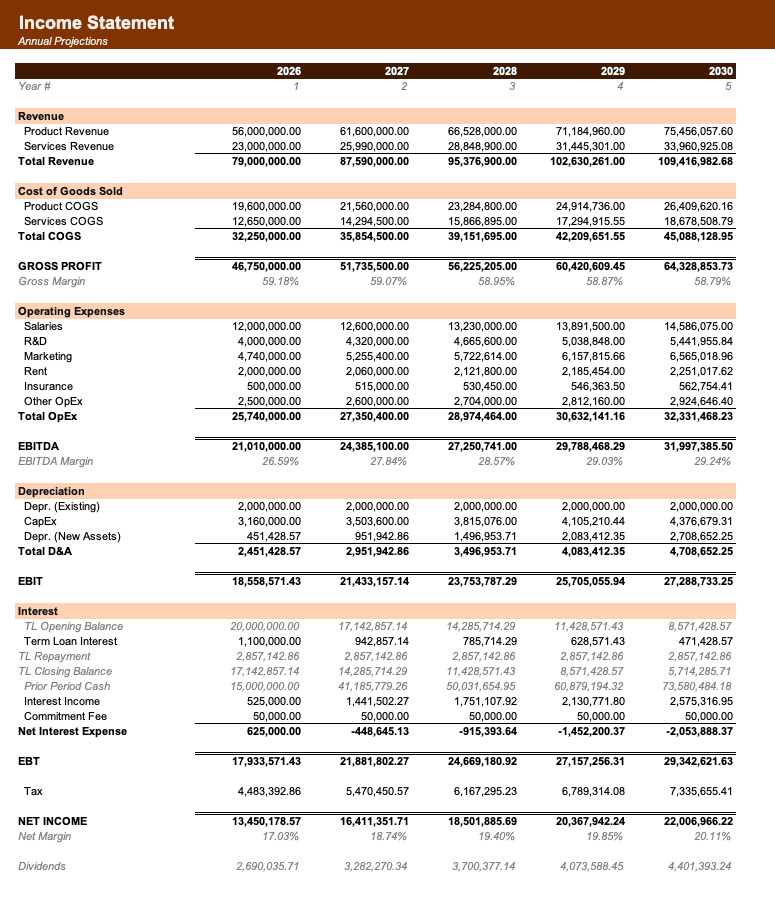
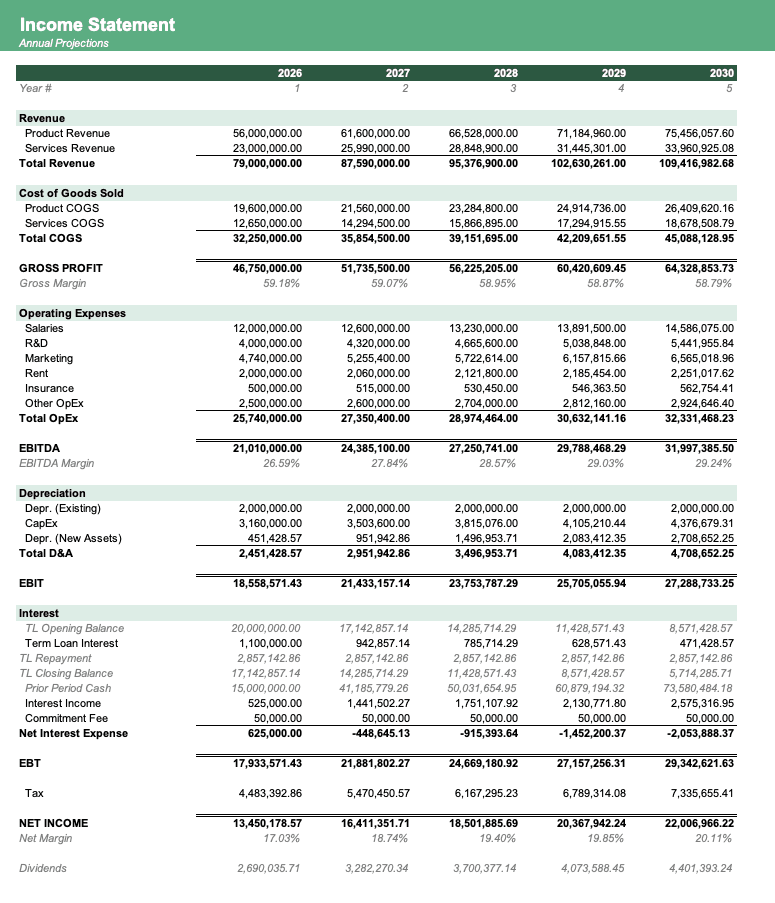
Formatted to IB standards
Named theme colors repaint the whole workbook in one click, on top of an investment-banking structure with clear input, output, and cross-sheet reference styling - brand-ready, institutional-grade, and fully auditable.

Created by ex-finance professionals
Hey, I’m Alex and I created Finamodel.
Over my years in the finance industry I kept building the same models over and over again. Same structure, same assumptions, different logo. So I started building frameworks to turn them into clean, reusable templates.
Every model here is one I’d actually use for a client, and I personally vet each one before it goes up.
I’m not an expert in every industry, but I’ve built enough models to know what belongs in one. And when something is completely foreign to me, I reach out to my network for experts to work on our models with us.
Having a template library on hand cuts a first build from hours to minutes.
Need help finding your model? You’ll find me in the Finamodel app!
Frequently asked
What is a photography studio financial model?+
A photography studio financial model captures the seven-year operating economics and intrinsic value of a boutique wedding photography studio. It resolves wedding demand against a discrete Saturday-slot lead-photographer capacity ceiling via an internal associate-photographer overflow valve, builds a forward-booked deposit liability off couples' typical booking lead time, and discounts an unlevered free-cash-flow stream to enterprise value, equity value and value per share.
Why is the capacity constraint a discrete slot count instead of continuous hours?+
A lead photographer can physically shoot at most one wedding per Saturday - there is no way to compress two weddings into one photographer's one day. That makes lead capacity a headcount-times-calendar-slot ceiling, structurally different from a continuous equipment- or labor-hours pool, and it is why capacity can only expand in discrete headcount steps, not smoothly.
Why does the deposit liability reference next year's weddings instead of rolling forward from this year?+
Wedding couples typically book 9-14 months ahead of their date, so a meaningful share of the deposits a studio holds at year-end were collected for weddings that will not be delivered until the following year. Every other deferred-revenue mechanic in this library resolves a backward roll-forward; this one is a genuine forward-column reference, because that is how the underlying cash timing actually works.
Have more financial modelling questions? Contact us
Related templates
Moving Company Model
Plan and value a moving company using local crew hours, long-distance weight tariffs, claims reserves, and a DCF.
Trampoline Park Model
Plan and value an indoor trampoline park using admissions, parties, memberships, capacity, and operating costs.
Driving School Operator Model
Plan and value a driving school operator using instructor fleet hours, classroom vs. behind-the-wheel pricing, and a DCF.
Food Manufacturing Model
Operating model for food production and processing businesses with ingredient sourcing, production scheduling, and margin analysis.