Risk-Adjusted Return on Capital (RAROC) Excel Model
Credit Financial Model (Excel Download)
Check whether each loan earns enough for the capital it uses. The model prices loans to a capital hurdle, flags borrowers above their name limit and tests renewal offers in a what-if.



professionals from Deloitte






About this model
A risk-adjusted return on capital (RAROC) model for a commercial loan book. The starting case is a fictional bank with six borrowers, $55.5m drawn and $17m undrawn, each with its own credit conversion factor, PD, LGD, economic capital rate and loan yield. Two funding cases are available: Base and FTP squeeze.
Exposure at default adds converted undrawn lines to drawn balances. Income less funding cost, operating cost, expected loss and tax gives risk-adjusted income, which is divided by allocated capital. Each borrower gets a required yield at the hurdle and a name capital cap. A Renewals sheet lets you select proposals, offer a new yield and cap undrawn lines, without changing the actual book.
In the Base case the portfolio has an EAD of $63.65m, allocated capital of $5.09m and an after-tax RAROC of 21.69% against a 14% hurdle. Two names are above their capital limit by $351,600 in total. The selected renewals lift RAROC to 24.66%. A checks sheet ties EAD, risk income, capital and economic profit.
What every model includes
Live formulas, no hardcoded values
Outputs are driven by live formulas, so the workbook updates from its assumptions instead of relying on hardcoded results.
All assumptions in one tab
Inputs are clearly marked in the Assumptions tab and separated from calculations, making it clear what to change and what to leave intact.
Statements always balancing
For integrated-statement models, the balance sheet, cash flow, and supporting schedules tie through properly.
Distinct schedules for clarity
Debt, working capital, taxes, and cash flow can get messy quickly. We group calculations in clear schedules, not across disconnected tabs.
No hidden macros or external links
There are no unexplained external workbook links or macros to undermine auditability or portability.
Changes flow through the model
Update a key driver and see the impact carry through the forecast, financing, and return outputs. We never use hardcoded numbers in formulas.
What's inside the Risk-Adjusted Return on Capital (RAROC) Excel Model
- Six-borrower loan book with drawn and undrawn balances, CCF, PD, LGD and EC rate
- Exposure at default, expected loss and allocated economic capital by borrower
- Income build with interest, fees, funding cost, operating cost, expected loss and tax
- After-tax RAROC, capital hurdle and economic profit
- Required yield per borrower and the price gap in basis points
- Name capital caps with excess capital and the EAD cut needed
- Borrower action queue: reduce exposure, reprice or both
- Renewal what-if with include flags, offered yield and customer ceiling



Formatted to IB standards
Named theme colors repaint the whole workbook in one click, on top of an investment-banking structure with clear input, output, and cross-sheet reference styling - brand-ready, institutional-grade, and fully auditable.

Created by ex-finance professionals
Hey, I’m Alex and I created Finamodel.
Over my years in the finance industry I kept building the same models over and over again. Same structure, same assumptions, different logo. So I started building frameworks to turn them into clean, reusable templates.
Every model here is one I’d actually use for a client, and I personally vet each one before it goes up.
I’m not an expert in every industry, but I’ve built enough models to know what belongs in one. And when something is completely foreign to me, I reach out to my network for experts to work on our models with us.
Having a template library on hand cuts a first build from hours to minutes.
Frequently asked
What is RAROC?+
RAROC is risk-adjusted return on capital. It divides income after funding, costs, expected loss and tax by the economic capital a loan needs. Banks compare it with a hurdle rate to see if a loan creates value.
How is the required yield set?+
For each borrower the model finds the yield that covers funding, fixed fees, operating cost, expected loss and a capital charge at the hurdle. If the current yield is lower, the gap is shown in basis points.
How does the renewal what-if work?+
You flag proposals to include, enter an offered yield and a customer ceiling. Retained undrawn lines are cut to fit the name capital cap. Results show beside the actual book and do not change it.
What is not included?+
The model does not calculate regulatory capital and uses entered PD, LGD and EC rates. Fees and operating cost stay at their entered dollar amounts. All borrowers and figures are fictional.
Can I add my own loans?+
Yes. Edit borrower data on LoanInputs and the funding, tax and hurdle on Inputs. If you add borrowers, extend the ranges on the calculation sheets.
Have more financial modelling questions? Contact us
Related templates
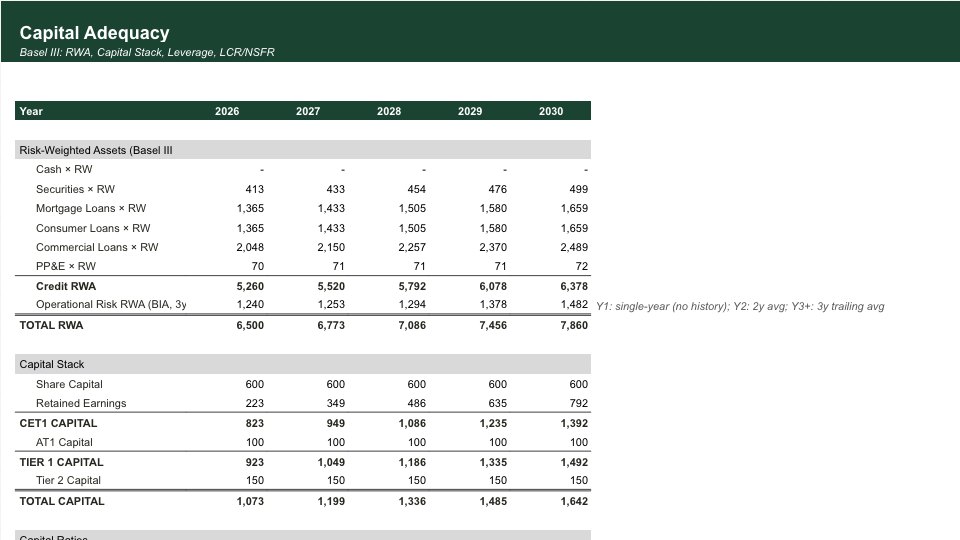
Bank Capital Adequacy Model
Regulatory capital calculations and stress testing for banks.
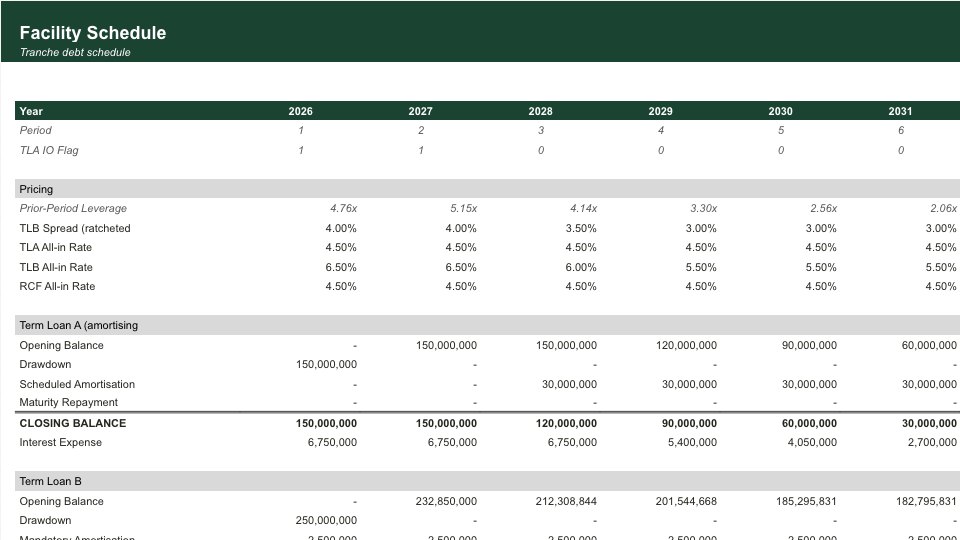
Syndicated Loan Underwriting
Model syndicated loan terms, pricing, club structure, and lender commitments with covenant tracking.
Bank Funds Transfer Pricing Curve Workbook
Build a bank's internal funding curve, charge and credit each loan and deposit, and test asset quotes under stress.
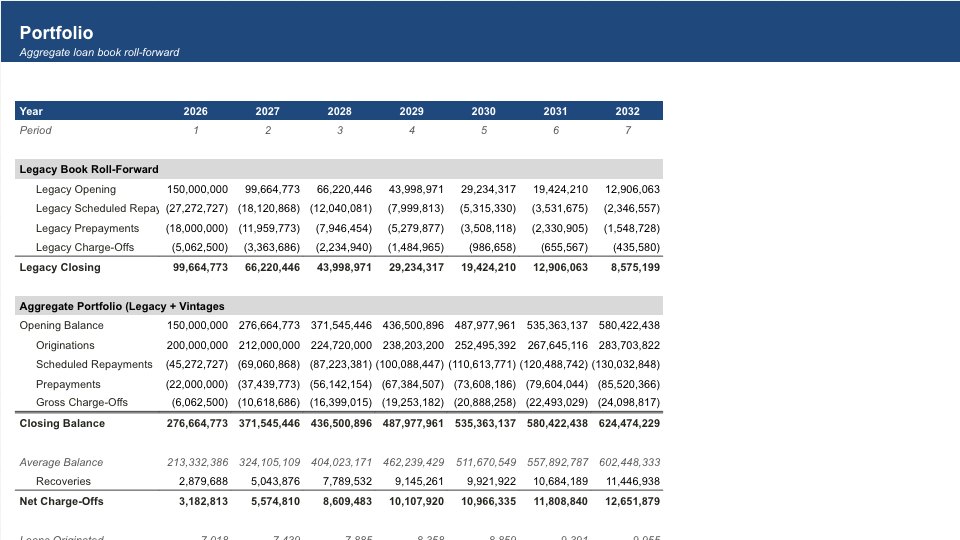
Auto Loan Portfolio Model
Automotive loan securitization and portfolio analysis.







