Supplier Should-Cost Negotiation Excel Model
Operating Businesses Financial Model (Excel Download)
Know what a supplier's part should cost before you negotiate. The model rebuilds unit cost from the ground up, sets target and walkaway prices and compares payment offers on equal terms.



professionals from Deloitte






About this model
A should-cost negotiation model for procurement and category teams. It rebuilds what a supplier's products should cost and uses that to set a fair price. The shipped case is a fictional buyer negotiating three valve actuator SKUs with one supplier.
Material cost comes from net quantities, yields and quoted prices. Labor, machine minutes and energy come from routing data, and fixed machine cost is allocated per minute at a normal load. Tooling and admin are added to reach production cost. Target and ceiling margins give a target price and a walkaway ceiling for each SKU. Two payment offers are compared on delivered cost and buyer present value.
On the shipped case the supplier quote is $3,530,440 a year against a target landed spend of $2,820,637, a gap of $709,803 or 20%. One counteroffer is above its ceiling. Offer B, with a 1% discount for paying in 15 days, beats Offer A by $25,083 in present value. Checks confirm capacity, allocation and margin rebuilds.
What every model includes
Live formulas, no hardcoded values
Outputs are driven by live formulas, so the workbook updates from its assumptions instead of relying on hardcoded results.
All assumptions in one tab
Inputs are clearly marked in the Assumptions tab and separated from calculations, making it clear what to change and what to leave intact.
Statements always balancing
For integrated-statement models, the balance sheet, cash flow, and supporting schedules tie through properly.
Distinct schedules for clarity
Debt, working capital, taxes, and cash flow can get messy quickly. We group calculations in clear schedules, not across disconnected tabs.
No hidden macros or external links
There are no unexplained external workbook links or macros to undermine auditability or portability.
Changes flow through the model
Update a key driver and see the impact carry through the forecast, financing, and return outputs. We never use hardcoded numbers in formulas.
What's inside the Supplier Should-Cost Negotiation Excel Model
- Material cost rebuild from net quantity, yield and price
- Labor, machine and energy cost from routing minutes
- Supplier practical capacity, load and fixed cost per minute
- Tooling and administration recovery per unit
- Reconstructed production cost by SKU
- Target ask price and walkaway ceiling from target and ceiling margins
- Counteroffer review against the ceiling with owner and approval
- Ranked negotiation levers for materials, wages and payment days



Formatted to IB standards
Named theme colors repaint the whole workbook in one click, on top of an investment-banking structure with clear input, output, and cross-sheet reference styling - brand-ready, institutional-grade, and fully auditable.

Created by ex-finance professionals
Hey, I’m Alex and I created Finamodel.
Over my years in the finance industry I kept building the same models over and over again. Same structure, same assumptions, different logo. So I started building frameworks to turn them into clean, reusable templates.
Every model here is one I’d actually use for a client, and I personally vet each one before it goes up.
I’m not an expert in every industry, but I’ve built enough models to know what belongs in one. And when something is completely foreign to me, I reach out to my network for experts to work on our models with us.
Having a template library on hand cuts a first build from hours to minutes.
Frequently asked
What is a should-cost model?+
A should-cost model estimates what a product ought to cost to make, based on its materials, labor, machine time and overheads plus a fair margin. Buyers use it to test a supplier quote and to set a fact-based negotiation target.
How is the target price set?+
The model rebuilds production cost per unit and adds a target gross margin to get the target ask. A higher ceiling margin gives the walkaway price. Counteroffers above the ceiling are flagged.
How are payment offers compared?+
Both offers price the same SKUs and volumes with freight and duty. Invoices are discounted to a common delivery date at the buyer's funding rate. The model also shows the funding rate at which both offers are equal.
What are the limits?+
Cost inputs are estimates with stated confidence, not a site audit. Duty is illustrative. The minimum supplier margin and practical capacity must hold for an offer to be feasible.
How do I use it with my own supplier?+
Enter your SKUs, volumes and quotes, then the bill of materials, routing, wage, energy and capacity data. Set target and ceiling margins and payment terms on Inputs.
Have more financial modelling questions? Contact us
Related templates
Supplier and Finance Service Quotation Comparison
Compare quotes for goods, services, loans, deposits and insurance on present cost and weighted scores, then pick a winner.
Landed Purchase Cost Allocation
Allocate freight, duty, handling and brokerage across received items and get the landed cost per unit for each SKU.
Make-or-Buy and Outsourcing Appraisal
Compare avoidable internal cost with supplier price, transition cost, freed capacity and risk to decide on outsourcing.
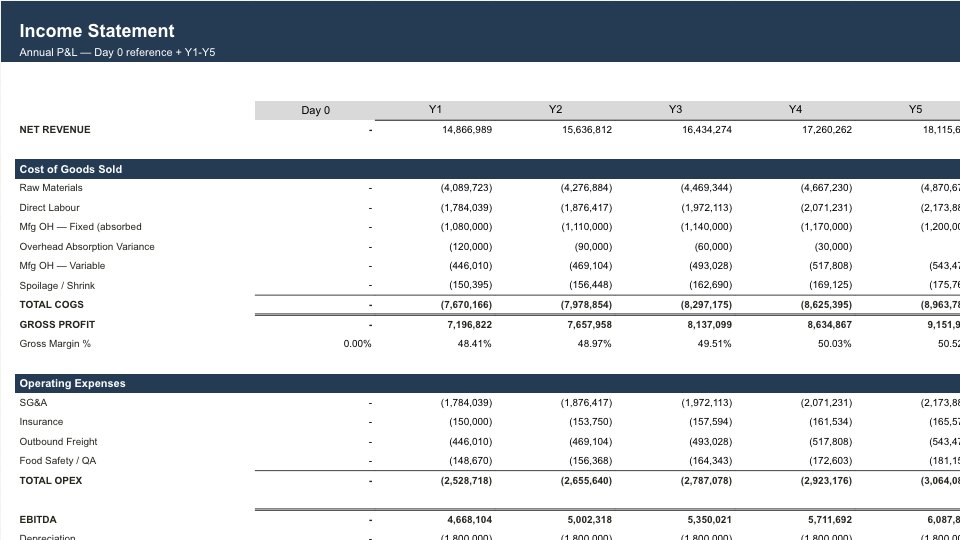
Food Manufacturing Model
Operating model for food production and processing businesses with ingredient sourcing, production scheduling, and margin analysis.







