 By Alex Tapio
 Hebbia alternatives
People look for Hebbia alternatives for a few reasons. There is no public price, and the pricing page offers only a demo request, so you cannot judge cost alone. It is sold to firms, not to one analyst. Its core is research and diligence, so teams whose main need is building models may want a tool made for that first, or a lower-cost option for smaller jobs. Others simply want to compare platforms before a firmwide contract.
What is Hebbia?
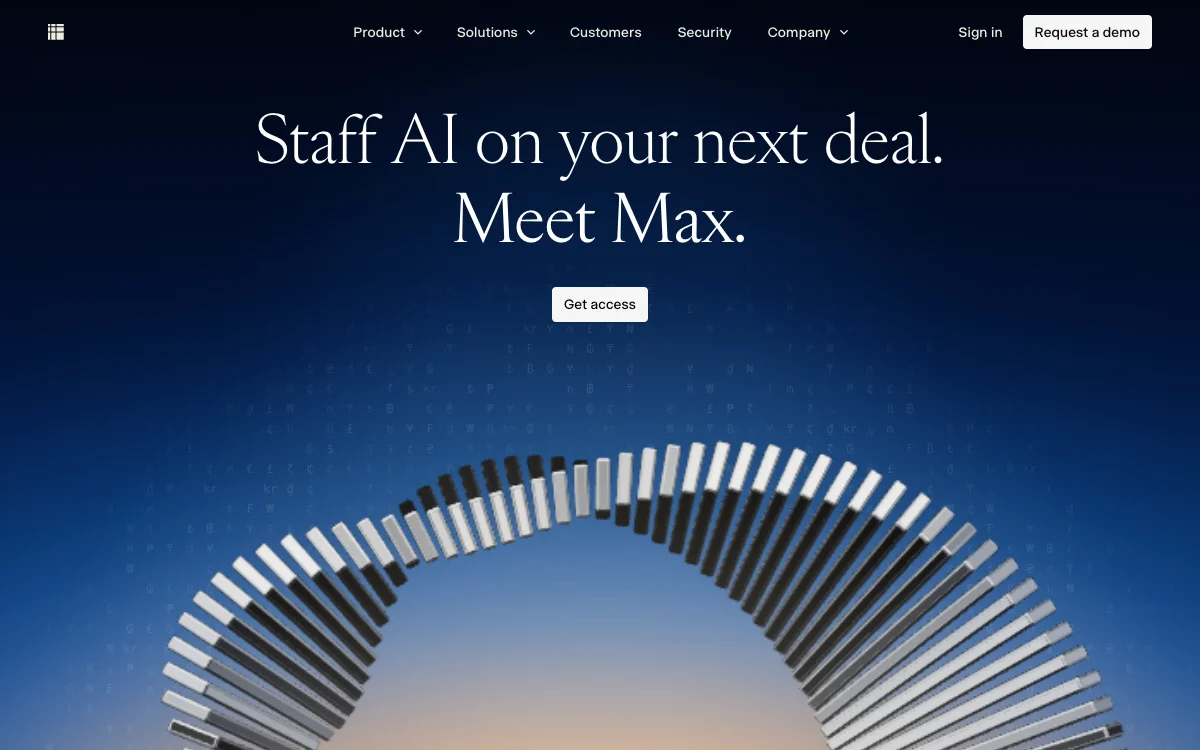
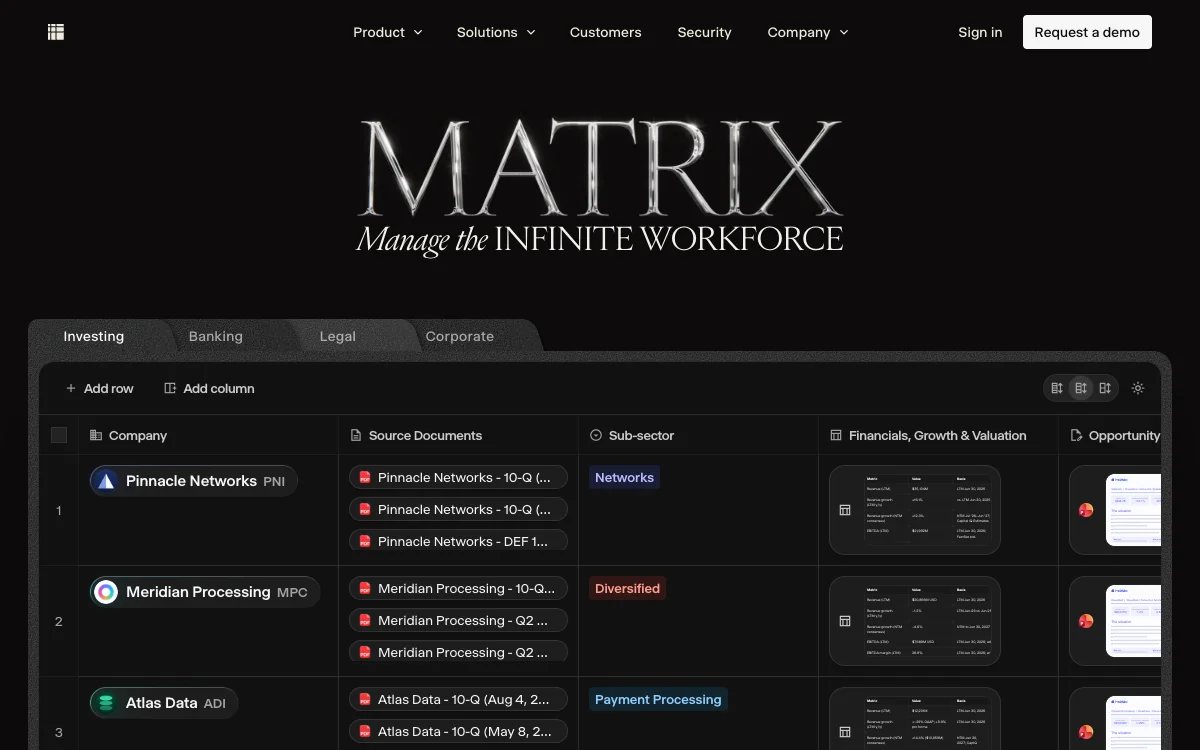
Hebbia is an AI research and diligence platform for investment firms, banks, law firms, consultancies and large companies. It has two products. Matrix is a grid of companies and analysis fields, with a cited answer in each cell. Max is an agent that produces spreadsheets, decks, Word documents, dashboards and reports. Add-ins bring it into Excel, Word and PowerPoint. Named customers include Morgan Stanley, MetLife and Centerview, and it raised a $130 million Series B led by Andreessen Horowitz in 2024.
Hebbia at a glance
Hebbia publishes no price; its pricing page has only a Request a demo button, and on 7 and 10 Nov 2026 it did not load at all. What you buy is Matrix, Max and the Office add-ins, with data from filings, FactSet, Capital IQ, PitchBook, Preqin and others. Security covers SOC 2 Type 2, ISO 27001 and ISO 42001, with US or EU processing and a dedicated tenant on offer.
Quick picks
Hebbia is the first row, for reference. This group mixes research platforms with tools that focus on building the model. Look at "Best for" first, then the price column: most enterprise research tools here sell through a demo. The Excel columns show which tools hand you a workbook, and which mainly answer questions.
| Tool | Best for | Type of tool | Price (entry plan) | Works in | Free option | Builds the model for you | Excel file you keep | AI edits your file | Templates library |
|---|---|---|---|---|---|---|---|---|---|
| Diligence across many documents | AI research platform | Demo only | Web, Excel, PowerPoint, Word | No: None listed | Yes: Max builds models | Yes: Cited models from Max | Yes: Max builds models | Not stated: Not stated |
 | Banking and credit agent library | AI platform | Demo only | Web; Office file output | No: None listed | Yes: From one prompt | Yes: Excel output | Yes: Agents build models | Not stated: Not stated |
 | Cited research and models | AI research tool | Demo only | Web, Excel, PowerPoint | Yes: Sample S-1 workbooks | Yes: Ask for the model | Yes: Cited cells, visible formulas | Yes: Builds 3-statement, comps | Not stated: Not stated |
 | PE document workflows | Document AI agents | Custom annual agreement | Web, Excel, slides, API | No: None listed | Yes: Fills your template | Yes: Your Excel template | Yes: Populates LBO, DCF | Not stated: Not stated |
 | One agent across Office | AI agent | Demo only | Excel, PowerPoint, Word, Teams | No: None listed | Yes: Models and decks | Yes: Excel add-in | Yes: Builds DCFs, comps | Not stated: Not stated |
 | One model, self-serve | Ready models + AI | $20/mo or $120/yr | Web app, Excel file | Yes: 30 models + free samples | Yes: Fina chat builds it | Yes: .xlsx, formulas visible | Yes: Fina chat edits it | Yes: 500+ models |
 | Verified public-company data | Research terminal + API | Not readable | Web, API, MCP | Yes: 7-day trial | No: Data, not models | Not stated: Not stated | No: No model building noted | Not stated: Not stated |
yes · no · not stated in the vendor's sources. Hover a mark for details. From each vendor's own site; prices change, so check before you buy.
1.Rogo
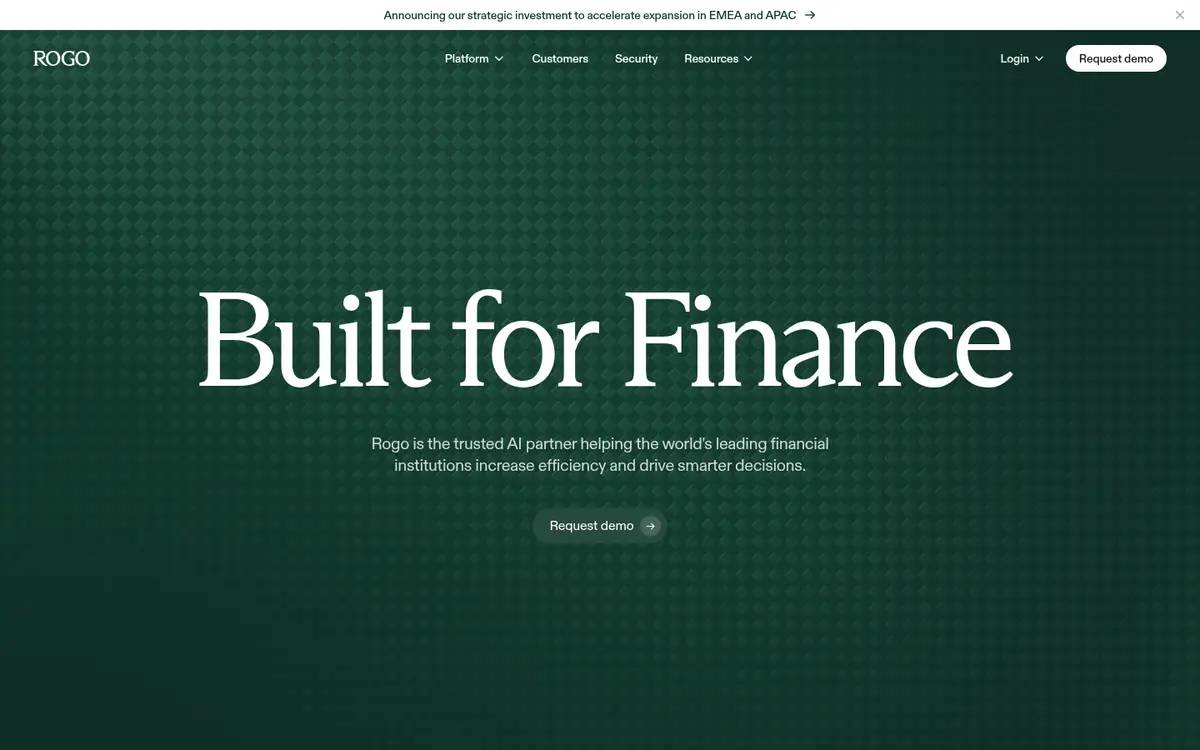
Rogo is an enterprise AI platform for banks, private equity, private credit and public-markets investors, bought firmwide. Its Agent Library has hundreds of finance agents that return Excel models, decks, Word documents and research from one prompt.
Banking agents build fairness-opinion-style DCFs and LBOs, public comps and precedent transactions, and analyse CIMs. Credit agents review credit agreements, structure covenants and run recovery and waterfall analysis. Each answer cites the filing, model or document behind it. Intelligence keeps firm memory, Watchtower routes each task to the AI model that fits its quality, cost and speed needs, and custom agents learn the firm's templates and conventions.
Data partners include PitchBook, Preqin, Intralinks, Datasite and Octus, and former bankers and investors embed with client teams during rollout. Rogo says more than 450 finance firms use it, across banking, private equity, credit and public markets. That hands-on rollout suits firms that want help changing how teams work, not just a login.
Hebbia and Rogo are often on the same shortlist, but they lean different ways. Hebbia starts from documents: Matrix reads a data room or a set of filings and fills a cited grid, and model building is a smaller part. Rogo starts from deliverables: a named agent for each banking or credit task, from a DCF to a covenant review. Both cite their sources, both sell through demos with no public price, and neither has a free plan. Pick by your bottleneck: reading many documents points to Hebbia, producing standard deal outputs points to Rogo.
- Price
- No public price. Demo first.
- Free option
- None listed.
Pros
- Named agents for banking and credit tasks
- Cited answers on every output
- Former bankers embed during rollout
Cons
- No public price
- No free plan or trial
Pick it if your bottleneck is standard deal outputs rather than reading documents.
2.Kepler
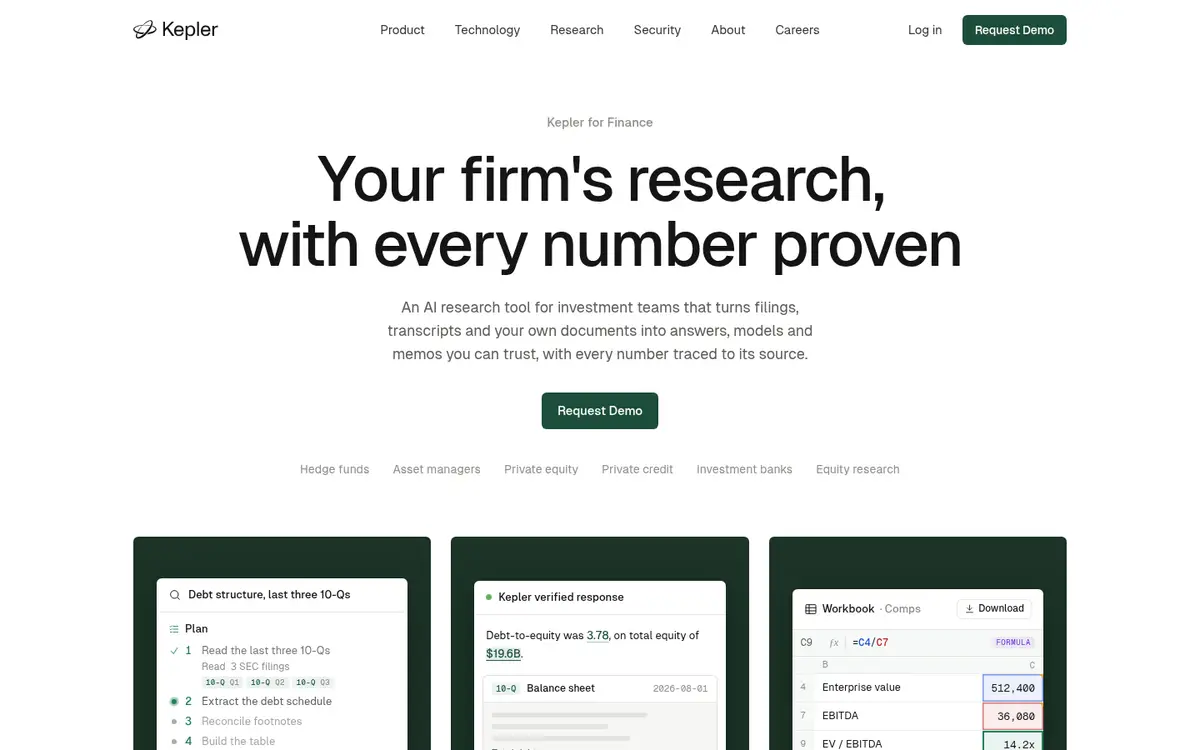
Kepler is an AI research tool for investment teams at hedge funds, private equity, equity research and investment banks. It turns filings, transcripts and firm documents into answers, Excel models and memos, with each number traced to its source.
You ask in plain language, and Kepler shows a multi-step plan, such as reading the last three 10-Qs and extracting the debt schedule, before it answers. Citations click through to the filing, and it flags where sources disagree. Ask for a model and the workbook comes back with every cell traced to the filing, page and line item, with visible formulas. It also drafts IC memos, pitch-book pages and earnings updates in the firm's templates.
Firms can save their own definitions, such as adjusted EBITDA, and feed in private data. It works as an add-in in Excel and PowerPoint, and holds SOC 2 Type II. Its design rule, in its own words, is that the model writes the words and code writes the numbers.
Kepler is the closest to Hebbia in spirit, cited research first, but it leans further into model output. Where Hebbia's Max has added model features in steps, Kepler makes the workbook a core output. You can also judge it for free: it publishes research notes, such as an Anthropic S-1 breakdown from October 2026, with downloadable source-linked Excel workbooks. Like Hebbia, it has no public price and starts with a demo. Its finance product sits inside a broader platform that also serves law and manufacturing, and there is no public changelog.
- Price
- No public price. Request a demo.
- Free option
- Free public research notes with downloadable Excel workbooks.
Pros
- Every workbook cell cited to filing, page and line
- Free sample notes with Excel workbooks
- Firm definitions such as adjusted EBITDA
Cons
- No public price
- No public changelog
Pick it if you want cited research and the model in one tool.
3.V7
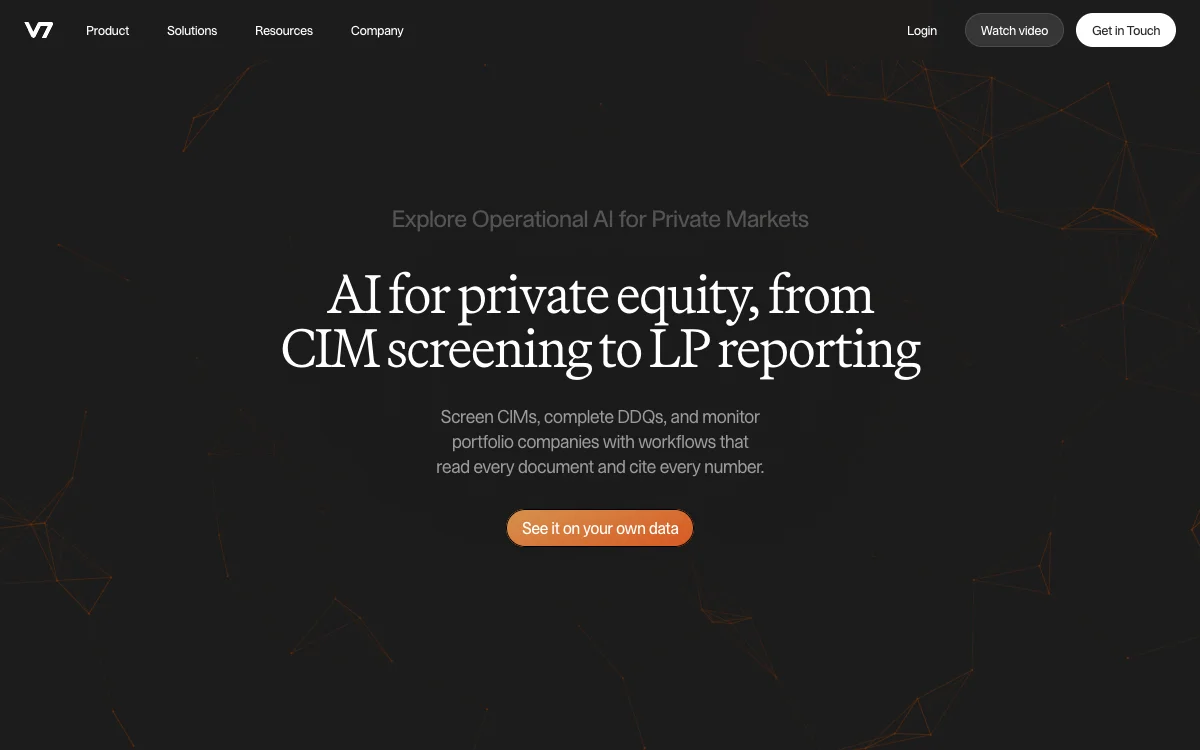
V7 Go is an enterprise AI agent platform for document-heavy work in private markets, insurance and real estate. It includes a Financial Model Builder Agent aimed at private equity, investment banking and corporate development.
The model builder reads CIMs, management presentations, financial statements and data-room files, then fills LBO, DCF and M&A models into your firm's own Excel template. Every number placed in the model is visually linked to its source document. Other agents handle CIM screening, IC memos, DDQs, portfolio monitoring and underwriting, and V7 claims more than 280 prebuilt agents plus custom builds. Output also goes to slides through V7 Go Slides.
Deal teams, underwriters, analysts and reviewers are the users. It integrates with PitchBook and Affinity, connects through an API, holds SOC 2 Type II and offers private deployment. Go Agent V2 lets you choose the AI model and replay a run to see how it got its answer. Insurance and real estate teams use the same platform for their own document flows.
Against Hebbia, V7 Go's strong point is the template. Hebbia's Max formats models to the firm's style; V7 fills the exact Excel file your team already uses, which keeps reviews familiar. Hebbia has deeper data links to FactSet, Capital IQ, Preqin and expert networks. Pricing works the same way at both: no public list, and V7 scopes a custom annual agreement on a call. Financial modelling is one use case among many on V7's platform, so test the model builder itself, not only the demo of document review.
- Price
- No public price list. Custom annual agreement, scoped by call.
- Free option
- None listed.
Pros
- Fills your firm's own Excel template
- Each number linked to its source document
- Prebuilt agents for CIMs, IC memos and DDQs
Cons
- No public price list
- Modelling is one use case among many
Pick it if you want diligence agents that fill your own Excel templates.
4.Model ML
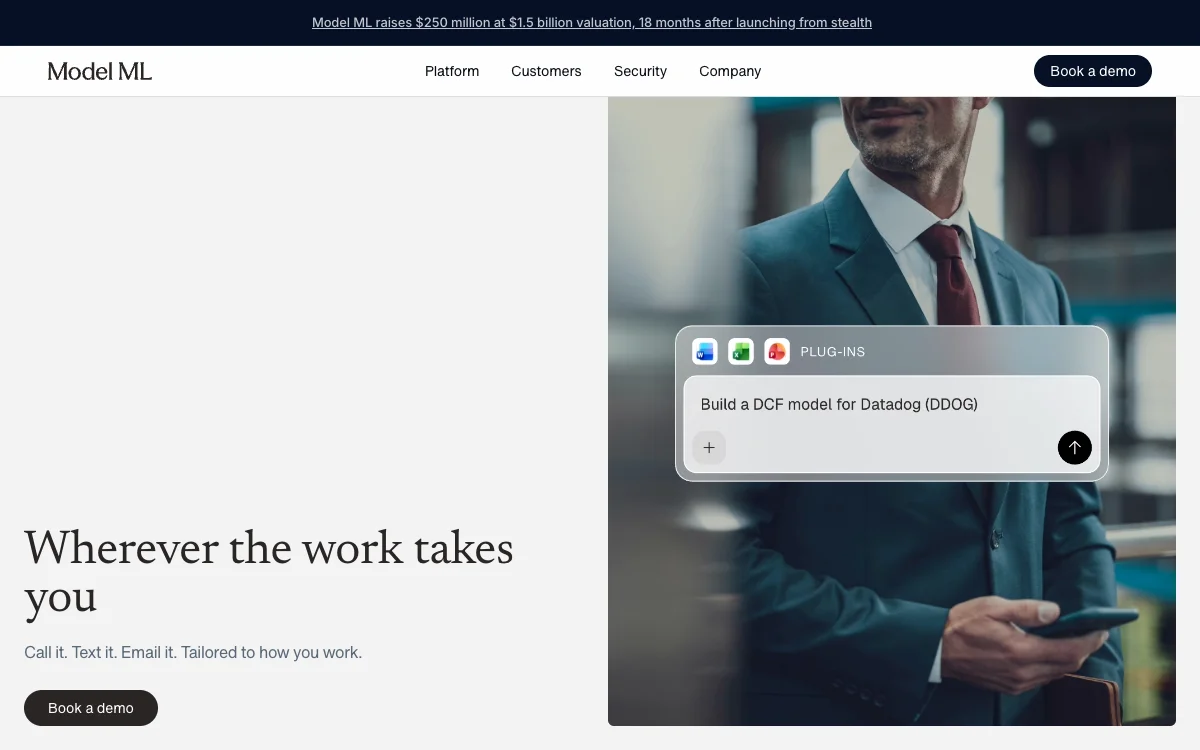
Model ML is an AI finance agent for large banks, consultancies, private equity and credit firms, and asset and wealth managers. One agent works across Excel, PowerPoint, Word, Outlook and Teams.
Its surfaces include Workflows, Grids, Document Review, Chat, a Notetaker and Sites. Grids and the Document Review agent cover ground close to Hebbia's: checking documents for details and risks across a set of files. The agent then produces memos, tearsheets, comps, pitch books, diligence material, decks and models, and figures can carry source footnotes you hover over and click. Its chat page gives building a DCF in Excel from scratch as one example of a delegated workflow.
Tasks arrive by voice, chat, email or triggers, and connectors reach mail, SharePoint and Drive, calendars, CRMs and licensed data from Capital IQ, FactSet, PitchBook and Preqin. The agent can be taught a firm's business, style and delivery formats. That suits firms whose output must match a house format every time.
Model ML and Hebbia sell to similar firms in a similar way: demo first, no public price, no free plan. The difference is centre of gravity. Hebbia is built around research, with Matrix as its core grid and a broad data catalogue including Fitch, Third Bridge and Guidepoint. Model ML is built around getting deliverables out inside Office, with meeting notes and Teams in the same agent. Teams that spend their day in Outlook and PowerPoint may find Model ML closer to how they already work. Ask both for a pilot on one live deal.
- Price
- No public price. Demo first.
- Free option
- None listed.
Pros
- One agent across Office, Outlook and Teams
- Document Review agent for risks and details
- Source footnotes on figures
Cons
- No public price
- Built for large firms
Pick it if your team lives in Outlook and PowerPoint and wants diligence and deliverables in one agent.
5.Finamodel
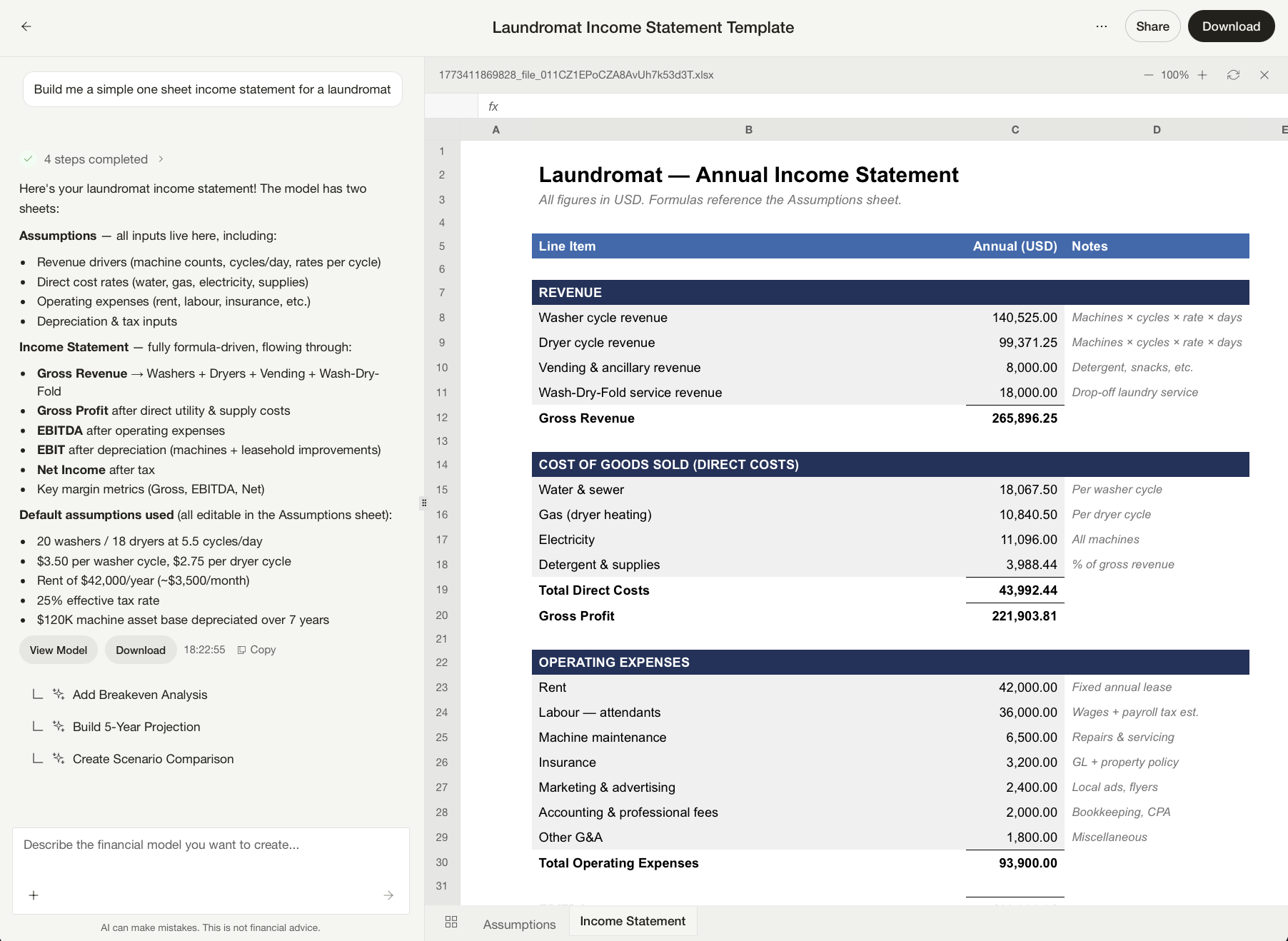
Finamodel is a library of ready Excel financial models with an AI assistant called Fina. Hebbia reads documents and finds answers; Finamodel gives you the model to put those answers into.
You open a ready model, such as a DCF, an LBO or a comparable company analysis, and give Fina your numbers and assumptions: the figures from a CIM, a growth case, a target debt level. Ask for a downside case and Fina updates the inputs; the outputs recalculate through the formulas. Fina builds, edits, explains and fixes the model, and version history lets you restore any earlier file. The download is a real .xlsx file with every formula visible. It works without Finamodel and opens in Excel, Google Sheets and Numbers.
A typical flow is to pull figures from your research tool, paste them into the request, and ask Fina to update the model and explain what moved. Read-only links to QuickBooks, Google Sheets, Google Drive and 42 other apps can bring in your own data, and a voice walkthrough helps a colleague follow the model. You can try one of 30 free models or a free sample of any other model, and prices are listed. There is no demo or sales call.
Finamodel does not do Hebbia's core job. It does not read data rooms, filings or expert calls, it has no cited grid like Matrix, and it has no licensed data from FactSet, Capital IQ or PitchBook. It is not an Excel add-in, there is no dedicated tenant or rollout team, and support is by email. It suits an analyst at a small fund, a boutique or a corporate team who has the inputs already and needs the model built and adjusted this week, without a firmwide contract. For large firms, it can sit alongside a research platform rather than replace it.
How it works
- Pick a ready model, such as a DCF or a 3-statement model, from a library of more than 500.
- Ask Fina chat to change, explain or fix it for your case and your numbers.
- Download a real .xlsx file. Every formula is visible, and it works without Finamodel. It opens in Excel, Google Sheets and Numbers.
- Price
- Models plan: $20 a month or $120 a year. All Templates: $30 a month or $144 a year. You can cancel at any time.
- Free option
- 30 free models with live formulas, and a free sample of every other model, with values but no formulas. Both are sent by email link, one model email per email address per day. The library is free to browse.
Better than Hebbia at
- Listed prices and self-serve sign-up
- A ready model to drop your figures into
- A plain .xlsx file you keep
Worse than Hebbia at
- Does not read documents or data rooms
- No licensed data feeds
- No dedicated tenant or rollout team
Models that fit: DCF Model, LBO Model, Comparable Company Analysis.
Pick it if you already have the inputs and need a model built and adjusted fast.
6.Fiscal.ai
Fiscal.ai sells a stock research Terminal, a Data Feed API and MCP connectors, all built on extracted filings and investor relations data. It is aimed at investors and at the investing platforms and institutions that need clean company data.
The pipeline gathers filings and IR material, extracts the figures and has human analysts verify them. Fiscal.ai says data is available minutes after a filing and is fully auditable to its source. The same dataset reaches you three ways: through the Terminal for research, through the API for your own systems, or through MCP connectors that feed it into AI tools you already use.
That last route matters for Hebbia users: if what you value most is cited public-company numbers inside an AI assistant, connectors can bring them to the assistant you already have. A public-equity analyst who mainly needs fast, verified numbers may not need a full diligence platform. It holds SOC 2 Type II.
Fiscal.ai is a much narrower tool than Hebbia. It covers public-company data, not private data rooms, legal documents or expert calls, and it does not build models, decks or memos. What it offers instead is a way in without a sales process: the Terminal and MCP plans include a 7-day free trial on sign-up. Dollar prices were not visible on its pricing page on 22 Nov 2026, so check plans directly. Contact Sales is in the menu for larger buyers.
- Price
- Terminal, MCP and API plans. Dollar prices were not visible on its pricing page.
- Free option
- A 7-day free trial on the Terminal and MCP plans.
Pros
- Human-verified data from filings
- Terminal, API and MCP from one dataset
- 7-day free trial
Cons
- No private documents or models
- Prices not visible on its page
Pick it if you mostly need verified public-company data, not document diligence.
Who should pick what
Hebbia is mainly a research tool that also builds models. Before you compare, decide whether your bottleneck is reading documents, producing deal outputs, or building the model itself. The answer changes which of these tools deserves a demo, and which you can test today.
- Cited diligence across many documents: Hebbia, Kepler or V7 Go.
- A library of banking and credit agents with rollout help: Rogo. One agent across Office and Teams: Model ML.
- Verified public-company data for your own tools: Fiscal.ai.
- A ready Excel model to put your research into: Finamodel.
Most of these vendors sell through demos, so prepare one test for all of them: the same data room, the same question and the same model request. Ask each one whether it trains on your data and where it processes it. Hebbia says it does not train on customer data and offers US or EU processing.
Frequently asked
How much does Hebbia cost?+
Hebbia publishes no price. Its pricing page has only a Request a demo button, and on 7 and 10 Nov 2026 it did not load at all. We last checked on 22 Nov 2026.
Is there a free version of Hebbia?+
No free plan or trial is listed. Among the alternatives, Kepler publishes free sample research with Excel workbooks, Fiscal.ai has a 7-day trial, and Finamodel gives 30 free models with live formulas and a free sample of every other model.
What are the main Hebbia alternatives?+
For research and diligence platforms: Kepler, V7 Go and Rogo. For one agent across Office: Model ML. For verified public-company data: Fiscal.ai. For a ready Excel model that AI changes for your case: Finamodel.
Can Hebbia build financial models?+
Partly. Its Max agent builds models with a citation in every cell, formatted to the firm's style. Since June 2026 it can pull Capital IQ data to build a three-statement model, and since July 2026 it can refill a comps or LBO shell for a new target. Its core use is still research and diligence.
Hebbia vs Finamodel: which should I pick?+
Pick Hebbia if your firm needs cited research across many documents and can buy through a demo. Pick Finamodel if you already have the inputs and need a ready Excel model, at $20 a month or $120 a year.
Is Hebbia secure?+
Hebbia states SOC 2 Type 2, ISO 27001:2022, ISO 42001:2023 and GDPR and CCPA compliance. It says it does not train on customer data and offers US or EU processing and a dedicated tenant.
Sources for Hebbia (6), last checked 10 Nov 2026+
- hebbia.com · Homepage positioning · 10 Nov 2026
- hebbia.com · Pricing page (failed to load) · 10 Nov 2026
- hebbia.com · Investing use cases · 10 Nov 2026
- hebbia.com · Max agent page · 10 Nov 2026
- hebbia.com · Investment banking page · 10 Nov 2026
- hebbia.gitbook.io · Changelog (model-building entries) · 8 Nov 2026
Each alternative's own page lists its sources.


