The Rule of 72: Quick Mental Math for Growth and Investing
Key Takeaways
- Formula: Years to Double ≈ 72 / Growth Rate (%). Reverse it to solve for the rate needed to double within a target timeframe: Rate ≈ 72 / Years.
- Most accurate between 6% and 10%, where the estimate lands within about a tenth of a year of the exact answer.
- Exact formula: ln(2) / ln(1 + r) - use it, or the calculator above, whenever precision actually matters.
- Use it to sanity-check assumptions - a revenue growth rate, a discount rate, a terminal growth rate - before they drive a full model, not as a substitute for the model's actual compounding formulas.
- It assumes a constant rate. For uneven, multi-year growth paths, normalize to a single CAGR figure first, then apply the Rule of 72 to that.
- A few months of error is normal at the extremes - treat the output as "roughly this many years," not a precise deliverable.
For related valuation math, see how doubling-time thinking connects to NPV vs. IRR when comparing investment returns, or use the CAGR calculator to convert an uneven growth history into the single rate the Rule of 72 needs as its input.
The Rule of 72 estimates how long it takes a value to double at a given growth rate: divide 72 by the rate, and the answer is years to double. It's a mental-math shortcut, not a modeling formula, but it's genuinely useful for sanity-checking growth assumptions before they go into a spreadsheet - a quick way to ask "does this revenue growth rate or discount rate actually imply a sane outcome?" This guide covers the formula, exactly how accurate it is (and isn't), a worked example against the exact math, and how modelers use it to gut-check assumptions rather than compute them.
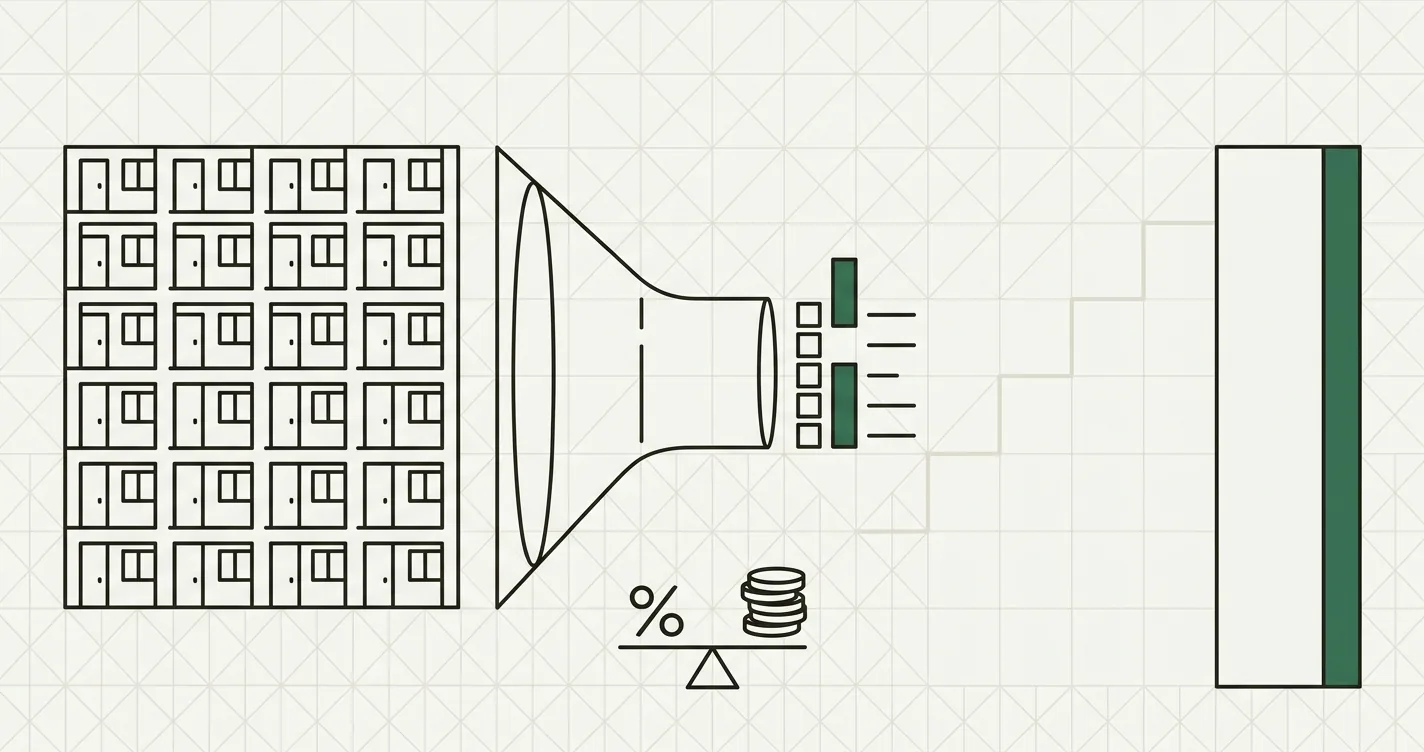
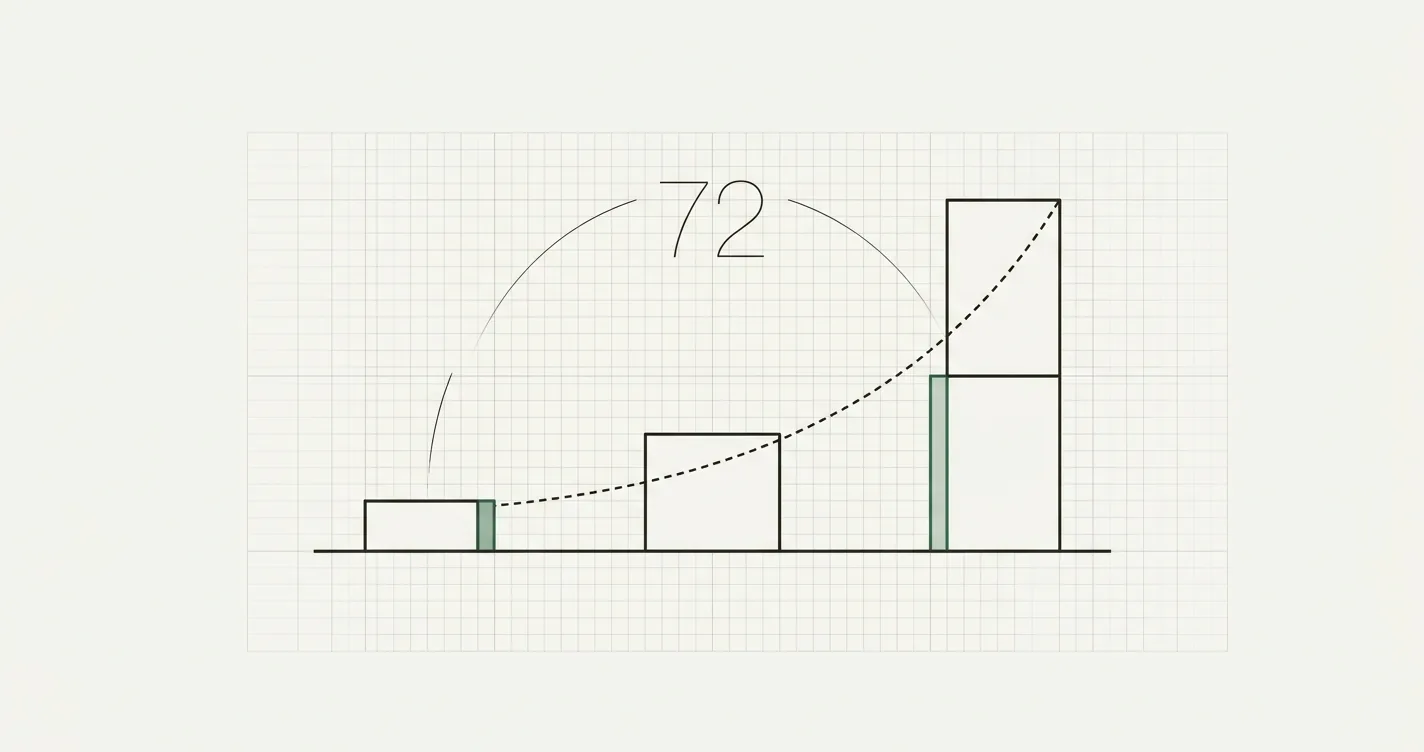
The Rule of 72 shortcut against the exact compounding formula it approximates.
What the Rule of 72 Actually Calculates
The Rule of 72 answers one question: at a constant annual growth rate, how many years until a value doubles? Divide 72 by the growth rate (as a whole number, not a decimal), and the result is the approximate number of years to double.
Years to Double ≈ 72 / Growth Rate (%)
It works for anything that compounds at a roughly constant rate - an investment return, revenue growth, inflation eroding purchasing power, or a debt balance compounding under a fixed interest rate. The "72" isn't arbitrary: it's a rounded stand-in for a more awkward constant, chosen because 72 divides cleanly by 1, 2, 3, 4, 6, 8, 9, and 12 - which makes it fast to compute in your head.
Why 72 and Not the Exact Number
The mathematically exact relationship comes from continuous compounding. Doubling time is:
Years to Double (exact) = ln(2) / ln(1 + r)
Since ln(2) ≈ 0.693, the "true" constant is closer to 69.3, not 72. You'll sometimes see this called the Rule of 69.3 (used for continuous compounding) or the Rule of 70 (a rougher, even-number version some economists prefer for inflation math). 72 wins for everyday use because it's easier to divide by mental-math-friendly numbers - the small loss of precision is the price of speed.
Worked Example: Doubling a $10,000 Investment at 8%
Say you're evaluating an account that compounds at 8% annually, starting with $10,000.
Years to Double = 72 / 8 = 9.0 years
Compare that to the exact formula:
Exact Years to Double = ln(2) / ln(1.08) = 9.01 years
| Method | Years to Double | $10,000 Becomes |
|---|---|---|
| Rule of 72 estimate | 9.00 years | $20,000 |
| Exact formula | 9.01 years | $20,000 |
| Difference | -0.01 years (about 4 days) | - |
At 8%, the estimate is essentially exact - which is not a coincidence. 8% sits inside the range where the Rule of 72 performs best.
Use the calculator above to test other rates - notice how the gap between the Rule of 72 estimate and the exact calculation widens as you move away from the 6-10% band.
How Accurate Is the Rule of 72? The 6-10% Sweet Spot
The Rule of 72 is an approximation, and the approximation error grows the further the rate gets from where 72 was implicitly calibrated. Here's the estimate against the exact doubling time across a range of rates:
| Rate | Rule of 72 Estimate | Exact Years | Difference |
|---|---|---|---|
| 2% | 36.00 | 35.00 | +1.00 yr |
| 4% | 18.00 | 17.67 | +0.33 yr |
| 6% | 12.00 | 11.90 | +0.10 yr |
| 8% | 9.00 | 9.01 | -0.01 yr |
| 10% | 7.20 | 7.27 | -0.07 yr |
| 15% | 4.80 | 4.96 | -0.16 yr |
| 20% | 3.60 | 3.80 | -0.20 yr |
| 30% | 2.40 | 2.64 | -0.24 yr |
Two patterns worth internalizing:
- Below 6%, the Rule of 72 overstates doubling time - useful to know if you're sanity-checking a low discount rate or a terminal growth assumption in a DCF, where you'd rather not be overly pessimistic on your own gut-check.
- Above 10%, it understates doubling time - relevant for early-stage growth-rate assumptions, where a 24-30% compounding rate is common and the shortcut quietly makes the outcome look faster than it is.
The error is never large in absolute terms (a few months at the extremes shown above), but it's large enough to matter when you're using the shortcut to challenge a specific number in a model rather than just to get a rough feel for the scale.
Using the Rule of 72 to Sanity-Check Model Growth Assumptions
This is where the Rule of 72 earns its keep for financial modelers: not as a formula that belongs in a model, but as a five-second gut-check on an assumption before you build on top of it.
Example. You're modeling a SaaS company and the revenue build assumes 24% YoY growth off a $5.0M ARR base. Before committing to that assumption across a five-year forecast, run the Rule of 72:
Years to Double = 72 / 24 = 3.0 years
So the assumption implies ARR roughly doubles - from $5.0M to $10.0M - every three years. Does that match what you know about the company's market, sales capacity, and stage? If yes, the assumption passes a basic plausibility check. If the company would need to more than double headcount and pipeline to support that trajectory and there's no plan to do so, the assumption needs scrutiny before it drives five years of projected revenue.
The exact figure, for reference:
Exact Years to Double = ln(2) / ln(1.24) = 3.22 years
$5.0M compounding at 24% for 3.22 years lands almost exactly at $10.0M - confirming the estimate was close enough for a sanity check, even though it understated the precise timeline by about 2.5 months.
A second use: reverse the formula. If a business plan targets doubling ARR in 6 years, back into the implied growth rate:
Required Rate ≈ 72 / Years to Double = 72 / 6 = 12%
The exact required rate is 2^(1/6) − 1 = 12.25%. Either way, you now have a fast answer to "is a 12% growth assumption enough to double the business in six years" without opening a spreadsheet - useful in a planning meeting where nobody wants to wait for a model to load.
// Rule of 72 estimate (years to double), rate in B2 as a whole number, e.g. 8 for 8%
=72/B2

// Exact years to double
=LN(2)/LN(1+B2/100)

// Reverse: rate needed to double in a target number of years (B3)
=72/B3

// Exact reverse: rate needed to double in B3 years
=2^(1/B3)-1
None of these belong inside the actual growth build of a model - there, you still want explicit compounding: =Revenue_PriorYear*(1+Growth_Rate). The Rule of 72 lives in the assumptions-review step, not the calculation engine.
Common Mistakes
- Using it as a modeling formula instead of a sanity check. The Rule of 72 belongs in your head or a margin note, not in a cell that feeds downstream calculations - use exact compounding (
=(1+r)^n) in the actual model. - Trusting it at the extremes. Below roughly 4% or above roughly 20%, the gap between the estimate and reality is wide enough to change a decision - always run the exact formula (or the calculator above) before relying on the number in anything consequential.
- Mixing up the rate's compounding period. 72 divided by a monthly rate gives months to double, not years - convert to an annualized rate first, or you'll be off by a factor of 12.
- Assuming a constant rate that doesn't exist. The Rule of 72 assumes one steady growth rate. If growth is lumpy or uneven year to year, smooth it into a single rate with CAGR first - otherwise the "doubling time" answer doesn't correspond to anything real.
- Misreading "doubles" as "grows by 72%." The rule estimates years to 2x the starting value (a 100% increase), not a 72% increase - an easy mix-up under time pressure.
- Forgetting it also works for erosion, not just growth. The same math tells you how long until a fixed cost base or a fixed-rate liability doubles, or - using the negative version - how long until purchasing power halves under a given inflation rate.

Alex Tapio
Founder of Finamodel • Professional Financial Modeller • Ex-Deloitte