Startup Runway and Burn Rate: How to Calculate
Key Takeaways
- Net burn drives runway. Gross burn is your cost base; net burn (gross burn minus cash revenue) is how fast your bank balance actually falls. Runway = Cash / Net Burn, and net burn is the number that matters.
- The formula is simple, the nuance is not. A single division gives you a snapshot, but a month-by-month forecast reveals whether net burn is rising or falling, and therefore whether your real runway is shorter or longer than the snapshot suggests.
- Smooth out lumpy months. Use a trailing three-month average net burn (change in cash over three months, divided by three) so one-off payments don't send you into a false panic or false comfort.
- Both levers compound. Cutting costs and pulling cash revenue forward each extend runway; done together they multiply it. Halving net burn doubles your runway.
- Raise for 18 to 24 months, and start early. Fundraising takes three to six months and always runs long. Begin the process with six to nine months of runway left so you negotiate from strength, not desperation.
- Know if you're default alive or default dead. On your current trajectory, do you reach breakeven before the cash runs out? Every founder should be able to answer that in one sentence, backed by a live model.
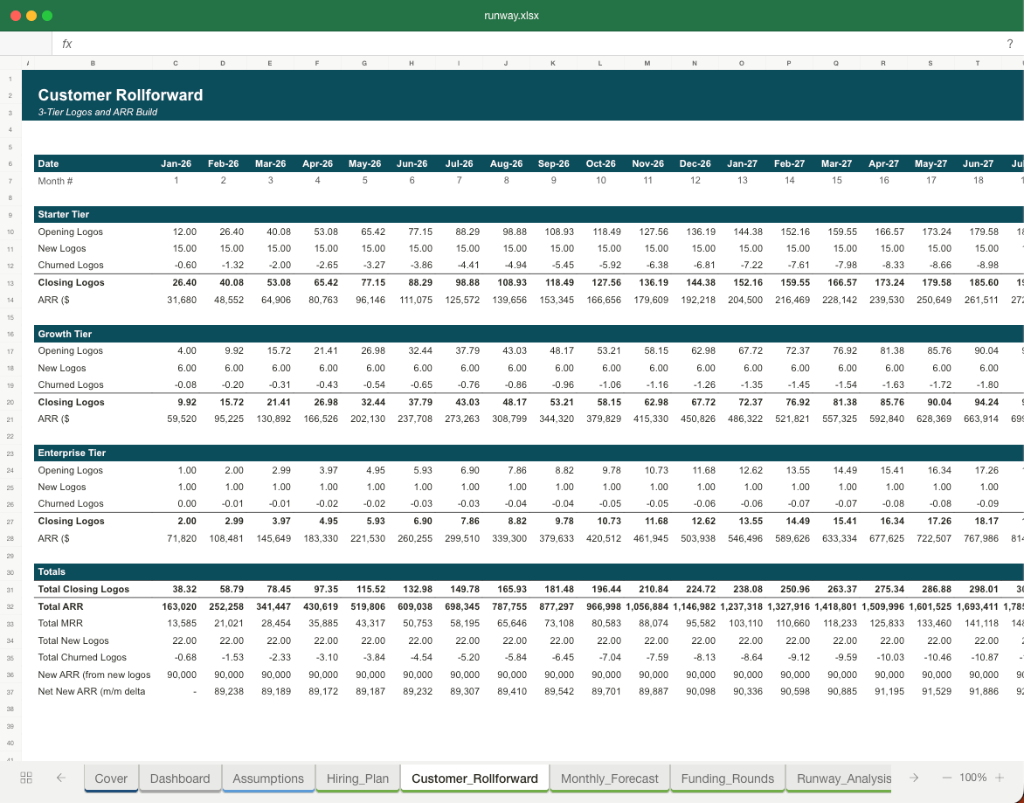
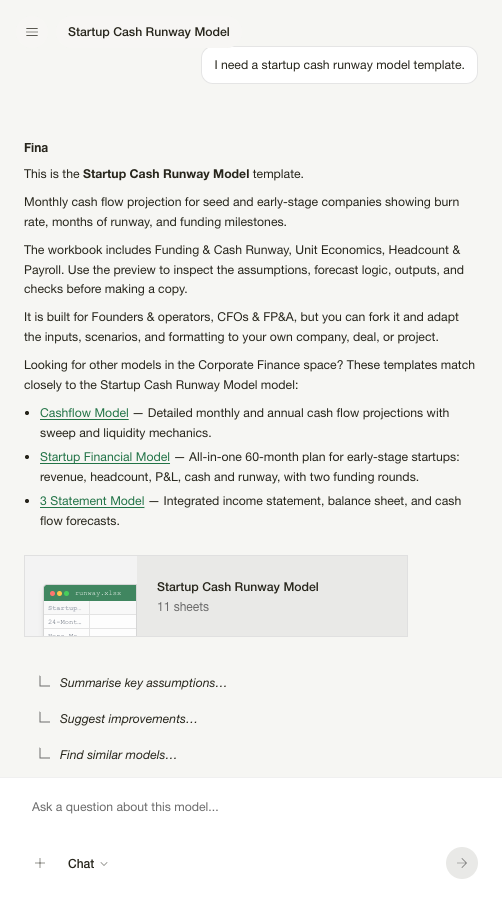
For a full picture of how burn fits into your projections, see our guide to building a startup financial model, and if you run a subscription business, our SaaS financial model guide covers how ARR, cohorts, and burn interact. When you're ready to build your own, download the free startup runway template.
Burn rate is the single most important number a startup founder tracks: it is how fast you are spending cash, and combined with your bank balance it tells you your runway, the number of months until you run out of money. This guide breaks down gross versus net burn rate, gives you the exact cash runway formula, walks through a full month-by-month worked example, and shows how to translate runway into a fundraising plan. Get this wrong and you can go from healthy to insolvent without seeing it coming; get it right and you always know how much time you have to buy.
Every startup is a race between traction and the bank balance. Burn rate measures how fast that balance is falling, and runway measures how many months of racing you have left. These two numbers drive nearly every important decision a founder makes: when to hire, when to raise, when to cut, and whether the company is fundamentally on track or quietly heading for a wall.
The mechanics are simple arithmetic, but the nuances, gross versus net burn, cash versus recognized revenue, static versus dynamic runway, are where founders get tripped up. This guide covers all of them with real numbers.
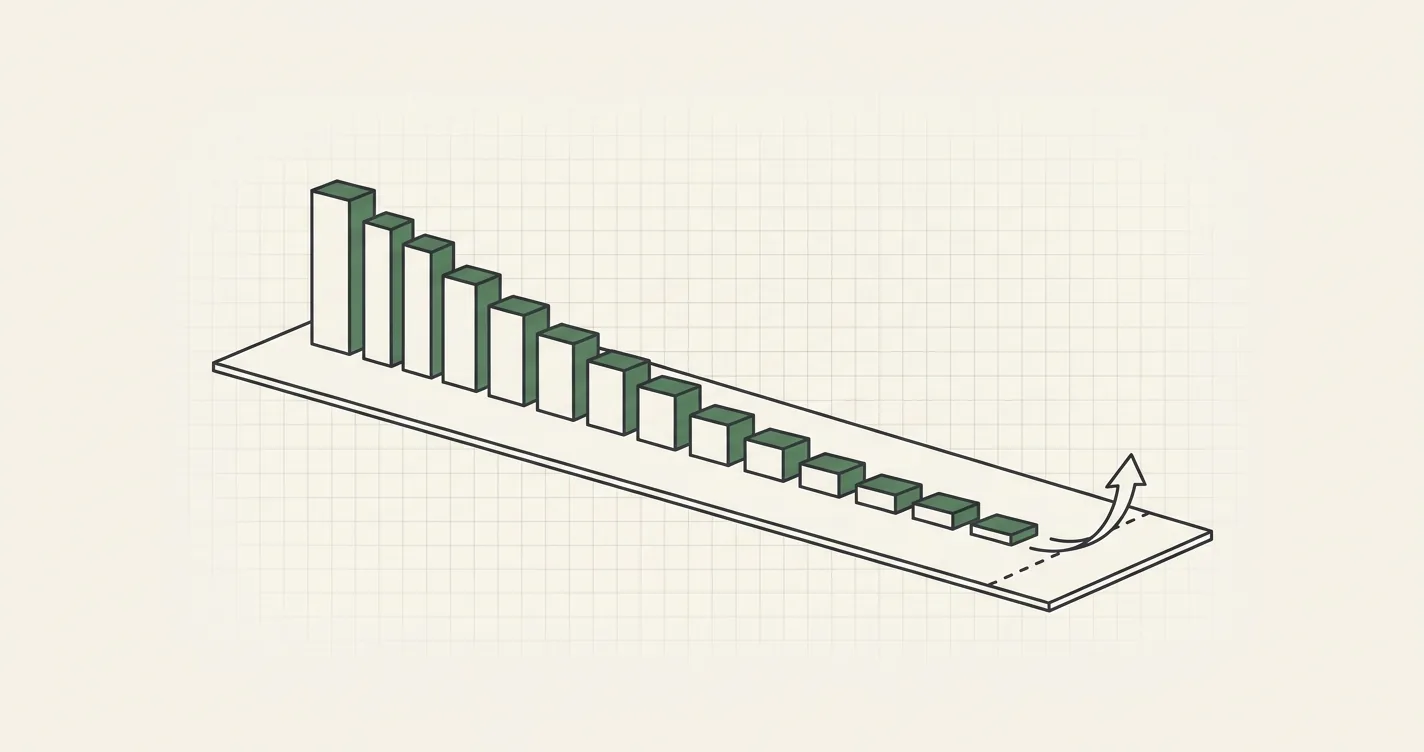
From cash and burn to runway: the decision every founder revisits each month.
Gross Burn vs Net Burn Rate
The first distinction to nail is gross burn versus net burn. Confusing the two is the most common burn-rate mistake, and it leads founders to badly overestimate their runway.
- Gross burn rate is your total monthly cash operating outflows: salaries, contractors, rent, software, cloud hosting, marketing spend, legal, everything that leaves the bank account to run the business. It ignores revenue entirely. Gross burn is your cost base.
- Net burn rate is gross burn minus the cash you actually collect from customers in the same month. It measures how much your bank balance genuinely shrinks. Net burn is what drives runway.
| Metric | Definition | Example |
|---|---|---|
| Gross burn | Total monthly cash operating outflows | $200,000 |
| Cash revenue | Cash collected from customers this month | $80,000 |
| Net burn | Gross burn minus cash revenue | $120,000 |
When someone asks "what's your burn?", they almost always mean net burn. But you should track both: gross burn tells you how expensive the machine is to run, and net burn tells you how long you can keep it running. A company can have a scary-looking gross burn of $500K but a modest net burn of $50K if it is collecting $450K of cash a month, and that company has plenty of runway.
// Net burn rate for the month
= Gross_Burn - Cash_Revenue

// Or read it straight off the cash balance
= Cash_Beginning_of_Month - Cash_End_of_Month
Note the second formula: net burn is simply how much your cash balance fell over the month. If your bank balance went from $1,080,000 to $960,000, your net burn was $120,000, regardless of how you slice the P&L. This is the definition to trust, because it captures every cash outflow (including one-offs like a tax payment or an equipment purchase), not just tidy operating expenses.
The Cash Runway Formula
Runway is the number of months your cash will last at the current net burn rate. The formula is the workhorse of startup finance:
Runway (months) = Cash Balance / Net Burn Rate
Using the numbers above:
Runway = $1,200,000 / $120,000 = 10.0 months
Ten months of runway. That single line is the heartbeat of the business. If it drops below the time it takes to raise your next round (typically three to six months), you are in danger.
// Simple runway in months
= Cash_Balance / Net_Burn_Rate
Try it with your own numbers below. Change the cash balance, monthly costs, and monthly revenue to see how runway responds.
Smoothing lumpy months with a trailing average
A single month can be misleading. Annual software renewals, quarterly tax payments, a one-off legal bill, or a large customer prepayment can make any individual month look far better or worse than your true underlying burn. The fix is to use a trailing three-month average, which is just the change in your cash balance over three months divided by three:
Net Burn (3-mo average) = (Cash 3 Months Ago - Cash Now) / 3
Suppose your month-end cash balances looked like this:
| Month-end | Cash Balance | Net Burn That Month |
|---|---|---|
| April | $1,500,000 | - |
| May | $1,380,000 | $120,000 |
| June | $1,290,000 | $90,000 |
| July | $1,200,000 | $90,000 |
The three-month trailing average net burn is:
= ($1,500,000 - $1,200,000) / 3 = $300,000 / 3 = $100,000 per month
That ties out to the average of the three monthly figures ($120K + $90K + $90K) / 3 = $100K. Using this smoothed $100K instead of any single month gives a runway from July of $1,200,000 / $100,000 = 12 months, a more reliable figure than reacting to one noisy month.
// 3-month trailing average net burn
= (Cash_3_Months_Ago - Cash_Current) / 3
A Worked Example: Month-by-Month Runway
The simple formula assumes burn stays flat. In reality, most startups have revenue growing faster than costs, so net burn shrinks over time and the true runway is longer than the snapshot suggests. The only way to see this clearly is a month-by-month cash forecast. Let's build one.
Assumptions for a seed-stage SaaS startup:
| Assumption | Value |
|---|---|
| Starting cash | $1,200,000 |
| Month 1 cash revenue | $80,000 |
| Revenue growth rate | 10% per month |
| Month 1 gross burn (cash costs) | $200,000 |
| Cost growth rate (hiring) | 4% per month |
Each month, net burn is gross burn minus cash revenue, and ending cash is the prior balance minus that net burn. Here is how the first eleven months play out:
| Month | Cash Revenue | Gross Burn | Net Burn | Ending Cash |
|---|---|---|---|---|
| 1 | $80.0K | $200.0K | $120.0K | $1,080.0K |
| 2 | $88.0K | $208.0K | $120.0K | $960.0K |
| 3 | $96.8K | $216.3K | $119.5K | $840.5K |
| 4 | $106.5K | $225.0K | $118.5K | $722.0K |
| 5 | $117.1K | $234.0K | $116.8K | $605.1K |
| 6 | $128.8K | $243.3K | $114.5K | $490.7K |
| 7 | $141.7K | $253.1K | $111.3K | $379.3K |
| 8 | $155.9K | $263.2K | $107.3K | $272.0K |
| 9 | $171.5K | $273.7K | $102.2K | $169.8K |
| 10 | $188.6K | $284.7K | $96.0K | $73.8K |
| 11 | $207.5K | $296.0K | $88.5K | -$14.8K |
Cash goes negative partway through month 11. The company runs out of money about 10.8 months in ($73.8K of month-10 ending cash divided by month-11 net burn of $88.5K adds another 0.83 of a month to the ten full months).
Notice the gap: the naive snapshot at month 1 was $1,200,000 / $120,000 = 10.0 months, but because revenue grows 10% a month while costs grow only 4%, net burn falls every month and the true runway is closer to 10.8 months. Growing revenue bought nearly an extra month of life. The reverse is also true, and far more dangerous: if costs grow faster than revenue, net burn rises each month and your real runway is shorter than the snapshot. Always forecast forward rather than trusting a single division.
The Two Levers: Cutting Burn vs Growing Revenue
Because runway equals cash divided by net burn, anything that lowers net burn extends runway, and the relationship is powerful. Halving net burn doubles your runway. There are only two levers, and they can be pulled together.
Holding cash constant at $1,200,000, here is how each lever moves runway:
| Scenario | Gross Burn | Cash Revenue | Net Burn | Runway |
|---|---|---|---|---|
| Base case | $200K | $80K | $120K | 10.0 months |
| Cut costs 20% | $160K | $80K | $80K | 15.0 months |
| Grow cash revenue 50% | $200K | $120K | $80K | 15.0 months |
| Both together | $160K | $120K | $40K | 30.0 months |
A 20% cost cut and a 50% revenue lift each buy the same five extra months on their own, but done together they triple the runway from 10 to 30 months. This is why founders in a cash crunch attack both sides at once: trimming the cost base while pulling revenue forward (annual prepaid deals, deposits, shorter payment terms) compounds far faster than either move alone.
// Runway under a cost-cut scenario
= Cash_Balance / (New_Gross_Burn - Cash_Revenue)
Turning Runway Into a Fundraising Plan
Runway is not just a survival gauge; it dictates when and how much to raise. Two rules of thumb govern the timing:
- Raise for 18 to 24 months of runway. A round should buy at least a year and a half of operating time so you can hit the milestones that justify the next round's valuation. Less than that and you are back on the road almost immediately.
- Start raising with six to nine months left. Fundraising takes three to six months from first meeting to wired cash, and it always takes longer than you hope. Starting with a comfortable buffer preserves your leverage; raising on fumes hands negotiating power to investors and forces you to accept worse terms.
To size the raise, multiply the runway you want by your expected net burn, then subtract the cash you already have:
Target Raise = (Target Runway Months x Net Burn Rate) - Current Cash
If you want 24 months of runway, expect to burn about $150K net per month over that period (burn usually rises as you hire post-raise), and hold $300K today:
Target Raise = (24 x $150,000) - $300,000 = $3,600,000 - $300,000 = $3,300,000
So you would target roughly a $3.3M round to reach 24 months of runway. In practice founders round up and raise $3.5M to $4M to leave a genuine buffer, because the one thing worse than raising too much is running out three months before the next round closes.
// How much to raise for a target runway
= (Target_Runway_Months * Expected_Net_Burn) - Current_Cash
Default alive or default dead?
The sharpest framing of runway comes from Paul Graham: is your startup default alive or default dead? Default alive means that on your current growth rate and spending, you would reach cash-flow breakeven before the money runs out, with no new funding. Default dead means you would hit zero first.
In the worked example above, revenue grows 10% a month while costs grow 4%, so net burn is falling and the lines are converging. Extend that forecast far enough and cash revenue eventually overtakes gross burn, the company crosses into profitability, and it becomes default alive. If the numbers were reversed, costs growing faster than revenue, the company would be default dead and no amount of optimism would change the arithmetic. Every founder should be able to answer this question in one sentence, backed by a live forecast.
Common Mistakes to Avoid
- Confusing gross and net burn. Quoting your gross burn as if it were net (or vice versa) can overstate or understate runway by a factor of two or more. Always be explicit about which one you mean, and drive runway off net burn.
- Using a single noisy month. One month distorted by an annual renewal, a tax payment, or a big customer prepayment is not your true burn. Use a trailing three-month average to smooth out the lumps.
- Counting bookings instead of cash. Runway is a cash concept. A $120K annual contract signed today is $120K of cash if paid upfront, but only $10K a month if billed monthly. Use cash actually collected, not revenue recognized, when computing net burn.
- Ignoring non-operating cash outflows. Burn is every dollar that leaves the bank, not just tidy operating expenses. Capital expenditure, loan repayments, and tax payments all reduce cash and shorten runway. The cash-balance definition of net burn (beginning cash minus ending cash) captures them automatically.
- Trusting the static formula when burn is changing. The single-division runway assumes flat burn. If costs are growing faster than revenue, your real runway is shorter than the snapshot, exactly when you can least afford the surprise. Forecast month by month.
- Forgetting the time it takes to raise. Runway that looks fine today evaporates if you start fundraising with three months left and the round takes five. Build the fundraising timeline into your runway, and start early.
- Not updating after a change. A new hire, a layoff, a price increase, or a closed round all change your burn immediately. Recalculate runway every month, not once a quarter.

Alex Tapio
Founder of Finamodel • Professional Financial Modeller • Ex-Deloitte