ACAcin Financial Model
Fintech Startup Financials (Free Excel Download)
SaaS and data subscription network for operational risk management at Tier 1 financial institutions



professionals from Deloitte
Used by professionals from






About this model
Acin is a SaaS and data-subscription network for operational-risk teams at global financial institutions. Its Terminal, common ACIN control identifiers, and benchmark reports replace fragmented, spreadsheet-led risk and control assessment work with a shared industry data layer.
The company is UK-headquartered and sells directly into relationship-led Tier 1 bank accounts. The documented network includes institutions such as Morgan Stanley, J.P. Morgan, UBS, Deutsche Bank, and Société Générale; each additional participant makes the benchmarking dataset more useful.
This financial model is driven by client institutions, annual contract value, subscription tier, and expansion into data or risk-intelligence reports. It should separately track the growth of ACIN identifiers and client adoption, then translate those recurring revenue streams into an enterprise SaaS P&L.
A turnkey financial model
Live formulas, no hardcoded values
Outputs are driven by live formulas, so the workbook updates from its assumptions instead of relying on hardcoded results.
All assumptions in one tab
Inputs are clearly marked in the Assumptions tab and separated from calculations, making it clear what to change and what to leave intact.
Statements always balancing
For integrated-statement models, the balance sheet, cash flow, and supporting schedules tie through properly.
Distinct schedules for clarity
Debt, working capital, taxes, and cash flow can get messy quickly. We group calculations in clear schedules, not across disconnected tabs.
No hidden macros or external links
There are no unexplained external workbook links or macros to undermine auditability or portability.
Changes flow through the model
Update a key driver and see the impact carry through the forecast, financing, and return outputs. We never use hardcoded numbers in formulas.
About Acin
acin.com
How to build a detailed financial model for Acin
A complete walkthrough of the business, drivers, and assumptions behind the downloadable Acin model - distilled from its pitch deck and publicly available information.
Product & value proposition
- Acin Terminal: web platform for managing, visualising, and benchmarking operational risk & controls data
- Acin Code / ACIN identifier: a unique "barcode" for each risk/control instance enabling cross-institution standardisation and network interoperability
- Network effect: risk intelligence shared across member institutions - a risk known to one is known to all; Acin acts as network hub
- Risk Intelligence reports: bespoke analysis (e.g. Covid-19 WFH, vendor incidents, rogue trading) produced from network data
- Value pillars: Data standardisation → benchmarking → network insights; reduces manual/Excel-based RCSA processes; provides regulator-ready quantitative evidence
- Predecessor: Anchura consulting (founded 2010, grew to £12m revenue by 2016); Acin spun out Sep 2017, pivoted fully to SaaS/data by Sep 2018
Market
No explicit TAM/SAM/SOM figures in deck. Contextual size indicators (all):
- $150bn p.a. gross operational risk losses (ORX Banking Loss Report, 2018)
- $376bn in regulatory fines since 2012 (AFME, Apr 2018)
- $26bn annual regulatory compliance costs (AFME, Apr 2018)
- $411bn OpRisk capital held at top 30 banks
Addressable universe: global Tier 1/2 banks, plus interdealer brokers, exchanges, clearing houses, insurance. Market size figure for Acin's SaaS/data product not stated.
Revenue model
- Model described as "SaaS and Data Subscription Network"
- Revenue streams implied: (1) subscription fees per institution to access the Acin Terminal and network; (2) data subscription / benchmarking reports; (3) risk intelligence reports
- No per-seat, per-ACIN-code, or ACV figures shown
- Sales channel: direct enterprise sales to Tier 1 FIs (named clients suggest relationship-driven sales)
Traction & metrics
- Clients named (slide 3 timeline): Credit Suisse, Morgan Stanley, Nomura, Société Générale, JP Morgan, Bank of America Merrill Lynch, Standard Chartered, Deutsche Bank, UBS
- Unique Control Identifiers (ACIN codes) in dataset:
- Oct 2018: 1,200
- Jan 2019: 1,400
- Apr 2019: 2,200
- Jul 2019: 5,200
- Oct 2019: 5,900
- Jan 2020: 35,000
- Case study client ACIN counts: Bank 1 = 45 ACINs; Bank 2 = 163 ACINs; Bank 3 = 333 ACINs
- % control gaps vs. Acin standard: Bank 1 = 32%, Bank 2 = 55%, Bank 3 = 48%
- No ARR, MRR, revenue, or customer count figures disclosed
Competition / moat
Not explicitly addressed in deck. Implied moats:
- Network effect: data value compounds with each additional institution
- Proprietary ACIN code taxonomy - "barcode for risk & controls" creates switching cost and standardisation lock-in
- Incumbent clients are the world's largest banks, creating credibility barrier for competitors
- Named regulatory references (FCA SM&CR, Basel II/III, ECB, ESMA) suggest deep domain expertise as a moat
Team & funding ask / use of funds
- Cris Conde (Former President & CEO, SunGard) cited as endorser/advisor
- Founding team: not named in deck
- Prior revenue: Anchura consulting reached £12m revenue by 2016; no Acin-entity revenue or funding history shown
Recommended financial model
- Archetype + why: B2B SaaS ARR model with network-effect data layer. Acin sells annual subscriptions to financial institutions - recurring, contract-based, high-retention. The ACIN code dataset is the core asset; model should capture both the subscription revenue and the data/network expansion flywheel. A 3-statement is warranted given the institutional client profile and likely investor expectation.
- Forecast horizon & granularity: 5 years (FY2020–FY2024), quarterly for Y1–Y2, annual thereafter. Deck dated April 2020; company is early commercial stage.
- Key drivers & assumptions:
- Number of client institutions (FIs) - starting point: ~9 named clients as of April 2020; new client adds per year
- ACV per client
- Revenue per client type: differentiate by data subscription tier (number of ACINs licensed/benchmarked)
- Data/ACIN identifier growth rate - 1,200 → 35,000 unique codes Oct 2018–Jan 2020 (~29× in 15 months);
- Gross margin, moderate headcount for risk intelligence reports]
- S&M as % of revenue
- R&D as % of revenue
- G&A
- Churn / net revenue retention
- Payback period
- Risk intelligence report revenue
- Scenarios (Base / Bull / Bear - which variables flex):
- Base: 4 new clients/yr, ACV £750k, 75% gross margin, 8% gross churn
- Bull: 7 new clients/yr, ACV £1.25m, faster data network growth driving premium pricing, 5% churn, expansion revenue from upsell
- Bear: 1–2 new clients/yr (long procurement cycles at Tier 1 banks), ACV £500k, higher S&M spend per logo, 12% churn
- Required sheets / outputs:
- Assumptions (all drivers in one place)
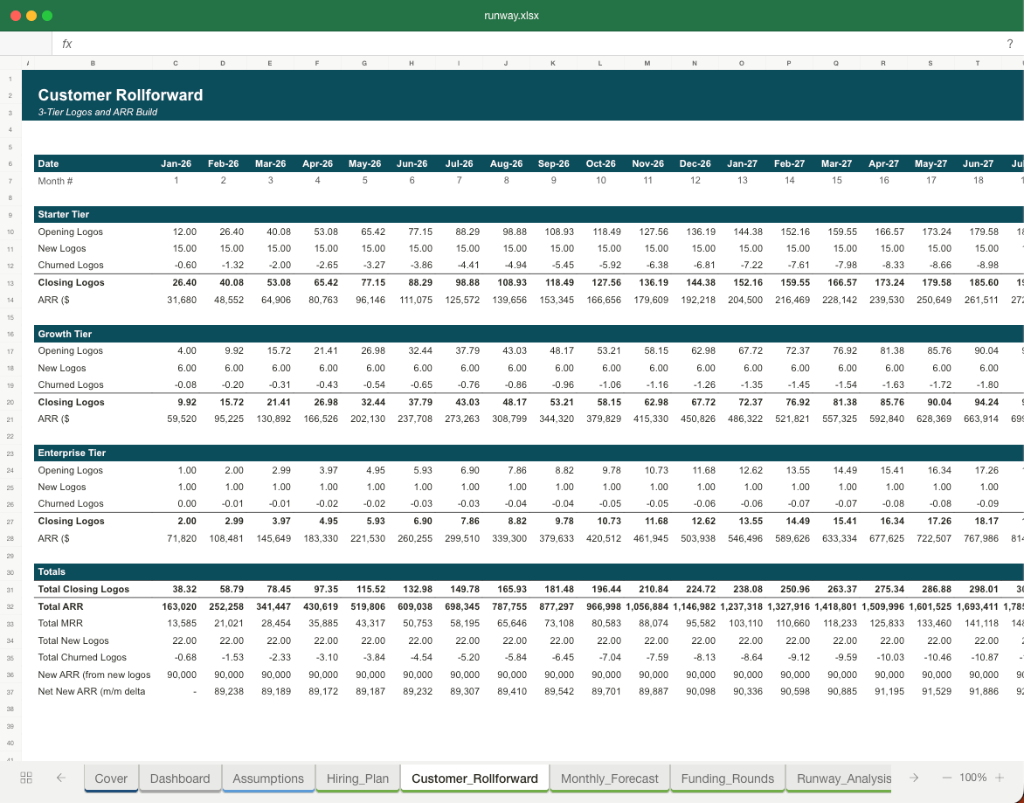
- Revenue build (clients × ACV, cohorted by year; ARR bridge: new + expansion − churn)
- Income Statement (Revenue, COGS, Gross Profit, OpEx by function, EBITDA, D&A, EBIT)
- Headcount plan (S&M, R&D, G&A, risk intelligence team)
- Balance Sheet
- Cash Flow Statement (incl. SaaS deferred revenue working capital)
- KPI dashboard: ARR, clients, ACIN codes in network, NRR, CAC payback
- Scenario toggle (Base / Bull / Bear)
Frequently asked
Is the Acin financial model free?+
Yes. The Acin model is a free Excel (.xlsx) download with live formulas. Sign up with your email and the workbook is yours to keep, review, and edit.
What's included in the model?+
A 5-year monthly forecast with P&L, cash flow and runway, valuation (exit multiple plus a DCF cross-check), MOIC/IRR returns, and unit economics, with live formulas throughout.
How was this model built?+
It was built from Acin's pitch deck and publicly available information, then structured to investment-banking standards as a fully editable Excel model.
Can I change the assumptions?+
Yes. You can change assumptions and the live formulas will recalculate in the downloadable Excel model.
Have more financial modelling questions? Contact us

Created by ex-finance professionals
Hey, I’m Alex and I created Finamodel.
Over my years in the finance industry I kept building the same models over and over again. Same structure, same assumptions, different logo. So I started building frameworks to turn them into clean, reusable templates.
Every model here is one I’d actually use for a client, and I personally vet each one before it goes up.
I’m not an expert in every industry, but I’ve built enough models to know what belongs in one. And when something is completely foreign to me, I reach out to my network for experts to work on our models with us.
Having a template library on hand cuts a first build from hours to minutes.
Need help finding your model? You’ll find me in the Finamodel app!
Other Fintech Startup Financial Models
Browse another startup in the same category.

Ageras Group
B2B SME ecosystem - marketplace connecting SMEs with accountants + cloud accounting/payroll software + embedded financial services (lending, factoring, banking)

Airbase
Unified non-payroll spend management platform (corporate cards, AP/bill pay, expense reimbursement, approval workflows) for mid-market companies.

Altruist
Vertically integrated all-in-one platform for registered investment advisors (RIAs) - combining custodial, portfolio management, practice management, and client acquisition tools.
Amenitiz
All-in-one hotel management SaaS platform ("Shopify for hotels") for independent hoteliers - PMS, booking engine, channel manager, website builder, payments, and AI-driven revenue management.

Anrok
SaaS sales tax compliance platform - nexus monitoring, calculation, registration, filing, and remittance - built specifically for SaaS companies.
Arrival
Arrival is an EV manufacturer of commercial vans and buses using proprietary Microfactories and vertically integrated components, going public via SPAC merger with CIIG Merger Corp.

AtoB
AtoB is building financial infrastructure for commercial fleets, starting with a no-fee Visa fleet card for fuel and expanding into payroll, BNPL, and international.

authID.ai
Cloud biometric identity authentication platform that replaces passwords with selfie-based verification for banks, fintechs, and enterprises.