 Anrok Financial Model
Fintech Startup Financials (Free Excel Download)
SaaS sales tax compliance platform - nexus monitoring, calculation, registration, filing, and remittance - built specifically for SaaS companies.



professionals from Deloitte
Used by professionals from






About this model
Anrok automates sales-tax compliance for SaaS companies, covering nexus monitoring, tax calculation, registrations, filing, and remittance. The product is built around a recurring operational problem that grows more complex as software businesses sell across jurisdictions.
Its commercial appeal is the ability to replace manual compliance workflows with a specialist platform designed for modern subscription businesses. The available research is educational rather than a fundraising deck, so it does not disclose detailed financial performance or pricing.
A model should therefore use a straightforward SaaS ARR structure: new customers, implementation timing, subscription ARPU, expansion, and churn. Usage-based inputs such as transactions or jurisdictions monitored can provide an additional pricing and retention layer where evidence becomes available.
A turnkey financial model
Live formulas, no hardcoded values
Outputs are driven by live formulas, so the workbook updates from its assumptions instead of relying on hardcoded results.
All assumptions in one tab
Inputs are clearly marked in the Assumptions tab and separated from calculations, making it clear what to change and what to leave intact.
Statements always balancing
For integrated-statement models, the balance sheet, cash flow, and supporting schedules tie through properly.
Distinct schedules for clarity
Debt, working capital, taxes, and cash flow can get messy quickly. We group calculations in clear schedules, not across disconnected tabs.
No hidden macros or external links
There are no unexplained external workbook links or macros to undermine auditability or portability.
Changes flow through the model
Update a key driver and see the impact carry through the forecast, financing, and return outputs. We never use hardcoded numbers in formulas.
About Anrok
anrok.com
How to build a detailed financial model for Anrok
A complete walkthrough of the business, drivers, and assumptions behind the downloadable Anrok model - distilled from its pitch deck and publicly available information.
Product & value proposition
- End-to-end SaaS sales tax automation: nexus monitoring (economic + physical), registration, calculation across finance stack, returns filing (via Easyfile), and remittance.
- Differentiator: only solution tracking both economic and physical nexus simultaneously; jurisdiction-specific thresholds at state and local level.
- Triggers post-Wayfair (2018 South Dakota v. Wayfair Supreme Court ruling): SaaS companies now must collect/remit sales tax based on economic presence, not just physical.
- Key workflow: nexus survey → registration → calculation → returns → remittance; Anrok automates all five steps.
Market
Context available: US has 45 states + DC with sales tax; post-Wayfair compliance burden falls on all SaaS companies with economic nexus (typically $100k sales or 100 transactions per state). Addressable universe is the entire US SaaS market. No quantified market size figures in deck.
Traction & metrics
Notable qualitative signals only:
- Backed by Sequoia and Index Ventures.
- Coverage in Forbes and TechCrunch.
Unit economics
The only quantitative economics in the deck relate to the *customer's* problem cost, not Anrok's own unit economics:
- Non-compliance effective penalty rate by state: NY 11.3%, TX 7.4%, PA 10.5%, TN 12.4%, WA 8.7%, Other 8.3%, blended 8.8%.
- Weighted revenue drag from non-compliance (GDP-share weighted): ~4.3% of revenue across all states.
Competition / moat
- Deck claims to be "the only solution that tracks both economic and physical nexus".
- Moat framing: SaaS-specific accuracy, end-to-end automation (vs. point solutions), and team with firsthand SaaS pain-point experience.
- No named competitors cited in deck.
Team & funding ask / use of funds
- CEO & Co-founder: Michelle Valentine.
- No other team members named.
- No funding ask, round size, or use of funds disclosed. Deck is not a fundraising pitch.
- Investors (existing): Sequoia, Index Ventures.
Recommended financial model
Note: This deck is a sales/educational webinar presentation, not a fundraising or investor pitch deck. It contains no financial projections, revenue figures, unit economics, or funding ask. The design doc below describes what model *would* be appropriate for Anrok as a business, based on the product and business model observable in the deck.
- Archetype + why: SaaS ARR subscription model. Anrok sells ongoing compliance automation to SaaS companies on a recurring basis. Revenue is subscription-driven (monthly/annual contracts), making ARR build-up the correct top-line structure. Secondary revenue line possible for professional services (nexus survey, registration assistance) but not confirmed in deck.
- Forecast horizon & granularity: 3 years monthly (Yr 1–2) then annual (Yr 3), or 5-year annual with monthly detail in Year 1. Monthly granularity needed to capture new logo ramp and churn dynamics.
- Key drivers & assumptions:
| Driver | Value |
|---|---|
| Starting customer count | Unknown |
| Non-compliance drag (prospect pain point) | ~4.3% of revenue |
| Effective non-compliance rate (blended) | 8.8% |
| States with economic nexus threshold | $100k sales or 100 transactions (most states) |
- Scenarios (Base / Bull / Bear - which variables flex):
- Base: steady logo growth, 7% gross churn, 110% NRR, 75% GM.
- Bull: faster new logo ramp (product-led growth or channel partnerships), lower churn (sticky integrations), NRR 120%+.
- Bear: slower sales cycle (compliance purchasing delayed by startups), higher churn if customers perceive tool as one-time setup, compressed margins from manual filing labor.
- Required sheets / outputs:
- Assumptions - all drivers, clearly labeled vs..
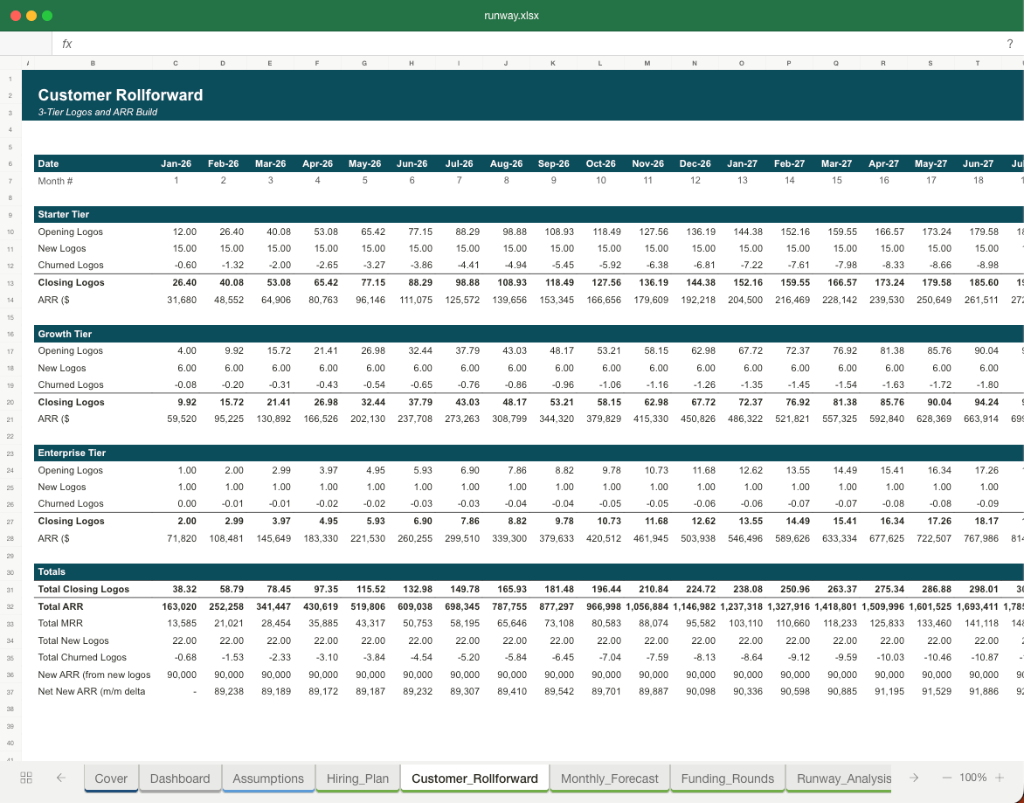
- ARR Waterfall - beginning ARR + new ARR + expansion ARR − churn ARR = ending ARR, monthly.
- Revenue Bridge - subscription revenue; optional services revenue line.
- P&L - gross profit, S&M, R&D, G&A, EBITDA, net income.
- Headcount Plan - CS (compliance specialists), engineering, sales, G&A; drives opex.
- Cash Flow - operating CF, capex (minimal for SaaS), ending cash; burn rate and runway.
- KPI Dashboard - ARR, MRR, logo count, NRR, LTV/CAC (once data available), gross margin %.
- Customer ROI model (optional, for sales use) - prospects' estimated non-compliance drag vs. Anrok cost, using the 4.3% drag figure from deck.
Frequently asked
Is the Anrok financial model free?+
Yes. The Anrok model is a free Excel (.xlsx) download with live formulas. Sign up with your email and the workbook is yours to keep, review, and edit.
What's included in the model?+
A 5-year monthly forecast with P&L, cash flow and runway, valuation (exit multiple plus a DCF cross-check), MOIC/IRR returns, and unit economics, with live formulas throughout.
How was this model built?+
It was built from Anrok's pitch deck and publicly available information, then structured to investment-banking standards as a fully editable Excel model.
Can I change the assumptions?+
Yes. You can change assumptions and the live formulas will recalculate in the downloadable Excel model.
Have more financial modelling questions? Contact us

Created by ex-finance professionals
Hey, I’m Alex and I created Finamodel.
Over my years in the finance industry I kept building the same models over and over again. Same structure, same assumptions, different logo. So I started building frameworks to turn them into clean, reusable templates.
Every model here is one I’d actually use for a client, and I personally vet each one before it goes up.
I’m not an expert in every industry, but I’ve built enough models to know what belongs in one. And when something is completely foreign to me, I reach out to my network for experts to work on our models with us.
Having a template library on hand cuts a first build from hours to minutes.
Need help finding your model? You’ll find me in the Finamodel app!
Other Fintech Startup Financial Models
Browse another startup in the same category.
Acin
SaaS and data subscription network for operational risk management at Tier 1 financial institutions

Ageras Group
B2B SME ecosystem - marketplace connecting SMEs with accountants + cloud accounting/payroll software + embedded financial services (lending, factoring, banking)

Airbase
Unified non-payroll spend management platform (corporate cards, AP/bill pay, expense reimbursement, approval workflows) for mid-market companies.

Altruist
Vertically integrated all-in-one platform for registered investment advisors (RIAs) - combining custodial, portfolio management, practice management, and client acquisition tools.
Amenitiz
All-in-one hotel management SaaS platform ("Shopify for hotels") for independent hoteliers - PMS, booking engine, channel manager, website builder, payments, and AI-driven revenue management.
Arrival
Arrival is an EV manufacturer of commercial vans and buses using proprietary Microfactories and vertically integrated components, going public via SPAC merger with CIIG Merger Corp.

AtoB
AtoB is building financial infrastructure for commercial fleets, starting with a no-fee Visa fleet card for fuel and expanding into payroll, BNPL, and international.

authID.ai
Cloud biometric identity authentication platform that replaces passwords with selfie-based verification for banks, fintechs, and enterprises.