 authID.ai Financial Model
Fintech Startup Financials (Free Excel Download)
Cloud biometric identity authentication platform that replaces passwords with selfie-based verification for banks, fintechs, and enterprises.



professionals from Deloitte
Used by professionals from






About this model
authID.ai is a cloud biometric identity platform that uses selfie-based verification to authenticate users for banks, fintechs, and enterprises. It replaces password-led access with a more continuous, fraud-resistant identity layer.
The company sells a combination of recurring identity services and consumption-based authentication. Its disclosed operating language distinguishes booked ARR, deferred revenue, and recognised ARR, reflecting the delay between contract signature, deployment, and live usage.
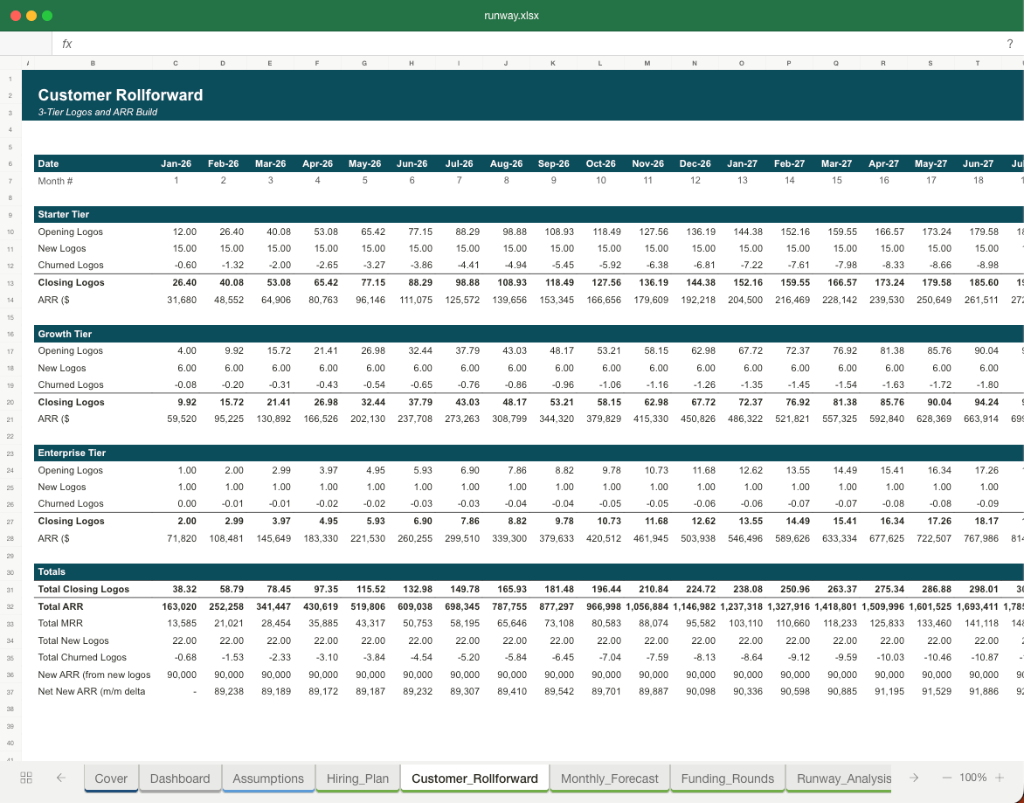
The model should explicitly bridge bookings through implementation and revenue recognition. New contracts, contract value, go-live lag, verification volume, and renewal rates drive ARR, while deferred-revenue movements keep the forecast aligned with cash collection and reported revenue.
A turnkey financial model
Live formulas, no hardcoded values
Outputs are driven by live formulas, so the workbook updates from its assumptions instead of relying on hardcoded results.
All assumptions in one tab
Inputs are clearly marked in the Assumptions tab and separated from calculations, making it clear what to change and what to leave intact.
Statements always balancing
For integrated-statement models, the balance sheet, cash flow, and supporting schedules tie through properly.
Distinct schedules for clarity
Debt, working capital, taxes, and cash flow can get messy quickly. We group calculations in clear schedules, not across disconnected tabs.
No hidden macros or external links
There are no unexplained external workbook links or macros to undermine auditability or portability.
Changes flow through the model
Update a key driver and see the impact carry through the forecast, financing, and return outputs. We never use hardcoded numbers in formulas.
About authID.ai
authid.ai
How to build a detailed financial model for authID.ai
A complete walkthrough of the business, drivers, and assumptions behind the downloadable authID.ai model - distilled from its pitch deck and publicly available information.
Product & value proposition
- Core product: Verified™ - cloud biometric authentication via selfie (facial recognition). Replaces passwords and OTPs.
- Two integration paths: (1) REST API ("few lines of code") for custom integration; (2) Cloud|Connect - no-code connector to major IAM platforms (Auth0, Okta, Temenos, CUNextGen).
- Value prop: Fraud-proof, frictionless, portable, in-browser authentication with an indisputable audit trail. Eliminates password compromise, OTP/SIM-swap fraud, KYC/KYB breaches, and customer attrition from poor UX.
- Three-step process: (1) verify identity at onboarding, (2) bind user to that identity, (3) re-authenticate whenever required.
- Sales motion: Proof-of-Value (POV) trials → assess outcomes → full proposal & pricing.
Market
- Biometrics as a Service Market CAGR 2021–2026: 22.7%
- 1.4 billion+ consumers will use facial biometrics for payments by 2025
- 92% of retail banks increasing budget for digital transformation
- 80% of businesses have a customer recognition strategy in place (+26% vs. pre-COVID)
- Banking revenue context (used as proxy for addressable spend uplift): 2020 global banking revenue $2,062B; projected 2025 $3,186B (+5.3% CAGR baseline + 3.8% CAGR uplift from non-linear model adoption = $518B incremental opportunity).
- Password problems cost smaller banks $12.5M+ annually (fraud $7.63M, compliance $2.13M, reset costs $2.13M, attrition $0.66M).
- No explicit TAM/SAM/SOM breakdown provided. TAM/SAM figures not in deck.
Revenue model
- SaaS / consumption-based: recurring revenue tied to identity verifications and transaction authentications.
- KPI definitions disclosed (Q3 2022 Earnings Call context):
- Identity Booked ARR (bARR): minimum annual recurring revenue from signed contracts not yet live. Non-GAAP.
- Identity Deferred Revenue: cash collected upfront for identity products not yet revenue-recognized.
- Identity ARR: trailing 3-month average monthly revenue × 12. Non-GAAP.
-
- Some SaaS contract value collected upfront (deferred), then recognized upon customer go-live.
- B2B sale to banks, fintechs, crypto platforms, iGaming, healthcare.
- Pricing not disclosed in deck - tailored proposal per customer post-POV.
- Up-sell / cross-sell within enterprise accounts after initial deployment.
Traction & metrics
- Platform launched: Verified™ launched October 24, 2021 (Money 20/20 USA). Upgraded to V2.4 on January 21, 2022.
- No ARR, revenue, or customer count figures disclosed - company committed to reporting Identity KPIs with Q2 2022 results ("meaningful figures to share by mid-2022").
- Uplisted to Nasdaq (AUID) June 14, 2021; closed public offering of ~$11.5M.
- Developer portal launched for self-service integration.
- Pipeline examples: ecommerce platform, crypto trading platform, medical certification group (~30K physicians), fintech money transfer, fintech notary platform, iGaming. - these are POV / pipeline, not closed contracts.
- No quantified customer count, user volumes, or revenue figures in deck.
Competition / moat
- Moat framed around: (1) cloud-native biometric approach vs. legacy password/OTP incumbents; (2) API-first + no-code Cloud|Connect reducing implementation friction; (3) indisputable audit trail.
- No named competitors shown. Competitive comparison is legacy-password vs. biometric (structural, not vendor vs. vendor).
- Comparable SaaS comps cited (for valuation context, not competitive): Okta, Ping Identity, DocuSign, Twilio, Zoom, Shopify, Salesforce, Adobe, Square - median EV/ARR at IPO 10.60x, mean 285% ARR CAGR in 2 years prior to IPO.
Team & funding ask / use of funds
- CEO: Tom Thimot; President & CTO: Tripp Smith; CMO: Peter Curtis; SVP MarCom & IR: Grace de Fries; SVP Product: Jeremiah Mason; SVP Sales: Steve Fazio.
- Hired across sales, product, marketing, engineering, customer success in 2021; 45% persons of color and/or women.
- Engaged PR, marketing, and tech/engineering vendors.
- No funding ask in deck - this is a public-company investor relations presentation (NASDAQ: AUID), not a venture fundraising deck. $11.5M public offering already closed June 2021.
- No use-of-funds slide.
Recommended financial model
- Archetype + why: SaaS ARR build-up model (bARR → Deferred Revenue → recognized ARR waterfall). The company explicitly defines its KPIs as bARR, Deferred Revenue, and ARR in sequence (sign → collect → go-live → recognize). This is a pre-revenue early-growth SaaS business, so the model must bridge from pipeline/bookings through implementation lag to recognized revenue. Secondary layer: consumption/transaction-based volume overlaid once ARR is live.
- Forecast horizon & granularity: Monthly for years 1–2 (to capture the 4–12 month sales cycle lag and deferred-to-recognized revenue timing); quarterly for years 3–5. Five-year total horizon to show path from pre-revenue to scale.
- Key drivers & assumptions:
- New logo wins per quarter: 2–4 new enterprise contracts/quarter in year 1, ramping to 8–12 by year 3; rationale: POV pipeline shown across 6 verticals, zero live revenue as of early 2022, long sales cycles.
- Average contract ACV: $150K–$400K based on enterprise SaaS identity peers (no deck data); will need to update once pricing disclosed.
- Implementation lag (sign to go-live): 3–6 months per deal; rationale: B2B SaaS industry benchmark per slide 18 + typical enterprise rollout.
- Upfront cash collection (deferred %): 25–50% of ACV collected at signing; remainder on go-live milestones.
- Net Revenue Retention (NRR): 110–120% at scale; rationale: enterprise identity platforms with cross-sell/upsell motion (per slide 19 six-step model) typically achieve >100% NRR.
- Gross margin: 65–75%; rationale: cloud biometric SaaS with API delivery, no hardware; peers (Okta, Ping) run 70–75%.
- CAC / S&M spend: 40–60% of revenue in year 1–2, declining to 25–35% at scale; rationale: early-stage SaaS with long sales cycles.
- R&D spend: 20–30% of revenue; rationale: active product iteration (V2.4 already released).
- G&A: 15–20% of revenue early, declining to 8–10% at scale.
- Biometrics as a Service market CAGR: 22.7% - used as ceiling check on growth assumptions.
- Banking digital transformation as primary vertical: 92% of banks increasing budgets; confirms TAM receptivity but no share capture rate available.
- Scenarios (Base / Bull / Bear - which variables flex):
- Base: 3 new logos/quarter in Y1 ramping to 8 by Y3, ACV $200K, 4-month implementation lag, NRR 110%.
- Bull: Faster logo wins (5/quarter Y1 → 12 by Y3), higher ACV ($300K), Cloud|Connect drives accelerated no-code adoption shortening lag to 2 months, NRR 120%.
- Bear: Slow enterprise adoption (1–2 logos/quarter Y1), ACV $150K, 6-month lag, NRR 100% (no expansion in early cohorts).
- Key scenario levers: logo win rate, ACV, implementation lag, NRR.
- Required sheets / outputs:
- Assumptions - all drivers with toggle inputs.
- Pipeline & Bookings - new logos × ACV = bARR; cohort-based signing schedule.
- Revenue Waterfall - bARR → Deferred Revenue → recognized ARR (month-by-month lag model).
- P&L - Gross Profit, S&M, R&D, G&A, EBITDA, Net Income.
- Cash Flow - operating CF including deferred revenue cash timing (upfront collections vs. recognition).
- Balance Sheet - light; focus on deferred revenue liability, cash, and equity.
- KPI Dashboard - bARR, Deferred Revenue, ARR, ARR growth %, gross margin %, NRR, logo count, ACV.
- Comps / Valuation - EV/ARR at IPO and post-IPO benchmarks from slide 23: median IPO EV/ARR 10.60x; 2-year post-IPO median EV/ARR 7.12x; apply to forward ARR scenarios.
- Scenario toggle - Base / Bull / Bear switcher feeding all sheets.
Frequently asked
Is the authID.ai financial model free?+
Yes. The authID.ai model is a free Excel (.xlsx) download with live formulas. Sign up with your email and the workbook is yours to keep, review, and edit.
What's included in the model?+
A 5-year monthly forecast with P&L, cash flow and runway, valuation (exit multiple plus a DCF cross-check), MOIC/IRR returns, and unit economics, with live formulas throughout.
How was this model built?+
It was built from authID.ai's pitch deck and publicly available information, then structured to investment-banking standards as a fully editable Excel model.
Can I change the assumptions?+
Yes. You can change assumptions and the live formulas will recalculate in the downloadable Excel model.
Have more financial modelling questions? Contact us

Created by ex-finance professionals
Hey, I’m Alex and I created Finamodel.
Over my years in the finance industry I kept building the same models over and over again. Same structure, same assumptions, different logo. So I started building frameworks to turn them into clean, reusable templates.
Every model here is one I’d actually use for a client, and I personally vet each one before it goes up.
I’m not an expert in every industry, but I’ve built enough models to know what belongs in one. And when something is completely foreign to me, I reach out to my network for experts to work on our models with us.
Having a template library on hand cuts a first build from hours to minutes.
Need help finding your model? You’ll find me in the Finamodel app!
Other Fintech Startup Financial Models
Browse another startup in the same category.
Acin
SaaS and data subscription network for operational risk management at Tier 1 financial institutions

Ageras Group
B2B SME ecosystem - marketplace connecting SMEs with accountants + cloud accounting/payroll software + embedded financial services (lending, factoring, banking)

Airbase
Unified non-payroll spend management platform (corporate cards, AP/bill pay, expense reimbursement, approval workflows) for mid-market companies.

Altruist
Vertically integrated all-in-one platform for registered investment advisors (RIAs) - combining custodial, portfolio management, practice management, and client acquisition tools.
Amenitiz
All-in-one hotel management SaaS platform ("Shopify for hotels") for independent hoteliers - PMS, booking engine, channel manager, website builder, payments, and AI-driven revenue management.

Anrok
SaaS sales tax compliance platform - nexus monitoring, calculation, registration, filing, and remittance - built specifically for SaaS companies.
Arrival
Arrival is an EV manufacturer of commercial vans and buses using proprietary Microfactories and vertically integrated components, going public via SPAC merger with CIIG Merger Corp.

AtoB
AtoB is building financial infrastructure for commercial fleets, starting with a no-fee Visa fleet card for fuel and expanding into payroll, BNPL, and international.