 Aphea.Bio Financial Model
Biotech/Pharma Startup Financials (Free Excel Download)
Aphea.Bio is a Belgian ag-biotech company developing and commercialising microbial biologicals (biostimulants, biofungicides, bioherbicides, bioinsecticides) for row crops, targeting yield improvement and reduced synthetic input use.



professionals from Deloitte
Used by professionals from






About this model
Aphea.Bio develops microbial biologicals intended to reduce synthetic fertiliser and crop-protection use. Its biostimulants support nutrient efficiency and yield, while biocontrol products address fungi, weeds, and insects across wheat, barley, maize, fruit, and vegetables.
The first wheat and maize nutrient-use-efficiency products were planned for launch in 2024 and 2025, with 30 market introductions from 16 active substances targeted through 2031. A strain library of more than 100,000 candidates feeds a four-phase R&D funnel, supported by a broad patent portfolio.
Field trials showed wheat yield gains of 2.7% to 6.3% and maize biomass gains of 5% to 22% under reduced fertiliser. The company was pre-revenue, targeting first sales in 2023 and break-even in 2027. The model should forecast regulatory timing, acres treated, product price, distributor margin, manufacturing, trials, and adoption.
A turnkey financial model
Live formulas, no hardcoded values
Outputs are driven by live formulas, so the workbook updates from its assumptions instead of relying on hardcoded results.
All assumptions in one tab
Inputs are clearly marked in the Assumptions tab and separated from calculations, making it clear what to change and what to leave intact.
Statements always balancing
For integrated-statement models, the balance sheet, cash flow, and supporting schedules tie through properly.
Distinct schedules for clarity
Debt, working capital, taxes, and cash flow can get messy quickly. We group calculations in clear schedules, not across disconnected tabs.
No hidden macros or external links
There are no unexplained external workbook links or macros to undermine auditability or portability.
Changes flow through the model
Update a key driver and see the impact carry through the forecast, financing, and return outputs. We never use hardcoded numbers in formulas.
About Aphea.Bio
aphea.bio
How to build a detailed financial model for Aphea.Bio
A complete walkthrough of the business, drivers, and assumptions behind the downloadable Aphea.Bio model - distilled from its pitch deck and publicly available information.
Product & value proposition
- Microbial biologicals that replace or reduce synthetic fertilisers and chemical crop protection products.
- Two product categories: Biostimulants (Nutrient Use Efficiency / yield, abiotic stress) and Biocontrols (fungicides, herbicides, insecticides).
- Primary crops targeted: wheat, barley, maize, durum, hybrid wheat, fruit & vegetables.
- Two lead products imminent at time of deck (May 2022): wheat NUE biostimulant (launching 2024, timeline slide 7) and maize NUE biostimulant (launching 2025, slide 8).
- Claims yield increase of 2.7–6.3% on wheat and 5–22% on maize biomass under reduced fertiliser use.
- Pipeline: 30 planned market introductions based on 16 distinct active substances, running through 2031.
- High-throughput R&D platform: >100,000 strain library screened down to ≥1 strain per product via 4-phase funnel.
- Broad patent portfolio cited as "major competitive advantage".
- B-Corp certification targeted for 2023 alongside first sales.
Revenue model
Not explicitly stated in deck. Inferred from business model:
- Product sales of registered biological crop-protection and nutrition products to farmers, presumably via agrochemical distributors / co-ops (standard ag-product distribution model).
- Revenue recognised per product (SKU) per crop per geography; both EU and US markets planned.
- No pricing per litre/ha or per-unit economics disclosed.
- No licensing, royalty, or contract-manufacturing revenue mentioned.
Traction & metrics
- Series A raised: €7.7m (2017)
- Series B raised: €19.8m (2021)
- Headcount milestones (FTEs on timeline): 9 (2017) → 17 (2018) → 21 (2019) → 30 (2020) → 36 (2021) → 43 (2022) → 66 (2023 projected) → 78 (2026 projected)
- Wheat biostimulant field-trial results (2019–2021): yield increase Mediterranean 2.7% / win rate 67%; South-East 4.2% / 100%; North-East 6.3% / 75%
- Maize biostimulant field-trial results (2021): yield increase Maritime 5.0% / win rate 67%; Mediterranean 10.0% / 100%; North-East 22.0% / 100%
- Regulatory submission of first product: 2022 milestone
- First sales: targeted 2023
- Break-even: targeted 2027
- Revenue at time of deck: €0 (pre-revenue, regulatory submission phase) - no historical revenue figures shown.
Competition / moat
- Moat: proprietary >100,000-strain microbial library; broad patent portfolio; "untapped microbial space" positioning (novel organisms vs. existing biologicals); integrated high-throughput R&D platform combining multiple technologies.
- Cost advantage: stringent CoGs focus on row crops (commodity-scale volumes).
- Competitive landscape: not explicitly named. Broader framing positions company against conventional synthetic ag-inputs, not named biologicals competitors.
- Team pedigree: prior employers include Bayer, BASF, Syngenta, Nufarm, Biotalys, Lallemand - relevant industry backgrounds.
Team & funding ask / use of funds
- CEO: Isabel Vercauteren, PhD Plant Biotechnology, ~20 yrs, ex-Bayer/DevGen
- BD: Benoit Lixon, ~15 yrs, ex-Tessenderlo/Eastman
- Portfolio & ESG: Inge Van Daele, PhD, ~10 yrs, ex-Biotalys/AgroSavfe
- Finance: Geert Bossuyt, ~25 yrs, ex-Deutsche Bank/KBC
- Research: Steven Vandenabeele, PhD Biotechnology, ~15 yrs, ex-BASF/Cropdesign
- Strategy: Ralph Beckers, PhD Biology, ~30 yrs, ex-Nufarm/Syngenta
- Development: Manuele Ricci, MSc Agronomy, ~35 yrs, ex-Lallemand/Bayer
- Total joint experience: 150 years cited
- Funding ask: €50m (Series C)
- Use of proceeds: R&D Expenses & Capex 67% / Sales, Marketing & Regulatory 18% / G&A 15%
- Potential exit flagged at 2027 milestone
Recommended financial model
Archetype + why: Pipeline-stage biotech / agri-biotech P&L model with probability-weighted revenue build. Closest archetype is a pharma-style pipeline NPV + operating P&L adapted for ag-biologicals: each of the 30 products is a discrete revenue stream with a launch year, ramp curve, and probability of success. This mirrors how the deck's own projections are constructed ("probability weighted"). A standard 3-statement model with a product-by-product revenue driver sheet is the right build.
Forecast horizon & granularity: Annual, 2022–2033 (matches deck's own presentation). Monthly detail not warranted pre-revenue; switch to annual throughout.
Key drivers & assumptions:
*Revenue build (by product cohort):*
- Number of products launched per year: per roadmap, first launch 2023/2024, ramping to 30 introductions through 2031
- Revenue ramp post-launch: Year 1–3 ramp (0%→30%→70%→100% of peak), typical for registered ag products with distributor onboarding lag
- Probability weight per product by pipeline phase: Phase 1 ~25%, Phase 2 ~50%, Phase 3 ~75%, Phase 4 ~90% (standard biotech attrition; deck implies probability-weighted numbers)
- Geographic split EU vs US: EU first, US lagging ~2 years per roadmap; US addressable market 1.5–2× EU given crop acres
*Cost structure:*
- R&D Expenses + Capex: ~67% of €50m raise = ~€33.5m over ~3–4 years; model as declining % of sales post-commercialisation
- Sales, Marketing & Regulatory: 18% of raise = ~€9m over raise period; scale with product launches
- G&A: 15% of raise = ~€7.5m, relatively fixed; grows with headcount
- Headcount: From 43 (2022) → 66 (2023) → 78 (2026) per deck; further growth post-2026 to support 30-product portfolio
- Break-even: targeted 2027
*Financing:*
- Series A: €7.7m (2017)
- Series B: €19.8m (2021)
- Series C: €50m (2022, this raise)
- No further dilutive raises modelled; exit scenario 2027 per deck hint
Scenarios (Base / Bull / Bear - which variables flex):
- Base: Pipeline attrition per phase probabilities above; EU revenue at midpoint; 35% gross margin at first launch, expanding to 55% by 2030.
- Bull: Higher win rates (slide 7–8 win rates are already strong at 67–100%), faster regulatory timelines, US market opens on schedule 2024–2025; all 30 products launch.
- Bear: Regulatory delays push first wheat launch to 2025; 40% of pipeline fails to reach market; US delayed to 2027+; margin pressure from CRO/manufacturing scale-up costs.
- Key flex variables: product count reaching market, revenue/product at maturity, gross margin trajectory, year of breakeven.
Required sheets / outputs:
- Assumptions - all drivers centralised; switches for Base/Bull/Bear
- Pipeline - product-by-product table: launch year, target market (EU/US), probability weight, peak revenue, ramp schedule → annual revenue per product
- P&L - Revenue (sum of pipeline), CoGS, Gross Profit, R&D, S&M&Regulatory, G&A, EBITDA, D&A, EBIT, net (simplified; no tax benefit until profitable)
- Cash Flow - Operating CF, Capex (fermentation/formulation scale-up), net burn, cumulative cash; must reconcile to "cumulative cash" curve shown on slide 10
- Balance Sheet - simplified (cash, intangibles/IP, debt if any)
- Funding & Runway - Series C €50m drawdown, monthly burn vs. projected first revenues, runway to breakeven
- Dashboard - KPI summary: products launched by year, revenue, EBITDA, cumulative cash, headcount
Frequently asked
Is the Aphea.Bio financial model free?+
Yes. The Aphea.Bio model is a free Excel (.xlsx) download with live formulas. Sign up with your email and the workbook is yours to keep, review, and edit.
What's included in the model?+
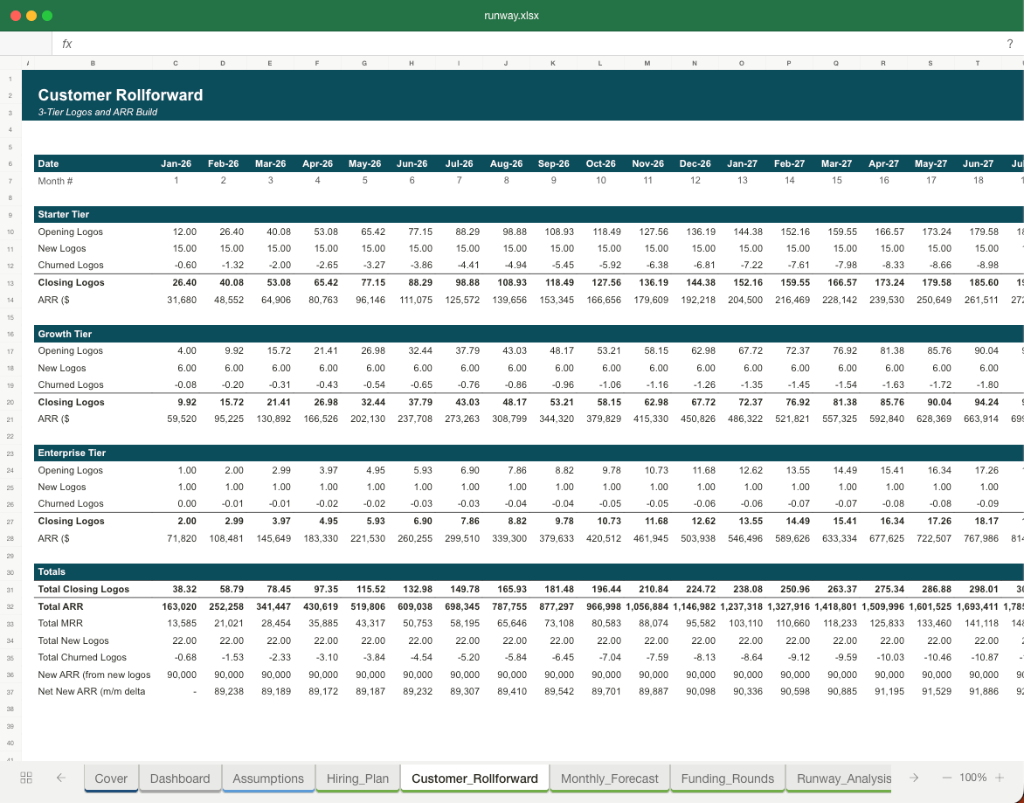
A 5-year monthly forecast with P&L, cash flow and runway, valuation (exit multiple plus a DCF cross-check), MOIC/IRR returns, and unit economics, with live formulas throughout.
How was this model built?+
It was built from Aphea.Bio's pitch deck and publicly available information, then structured to investment-banking standards as a fully editable Excel model.
Can I change the assumptions?+
Yes. You can change assumptions and the live formulas will recalculate in the downloadable Excel model.
Have more financial modelling questions? Contact us

Created by ex-finance professionals
Hey, I’m Alex and I created Finamodel.
Over my years in the finance industry I kept building the same models over and over again. Same structure, same assumptions, different logo. So I started building frameworks to turn them into clean, reusable templates.
Every model here is one I’d actually use for a client, and I personally vet each one before it goes up.
I’m not an expert in every industry, but I’ve built enough models to know what belongs in one. And when something is completely foreign to me, I reach out to my network for experts to work on our models with us.
Having a template library on hand cuts a first build from hours to minutes.
Need help finding your model? You’ll find me in the Finamodel app!
Other Biotech/Pharma Startup Financial Models
Browse another startup in the same category.

Ada Health
AI-powered symptom assessment app and clinical decision-support platform for consumers and healthcare partners.
Affini-T
Engineered T cell therapies targeting oncogenic driver mutations (KRAS, p53) in hard-to-treat solid tumors

Alto Pharmacy
Alto Pharmacy is a tech-enabled, same-day prescription delivery pharmacy disrupting the $450B US pharmacy market via a direct-to-patient courier model and provider-facing software platform.

Aurion Biotech
Cell therapy company developing an injectable corneal endothelial cell treatment to restore vision in patients with corneal endothelial disease.

Beckley Psytech
Clinical-stage psychedelic drug development platform advancing a pipeline of psychedelic compounds (psilocybin, 5-MeO-DMT, NCEs) as licensed pharmaceutical medicines for neuropsychiatric disorders.

BrightInsight
Regulated digital health platform-as-a-service for biopharma and medtech companies to build, launch, and maintain compliant connected-drug and medical-device software products.
Carrum Health
Value-based care marketplace connecting self-insured employers to top-tier surgical and oncology Centers of Excellence (COEs) via all-inclusive bundled payments.

Castor
SaaS platform enabling self-service decentralized clinical trials (DCT) for pharma, biotech, and research institutions.