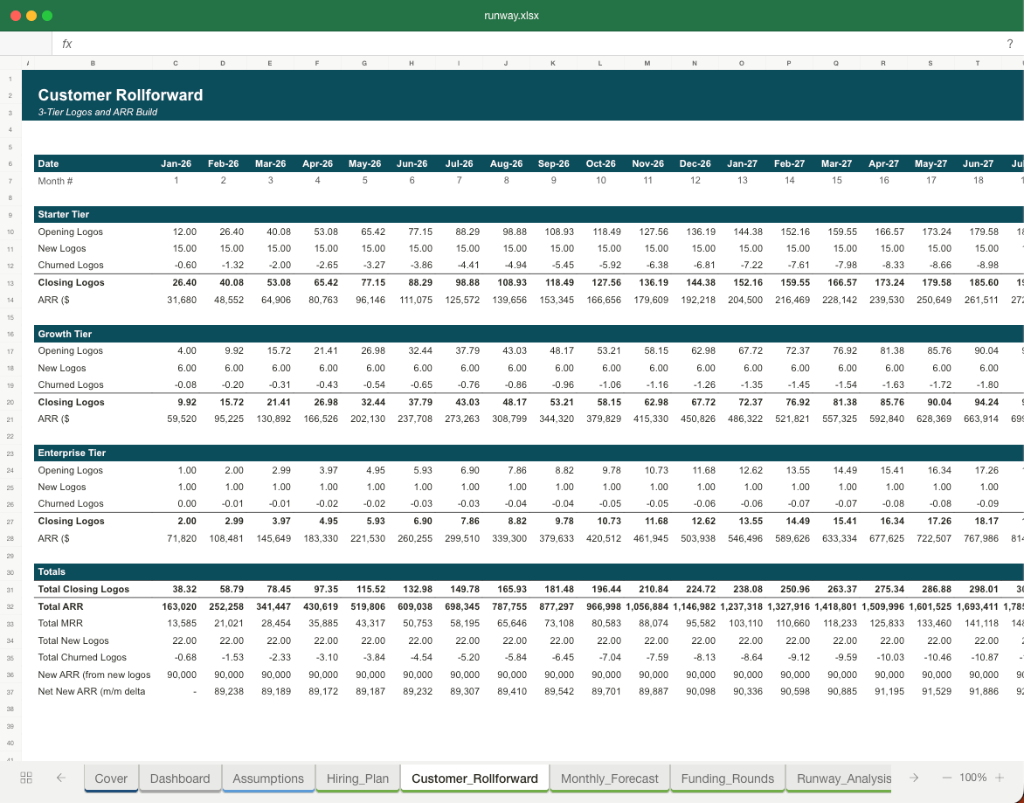
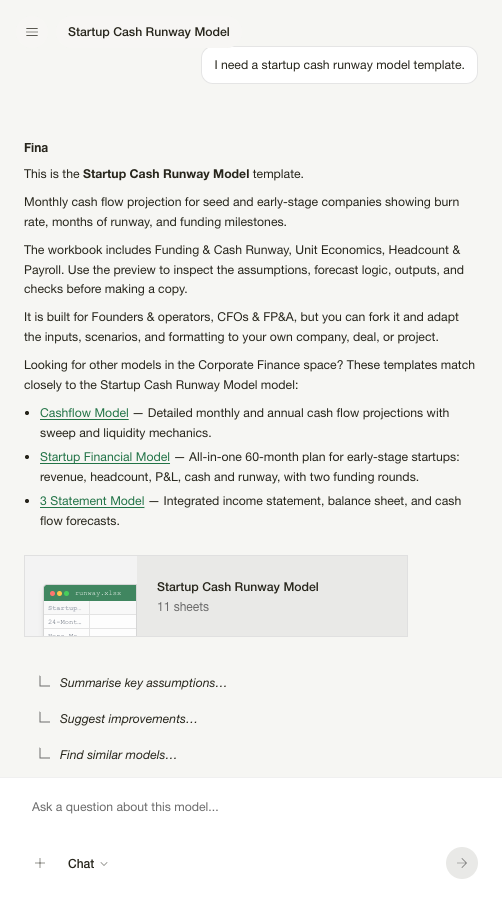
 Beckley Psytech Financial Model
Biotech/Pharma Startup Financials (Free Excel Download)
Clinical-stage psychedelic drug development platform advancing a pipeline of psychedelic compounds (psilocybin, 5-MeO-DMT, NCEs) as licensed pharmaceutical medicines for neuropsychiatric disorders.


professionals from Deloitte
Used by professionals from






About this model
Beckley Psytech develops psychedelic medicines through three generations: reformulations or new applications of established agents, short-acting 5-MeO-DMT, and novel chemical entities. Beckley Deep Labs supports clinical development, applications, signal-finding, and partnerships with AI and machine learning.
The company draws on more than 20 years of Beckley Foundation research, including over 50 publications and pioneering brain-imaging and treatment-resistant-depression studies. Its investment case emphasises shorter 5-MeO-DMT sessions, early-mover IP, data exclusivity, and future composition-of-matter protection rather than a current commercial product.
Revenue is expected from partnering or licensing after Phase 2/3 data, future royalties, or acquisition; a share of commercial proceeds is committed to the Beckley Foundation. The company reports no sponsored-trial patients or revenue. The model should forecast trial spend, clinical probabilities, deal milestones, royalties, and runway.
A turnkey financial model
Live formulas, no hardcoded values
Outputs are driven by live formulas, so the workbook updates from its assumptions instead of relying on hardcoded results.
All assumptions in one tab
Inputs are clearly marked in the Assumptions tab and separated from calculations, making it clear what to change and what to leave intact.
Statements always balancing
For integrated-statement models, the balance sheet, cash flow, and supporting schedules tie through properly.
Distinct schedules for clarity
Debt, working capital, taxes, and cash flow can get messy quickly. We group calculations in clear schedules, not across disconnected tabs.
No hidden macros or external links
There are no unexplained external workbook links or macros to undermine auditability or portability.
Changes flow through the model
Update a key driver and see the impact carry through the forecast, financing, and return outputs. We never use hardcoded numbers in formulas.
About Beckley Psytech
beckleypsytech.com
How to build a detailed financial model for Beckley Psytech
A complete walkthrough of the business, drivers, and assumptions behind the downloadable Beckley Psytech model - distilled from its pitch deck and publicly available information.
Product & value proposition
Three-generation drug development platform:
- 1st Generation: Innovative formulations / novel applications of well-characterised psychedelic agents (compound undisclosed - "Confidential"). PoC trial in patients targeted with current raise.
- 2nd Generation: 5-MeO-DMT - short-acting psychedelic, first-in-man Phase 1 trial targeted. Positioned on: short session length (resource efficiency vs. psilocybin), early-mover IP, data exclusivity, unique receptor binding profile.
- 3rd Generation: New Chemical Entities (NCEs) - composition-of-matter IP, potential safety/clinical advantages. Pre-clinical / discovery stage.
- Beckley Deep Labs: Advanced research division; AI/ML for clinical development, novel applications, NCE signal-finding, pioneering partnerships.
Value proposition: leverage 20+ years of Beckley Foundation psychedelic research IP and clinical relationships (50+ publications, 1st brain imaging LSD/psilocybin, 1st psilocybin TRD study) to de-risk and accelerate development.
Comparator precedents cited:
- Epidiolex (GW Pharma, cannabidiol): FDA-approved, $2bn peak sales forecast.
- Spravato (J&J, esketamine): FDA-approved, $1.35bn peak sales forecast.
Market
- 1 in 4 people globally suffer from neurological and psychiatric disorders.
- $6 trillion anticipated cost of treating global mental illness by 2030.
- 33% of patients resistant to available treatments (treatment-resistant depression etc.) - defines addressable clinical niche.
- No explicit TAM/SAM/SOM breakdown provided.
- Psychedelic sector characterised as emerging with strong macro tailwinds: Bloomberg, FT, Forbes, Sifted, Wired coverage cited (Feb 2018 – Jun 2020).
Revenue model
- Licensing / partnering deals post-Phase 2/3 data.
- Potential acquisition (precedent: Beckley Canopy Therapeutics sold to Canopy Growth in 2019 at 3.3x return in 13 months).
- Future royalties on commercialised medicines.
- Donation of a share of future revenues to the non-profit Beckley Foundation is committed - reduces net revenue available to investors.
Traction & metrics
- Clinical efficacy data from prior academic studies (not Beckley Psytech sponsored, but from the Beckley Foundation and academic partners):
- Psilocybin + tobacco addiction (2014): 80% smoke-free.
- Ayahuasca + depression (2015): 82% reduction in depression scales.
- Psilocybin + treatment-resistant depression (2016, Beckley Foundation): 63% remission rates.
- Psilocybin + existential distress (2016): 80% response rate.
- Track record: Beckley Canopy Therapeutics - founded 2018, sold 2019 to Canopy Growth, >3.3x return for investors in 13 months.
- No revenue, no patients enrolled in Beckley Psytech-sponsored trials disclosed.
Competition / moat
Competitive positioning:
- 1st Generation program: differentiated application, market segment, treatment model; data and market exclusivity protections (details confidential).
- 2nd Generation (5-MeO-DMT): early mover, strong IP opportunities, shorter session length = significant cost/resource advantage over psilocybin (which requires 6–8 hr supervised sessions); data exclusivity potential.
- 3rd Generation NCEs: composition-of-matter patents = strongest IP protection tier.
- Moat sources: Beckley Foundation's 20+ year research head-start, 50+ publications, KOL relationships (Oxford, Imperial, Johns Hopkins), proprietary data/IP pipeline from Foundation, and formulation IP design.
- Main competitive risks: COMPASS Pathways (psilocybin, NASDAQ-listed), MindMed, Numinus, ATAI Life Sciences - all emerging competitors in psychedelic pharma space (not discussed in deck but sector context from Slide 11 media references).
Team & funding ask / use of funds
Team:
- Cosmo Feilding Mellen - Director / CEO (ex-Beckley Canopy, Canopy Growth)
- Lady Amanda Feilding - Director / Chair SAB (Beckley Foundation founder)
- Marc Wayne - Chairman (ex-Beckley Canopy, Canopy Growth)
- Dr. Steve Wooding MBBS MBA FFPM - Director / CSO (ex-Beckley Canopy, J&J)
- Michael Norris FCMA - Director / CFO (ex-Beckley Canopy, Sensyne Health)
- Tim Mason MSc - CDO (ex-Beckley Canopy, Allergan)
- Dr. Fiona Dunbar - Chief Medical Advisor (ex-J&J)
- Kalpana Sawant - Director Clinical Operations (ex-Biogen)
- Becky Hutchinson MBA - Commercial Director (ex-J&J)
- Ilgi Kim - Corporate Board Advisor (ex-Capita, Accenture)
Scientific Advisory Board: Prof Guy Goodwin (Oxford), Fred Reinhold (King's College London), Prof Matthew Johnson (Johns Hopkins), Dr Robin Carhart-Harris (Imperial College), Prof Joanna Neil (Manchester), Dr Mike Emanuel (Sinto Pharma).
Funding ask: $18m, Autumn 2020.
Use of funds:
- 1st Generation: Conduct Proof-of-Concept trial in patients.
- 2nd Generation: Complete First-in-Man Phase 1 trial in 5-MeO-DMT.
- 3rd Generation: Advance internal NCE development + in-licensing opportunities.
- Launch advanced research programs through Beckley Deep Labs.
No prior round size or pre-money valuation disclosed.
Recommended financial model
- Archetype + why: Pre-revenue biotech / clinical-stage milestone model with a probability-weighted NPV (rNPV) framework. This is standard for clinical-stage pharma/biotech with no revenue - value is entirely driven by probability-adjusted expected value of each pipeline asset clearing successive clinical gates, culminating in licensing/acquisition or royalty streams. The team's prior exit (Beckley Canopy → Canopy Growth, 3.3x in 13 months) further supports an M&A exit scenario as a primary value crystallisation event.
- Forecast horizon & granularity:
- Clinical spend (cash burn): Monthly for first 24–36 months (runway model against $18m raise).
- rNPV / milestone valuation: Annual, 10–15 year horizon to capture Phase 1 → Phase 2 → Phase 3 → approval → licensing/royalty or exit.
- Key drivers & assumptions:
- Raise amount: $18m.
- Programs in scope: 1st Gen (confidential), 2nd Gen (5-MeO-DMT), 3rd Gen NCEs, Deep Labs.
- Clinical trial costs:
- PoC Phase 1/2 (1st Gen): ~$3–6m; small N psychedelic trials typically $2–8m.
- Phase 1 FIM (5-MeO-DMT): ~$3–5m; healthy volunteer Phase 1.
- NCE preclinical/discovery: ~$2–4m.
- Deep Labs / overhead: ~$3–5m over runway period.
- Timeline:
- PoC readout (1st Gen): 18–24 months post-funding.
- FIM Phase 1 readout (5-MeO-DMT): 18–30 months post-funding.
- NCE IND filing: 36–48 months.
- Probability of success per stage (industry standard):
- Phase 1 success: ~70–80%.
- Phase 2 success: ~40–50% (psychedelics may be higher given efficacy signals).
- Phase 3 success: ~50–60%.
- Regulatory approval: ~85% post Phase 3.
- Peak sales / licensing value:
- Comparator anchors: Epidiolex $2bn, Spravato $1.35bn.
- Lead program peak sales: $500m–$1.5bn depending on indication and label breadth.
- Royalty rate on out-licensing: 8–15% of net sales.
- Deal structure at licensing: upfront + milestones + royalties, or full acquisition.
- Discount rate: 15–20% (biotech risk premium; pre-revenue clinical stage).
- Revenue share to Beckley Foundation: ~5% of net revenues (commitment made in deck but quantum not stated).
- Headcount / burn rate: ~8–12 FTE currently; ~$3–5m/year G&A/ops.
- Runway: $18m raise yields ~3–4 years depending on trial costs.
- Scenarios (Base / Bull / Bear):
- Bear: 1st Gen PoC fails, 5-MeO-DMT Phase 1 delayed, NCE pipeline deprioritised. Company raises a bridge or winds down. rNPV near zero. Exit via acqui-hire or IP sale only.
- Base: 1st Gen PoC succeeds and 5-MeO-DMT Phase 1 positive; raises Series B at higher valuation; M&A interest. rNPV $100–300m.
- Bull: Both lead programs succeed, compelling data triggers competitive licensing/M&A deal at Spravato-level peak sales precedent ($1.35bn+). rNPV $400–800m; early exit akin to Beckley Canopy precedent but at much larger scale.
- Flex variables: PoC success probability, time to data readout, deal terms, competitive landscape, regulatory timeline.
- Required sheets / outputs:
- Assumptions dashboard - all key inputs in one place, flagged vs.
- Cash burn / runway model - monthly, by program (1st Gen, 2nd Gen, 3rd Gen, Deep Labs, G&A). Shows when $18m is exhausted and next financing trigger.
- Pipeline rNPV model - per asset: peak sales estimate × probability-adjusted royalty/proceeds × discount factor = rNPV. Sum across portfolio = company rNPV.
- Milestone timeline - Gantt-style: clinical stages, key binary events (PoC readout, Phase 1 top-line, IND, etc.) tied to cash spend.
- Sensitivity table - rNPV vs. peak sales assumption and discount rate (2D table); rNPV vs. clinical success probability.
- Exit / M&A scenario - implied acquisition price at various revenue multiples vs. comparable deals (Epidiolex/Spravato benchmarks, Beckley Canopy 3.3x precedent).
- Returns waterfall - investor return at various exit valuations vs. $18m entry (no cap table or liquidation prefs disclosed, so simplified).
Frequently asked
Is the Beckley Psytech financial model free?+
Yes. The Beckley Psytech model is a free Excel (.xlsx) download with live formulas. Sign up with your email and the workbook is yours to keep, review, and edit.
What's included in the model?+
A 5-year monthly forecast with P&L, cash flow and runway, valuation (exit multiple plus a DCF cross-check), MOIC/IRR returns, and unit economics, with live formulas throughout.
How was this model built?+
It was built from Beckley Psytech's pitch deck and publicly available information, then structured to investment-banking standards as a fully editable Excel model.
Can I change the assumptions?+
Yes. You can change assumptions and the live formulas will recalculate in the downloadable Excel model.
Have more financial modelling questions? Contact us

Created by ex-finance professionals
Hey, I’m Alex and I created Finamodel.
Over my years in the finance industry I kept building the same models over and over again. Same structure, same assumptions, different logo. So I started building frameworks to turn them into clean, reusable templates.
Every model here is one I’d actually use for a client, and I personally vet each one before it goes up.
I’m not an expert in every industry, but I’ve built enough models to know what belongs in one. And when something is completely foreign to me, I reach out to my network for experts to work on our models with us.
Having a template library on hand cuts a first build from hours to minutes.
Need help finding your model? You’ll find me in the Finamodel app!
Other Biotech/Pharma Startup Financial Models
Browse another startup in the same category.

Ada Health
AI-powered symptom assessment app and clinical decision-support platform for consumers and healthcare partners.
Affini-T
Engineered T cell therapies targeting oncogenic driver mutations (KRAS, p53) in hard-to-treat solid tumors

Alto Pharmacy
Alto Pharmacy is a tech-enabled, same-day prescription delivery pharmacy disrupting the $450B US pharmacy market via a direct-to-patient courier model and provider-facing software platform.

Aphea.Bio
Aphea.Bio is a Belgian ag-biotech company developing and commercialising microbial biologicals (biostimulants, biofungicides, bioherbicides, bioinsecticides) for row crops, targeting yield improvement and reduced synthetic input use.

Aurion Biotech
Cell therapy company developing an injectable corneal endothelial cell treatment to restore vision in patients with corneal endothelial disease.

BrightInsight
Regulated digital health platform-as-a-service for biopharma and medtech companies to build, launch, and maintain compliant connected-drug and medical-device software products.
Carrum Health
Value-based care marketplace connecting self-insured employers to top-tier surgical and oncology Centers of Excellence (COEs) via all-inclusive bundled payments.

Castor
SaaS platform enabling self-service decentralized clinical trials (DCT) for pharma, biotech, and research institutions.