BOBolt Financial Model
Fintech Startup Financials (Free Excel Download)
One-click checkout network that lets shoppers transact across any Bolt merchant with a single identity.



professionals from Deloitte
Used by professionals from






About this model
Bolt operates a one-click checkout network that lets shoppers use a single identity across participating merchants. The product is designed to improve conversion and repeat purchasing by removing repeated account creation and checkout friction.
Its commercial model depends on both sides of the network: merchants adopt checkout infrastructure, while returning shopper identities make that infrastructure increasingly valuable. The research does not disclose a confirmed price card or take rate.
The model should connect active merchants, shopper accounts, purchase frequency, and average order value to GMV. Apply a merchant transaction take rate and, if used, platform fees; then test conversion uplift, merchant retention, and network-driven acquisition costs as core value drivers.
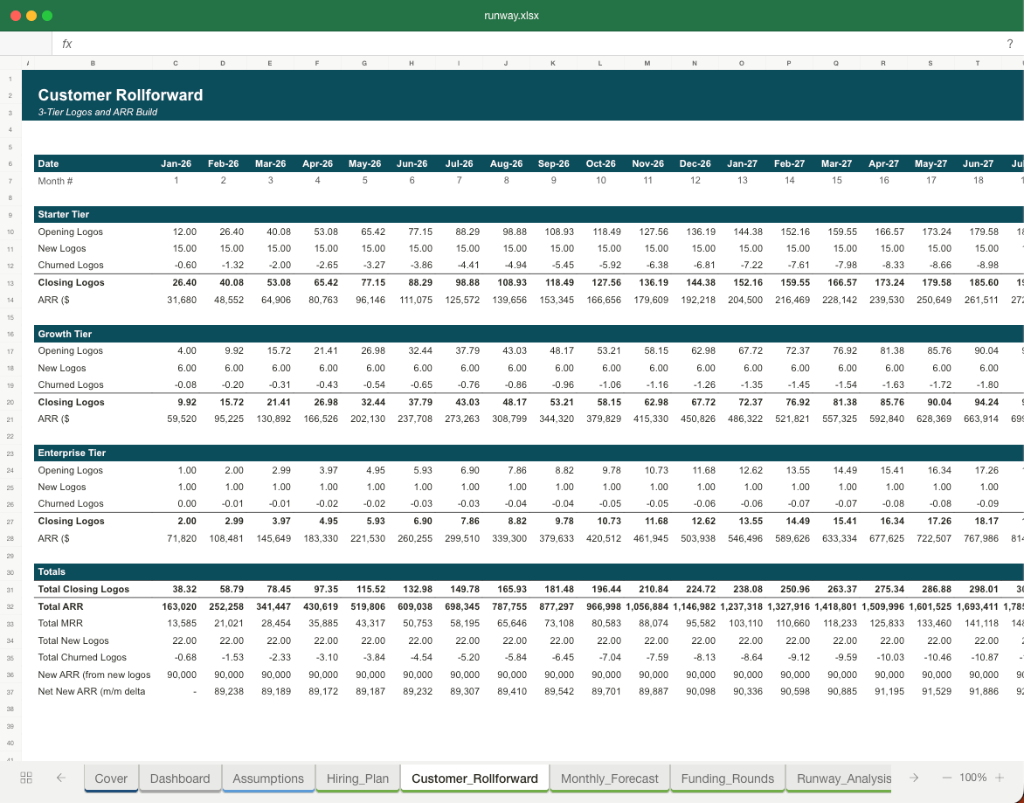
A turnkey financial model
Live formulas, no hardcoded values
Outputs are driven by live formulas, so the workbook updates from its assumptions instead of relying on hardcoded results.
All assumptions in one tab
Inputs are clearly marked in the Assumptions tab and separated from calculations, making it clear what to change and what to leave intact.
Statements always balancing
For integrated-statement models, the balance sheet, cash flow, and supporting schedules tie through properly.
Distinct schedules for clarity
Debt, working capital, taxes, and cash flow can get messy quickly. We group calculations in clear schedules, not across disconnected tabs.
No hidden macros or external links
There are no unexplained external workbook links or macros to undermine auditability or portability.
Changes flow through the model
Update a key driver and see the impact carry through the forecast, financing, and return outputs. We never use hardcoded numbers in formulas.
About Bolt
How to build a detailed financial model for Bolt
A complete walkthrough of the business, drivers, and assumptions behind the downloadable Bolt model - distilled from its pitch deck and publicly available information.
Product & value proposition
- Bolt sits between merchants and shoppers as a hosted checkout layer.
- For shoppers: one account / one-click purchase across all Bolt merchants (no per-site credential creation).
- For merchants: higher conversion (75% Bolt shopper vs. 49% guest - a ~53% lift) and incremental GMV from the shared shopper pool.
- For Bolt: every new merchant adds shoppers to the network; every new shopper increases merchant value - a classic two-sided network flywheel.
- Three-phase roadmap: (1) build the checkout layer, (2) build the network, (3) ubiquitous "Bolt everywhere."
- End-market coverage: micro-merchants, mid-market, enterprise, platforms, portfolio groups, publishers, digital goods & subscriptions - claimed as uniquely broad vs. redacted competitors.
Revenue model
Not explicitly stated in deck. Implied model based on product description:
- Transaction-fee on GMV processed through Bolt checkout (standard for checkout/payments infrastructure; typical range 0.5%–2.5% of GMV). Rationale: Bolt processes payments; merchant pays per transaction.
- Possible monthly SaaS platform fee layered on top for enterprise merchants. Rationale: common in checkout-as-a-service (e.g., Checkout.com, Stripe).
- No pricing page, take-rate, or revenue line shown in deck.
Traction & metrics
- Network size: 5.6M one-click shoppers in Bolt's network
- Network growth: 180%+ YoY
- GMV on platform: "$XB GMV Live with Bolt" - exact figure redacted in image
- Network-driven transactions as % of GMV: grew from ~0.8% (Jan 2020) to ~4.7–5.0% (Apr–May 2021)
- Breakout verticals - network-driven GMV share, Jan 2020 → May 2021: Automotive 12%→31%, Clothing 3%→11%, Furniture 12%→49%
- Bolt shopper conversion rate: 75%
- Guest shopper conversion rate: 49%
- ~24 named merchant logos displayed; brands include Forever 21, Lucky Brand, Milk Makeup, Swiss Gear, Burt's Bees Baby
Unit economics
- AOV lift: Bolt shoppers have 23% higher AOV vs. guest checkout
- Repurchase lift: Bolt shoppers 39% more likely to repurchase vs. guest checkout
- Checkout speed: 38% faster completion vs. guest checkout
- Conversion lift: 50% higher conversion rate vs. guest checkout (note: slide 5 states 75% vs. 49%, a ~53% relative lift; the "50%" figure on slide 7 appears to be rounded/approximated)
Competition / moat
- Comparison table (slide 6) shows Bolt vs. two redacted competitors across end-market segments. Bolt claimed as the only player serving all segments (micro-merchant through publisher/digital goods).
- Moat thesis: network effects - each merchant adds shoppers; each shopper reduces friction on all future merchants. At claimed critical mass of 50M accounts, Bolt would power ~1/3 of a merchant's transactions before signing.
- Named competitors redacted; category implies PayPal One Touch, Shop Pay (Shopify), Amazon Pay, and fast-checkout challengers.
- "Conscious Culture" brand/employer-value-proposition highlighted as a retention/recruiting moat.
Team & funding ask / use of funds
- Founder/CEO: Ryan Breslow
- No other team slides shown.
Recommended financial model
- Archetype + why: GMV-based payments / checkout SaaS model. Bolt's economics are driven by gross merchandise volume flowing through the network, a take-rate on that GMV, and optionally a per-merchant SaaS fee. The network flywheel means shopper and merchant counts are co-dependent inputs. This is structurally similar to a two-sided marketplace model (Adyen/Stripe hybrid with network-effect overlay).
- Forecast horizon & granularity: 5 years (2021–2026), monthly for Year 1–2 (network ramp is nonlinear and monthly granularity captures the S-curve inflection), quarterly thereafter.
- Key drivers & assumptions:
| Driver | Seed value |
|---|---|
| Bolt network shoppers (base) | 5.6M |
| Shopper YoY growth rate | 180% (current) → normalizes to ~60% by Y3 |
| Target shoppers at critical mass | 50M accounts |
| GMV per active shopper per year | ~$800–$1,200 |
| Take-rate on GMV | 1.0%–1.5% of GMV |
| Merchant platform fee (monthly) | $0–$500/mo blended by tier |
| Bolt shopper conversion rate | 75% |
| Guest (baseline) conversion rate | 49% |
| AOV lift from Bolt shoppers | +23% vs. guest |
| Repurchase lift | +39% vs. guest |
| Network-driven GMV as % total | ~5% as of Apr 2021, trending up |
| Gross margin | 50%–65% (SaaS/payments infra typical) |
| S&M as % revenue | 40%–60% in growth phase |
| R&D as % revenue | 20%–30% |
| G&A as % revenue | 10%–15% |
- Scenarios (Base / Bull / Bear):
- Flex variables: shopper growth rate, take-rate, merchant count, and network-driven GMV % penetration.
- Bull: shopper growth stays >100% through Y3; take-rate 1.5%; network GMV% reaches 15% by 2024.
- Base: shopper growth decelerates to ~50% by Y3; take-rate 1.0%; network GMV% reaches 8% by 2024.
- Bear: growth competition from Shop Pay/PayPal compresses take-rate to 0.7%; shopper growth stalls at 30% by Y3.
- Required sheets / outputs:
- `Assumptions` - all input toggles; scenario selector.
- `Shopper & Merchant Model` - two-sided network build (shoppers, merchants, cross-network transaction penetration).
- `GMV Build` - GMV by cohort (merchant vintage), network-driven vs. direct.
- `Revenue` - take-rate revenue + SaaS fee revenue by merchant tier.
- `P&L` - gross profit, EBITDA, operating expenses (S&M, R&D, G&A), net income.
- `Cash Flow & Runway` - burn, fundraise timing (if modeling to next round).
- `KPI Dashboard` - Shopper count, Merchant count, GMV, take-rate, conversion lift, network GMV%.
- `Sensitivity` - take-rate × shopper growth; GMV × margin.
Frequently asked
Is the Bolt financial model free?+
Yes. The Bolt model is a free Excel (.xlsx) download with live formulas. Sign up with your email and the workbook is yours to keep, review, and edit.
What's included in the model?+
A 5-year monthly forecast with P&L, cash flow and runway, valuation (exit multiple plus a DCF cross-check), MOIC/IRR returns, and unit economics, with live formulas throughout.
How was this model built?+
It was built from Bolt's pitch deck and publicly available information, then structured to investment-banking standards as a fully editable Excel model.
Can I change the assumptions?+
Yes. You can change assumptions and the live formulas will recalculate in the downloadable Excel model.
Have more financial modelling questions? Contact us

Created by ex-finance professionals
Hey, I’m Alex and I created Finamodel.
Over my years in the finance industry I kept building the same models over and over again. Same structure, same assumptions, different logo. So I started building frameworks to turn them into clean, reusable templates.
Every model here is one I’d actually use for a client, and I personally vet each one before it goes up.
I’m not an expert in every industry, but I’ve built enough models to know what belongs in one. And when something is completely foreign to me, I reach out to my network for experts to work on our models with us.
Having a template library on hand cuts a first build from hours to minutes.
Need help finding your model? You’ll find me in the Finamodel app!
Other Fintech Startup Financial Models
Browse another startup in the same category.
Acin
SaaS and data subscription network for operational risk management at Tier 1 financial institutions

Ageras Group
B2B SME ecosystem - marketplace connecting SMEs with accountants + cloud accounting/payroll software + embedded financial services (lending, factoring, banking)

Airbase
Unified non-payroll spend management platform (corporate cards, AP/bill pay, expense reimbursement, approval workflows) for mid-market companies.

Altruist
Vertically integrated all-in-one platform for registered investment advisors (RIAs) - combining custodial, portfolio management, practice management, and client acquisition tools.
Amenitiz
All-in-one hotel management SaaS platform ("Shopify for hotels") for independent hoteliers - PMS, booking engine, channel manager, website builder, payments, and AI-driven revenue management.

Anrok
SaaS sales tax compliance platform - nexus monitoring, calculation, registration, filing, and remittance - built specifically for SaaS companies.
Arrival
Arrival is an EV manufacturer of commercial vans and buses using proprietary Microfactories and vertically integrated components, going public via SPAC merger with CIIG Merger Corp.

AtoB
AtoB is building financial infrastructure for commercial fleets, starting with a no-fee Visa fleet card for fuel and expanding into payroll, BNPL, and international.