 Casai Financial Model
Fintech Startup Financials (Free Excel Download)
Tech-enabled boutique apartment rental operator targeting Latin America, blending hotel consistency with Airbnb-style local authenticity.



professionals from Deloitte
Used by professionals from






About this model
Casai is a tech-enabled apartment-rental operator in Latin America, aiming to combine hotel-grade consistency with the character and flexibility of short-term rentals. It manages the guest experience, property operations, and brand rather than acting only as a booking marketplace.
The company serves short corporate stays, leisure demand, and longer urban stays through its own app and likely third-party booking channels. Its boutique positioning also creates smaller ancillary opportunities, such as commissions on displayed local art.
The model should build revenue from apartments under management, available nights, occupancy, and average daily rate by stay type. Property leases, housekeeping, utilities, furnishing, and channel costs must sit below revenue, with unit ramp and contribution margin driving the capital-intensive scaling case.
A turnkey financial model
Live formulas, no hardcoded values
Outputs are driven by live formulas, so the workbook updates from its assumptions instead of relying on hardcoded results.
All assumptions in one tab
Inputs are clearly marked in the Assumptions tab and separated from calculations, making it clear what to change and what to leave intact.
Statements always balancing
For integrated-statement models, the balance sheet, cash flow, and supporting schedules tie through properly.
Distinct schedules for clarity
Debt, working capital, taxes, and cash flow can get messy quickly. We group calculations in clear schedules, not across disconnected tabs.
No hidden macros or external links
There are no unexplained external workbook links or macros to undermine auditability or portability.
Changes flow through the model
Update a key driver and see the impact carry through the forecast, financing, and return outputs. We never use hardcoded numbers in formulas.
About Casai
casai.com
How to build a detailed financial model for Casai
A complete walkthrough of the business, drivers, and assumptions behind the downloadable Casai model - distilled from its pitch deck and publicly available information.
Product & value proposition
- Curated furnished apartments in trendy LatAm neighborhoods combining boutique hotel design (in-house design team, local art, housekeeping, 24/7 concierge), smart-home tech (keyless entry, smart speakers, Chromecast, lights via app), and vacation-rental local feel.
- Three segment types: corporate (studios–1BR in business hubs), urban retreat (1–2BR, eclectic neighborhoods), extended stay (2–3BR, business hubs).
- Proprietary "My Casai" app: booking management, QR check-in, smart-home controls, 24/7 live concierge chat, curated city guide.
- "Casai Gallery" - local art displayed and sold in apartments via QR codes.
- COVID positioning: work-from-anywhere, contactless check-in, flexible long-term rentals.
Market
- Global short-term apartment rental supply: ~7 million units on Airbnb vs. Marriott 1.4M, Hilton 978K, IHG 842K, Wyndham 831K, Accor 740K, Choice 570K, Hyatt 223K, Radisson 180K.
- Framing: STR supply is larger than all major hotel chains combined and continues to grow.
- No TAM/SAM/SOM dollar figures presented in deck.
- No LatAm-specific market size figures presented.
Revenue model
- Primary revenue: nightly/weekly/monthly apartment rental fees charged to guests.
- Three stay-duration segments imply tiered pricing: short corporate stays, leisure urban stays, extended stays (implies monthly pricing/discounts).
- Booking channel: proprietary Casai app + likely OTAs (not explicitly stated).
- Secondary/ancillary: art sales commission via Casai Gallery (art priced at $1,000–$3,700 MXN per piece shown).
- No ADR (average daily rate), occupancy rate, or revenue per unit figures in deck.
Traction & metrics
- Total investment raised: USD $53M
- Team size: >130 employees ("Casaiers")
- Jobs created in Mexico: >100
- 90% of design assets made in Mexico
- No revenue, GMV, unit count, occupancy, or guest volume figures disclosed in deck.
Competition / moat
- Competitive set: Hotel chains (Marriott, Hilton, IHG, Wyndham, Accor, Choice, Hyatt, Radisson), boutique hotels, Airbnb, unmanaged apartment rentals.
- Casai's differentiators vs. all alternatives: fully furnished apartments + trendy locations + workspace-ready + guaranteed high-speed wifi + smart-home tech + high cleaning standards + seamless booking + tech platform/app + 24/7 local concierge + stunning design + sense of community.
- Airbnb lacks: consistent cleaning standards, 24/7 concierge, smart-home tech, seamless booking.
- Hotel chains lack: trendy neighborhood locations, local ambiance, full-apartment living.
- Moat sources: proprietary app, in-house design team, local artisan network, brand identity in LatAm.
Team & funding ask / use of funds
- Founders: Nico Barawid (CEO, Yale/BCG/Oxford), Maricarmen Herrerías (COO, Intercontinental/Ibero).
- Leadership team (10 named): CTO (Amazon/Google/Stanford), CGO (Selina/Citi/Stanford), Director of Finance (Thor Urbana/LBS), VP Product (McKinsey/Microsoft), CRO (McKinsey/Stanford), VP Guest Experience (Starbucks/WeWork), Director of Strategy (Monashees/Santander), Director of Legal (Edinburgh/Thor Urbana).
- Investors: Andreessen Horowitz (a16z), Monashees+, Kaszek Ventures - total USD $53M raised.
Recommended financial model
- Archetype + why: Hospitality unit-economics P&L (similar to Selina/Sonder model). Revenue driven by units under management × occupancy × ADR; costs split between property-level (rent/lease, housekeeping, utilities, consumables) and corporate overhead (tech, design, G&A, S&M). Not a marketplace/OTA model - Casai operates the units directly and bears lease cost. A 3-statement model is appropriate given the capital intensity of scaling leased inventory.
- Forecast horizon & granularity: 3–5 years annual; Year 1 monthly for cash planning. Operating company is clearly beyond pre-revenue (>130 staff, $53M raised) so model starts from a non-zero revenue base.
- Key drivers & assumptions:
- Units under management (end of period): start at ~200–300 (Mexico City only, consistent with $53M raised and team size); grow ~50–100% YoY as LatAm expansion proceeds.
- Average daily rate (ADR): ~$80–120 USD/night for Mexico City market, blending corporate and leisure segments; to be validated against Airbnb/hotel comps.
- Occupancy rate: 65–75% stabilized per unit; ramp period of 2–3 months per new property.
- Revenue per available unit (RevPAU) = ADR × occupancy.
- Lease cost per unit per month: ~$800–1,200 USD/month for Mexico City; largest cost line.
- Gross margin per unit: ~40–55% after direct property costs (lease, housekeeping, utilities, amenities).
- Headcount/G&A: scales sub-linearly with units; tech/product costs relatively fixed.
- Stay-mix: corporate (short stays, higher ADR), leisure (medium), extended (lower nightly rate, higher occupancy, lower CAC).
- CAC: lower via repeat guests and corporate accounts; OTA commission ~15–18% if applicable.
- Art/ancillary revenue: immaterial (<1% of revenue); exclude from base case.
- Scenarios (Base / Bull / Bear - which variables flex):
- Base: Unit growth ~60% YoY, ADR $95, occupancy 70%.
- Bull: Faster LatAm city rollout (Bogotá, São Paulo, Buenos Aires), ADR $110+, occupancy 78%.
- Bear: Slow expansion (Mexico City only), ADR compression from Airbnb competition, occupancy 60%, extended ramp times.
- Required sheets / outputs:
- Assumptions dashboard (all drivers in one place).
- Unit build (units added per city per quarter, occupancy ramp curve).
- Revenue model (ADR × occupancy × units, by segment).
- Property P&L (per-unit economics: revenue, lease cost, opex, unit-level EBITDA).
- Corporate P&L (consolidated IS: revenue, COGS, gross profit, S&M, tech/product, G&A, EBITDA).
- Headcount plan.
- Cash flow / runway (critical given lease commitments).
- Balance sheet (lease liabilities if IFRS 16/ASC 842 scope relevant).
- Scenario toggle.
Frequently asked
Is the Casai financial model free?+
Yes. The Casai model is a free Excel (.xlsx) download with live formulas. Sign up with your email and the workbook is yours to keep, review, and edit.
What's included in the model?+
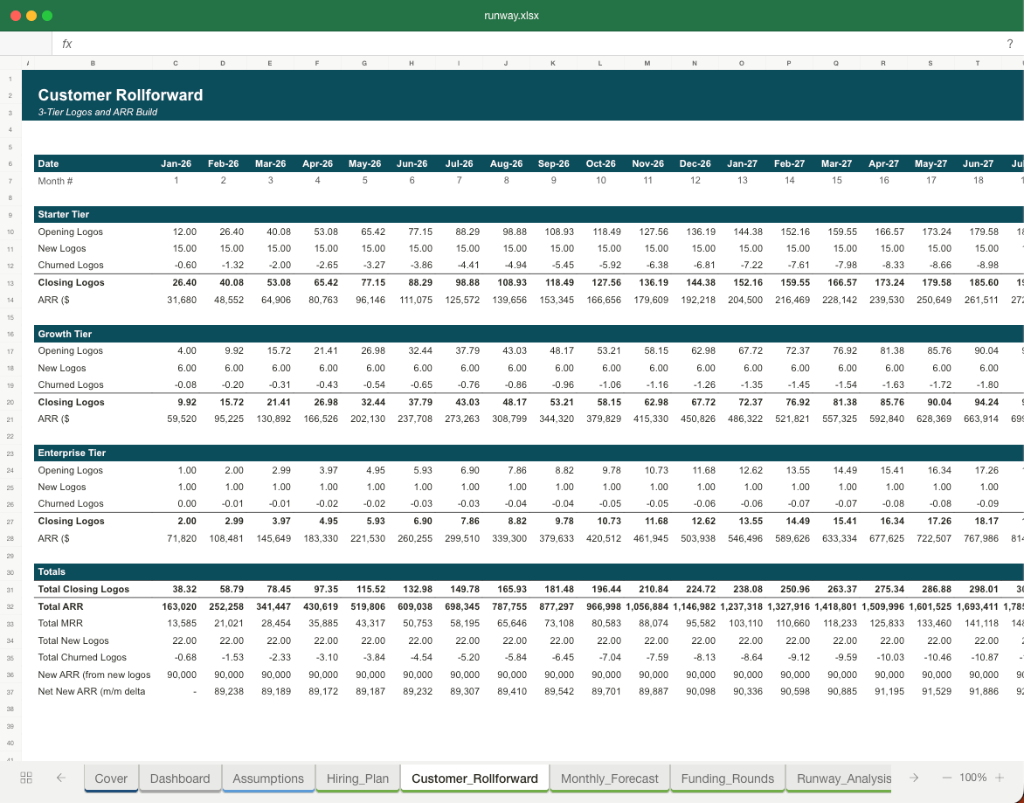
A 5-year monthly forecast with P&L, cash flow and runway, valuation (exit multiple plus a DCF cross-check), MOIC/IRR returns, and unit economics, with live formulas throughout.
How was this model built?+
It was built from Casai's pitch deck and publicly available information, then structured to investment-banking standards as a fully editable Excel model.
Can I change the assumptions?+
Yes. You can change assumptions and the live formulas will recalculate in the downloadable Excel model.
Have more financial modelling questions? Contact us

Created by ex-finance professionals
Hey, I’m Alex and I created Finamodel.
Over my years in the finance industry I kept building the same models over and over again. Same structure, same assumptions, different logo. So I started building frameworks to turn them into clean, reusable templates.
Every model here is one I’d actually use for a client, and I personally vet each one before it goes up.
I’m not an expert in every industry, but I’ve built enough models to know what belongs in one. And when something is completely foreign to me, I reach out to my network for experts to work on our models with us.
Having a template library on hand cuts a first build from hours to minutes.
Need help finding your model? You’ll find me in the Finamodel app!
Other Fintech Startup Financial Models
Browse another startup in the same category.
Acin
SaaS and data subscription network for operational risk management at Tier 1 financial institutions

Ageras Group
B2B SME ecosystem - marketplace connecting SMEs with accountants + cloud accounting/payroll software + embedded financial services (lending, factoring, banking)

Airbase
Unified non-payroll spend management platform (corporate cards, AP/bill pay, expense reimbursement, approval workflows) for mid-market companies.

Altruist
Vertically integrated all-in-one platform for registered investment advisors (RIAs) - combining custodial, portfolio management, practice management, and client acquisition tools.
Amenitiz
All-in-one hotel management SaaS platform ("Shopify for hotels") for independent hoteliers - PMS, booking engine, channel manager, website builder, payments, and AI-driven revenue management.

Anrok
SaaS sales tax compliance platform - nexus monitoring, calculation, registration, filing, and remittance - built specifically for SaaS companies.
Arrival
Arrival is an EV manufacturer of commercial vans and buses using proprietary Microfactories and vertically integrated components, going public via SPAC merger with CIIG Merger Corp.

AtoB
AtoB is building financial infrastructure for commercial fleets, starting with a no-fee Visa fleet card for fuel and expanding into payroll, BNPL, and international.