CLClair Financial Model
Fintech Startup Financials (Free Excel Download)
Embedded earned-wage access (EWA) paycard for hourly workers, distributed through Time & Attendance (T&A) software partners.



professionals from Deloitte
Used by professionals from






About this model
Clair offers embedded earned-wage access through a paycard for hourly workers, distributed via time-and-attendance software partners. It gives employees earlier access to earned pay without requiring their employer to become a financial-services provider.
The business is partner-led: time-and-attendance platforms bring employers, who in turn expose the product to workers. Mastercard card usage and revenue sharing with partners underpin the commercial logic, alongside the operational demands of bank and BaaS relationships.
The model should start with partners, employers per partner, eligible employees, enrolment, and active cardholders. Card spend and net interchange drive revenue; any wage-advance economics need their own funding, repayment, loss, and float assumptions rather than being treated as SaaS ARR.
A turnkey financial model
Live formulas, no hardcoded values
Outputs are driven by live formulas, so the workbook updates from its assumptions instead of relying on hardcoded results.
All assumptions in one tab
Inputs are clearly marked in the Assumptions tab and separated from calculations, making it clear what to change and what to leave intact.
Statements always balancing
For integrated-statement models, the balance sheet, cash flow, and supporting schedules tie through properly.
Distinct schedules for clarity
Debt, working capital, taxes, and cash flow can get messy quickly. We group calculations in clear schedules, not across disconnected tabs.
No hidden macros or external links
There are no unexplained external workbook links or macros to undermine auditability or portability.
Changes flow through the model
Update a key driver and see the impact carry through the forecast, financing, and return outputs. We never use hardcoded numbers in formulas.
About Clair
clair.com
How to build a detailed financial model for Clair
A complete walkthrough of the business, drivers, and assumptions behind the downloadable Clair model - distilled from its pitch deck and publicly available information.
Product & value proposition
- Free instant wage advances: employees draw earned wages the moment they clock out, via T&A system data.
- FDIC-insured checking & savings accounts with no high/hidden fees; banking services provided by Synapse's partners.
- Mastercard debit paycard; free ATM withdrawals at 55,000 ATMs.
- Smart saving tools, mobile-first iOS + Android.
- Distribution model: T&A partners embed Clair sign-up in their UX; employer gives checkbox consent; Clair is free to employees.
Market
- 80% of US workers live paycheck to paycheck.
- 39% of Americans under 25 are underbanked.
- $150 average annual banking fees for banked workers.
- 400% average annual interest on payday loans.
- 40% of Americans cannot cover a $400 emergency expense.
- T&A market described as "fragmented - almost half the market belongs to players with <1% market share"; no explicit TAM/SAM/SOM dollar figures in deck.
- Addressable users through signed/pipeline T&A partner: 450,000+ (signed) + >2M (4 additional T&A partners post-prototype).
- Employer pipeline includes: 800-employee cloud kitchen (signed), 130,000-employee supermarket, 16,000-employee cloud kitchen, 3,000-employee call center.
Revenue model
- Not explicitly stated in deck. Implied revenue streams:
- Interchange revenue on Mastercard paycard transactions (standard embedded banking model).
- Revenue-sharing with T&A partners mentioned as a mechanism to attract partners ("increase $/customers with revenue sharing") - implies Clair earns enough per user to share.
- Back-end bank line item = 17% of use of funds - confirms a bank partner relationship (Synapse), typical of BaaS interchange-split model.
- No explicit pricing page, no fee schedule, no stated take rate or ARPU in deck.
Traction & metrics
- Pre-seed raised: $550,000.
- Round ask: $3.0M equity.
- T&A partner signed & integrated with 450,000+ users.
- Additional 4 T&A partnership agreements: >2M user potential post-prototype.
- Employer pilot: 1 cloud kitchen, 800 employees, signed contract.
- Sales pipeline: 1 client signed to prototype; 10+ in pipeline.
- Product: app live on Apple and Android, 4 weeks ahead of schedule.
- Compliance approval achieved in 2.5 months vs ~6-month standard.
- 20 test cards printed; testing underway.
- No revenue figures in deck (pre-revenue at time of deck, ~2020).
- App rating: shown as 5 stars with 2 reviews visible (very early).
Unit economics
- ROI for employers stated as "8-10x" from reduced turnover/hiring costs; no calculation breakdown.
- No CAC, LTV, gross margin, or payback period figures in deck.
Competition / moat
- Competitors referenced implicitly: Uber Instant Pay (2015), Lyft Express Pay, Walmart early wage access, ADP marketplace, Paylocity On Demand Pay, Paychex Pay-On-Demand, Ceridian Dayforce Wallet.
- Clair's differentiation: embedded at the T&A layer (not HCM/payroll), free to employees, includes full banking/paycard not just wage advance, plug-and-play with checkbox employer consent.
- Moat: T&A integration partnerships, FDIC-insured banking via Synapse, regulatory compliance head-start (2.5 months vs 6-month standard).
- One T&A prospect noted a prior partner was pulled due to regulatory scrutiny - Clair positioning on compliance as differentiator.
Team & funding ask / use of funds
- Nico Simko (CEO, co-founder): Harvard, JPMorgan Wholesale Payments M&A / Investments team, oversaw >$25B in deals.
- Erich Nussbaumer (CPO, co-founder): Harvard Kennedy School MPA; prior work on mobile micro-lending in Africa.
- Alex Kostecki (COO, co-founder): Deloitte Consulting Manager, NYU MBA, WSJ published.
- Julie Gelé (Head of Tech.): Ex-CTO of Payment Approved; full-stack engineer, transactional banking expertise, BS/MS Texas A&M.
Funding ask: $3.0M equity seed round. Pre-seed raised: $550,000.
Use of $3.0M funds: | Category | % | | -- | -- | | Hiring | 46% (~$1.38M) | | Back-end bank | 17% (~$510K) | | Sales & marketing | 15% (~$450K) | | Contractors | 13% (~$390K) | | G&A | 6% (~$180K) | | Technology | 4% (~$120K) |
Hiring plan by function: Technology 33%, Sales 17%, Operations 14%, Marketing 11%, Product & Data 12%, G&A 5%, Integration 5%, Legal 4%.
Recommended financial model
- Archetype + why: B2B2C embedded FinTech - user growth funnel model (T&A partners → employers → employees enrolled → active cardholders) driving interchange revenue + optional float/advance revenue. This is a distribution-led network model, not a pure SaaS or DTC play. Closest archetype: embedded payments / BaaS unit economics model, structured as a 3-statement with a detailed cohort/user funnel as the revenue engine.
- Forecast horizon & granularity: Monthly, 3 years (2020–2023). Year 1 is ramp/prototype; Years 2–3 are growth. Monthly needed because cash burn from a $3M raise with heavy hiring must be tracked to runway.
- Key drivers & assumptions:
| Driver | Value |
|---|---|
| T&A partners signed at model start | 1 (450K user pool) |
| T&A partners in pipeline (post-prototype) | 4 (>2M user pool) |
| T&A partner conversion timeline (pipeline → live) | 6–9 months post-seed close |
| Employer adoption rate per T&A (% of employer base that enables Clair) | 5–15% |
| Employee sign-up rate per enabled employer | 20–40% |
| Monthly active user (MAU) / enrolled ratio | 50–65% |
| Average paycard spend per MAU per month | $800–$1,200 |
| Interchange rate (Mastercard debit) | 1.0–1.5% of spend |
| Revenue share with T&A partners | 10–20% of interchange |
| Gross margin (after banking/Synapse fees) | 40–60% |
| Monthly burn pre-revenue ramp | ~$150–200K/month |
| Headcount at seed close | ~10–15 |
| CAC (B2B - cost to sign T&A partner) | $0 direct (T&A co-markets); sales team cost allocated |
| EWA advance take rate (fee or spread) | $0 to employee per deck; potential float income |
| Churn / attrition of employees | 5–10%/month |
- Scenarios (Base / Bull / Bear - which variables flex):
- Base: 1 T&A signed live in Y1; 2 additional live in Y2; employer adoption 10%; employee sign-up 25%; MAU rate 55%; spend $1,000/month.
- Bull: 3 T&A partners live by end Y1 (pipeline converts fast); employer adoption 20%; employee sign-up 40%; spend $1,200.
- Bear: Only 1 T&A live through Y2 (integration delays); employer adoption 5%; employee sign-up 15%; additional $500K raised needed by end Y2.
- Required sheets / outputs:
- Assumptions - all drivers in one place, clearly tagged vs.
- User funnel - T&A partners → employers enabled → employees enrolled → MAU by month.
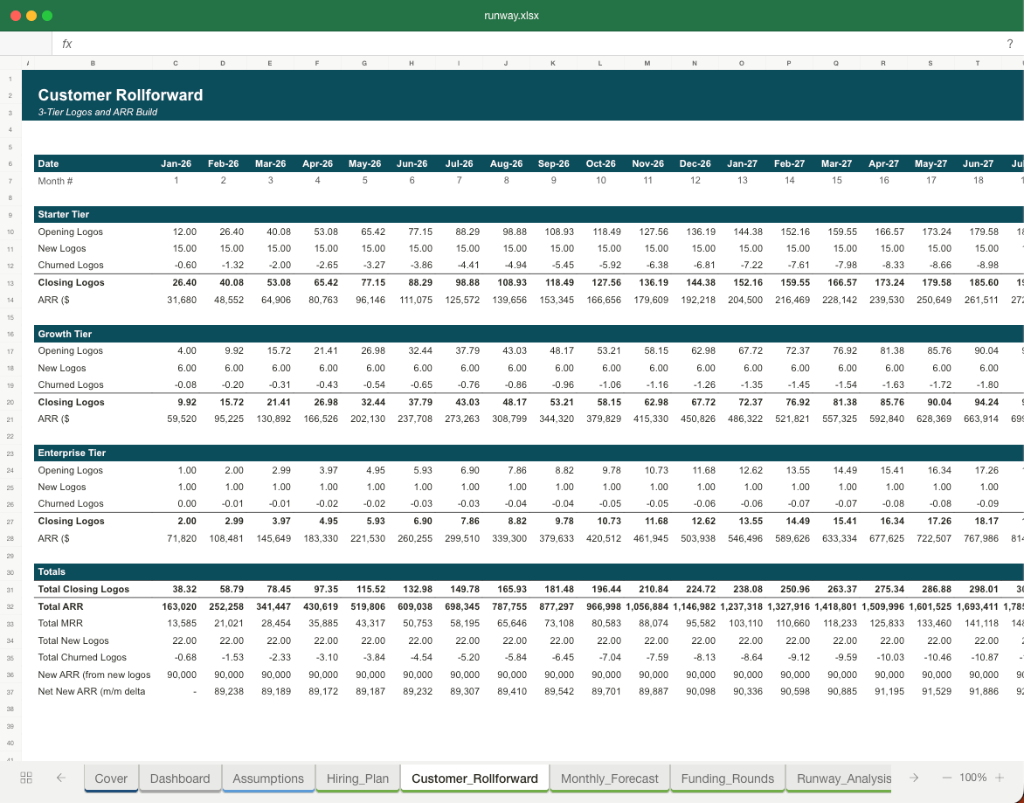
- Revenue build - MAU × spend × interchange rate × (1 − partner rev share).
- Opex / headcount plan - mirrors use-of-funds split; hiring plan by function with monthly salary ramp.
- P&L (Income Statement) - monthly, 36 months; gross profit, EBITDA.
- Cash flow & runway - monthly cash burn, runway from $3M raise, next fundraise trigger.
- Balance sheet - simplified; track cash, advance receivables (EWA float), and equity.
- Scenario toggle - Base / Bull / Bear on a single control sheet.
- KPI summary - enrolled users, MAU, monthly revenue, burn, runway (months remaining).
Frequently asked
Is the Clair financial model free?+
Yes. The Clair model is a free Excel (.xlsx) download with live formulas. Sign up with your email and the workbook is yours to keep, review, and edit.
What's included in the model?+
A 5-year monthly forecast with P&L, cash flow and runway, valuation (exit multiple plus a DCF cross-check), MOIC/IRR returns, and unit economics, with live formulas throughout.
How was this model built?+
It was built from Clair's pitch deck and publicly available information, then structured to investment-banking standards as a fully editable Excel model.
Can I change the assumptions?+
Yes. You can change assumptions and the live formulas will recalculate in the downloadable Excel model.
Have more financial modelling questions? Contact us

Created by ex-finance professionals
Hey, I’m Alex and I created Finamodel.
Over my years in the finance industry I kept building the same models over and over again. Same structure, same assumptions, different logo. So I started building frameworks to turn them into clean, reusable templates.
Every model here is one I’d actually use for a client, and I personally vet each one before it goes up.
I’m not an expert in every industry, but I’ve built enough models to know what belongs in one. And when something is completely foreign to me, I reach out to my network for experts to work on our models with us.
Having a template library on hand cuts a first build from hours to minutes.
Need help finding your model? You’ll find me in the Finamodel app!
Other Fintech Startup Financial Models
Browse another startup in the same category.
Acin
SaaS and data subscription network for operational risk management at Tier 1 financial institutions

Ageras Group
B2B SME ecosystem - marketplace connecting SMEs with accountants + cloud accounting/payroll software + embedded financial services (lending, factoring, banking)

Airbase
Unified non-payroll spend management platform (corporate cards, AP/bill pay, expense reimbursement, approval workflows) for mid-market companies.

Altruist
Vertically integrated all-in-one platform for registered investment advisors (RIAs) - combining custodial, portfolio management, practice management, and client acquisition tools.
Amenitiz
All-in-one hotel management SaaS platform ("Shopify for hotels") for independent hoteliers - PMS, booking engine, channel manager, website builder, payments, and AI-driven revenue management.

Anrok
SaaS sales tax compliance platform - nexus monitoring, calculation, registration, filing, and remittance - built specifically for SaaS companies.
Arrival
Arrival is an EV manufacturer of commercial vans and buses using proprietary Microfactories and vertically integrated components, going public via SPAC merger with CIIG Merger Corp.

AtoB
AtoB is building financial infrastructure for commercial fleets, starting with a no-fee Visa fleet card for fuel and expanding into payroll, BNPL, and international.