 Claroty Financial Model
Hardware/Deep-tech Startup Financials (Free Excel Download)
Industrial cybersecurity platform that identifies, manages, and protects OT, IoT, and IIoT assets.



professionals from Deloitte
Used by professionals from






About this model
Claroty provides industrial cybersecurity for OT, IoT, and IIoT assets. It helps enterprises identify, manage, and protect operational systems that cannot be secured like conventional IT, including environments where availability and safety constraints limit the use of ordinary endpoint-security approaches.
The buyer is typically an enterprise operating sites with specialised assets and long technology lifecycles. This creates a platform revenue opportunity linked to sites, assets, and modules, but also a demanding implementation and services requirement as customers connect industrial networks and coordinate IT and operational teams.
Model enterprise customers, sites, protected assets, platform ARR, implementation, services, module adoption, expansion, renewals, and churn. Include solution engineering, threat research, support, cloud delivery, and sales costs. Site rollout, asset coverage, module attach, contract value, services margin, retention, and sales-cycle duration should determine scenarios.
A turnkey financial model
Live formulas, no hardcoded values
Outputs are driven by live formulas, so the workbook updates from its assumptions instead of relying on hardcoded results.
All assumptions in one tab
Inputs are clearly marked in the Assumptions tab and separated from calculations, making it clear what to change and what to leave intact.
Statements always balancing
For integrated-statement models, the balance sheet, cash flow, and supporting schedules tie through properly.
Distinct schedules for clarity
Debt, working capital, taxes, and cash flow can get messy quickly. We group calculations in clear schedules, not across disconnected tabs.
No hidden macros or external links
There are no unexplained external workbook links or macros to undermine auditability or portability.
Changes flow through the model
Update a key driver and see the impact carry through the forecast, financing, and return outputs. We never use hardcoded numbers in formulas.
About Claroty
claroty.com
How to build a detailed financial model for Claroty
A complete walkthrough of the business, drivers, and assumptions behind the downloadable Claroty model - distilled from its pitch deck and publicly available information.
Product & value proposition
Claroty's platform claims to be the only solution protecting all assets "within four walls" - OT, IoT, and IIoT. Three core product lines:
- Claroty Continuous Threat Detection (CTD): "Right for Me" collection architecture, sophisticated threat detection, threat intelligence.
- Claroty Edge: Zero-infrastructure OT security solution - fast deployment, no network changes required; industry first.
- Claroty Secure Remote Access (SRA): Zero Trust Network Architecture for OT; compensating controls for insecure OT assets.
Platform capabilities span: Asset Visibility, Vulnerability Management, Threat Detection, Threat Intelligence, Risk Management, Secure Remote Access.
Customer journey framing: three onramps based on enterprise maturity - Understand Your Network → Detect Threats → Control Access.
Market
- Enterprise IoT spending expected to exceed $4B in 2024.
- Bubble chart (slide 3) shows largest 2024 TAM segments by vertical: Manufacturing & Natural Resources (~$4.0B+, largest bubble), Healthcare Providers and Utilities (high growth %, ~$0.5B), Building Automation, Physical Security, Government.
- OT & IIoT Security Market combined (slide 13):
- 2018A: OT $1,419M + IIoT $250M = $1,669M
- 2019E: OT $1,671M + IIoT $380M = $2,051M
- 2020E: OT $1,969M + IIoT $585M = $2,554M
- 2021E: OT $2,319M + IIoT $820M = $3,139M
- 2022E: OT $2,732M + IIoT $1,115M = $3,847M
- CAGR ~23.2%
- Global IoT-connected devices: 8.6B (2018A) → 10.8B (2019A) → 12.8B (2020E) → 14.6B (2021E).
- 93% of companies will augment/replace OT monitoring systems within 3 years due to IoT adoption.
Revenue model
- Not explicitly detailed in the deck. Model inferred as enterprise SaaS/subscription given:
- Platform described as continuously monitoring OT networks.
- Three distinct product modules (CTD, Edge, SRA) suggest modular licensing or tiered subscription.
- Channel: direct sales + channel/reseller partners (NTT, Deloitte, KPMG, PwC) + ICS/automation OEM partners (Rockwell, Siemens, Schneider, Yokogawa).
- No ACV, ARR, contract length, or pricing tier data in deck.
Traction & metrics
- Funding: $100M total raised, Series C.
- Employees: 270+.
- Founded: 2015.
- HQ: New York City.
- Claims market leadership: "leading ICS market in 2020 in terms of new vulnerabilities disclosed".
- No revenue, ARR, customer count, NRR, or growth rate disclosed in deck.
Competition / moat
Three stated competitive advantages:
- Deep Protocol Library: Proprietary protocol/asset library; vendor relationships for rapid new protocol support; creates barrier to entry.
- Best-in-Class Security Research: ICS vulnerability research and disclosures; threat intelligence; market thought leadership.
- Broadest Portfolio: Widest capability set in industrial cybersecurity (visibility + threat detection + remote access); API-based adjacency expansion.
Self-described as "market leader". Competitive landscape and named competitors not shown.
Team & funding ask / use of funds
Leadership:
- Yaniv Vardi - CEO (Centrica Business Solutions, Panoramic Power, Sparta Systems)
- Galina Antova - Co-Founder, Chief Business Development Officer (Siemens, IBM)
- Benny Porat - Co-Founder, CTO (IDF Unit 8200)
- Udi Bar Sela - CFO (Ormat Technologies, Danaher, AVT)
- Grant Geyer - CPO (RSA Security, Symantec, Riptech)
- Simon Chassar - CRO (NTT, Actifio, VMware)
- Amir Zilberstein - Chairman & Co-Founder (Waterfall Security, Gita Technologies)
- Nadav Zafrir - Board Director (Team8)
- Admiral (ret.) Michael Rogers - Board Advisor Chairman (NSA, US Cyber Command)
- Dave DeWalt - Board Advisor (FireEye, McAfee, EMC)
Investors: Rockwell Automation, GM, Bessemer Venture Partners, Schneider Electric, BMW, Temasek, Siemens, IQT (In-Q-Tel), Team8.
Recommended financial model
- Archetype + why: Enterprise SaaS ARR model with multi-module expansion. Claroty sells a platform with three product modules (CTD, Edge, SRA) into large enterprises; revenue is subscription-based and expands as customers add modules. Standard SaaS ARR waterfall (new ARR + expansion ARR - churn = net ARR) with an ACV/seat or site-based pricing construct is most appropriate. No GMV/transaction layer; no insurance or inventory components.
- Forecast horizon & granularity: 5 years (2020–2025), quarterly for years 1–2, annual for years 3–5. Deck dated 2020 (copyright), post-Series C.
- Key drivers & assumptions:
| Driver | Value |
|---|---|
| Total addressable OT+IIoT security market 2020E | $2,554M |
| Market CAGR (2018–2022E) | ~23.2% |
| Market CAGR post-2022 | 18–20% |
| ARR growth rate Y1–Y2 | 60–80% |
| ARR growth rate Y3–Y5 | 35–50% taper |
| Gross margin | 70–75% |
| ACV per customer | $150K–$500K |
| Net Revenue Retention (NRR) | 115–125% |
| New logo adds per year (starting) | 30–50 |
| Sales & Marketing % of revenue | 50–60% |
| R&D % of revenue | 25–35% |
| G&A % of revenue | 10–15% |
| EBITDA margin at maturity (Year 5) | 5–15% |
| Headcount growth | ~30–40% YoY |
| Target verticals (near-term) | Critical Infrastructure, Industrial Manufacturing, Natural Resources, Life Sciences |
| Geographic expansion | US primary → EMEA, APAC |
- Scenarios (Base / Bull / Bear - which variables flex):
- Base: ARR grows ~70% Y1, tapering to ~40% by Y5; NRR 118%; gross margin 72%.
- Bull: Faster module adoption (SRA cross-sell accelerates post-COVID remote-work dynamic); NRR 125%+; ARR growth stays above 60% through Y3.
- Bear: Enterprise budget compression; slower OT security adoption; NRR 108%; growth slows to 35% by Y2.
- Flex variables: new logo adds, ACV, NRR, market share penetration rate, geographic ramp timeline.
- Required sheets / outputs:
- Assumptions dashboard (all drivers in one place)
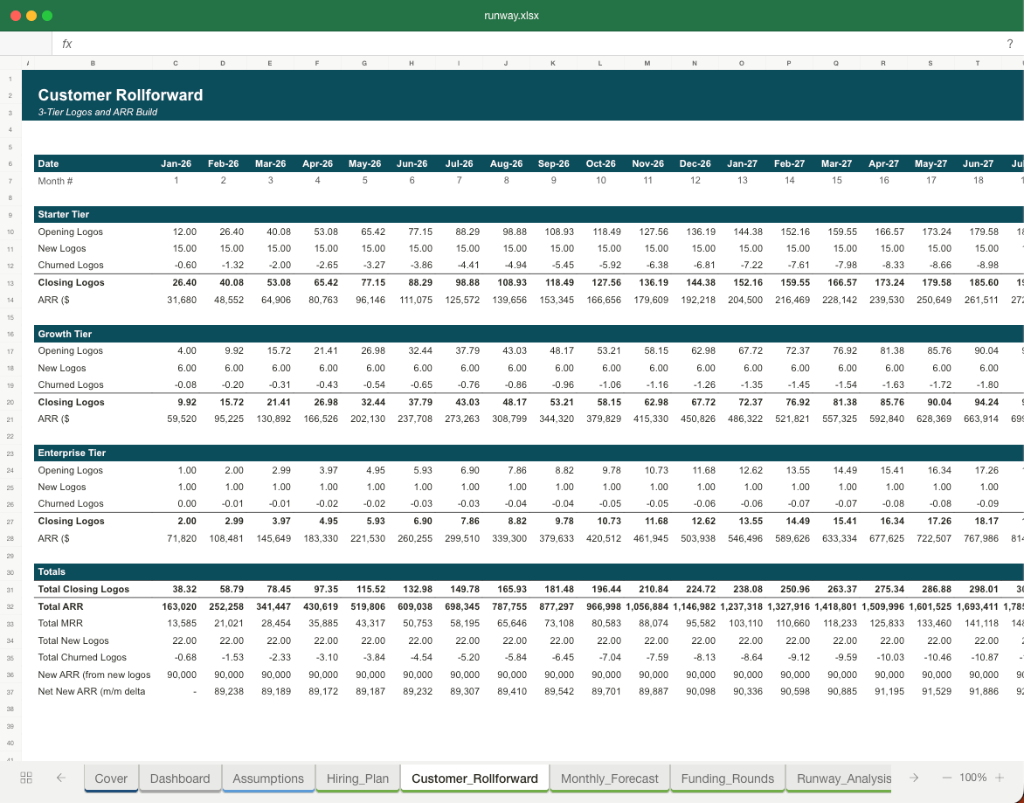
- ARR waterfall (beginning ARR + new ARR + expansion - churn = ending ARR)
- Income Statement (revenue, COGS, gross profit, S&M, R&D, G&A, EBITDA, net income)
- Headcount plan (by department: Sales, CS, R&D, G&A)
- Cash flow & runway (given $100M raised, model burn and runway to next milestone)
- Market share build (TAM × penetration rate cross-check vs. bottoms-up ARR)
- Scenario toggle (Base / Bull / Bear)
- KPI dashboard (ARR, customers, ACV, NRR, gross margin, burn rate, runway)
Frequently asked
Is the Claroty financial model free?+
Yes. The Claroty model is a free Excel (.xlsx) download with live formulas. Sign up with your email and the workbook is yours to keep, review, and edit.
What's included in the model?+
A 5-year monthly forecast with P&L, cash flow and runway, valuation (exit multiple plus a DCF cross-check), MOIC/IRR returns, and unit economics, with live formulas throughout.
How was this model built?+
It was built from Claroty's pitch deck and publicly available information, then structured to investment-banking standards as a fully editable Excel model.
Can I change the assumptions?+
Yes. You can change assumptions and the live formulas will recalculate in the downloadable Excel model.
Have more financial modelling questions? Contact us

Created by ex-finance professionals
Hey, I’m Alex and I created Finamodel.
Over my years in the finance industry I kept building the same models over and over again. Same structure, same assumptions, different logo. So I started building frameworks to turn them into clean, reusable templates.
Every model here is one I’d actually use for a client, and I personally vet each one before it goes up.
I’m not an expert in every industry, but I’ve built enough models to know what belongs in one. And when something is completely foreign to me, I reach out to my network for experts to work on our models with us.
Having a template library on hand cuts a first build from hours to minutes.
Need help finding your model? You’ll find me in the Finamodel app!
Other Hardware/Deep-tech Startup Financial Models
Browse another startup in the same category.

ANYbotics
ANYbotics builds and sells autonomous legged inspection robots (ANYmal) for industrial facilities, targeting oil & gas, chemicals, power, offshore, mining, and manufacturing sectors.
Awake Security
Awake Security - AI-driven Network Detection & Response (NDR) platform for the hybrid cloud, positioning as the "intent detection" layer of the SOC visibility triad.

Beem
AR communications platform that overlays full-body "hologram" video of a person into the recipient's physical space via smartphone or web.

Blue White Robotics
Autonomous robotics platform converting existing farm equipment to self-driving tractors for permanent-crop growers, sold as Robots-as-a-Service.

Cambridge GaN Devices
Fabless semiconductor startup commercialising self-protected GaN power transistors (HiGaN) that replace silicon and standard GaN with higher efficiency and no external protection circuitry.

Canix
Cannabis-focused ERP (inventory tracking, compliance automation, sales management, yield forecasting) sold as SaaS to cannabis cultivators, manufacturers, and distributors.
Chobani
Chobani is the US market leader in Greek yogurt; TPG invested $671M in April 2014 for a 35% stake via a structured second lien + equity deal
Cipher Skin
Wearable sensor mesh platform that collects dense multi-modal data from human bodies and industrial objects to predict structural and functional failure before it occurs.