 ComplyAdvantage Financial Model
Fintech Startup Financials (Free Excel Download)
AI-powered AML compliance SaaS platform providing real-time financial crime data (sanctions, PEPs, adverse media) and transaction monitoring/screening to banks and fintechs via API.



professionals from Deloitte
Used by professionals from






About this model
ComplyAdvantage provides AI-powered financial-crime compliance software, including sanctions, PEP, adverse-media data, screening, and transaction monitoring. Banks and fintechs use its API and workflow tools to manage AML obligations with more current data.
The product combines a recurring platform relationship with usage that can rise as a customer screens more entities or transactions. Implementation support may add one-time revenue, but the core commercial value comes from embedded compliance infrastructure and recurring data access.
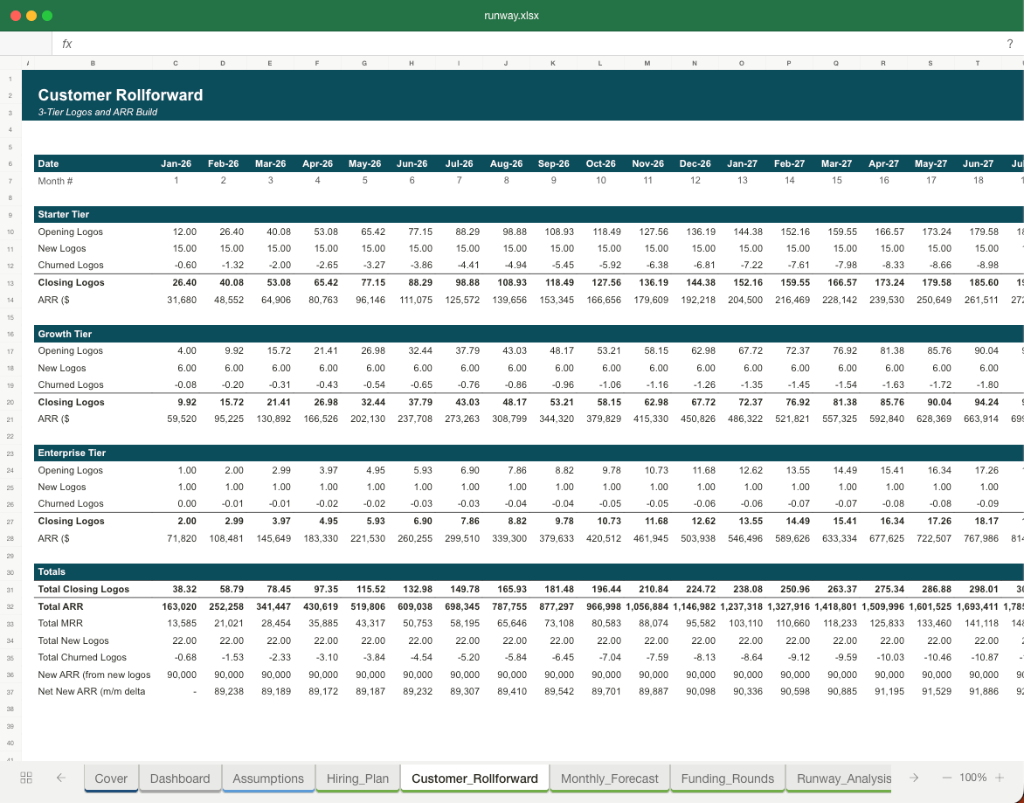
The model should build subscription ARR from new logos, licence tiers, expansion, and churn, then layer in volume-based pricing for screened entities or transactions. Implementation fees and delivery cost should be separated from recurring revenue to preserve a clear view of SaaS retention and gross margin.
A turnkey financial model
Live formulas, no hardcoded values
Outputs are driven by live formulas, so the workbook updates from its assumptions instead of relying on hardcoded results.
All assumptions in one tab
Inputs are clearly marked in the Assumptions tab and separated from calculations, making it clear what to change and what to leave intact.
Statements always balancing
For integrated-statement models, the balance sheet, cash flow, and supporting schedules tie through properly.
Distinct schedules for clarity
Debt, working capital, taxes, and cash flow can get messy quickly. We group calculations in clear schedules, not across disconnected tabs.
No hidden macros or external links
There are no unexplained external workbook links or macros to undermine auditability or portability.
Changes flow through the model
Update a key driver and see the impact carry through the forecast, financing, and return outputs. We never use hardcoded numbers in formulas.
About ComplyAdvantage
complyadvantage.com
How to build a detailed financial model for ComplyAdvantage
A complete walkthrough of the business, drivers, and assumptions behind the downloadable ComplyAdvantage model - distilled from its pitch deck and publicly available information.
Product & value proposition
Three core data products delivered via RESTful API:
- Global Sanctions & Watchlists - 1,000s of government/regulatory/law-enforcement watchlists; sanction updates in 15 minutes, 7 hours ahead of official source emails.
- Politically Exposed Persons (PEPs) - 100% of profiles checked for updates daily; consolidated with sanctions and adverse media.
- Adverse Media - 10,000 unique qualified media sources analysed daily; 200M articles read/month; 150,000 profiles added monthly; 40,000 existing profiles updated daily; 3M adverse media individuals; 200+ countries covered.
Platform modules:
- Customer Screening & Monitoring (KYC/AML onboarding)
- Transaction Screening & Monitoring (real-time and batch)
- FinCrime Knowledge Graph (proprietary AI/ML-powered dataset)
- Case Management, Analytics, Reporting
Key differentiators: real-time updates (not nightly batches), API-first ("integrate in an afternoon"), ISO 27001 certified, configurable rule-based approach.
Market
- $2 trillion estimated to be laundered globally each year.
- Record fines issued annually (no specific figure cited).
- No TAM/SAM/SOM breakdown presented in deck.
Revenue model
Not explicitly stated in deck. Implied model based on product architecture:
- API subscription / SaaS licence: customers integrate via RESTful API; pricing likely per-seat, per-entity-screened, or flat annual subscription tiered by volume.
- Platform licence: transaction monitoring and case management modules are configurable platform tools - likely an additional recurring licence layer.
- Professional services: dedicated implementation team mentioned - likely a one-time implementation fee or time-and-materials.
No pricing tiers, ACV, or contract terms disclosed in deck.
Traction & metrics
Customer outcomes (no company-level revenue or customer count disclosed):
- Large Global Retail Bank: reduced customer onboarding time by 50% via automated adverse media screening.
- Large Global FinTech: reduced false positive rate by 74% while increasing ability to spot risks.
- Santander (Corporate & Commercial Banking): reduced account application-to-open cycle time from 12 days to 2 days; 80% reduction in employee effort.
- Platform scale example: 9,095,750 accepted transactions; 45,156 awaiting analysis; 642 escalated & accepted; 435 escalated; 115 escalated and blocked; 5 blocked - shown in a live UI screenshot.
- Transaction monitoring product claims 60% reduction in alerts for customers.
Awards / external validation (proxy for growth stage):
- Sunday Times Tech Track 100: 16th fastest-growing private technology company in Britain.
- Deloitte UK Technology Fast 50 (2019): 21st.
- Celent Model Bank Award 2019: Commercial Customer Onboarding.
- Finovate Awards: Best RegTech Solution 2019.
- Financial Innovation Awards: Best Innovation in Product/Service Design for Corporate Digital Onboarding.
No revenue figures, ARR, customer count, or growth rate disclosed in deck.
Competition / moat
Not directly addressed. Implied moats:
- Proprietary FinCrime Knowledge Graph (AI/ML-powered, continuously updated).
- Data freshness: sanctions updates in 15 minutes vs hours/days for legacy vendors.
- Network effect on data: 200M articles/month processed; 40,000 profiles updated daily.
- ISO 27001 certification.
- Named competitors: not mentioned in deck.
Team & funding ask / use of funds
- CEO/Founder referenced only as "Charlie" (shortlisted for CityAM Entrepreneur of the Year).
- No team slide, headcount, funding ask, raise amount, or use of funds in deck.
Recommended financial model
- Archetype + why: B2B SaaS ARR model with a usage/volume tier overlay. Revenue is recurring API subscription + platform licence; implementation fees are one-time. Standard SaaS ARR build is the right frame; add a volume-screened-entities driver to capture API consumption growth.
- Forecast horizon & granularity: 3 years (Y1 monthly, Y2–Y3 quarterly). Monthly granularity in Y1 captures sales cycle ramp and implementation lag.
- Key drivers & assumptions:
- New logos signed per month
- Average contract value (ACV)
- Revenue mix: % from data subscription vs platform licence vs professional services
- Implementation fee per new logo
- Net Revenue Retention (NRR)
- Gross churn rate
- Gross margin
- S&M as % of revenue
- R&D as % of revenue
- G&A as % of revenue
- Headcount plan: sales reps, data engineers, compliance analysts
- Implementation duration
- Scenarios (Base / Bull / Bear - which variables flex):
- Bear: slower enterprise sales cycles, ACV pressure from fintechs, higher data infrastructure COGS, NRR ~110%.
- Base: steady logo additions, blended ACV ~$100K, NRR ~118%, gross margin ~72%.
- Bull: accelerated enterprise deals (Tier 1 banks at $200K+ ACV), cross-sell of all three modules, NRR ~130%.
- Flex variables: new logos/month, ACV, NRR, gross margin.
- Required sheets / outputs:
- Assumptions dashboard (all drivers in one place)
- ARR bridge (new ARR, expansion ARR, churned ARR, net new ARR)
- Revenue P&L (subscription revenue + implementation fees)
- Operating expense build (S&M, R&D, G&A, headcount)
- EBITDA / cash burn timeline
- Customer cohort table (logo count, ACV, NRR by cohort year)
- Scenario toggle (Base / Bull / Bear)
Frequently asked
Is the ComplyAdvantage financial model free?+
Yes. The ComplyAdvantage model is a free Excel (.xlsx) download with live formulas. Sign up with your email and the workbook is yours to keep, review, and edit.
What's included in the model?+
A 5-year monthly forecast with P&L, cash flow and runway, valuation (exit multiple plus a DCF cross-check), MOIC/IRR returns, and unit economics, with live formulas throughout.
How was this model built?+
It was built from ComplyAdvantage's pitch deck and publicly available information, then structured to investment-banking standards as a fully editable Excel model.
Can I change the assumptions?+
Yes. You can change assumptions and the live formulas will recalculate in the downloadable Excel model.
Have more financial modelling questions? Contact us

Created by ex-finance professionals
Hey, I’m Alex and I created Finamodel.
Over my years in the finance industry I kept building the same models over and over again. Same structure, same assumptions, different logo. So I started building frameworks to turn them into clean, reusable templates.
Every model here is one I’d actually use for a client, and I personally vet each one before it goes up.
I’m not an expert in every industry, but I’ve built enough models to know what belongs in one. And when something is completely foreign to me, I reach out to my network for experts to work on our models with us.
Having a template library on hand cuts a first build from hours to minutes.
Need help finding your model? You’ll find me in the Finamodel app!
Other Fintech Startup Financial Models
Browse another startup in the same category.
Acin
SaaS and data subscription network for operational risk management at Tier 1 financial institutions

Ageras Group
B2B SME ecosystem - marketplace connecting SMEs with accountants + cloud accounting/payroll software + embedded financial services (lending, factoring, banking)

Airbase
Unified non-payroll spend management platform (corporate cards, AP/bill pay, expense reimbursement, approval workflows) for mid-market companies.

Altruist
Vertically integrated all-in-one platform for registered investment advisors (RIAs) - combining custodial, portfolio management, practice management, and client acquisition tools.
Amenitiz
All-in-one hotel management SaaS platform ("Shopify for hotels") for independent hoteliers - PMS, booking engine, channel manager, website builder, payments, and AI-driven revenue management.

Anrok
SaaS sales tax compliance platform - nexus monitoring, calculation, registration, filing, and remittance - built specifically for SaaS companies.
Arrival
Arrival is an EV manufacturer of commercial vans and buses using proprietary Microfactories and vertically integrated components, going public via SPAC merger with CIIG Merger Corp.

AtoB
AtoB is building financial infrastructure for commercial fleets, starting with a no-fee Visa fleet card for fuel and expanding into payroll, BNPL, and international.