 Convious Financial Model
Marketplace Startup Financials (Free Excel Download)
Vertical SaaS + transaction-fee platform connecting out-of-home experience (OOHE) venues to visitors via e-commerce, dynamic pricing, marketing automation, and on-site operations.



professionals from Deloitte
Used by professionals from






About this model
Convious is a vertical commerce platform for attractions and leisure venues, including theme parks, museums, ski resorts, and zoos. It combines ticketing, dynamic pricing, marketing automation, e-commerce, POS, loyalty, and operational tools to help venues sell directly to visitors.
The business had 120 venues in 16 countries, processed more than 30 million visitors and 8 million bookings in 2020, and reported less than 1% annual venue churn. It earns a percentage of transactions flowing through the platform, with a possible subscription component for the software layer.
The model builds venue growth, visitors, bookings, spend per booking, and resulting GMV. A transaction take rate and any platform fees become revenue, while venue onboarding, customer success, product development, and sales costs feed the P&L. Retention, expansion revenue, and recovery in visitor demand are the critical scenario variables.
A turnkey financial model
Live formulas, no hardcoded values
Outputs are driven by live formulas, so the workbook updates from its assumptions instead of relying on hardcoded results.
All assumptions in one tab
Inputs are clearly marked in the Assumptions tab and separated from calculations, making it clear what to change and what to leave intact.
Statements always balancing
For integrated-statement models, the balance sheet, cash flow, and supporting schedules tie through properly.
Distinct schedules for clarity
Debt, working capital, taxes, and cash flow can get messy quickly. We group calculations in clear schedules, not across disconnected tabs.
No hidden macros or external links
There are no unexplained external workbook links or macros to undermine auditability or portability.
Changes flow through the model
Update a key driver and see the impact carry through the forecast, financing, and return outputs. We never use hardcoded numbers in formulas.
About Convious
convious.com
How to build a detailed financial model for Convious
A complete walkthrough of the business, drivers, and assumptions behind the downloadable Convious model - distilled from its pitch deck and publicly available information.
Product & value proposition
- End-to-end vertical SaaS platform for leisure operators (theme parks, ski resorts, museums, zoos, water parks, FECs, etc.).
- Core modules: Marketing (CRM, email, push/SMS, paid campaigns), Commerce (dynamic pricing, web shop, upsells, vouchers, reseller/channel manager), POS & Hardware, Mobile App (e-wallet, in-app purchase, F&B ordering), Loyalty & Support, BI & Forecasting.
- Key differentiation: real-time AI dynamic pricing + crowd control; D2C model bypasses third-party resellers and their commissions; single platform replaces legacy fragmented stack.
- Customer case stat: +201% increase in revenue, +86% increase in conversion (unnamed customer).
Market
- TAM: $8.8TN total global Out-of-Home Experience (OOHE) market.
- Market represents ~10.4% of world GDP; 500k+ venues globally; 319 million jobs.
- Only 17% of OOHE revenue was booked online in 2020 - "underpenetrated market."
- Online OOHE CAGR: 22.6% (2021–2027).
Revenue model
- Primary: Percentage take-rate on every transaction processed through the platform (tickets, rides, reservations, F&B, ski passes, lockers, etc.). Exact % not disclosed - stated as "a %*" with asterisk.
- Secondary: Implied SaaS/platform subscription (vertical SaaS positioning, slide 5), but no explicit SaaS fee tier or pricing disclosed in deck.
- Channel: Direct sales to venue operators (B2B); then venues use the platform to sell D2C to end consumers (B2B2C).
- ARPA: Described as "$xxk" - specific value redacted in deck.
- GMV-driven revenue; Convious earns a take-rate on total transaction volume flowing through the platform.
Traction & metrics
- Venues: 120 (with <1% annual venue churn).
- Countries: 16 active.
- Visitors processed: 30M+ in 2020.
- Bookings: 8M in 2020.
- NPS: 42.7 (April 2021, trending up).
- GMV growth: "Growing 7x YoY despite COVID." Specific GMV figures (2018–2021F bar chart) are redacted as "xx" / "$xxxM" in the deck image - no actual dollar values readable.
- Expansion revenue: +184% expansion revenue in 2020 (existing customers spending more).
- Profitability: "Profitable for the second year in a row" as of deck date (~2021).
- Capital efficiency: "$xxxM forecasted GMV in 2021 with only $xM capital raised" - both values redacted.
- 2022 pipeline: "$xxxM booked for 2022" - redacted.
- LTC:CAC ratio mentioned but value redacted ("xx LTC to CAC ratio").
Unit economics
- ARPA: "$xxk" - redacted.
- LTV:CAC ratio: Mentioned, value redacted ("xx LTC to CAC").
- Venue churn: <1% annually.
- Expansion revenue: +184% in 2020 implies strong net revenue retention (NRR likely well above 100%).
Competition / moat
- Problem framing: incumbent/legacy ticketing vendors are described as having "no AI, no e-commerce, marketing or data play, no cloud APIs, no mobile."
- Moat claims: AI dynamic pricing + crowd control, full-stack D2C platform, deep integrations across the venue operations stack, high NPS, <1% churn.
- Direct competitors: Not named in deck.
Team & funding ask / use of funds
- CEO/Founder: Camiel Kraan - former CCO Bwin, Founder Squla; 25+ years experience.
- COO: Adriaan van der Hek - former CEO ShoppingMinds; 25+ years experience.
- CTO: Juozapas Zabukas - former CTO Productors; 15+ years experience.
- VP Sales: Bernard Kochen - former VP Sales TravelBird; 15+ years experience.
- CMO: Koen Scholte - former VP Marketing Talpa/Emesa; 15+ years experience.
- Team size: 40+ members.
- Prior employer logos shown: Backbase, TietoEnator, ShoppingMinds, Adform, Infor, Booking.com, Bwin, Talpa, TravelBird.
- Capital raised to date: "$xM" - redacted.
Recommended financial model
- Archetype + why: GMV-driven marketplace / vertical SaaS take-rate model. Revenue = GMV × take-rate % (transaction layer) + optional SaaS platform fee per venue. This is the natural archetype because Convious's stated revenue mechanism is a % of every transaction; the SaaS subscription (if any) is secondary or bundled. A 3-statement wrapper (P&L, Balance Sheet, Cash Flow) should sit beneath it given the company claims profitability.
- Forecast horizon & granularity: 5-year annual model (2021–2026) with monthly granularity for Year 1–2 (useful for cash flow given COVID-recovery lumpiness). Deck is ~2021-vintage.
- Key drivers & assumptions:
| Driver | Value / Source |
|---|---|
| Starting venue count | 120 |
| Venue churn rate | <1% p.a. - model at 1% |
| Avg visitors per venue per year | 30M visitors ÷ 120 venues = ~250k/venue |
| GMV per venue per year | Visitors × booking rate × avg ticket value |
| GMV growth rate (online penetration tailwind) | OOHE online CAGR 22.6%; |
| Profitability | Already profitable for 2 years; maintain positive EBITDA in base case |
- Scenarios (Base / Bull / Bear - which variables flex):
- Base: 22.6% OOHE online market CAGR; ~60 net new venues/yr; take-rate 3%; NRR 120%.
- Bull: Faster global expansion; 100+ net new venues/yr; take-rate 4%; NRR 140%; COVID recovery accelerates revenue expansion.
- Bear: Slower international rollout; 30 net new venues/yr; take-rate 2.5%; COVID resurgence delays recovery; NRR 110%.
- Primary flex variables: net new venues, take-rate %, avg GMV per venue, NRR.
- Required sheets / outputs:
- Assumptions - all drivers in one input sheet (color-coded hardcodes vs. formulas)
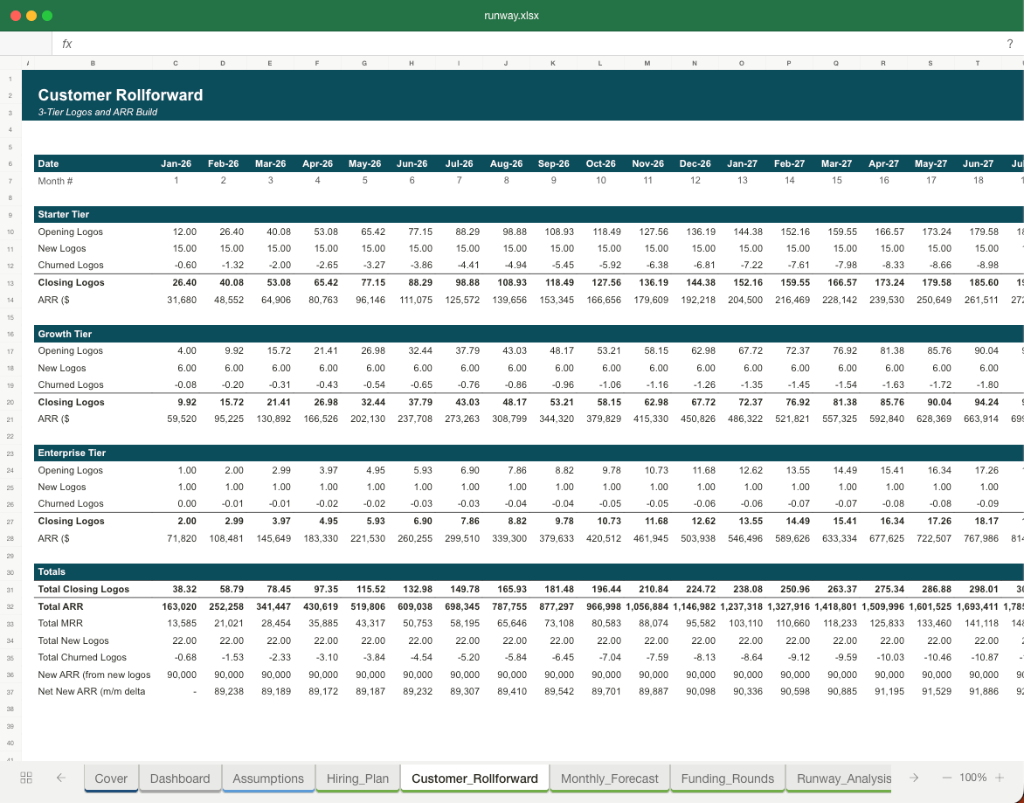
- Venue Roll-forward - opening count, new adds, churn, closing count by period
- GMV Build - venues × visitors/venue × booking rate × AOV → total GMV
- Revenue Build - GMV × take-rate + SaaS fees × venue count; expansion revenue modelled via NRR
- P&L - Revenue, COGS (payment processing, hosting), Gross Profit, S&M, R&D, G&A, EBITDA, EBIT, Net Income
- Cash Flow - Operating / Investing / Financing; working capital light (SaaS + take-rate = mostly prepaid or near-real-time)
- Balance Sheet - simplified; flag deferred revenue if annual SaaS contracts
- Unit Economics - CAC, LTV, payback, ARPA, NRR per cohort
- Scenarios - toggle sheet linking Base/Bull/Bear assumptions
- Dashboard - GMV, revenue, venue count, NRR, EBITDA margin over time
Frequently asked
Is the Convious financial model free?+
Yes. The Convious model is a free Excel (.xlsx) download with live formulas. Sign up with your email and the workbook is yours to keep, review, and edit.
What's included in the model?+
A 5-year monthly forecast with P&L, cash flow and runway, valuation (exit multiple plus a DCF cross-check), MOIC/IRR returns, and unit economics, with live formulas throughout.
How was this model built?+
It was built from Convious's pitch deck and publicly available information, then structured to investment-banking standards as a fully editable Excel model.
Can I change the assumptions?+
Yes. You can change assumptions and the live formulas will recalculate in the downloadable Excel model.
Have more financial modelling questions? Contact us

Created by ex-finance professionals
Hey, I’m Alex and I created Finamodel.
Over my years in the finance industry I kept building the same models over and over again. Same structure, same assumptions, different logo. So I started building frameworks to turn them into clean, reusable templates.
Every model here is one I’d actually use for a client, and I personally vet each one before it goes up.
I’m not an expert in every industry, but I’ve built enough models to know what belongs in one. And when something is completely foreign to me, I reach out to my network for experts to work on our models with us.
Having a template library on hand cuts a first build from hours to minutes.
Need help finding your model? You’ll find me in the Finamodel app!
Other Marketplace Startup Financial Models
Browse another startup in the same category.

Acquco
Amazon brand aggregator - acquires third-party Amazon seller businesses at attractive multiples, then scales them via proprietary growth playbooks and technology.
Arive
Premium q-commerce app delivering lifestyle and branded products in under 30 minutes across German cities.

Audience Town
Vertical data and advertising platform targeting home movers across the entire home journey - pre-move through post-move.

AudioMob
Non-intrusive in-game audio ad platform bridging music/brand advertisers to mobile game publishers.

Authoritive
Two-way messaging platform that turns creator expertise into scalable, push-delivered learning experiences via SMS/WhatsApp.

Avo
Building amenity and office perk platform delivering same-day grocery/pantry/goods to residential and commercial tenants via a white-label marketplace.
beehiiv
Newsletter platform for creators to build, grow, and monetize email audiences - SaaS subscription + native ad network revenue.
Borzo
Global same-day logistics marketplace connecting B2B merchants with crowdsourced couriers for last-mile delivery