DeckMatch Financial Model
AI/ML Startup Financials (Free Excel Download)
AI co-pilot that ingests unstructured inbound deal/candidate/tender flow and outputs structured data, AI-generated memos, CRM updates, and feedback - automating the top-of-funnel for knowledge-intensive B2B operators.



professionals from Deloitte
Used by professionals from






About this model
DeckMatch is an API-first copilot for teams overwhelmed by unstructured inbound opportunities. A user supplies investment, recruitment, tender, or grant criteria; the product ingests decks, CVs, and RFPs, produces structured data and an AI memo, updates the CRM, and sends feedback.
Private markets is the initial wedge, with HR and staffing, tenders and RFPs, and grant making sharing the same backbone. The pre-seed company had more than 50 VC beta sign-ups, targeted 100 happy testers, and planned a free-to-paid SaaS path with $200,000 first ARR.
The model follows the product-led funnel from free sign-up through activation, conversion, and churn. It tests entry and target ACV, LLM costs, and referral-led acquisition, then stages vertical expansion, founder and hire plans, the €1 million raise, monthly burn, and runway.
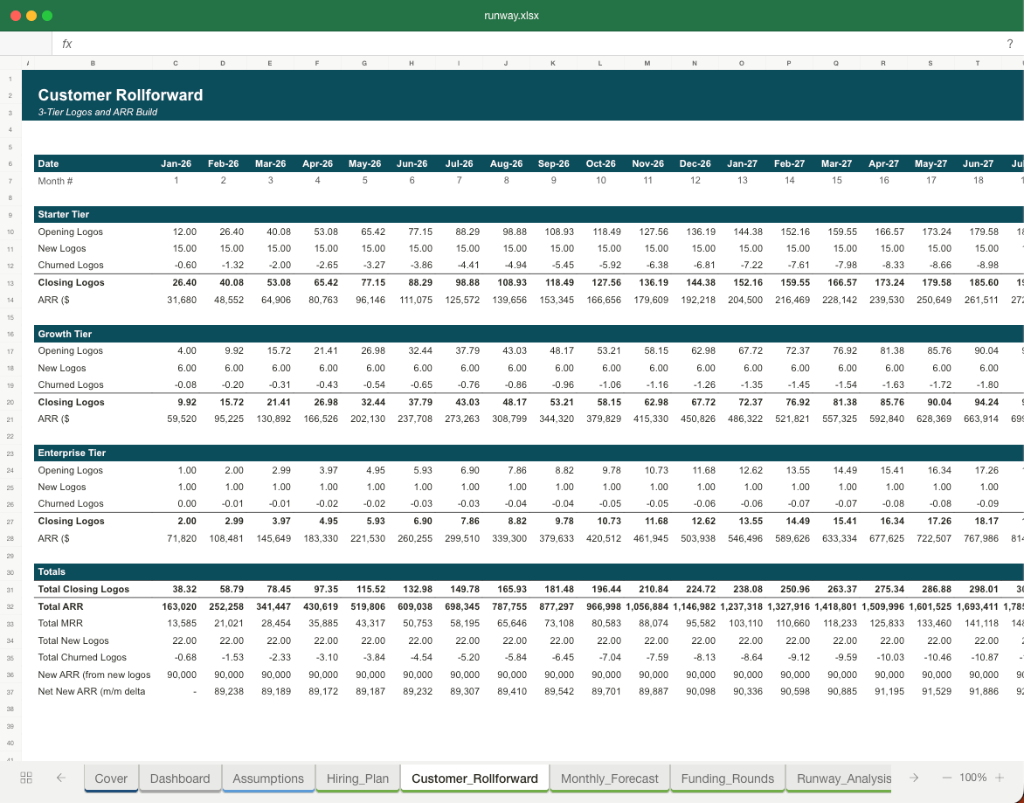
A turnkey financial model
Live formulas, no hardcoded values
Outputs are driven by live formulas, so the workbook updates from its assumptions instead of relying on hardcoded results.
All assumptions in one tab
Inputs are clearly marked in the Assumptions tab and separated from calculations, making it clear what to change and what to leave intact.
Statements always balancing
For integrated-statement models, the balance sheet, cash flow, and supporting schedules tie through properly.
Distinct schedules for clarity
Debt, working capital, taxes, and cash flow can get messy quickly. We group calculations in clear schedules, not across disconnected tabs.
No hidden macros or external links
There are no unexplained external workbook links or macros to undermine auditability or portability.
Changes flow through the model
Update a key driver and see the impact carry through the forecast, financing, and return outputs. We never use hardcoded numbers in formulas.
About DeckMatch
deckmatch.com
How to build a detailed financial model for DeckMatch
A complete walkthrough of the business, drivers, and assumptions behind the downloadable DeckMatch model - distilled from its pitch deck and publicly available information.
Product & value proposition
- Addresses "top of funnel firehose" - unstructured inbound (referred, cold, hunted) that overwhelms analysts/recruiters/procurement teams.
- API-first co-pilot: user inputs a thesis/criteria prompt; AI ingests pitch decks / CVs / RFP docs → outputs structured data, AI-generated memo, auto-updates CRM, sends AI-generated feedback.
- Integrates via RESTful API into existing CRM/workflow stack.
- OpenAI ChatGPT plugin approval secured.
- Four vertical use-cases on one shared AI backbone: Private Markets, HR & Staffing, Tenders & RFPs, Grant Making.
Market
Total addressable market broken out by vertical:
- Investment Opportunities: $1b p.a. market; 25,000 private market GPs across VC, PE, RE, Infra with $10tr AuM.
- HR & Recruitment: $100b p.a. market; $760b industry turnover p.a..
- Procurement: $4b p.a. market.
- Public Sector / Grant Making: $5b p.a. market.
- Industrial Application (knowledge sharing): $10b p.a. market.
- Combined TAM: ~$120b p.a..
No SAM or SOM defined in deck. Market sizing methodology not disclosed - these appear to be software/tech-spend sub-segments, not total industry revenue.
Revenue model
- SaaS subscription. Self-service upgrade path from free (beta) to paid.
- Target ACV: north of $20k p.a. (self-service validation goal).
- Implied ACV for first ARR goal: $10k p.a. per customer (20 customers × $10k = $200k ARR) - note this is below the $20k validation target, suggesting tiered or early-adopter pricing.
- API-first / RESTful API integration; potential for usage-based or per-seat components not stated in deck.
- Freemium funnel: free tier → paid upgrade; retention target of 30% for free users.
- Go-to-market: product-led growth (PLG), word-of-mouth beta, referral engine planned for 2024.
Traction & metrics
All figures are forward-looking targets / in-beta at time of deck - no revenue yet.
| Metric | Value | Source |
|---|---|---|
| Beta sign-ups (VCs) | 50+ via word of mouth | - |
| Beta tester goal (end Q3) | 100 happy beta testers | - |
| Free user retention target | 30% | - |
| First ARR goal (Q4) | $200k | - |
| Implied customer count at ARR goal | 20 customers | - |
| Implied ACV at ARR goal | $10k p.a. | - |
| SaaS pricing validation target | >$20k p.a. self-service | - |
No live revenue, no churn data, no paid customer count in deck.
Competition / moat
Moat framed as data and network effects:
- Unique dataset: aggregated top-of-funnel data across all clients → analytics on missed opportunities, diversity/ESG metrics, channel performance.
- Network effects: referral and onboarding quality improves as more opportunities flow through the platform; "stronger inbound from DeckMatch."
- Curated hunting ground: proprietary deal/candidate sourcing layer.
- No direct competitors named in deck.
Team & funding ask / use of funds
Team:
- Leo Gasteen - Co-Founder, CEO. Previously founded Edgefolio (marketplace tech, asset management).
- Walid Mustapha, PhD - Co-Founder, CTO. Previously founded Homefair. Domain expertise: AI, LLMs, mathematical optimisation, marketplaces.
Funding ask:
- Round: Pre-Seed
- Amount: EUR 1m
Recommended financial model
Archetype + why: SaaS ARR model with a PLG (product-led growth) funnel layer. Revenue is subscription-based (annual contracts implied), with a freemium-to-paid conversion funnel. The horizontal expansion roadmap (4 verticals) warrants a segment/cohort layer, but Private Markets is the clear wedge - model that first and add expansion revenue as a separate line from Year 2.
Forecast horizon & granularity:
- Monthly for Year 1 (beta → first revenue, conversion rates matter); quarterly for Years 2–3.
- Total horizon: 3 years.
Key drivers & assumptions:
*Funnel / acquisition:*
- Beta users at close of beta (Q3): 100 - then model organic + referral growth post-beta.
- Monthly new free signups post-beta: 30–50/month, ramping; PLG/word-of-mouth only in Year 1, paid acquisition from Year 2.
- Free-to-paid conversion rate: 5–10%; industry PLG benchmark ~3–8% for B2B tools. Deck targets self-service upgrade but no rate stated.
- Free user monthly retention (engagement proxy): 30% target; used as activation/stickiness gate for conversion model.
*Pricing:*
- Entry ACV: $10k p.a. (implied from $200k ARR / 20 customers goal).
- Target ACV: >$20k p.a. (validation goal).
- Model two tiers: Starter ~$10k and Pro ~$20k+. Starter-to-Pro upsell rate ~20% in Year 2.
- Annual contracts, paid upfront or monthly - assume monthly billing for simplicity; no payment terms in deck.
*Churn:*
- Monthly gross churn: 2% (= ~22% annual) for Year 1 (early product); improves to 1.5%/month in Year 2 as product matures. No churn data in deck.
*Expansion / verticals:*
- Private Markets: wedge vertical, modelled from Q4 of Year 1.
- HR & Staffing: expansion from 2024; model as new revenue cohort from Year 2.
- Tenders & RFPs, Grant Making: Year 3 placeholder.
- Each new vertical adds 20–30% incremental ARR to prior year's base at launch.
*Cost structure:*
- Two founders; assume seed hire plan funded by EUR 1m raise: 2–3 engineering hires + 1 sales/CS hire in Year 1.
- Gross margin: 75–80% (API/compute costs for LLM inference are the primary COGS; typical for AI-SaaS at this scale).
- COGS per customer: ~$500–$1,000/year in LLM API costs at current pricing; will compress as volume grows.
- Opex: personnel-heavy in Year 1; add sales/marketing budget from Year 2 as PLG engine is validated.
*Capital:*
- EUR 1m pre-seed raise.
- EUR/USD rate: 1.08 (model in USD for comparability; flag in assumptions tab).
- Runway: 18 months from close of round, targeting $200k ARR before next raise.
Scenarios (Base / Bull / Bear):
- Flex variables: free-to-paid conversion rate, ACV (entry vs. target), monthly churn, new signup growth rate, vertical expansion timing.
- Base: 5% free-to-paid conversion, $10k ACV, 2% monthly churn.
- Bull: 8% conversion, $15k blended ACV (faster Pro tier uptake), 1.5% churn, HR vertical live in Q2 Year 2.
- Bear: 3% conversion, $8k ACV (discounting to close), 3% monthly churn, HR vertical pushed to Year 3.
Required sheets / outputs:
- Assumptions - all drivers in one place, colour-coded vs..
- Funnel - free signups → activated → converted to paid → churned (monthly waterfall).
- ARR Bridge - new ARR, expansion ARR, churned ARR, net new ARR by month/quarter.
- P&L - Revenue, COGS (LLM/infra), Gross Profit, Opex (Headcount, S&M, G&A), EBITDA, Net Loss.
- Headcount - role-by-role hiring plan tied to funding runway.
- Cash & Runway - starting cash (EUR 1m), monthly burn, runway to zero, next raise trigger.
- Scenario toggle - Base / Bull / Bear via dropdown or named ranges.
- Dashboard - KPIs: ARR, MRR, paying customers, blended ACV, gross margin %, runway (months).
Frequently asked
Is the DeckMatch financial model free?+
Yes. The DeckMatch model is a free Excel (.xlsx) download with live formulas. Sign up with your email and the workbook is yours to keep, review, and edit.
What's included in the model?+
A 5-year monthly forecast with P&L, cash flow and runway, valuation (exit multiple plus a DCF cross-check), MOIC/IRR returns, and unit economics, with live formulas throughout.
How was this model built?+
It was built from DeckMatch's pitch deck and publicly available information, then structured to investment-banking standards as a fully editable Excel model.
Can I change the assumptions?+
Yes. You can change assumptions and the live formulas will recalculate in the downloadable Excel model.
Have more financial modelling questions? Contact us

Created by ex-finance professionals
Hey, I’m Alex and I created Finamodel.
Over my years in the finance industry I kept building the same models over and over again. Same structure, same assumptions, different logo. So I started building frameworks to turn them into clean, reusable templates.
Every model here is one I’d actually use for a client, and I personally vet each one before it goes up.
I’m not an expert in every industry, but I’ve built enough models to know what belongs in one. And when something is completely foreign to me, I reach out to my network for experts to work on our models with us.
Having a template library on hand cuts a first build from hours to minutes.
Need help finding your model? You’ll find me in the Finamodel app!
Other AI/ML Startup Financial Models
Browse another startup in the same category.

AI Rudder
AI Rudder provides multi-lingual conversational AI for B2C customer engagement - automating outbound and inbound voice/chat interactions at scale.

Aisera
AI Service Experience platform that automates IT, HR, and customer service workflows via conversational AI and automation.

Amberscript
AI + human hybrid transcription and subtitling platform targeting B2B customers in Europe

Apheris
Privacy-preserving federated ML platform enabling enterprises to train AI on distributed data without sharing raw data.

Arcane
AI copilot for marketing teams that automates data analysis, reporting, and repeatable tasks via a chat interface and scheduled workflows.

Artisan
AI-powered "digital workers" (branded Artisans) that autonomously perform role-specific tasks - starting with outbound sales - and are delivered as SaaS subscriptions.

Artisan Series A
AI-native B2B SaaS platform consolidating the enterprise software stack with human-like "Artisan" AI employees that automate role-specific workflows

Bigblue
Tech-enabled e-commerce fulfillment platform for European D2C brands - "Amazon-standard" delivery without Amazon.