 Destiny Robotics Financial Model
Hardware/Deep-tech Startup Financials (Free Excel Download)
Humanoid robot designed as a socially intelligent home assistant to address human loneliness.



professionals from Deloitte
Used by professionals from






About this model
Destiny Robotics is developing a socially intelligent humanoid home assistant aimed at loneliness and household support. The product blends physical robotics with an ongoing personal-service relationship, making perceived trust, safety, usefulness, and emotional acceptance as important as the underlying technical capabilities.
The company is at a development stage where hardware readiness and regulatory milestones precede a reliable commercial ramp. A consumer robot may generate an upfront device sale, but installation, care, software updates, support, and service subscriptions determine the economics after deployment and the cost of sustaining the relationship.
Model development milestones, units shipped, ASP, service or subscription attach, active installed base, and replacement cycle. Include R&D, tooling, manufacturing, quality, installation, customer support, software operations, insurance, and regulatory costs. Launch timing, hardware cost, attach rate, support intensity, retention, and safety approval should drive scenarios.
A turnkey financial model
Live formulas, no hardcoded values
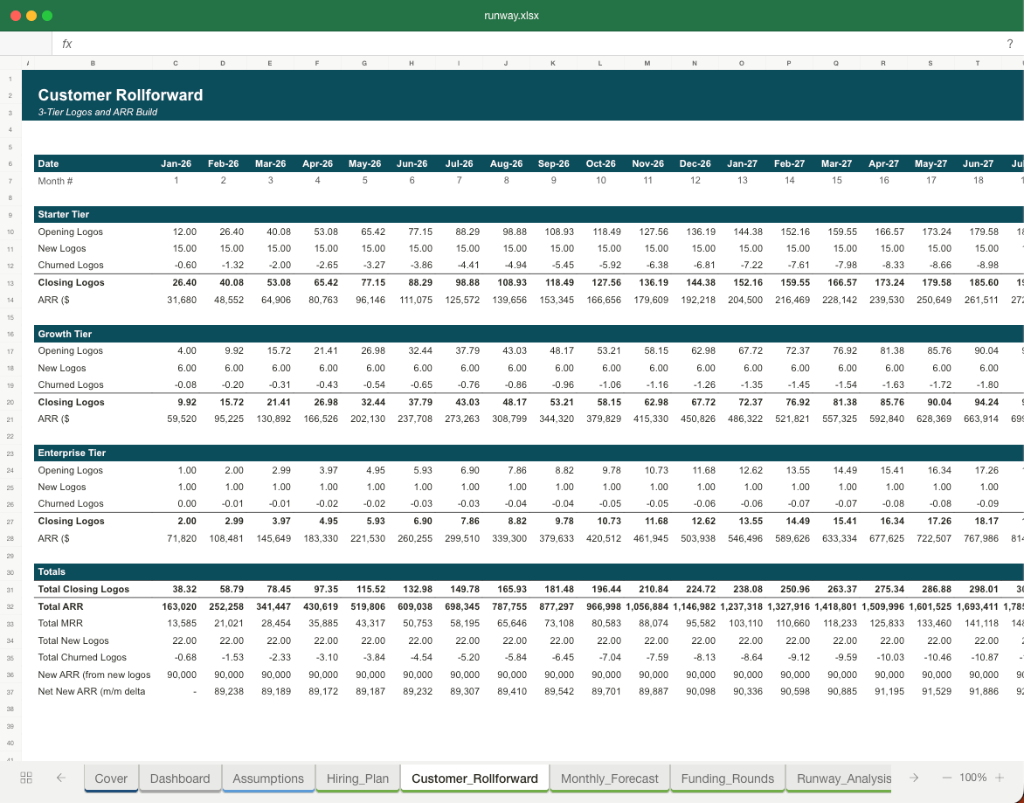
Outputs are driven by live formulas, so the workbook updates from its assumptions instead of relying on hardcoded results.
All assumptions in one tab
Inputs are clearly marked in the Assumptions tab and separated from calculations, making it clear what to change and what to leave intact.
Statements always balancing
For integrated-statement models, the balance sheet, cash flow, and supporting schedules tie through properly.
Distinct schedules for clarity
Debt, working capital, taxes, and cash flow can get messy quickly. We group calculations in clear schedules, not across disconnected tabs.
No hidden macros or external links
There are no unexplained external workbook links or macros to undermine auditability or portability.
Changes flow through the model
Update a key driver and see the impact carry through the forecast, financing, and return outputs. We never use hardcoded numbers in formulas.
About Destiny Robotics
destinyrobotics.io
How to build a detailed financial model for Destiny Robotics
A complete walkthrough of the business, drivers, and assumptions behind the downloadable Destiny Robotics model - distilled from its pitch deck and publicly available information.
Product & value proposition
- Product: "Destiny" - a humanoid robot home assistant.
- Value prop: Human-like physical interface enabling deeper emotional connection between humans and AI; addresses loneliness.
- Use cases (12 listed): Ordering, Health Control, Learning, Kids Care, Convenience & Safety, Crisis Management, Elderly Care, Games, Smart Home, Psychological Therapy, Entertainment, Hobbies.
- Technology basis: Convergence of advancements in robotics hardware and AI made development possible "only NOW."
Market
- Robotics Technology Market Size 2020: $62 Billion
- Robotics Technology Market Size by 2027: $189 Billion
- Source cited: Allied Market Research (alliedmarketresearch.com)
- Implied CAGR 2020–2027: ~17%
- No SAM or SOM defined in deck. No humanoid-specific or home-assistant sub-segment called out.
Revenue model
- Stage I: Pre-orders - collect deposits/full payment before manufacture.
- Stage II: Robot Sales per Household - ongoing/repeat unit sales to households.
- Channel: Direct-to-consumer implied (no retail/distribution partners mentioned).
- No subscription, SaaS, or services layer described.
Traction & metrics
- ~$140,000 Potential Worth from Total Number of Pre-orders
- Unit price implied: Cannot be derived without order count.
- No revenue, growth rates, or customer retention metrics disclosed.
Competition / moat
- Competitor positioning map (quadrant axes: Home Assistant vs. Humanoid AI):
- Destiny Robotics: High Home Assistant + High Humanoid AI (top-right quadrant - differentiated leader)
- Amazon Alexa: High Home Assistant + Low Humanoid AI (top-left)
- Hanson Robotics: Low Home Assistant + High Humanoid AI (bottom-right)
- Moat claim: Only player combining true humanoid form with home-assistant functionality.
- No IP, patents, or proprietary technology details provided.
Team & funding ask / use of funds
- Team:
- Megi Kavtaradze - Founder & CEO; serial entrepreneur; speaker at Harvard, Yale, Forbes NYC
- Jason Jordan - Chief Robotics Officer; background at U.S. Department of Defense, Mahle, Whirlpool
- George Q. - Head of Marketing; background at Tesla
- Erekle Shishniashvili - Senior AI Engineer; background at Huawei; awarded Microsoft Guardian AI Competition
- Lela Mirtskhulava - Chief Scientist, Ph.D.; visiting professor at Cambridge and UC Berkeley
- Irakli Datashvili - Head Software Engineer; background at HSBC, Motorola, ABB
Recommended financial model
- Archetype + why: Hardware DTC unit-sales P&L with pre-order cohort tracking. The business is a consumer hardware company (physical robot per household), not SaaS or a marketplace. Revenue is discrete unit transactions, not recurring subscriptions. The two-stage model (pre-orders → ongoing household sales) maps naturally to a cohort-based unit forecast with separate treatment for pre-order backlog conversion and steady-state sales.
- Forecast horizon & granularity: 5 years (Year 1–5); quarterly for Y1–Y2, annual for Y3–Y5. Pre-order pipeline should be modeled at monthly granularity for near-term cash planning given the ~$140K backlog starting point.
- Key drivers & assumptions:
- Unit selling price (ASP): ~$5,000–$10,000 per robot (humanoid home robots are capital-intensive; Hanson Robotics Sophia-class robots range from $10K–$70K; consumer-grade target likely sub-$10K) - must be confirmed with company
- Pre-order backlog: ~$140,000 total value; unit count = backlog / ASP (e.g. 14–28 units at $5K–$10K ASP)
- Pre-order conversion rate to delivery: 80–90%; typical for early-stage hardware
- Stage I pre-order period: 12–18 months before first unit delivery
- Stage II household sales ramp: starts Year 2; growth 50–100% YoY in Years 2–3 tapering to 20–30% in Years 4–5
- COGS / BOM: 40–60% of ASP in early production (hardware is margin-compressed at low volumes); improving to 30–40% at scale
- Gross margin: 40–60%, scaling upward with volume
- R&D spend: heavy pre-revenue; $500K–$2M annually in Y1–Y2
- S&M spend: 20–25% of revenue once sales begin
- G&A: 10–15% of revenue
- Headcount: ~10–20 FTE currently (6 named leadership + engineers); scale with funding
- Manufacturing: outsourced contract manufacturing initially; no capex model needed unless they bring in-house
- Market penetration: targeting small fraction of US households initially (130M US HHs; 0.001%–0.01% near-term)
- Scenarios (Base / Bull / Bear - which variables flex):
- Bear: ASP pressured downward, COGS higher than expected (manufacturing delays), pre-order conversion <70%, ramp to Stage II delayed 12 months
- Base: ASP holds, COGS improves with volume, pre-orders convert at 85%, Stage II launches on schedule
- Bull: ASP premium maintained, COGS beats on outsourcing efficiency, pre-order pipeline grows 3–5x pre-launch, strategic partnership accelerates distribution
- Required sheets / outputs:
- Assumptions dashboard (all drivers in one place)
- Pre-order cohort tracker (backlog in, conversions, revenue timing)
- Unit volume & revenue build (Stage I and Stage II separately)
- P&L (Revenue → Gross Profit → EBITDA → Net Income)
- Cash flow forecast (operating cash burn; no debt/equity structure given)
- Headcount & opex schedule
- Scenario toggle (Bear / Base / Bull)
- Summary KPI page (units sold, ASP, gross margin %, burn rate, cash runway)
Frequently asked
Is the Destiny Robotics financial model free?+
Yes. The Destiny Robotics model is a free Excel (.xlsx) download with live formulas. Sign up with your email and the workbook is yours to keep, review, and edit.
What's included in the model?+
A 5-year monthly forecast with P&L, cash flow and runway, valuation (exit multiple plus a DCF cross-check), MOIC/IRR returns, and unit economics, with live formulas throughout.
How was this model built?+
It was built from Destiny Robotics's pitch deck and publicly available information, then structured to investment-banking standards as a fully editable Excel model.
Can I change the assumptions?+
Yes. You can change assumptions and the live formulas will recalculate in the downloadable Excel model.
Have more financial modelling questions? Contact us

Created by ex-finance professionals
Hey, I’m Alex and I created Finamodel.
Over my years in the finance industry I kept building the same models over and over again. Same structure, same assumptions, different logo. So I started building frameworks to turn them into clean, reusable templates.
Every model here is one I’d actually use for a client, and I personally vet each one before it goes up.
I’m not an expert in every industry, but I’ve built enough models to know what belongs in one. And when something is completely foreign to me, I reach out to my network for experts to work on our models with us.
Having a template library on hand cuts a first build from hours to minutes.
Need help finding your model? You’ll find me in the Finamodel app!
Other Hardware/Deep-tech Startup Financial Models
Browse another startup in the same category.

ANYbotics
ANYbotics builds and sells autonomous legged inspection robots (ANYmal) for industrial facilities, targeting oil & gas, chemicals, power, offshore, mining, and manufacturing sectors.
Awake Security
Awake Security - AI-driven Network Detection & Response (NDR) platform for the hybrid cloud, positioning as the "intent detection" layer of the SOC visibility triad.

Beem
AR communications platform that overlays full-body "hologram" video of a person into the recipient's physical space via smartphone or web.

Blue White Robotics
Autonomous robotics platform converting existing farm equipment to self-driving tractors for permanent-crop growers, sold as Robots-as-a-Service.

Cambridge GaN Devices
Fabless semiconductor startup commercialising self-protected GaN power transistors (HiGaN) that replace silicon and standard GaN with higher efficiency and no external protection circuitry.

Canix
Cannabis-focused ERP (inventory tracking, compliance automation, sales management, yield forecasting) sold as SaaS to cannabis cultivators, manufacturers, and distributors.
Chobani
Chobani is the US market leader in Greek yogurt; TPG invested $671M in April 2014 for a 35% stake via a structured second lien + equity deal
Cipher Skin
Wearable sensor mesh platform that collects dense multi-modal data from human bodies and industrial objects to predict structural and functional failure before it occurs.