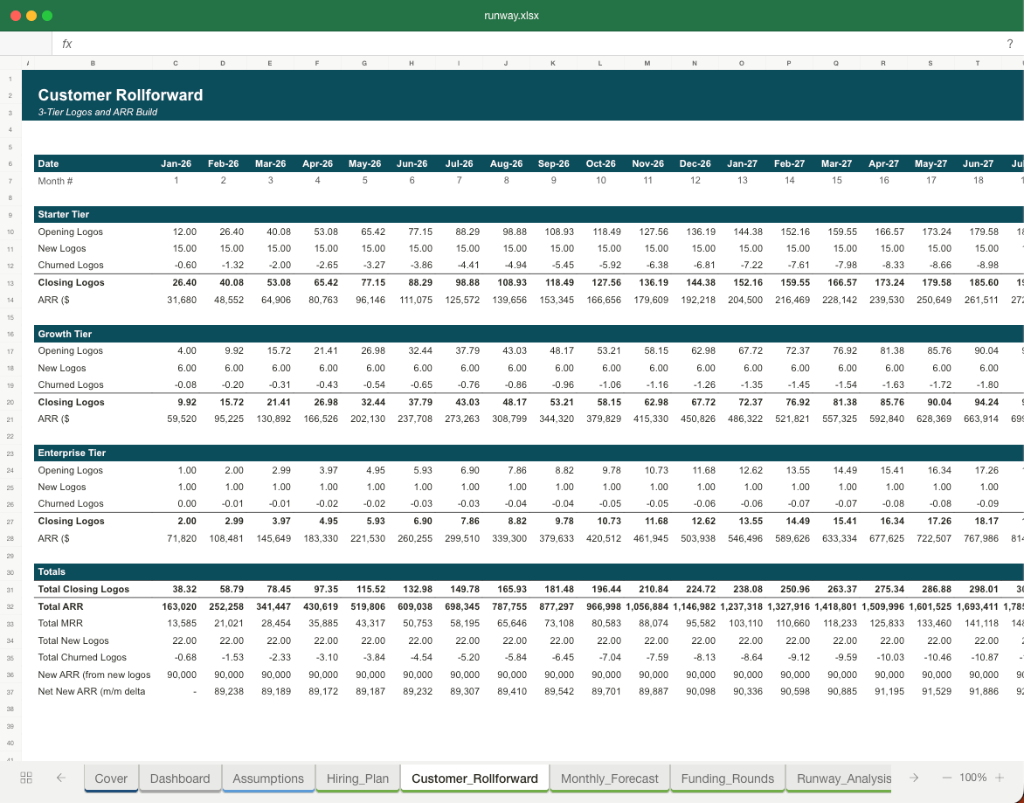
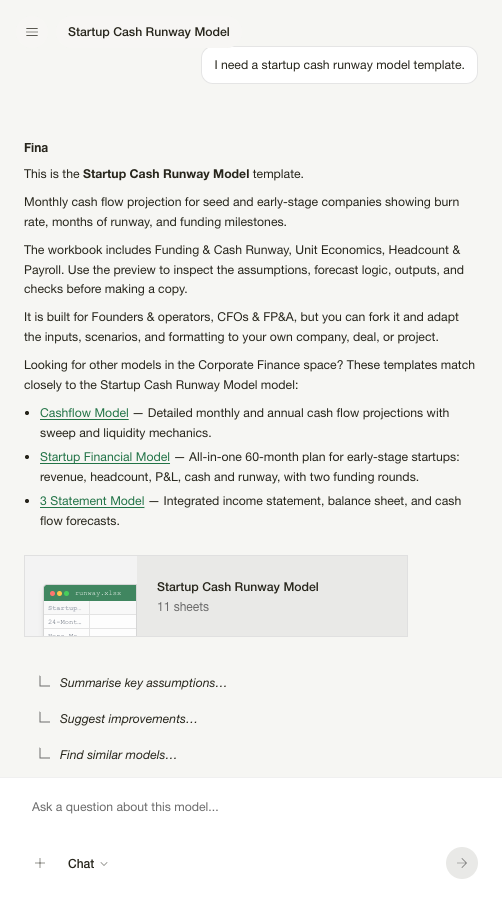
 Enduring Planet Financial Model
Fintech Startup Financials (Free Excel Download)
Climate-exclusive revenue-based financing (RBF) platform providing entrepreneur-friendly debt capital to climate-tech startups and SMBs, underwritten by ML/AI automation.



professionals from Deloitte
Used by professionals from






About this model
Enduring Planet provides climate-focused revenue-based financing to climate-tech startups and SMBs. Rather than taking equity or requiring fixed debt payments, it advances capital that is repaid as an agreed share of a borrower’s revenue.
The platform combines automated underwriting with a specialty-finance structure: capital is deployed through SPVs that can use institutional debt. Its climate-only mandate gives the business a focused sourcing and underwriting identity within alternative financing.
The model needs separate GP and investment-vehicle views. Forecast originations, average investment size, revenue-share yield, repayment speed, losses, and a 1% origination fee; then model SPV leverage, cost of capital, management costs, and cash available for new deployments.
A turnkey financial model
Live formulas, no hardcoded values
Outputs are driven by live formulas, so the workbook updates from its assumptions instead of relying on hardcoded results.
All assumptions in one tab
Inputs are clearly marked in the Assumptions tab and separated from calculations, making it clear what to change and what to leave intact.
Statements always balancing
For integrated-statement models, the balance sheet, cash flow, and supporting schedules tie through properly.
Distinct schedules for clarity
Debt, working capital, taxes, and cash flow can get messy quickly. We group calculations in clear schedules, not across disconnected tabs.
No hidden macros or external links
There are no unexplained external workbook links or macros to undermine auditability or portability.
Changes flow through the model
Update a key driver and see the impact carry through the forecast, financing, and return outputs. We never use hardcoded numbers in formulas.
About Enduring Planet
enduringplanet.com
How to build a detailed financial model for Enduring Planet
A complete walkthrough of the business, drivers, and assumptions behind the downloadable Enduring Planet model - distilled from its pitch deck and publicly available information.
Product & value proposition
- First product: Enduring Planet RBF - invests $100K–$2M in exchange for 2–10% top-line revenue share over a 1–3 year term.
- No personal guarantee, no collateral, no personal credit check.
- 1% origination fee.
- ML/AI-driven underwriting using bank accounts, CRM/billing, accounting systems, payment processors, and monthly P&L/BS submissions; automated ACH debit for collections.
- Value for entrepreneurs: fast affordable capital, access to VC network, active operational support.
- Future products planned: additional financial products for early-stage (pre-revenue) and growth-stage companies; potential ML software licensing to third-party lenders by 2025.
Market
- Venture investments in climate tech: $4.8B (2015) → $15.7B (2020) → $32B YTD (2021).
- Corporate net-zero commitments: 5 (2015) → 1,541 (2020), combined revenue $11.4T.
- Global carbon market: $272B in 2020, grew 20% YoY.
- Global clean energy technologies market: $452.8B projected by 2027.
- Carbontech described as "a trillion dollar opportunity".
- No explicit TAM/SAM/SOM sizing for the RBF addressable market is provided in the deck.
Revenue model
- Primary revenue: revenue-share repayments from portfolio companies (2–10% of borrower top-line revenue until capital + return is repaid, over 1–3 year terms).
- Secondary revenue: 1% origination fee per deal.
- Capital structure: equity raised via SAFE/seed round → deployed as equity into SPVs; SPVs lever up with institutional debt → SPVs deploy RBF investments to portfolio companies.
- Fund-of-funds / debt intermediary model: EP acts as GP/manager of SPVs, sourcing institutional debt capital to amplify deployment.
- Future revenue streams: additional financial products (unspecified) and potential ML underwriting software licensing.
Traction & metrics
- 582 companies sourced (via VC referrals, direct sourcing, website inbound).
- 139 companies met.
- $5M+ near-term pipeline.
- 7 term sheets issued, 3 signed.
- 1st deal closed.
- ~$2.1M committed to date for the SAFE round.
- Investment portfolio target for 2021: ~$500K.
- No revenue figures disclosed for current period.
- No portfolio company performance data disclosed.
Unit economics
- Revenue share rate: 2–10% of portfolio company top-line revenue.
- Deployment size: $100K–$2M per deal.
- Term: 1–3 years.
- Origination fee: 1%.
Competition / moat
- Competitive landscape: Equity (50%+ effective IRR, medium accessibility), Grants (low accessibility, high complexity), Commercial Debt/LOC (5–15%, medium accessibility, late stage only), Venture Debt (5–25%+, very low accessibility unless major-VC-backed), RBF peers - Pipe, Clearco, Lighter Capital, Capchase (15–40%, 90%+ focused on e-commerce/SaaS, not climate).
- Moat claims: climate-exclusive focus (no RBF competitor targets climate sector), ML/AI underwriting automation, VC network relationships (pipeline sourced via climate VCs), equity/inclusion scoring criteria.
- Sample VC partners listed: Obvious Ventures, Lowercarbon Capital, Avesta Fund, Pale Blue Dot, Prelude Ventures, VoLo Earth, Elemental Excelerator, Climate Capital, Congruent Ventures.
- Prior portfolio of team's past employer (EV) includes Lendable ($160M AUM), SunFunder ($170M AUM), $1B AUM climate fund-of-funds, M-KOPA ($189M raised), Zola Electric ($315M raised), d.light ($217M raised).
Team & funding ask / use of funds
- Co-founder & CEO: Dimitry Gershenson - Operating Partner at EV, Manager at Facebook, MS UC Berkeley.
- Co-founder & COO: Erin Davis - Co-founder SIMA, Investment Officer FINCA, MBA/MA American University.
- Board: Xavier Helgesen (Co-CEO EV, Co-founder Zola), Olympia De Castro (CIO/CFO Single Family Office, Co-founder CIM), Sieva Kozinsky (Co-CEO EV, GP The MBA Fund).
- Funding ask: $2M SAFE.
- ~$2.1M already committed from: Climate Capital, Possibilian, PSF, Keiki, CommonSense Fund, SIG, plus individual angels.
- Use of funds:
- $500K pilot investments (direct RBF deployments)
- $500K equity into first SPV (to lever with debt)
- $1M operating expenses (wages, marketing, software dev, legal)
- Post-SAFE roadmap: $7.5–$10M Seed + $25–$50M debt in 2022; $150M+ debt and $125M portfolio in 2023; $300M+ debt and ~$400M portfolio in 2024; $500M+ debt and $1B portfolio in 2025.
Recommended financial model
- Archetype + why: RBF fund / specialty finance model - hybrid of a credit fund P&L and a fund-manager operating company model. EP has two interlocking financial entities: (a) the GP/management company (OpCo) earning origination fees and eventually management fees; (b) the SPV vehicles that hold the loan/RBF portfolio and generate interest/revenue-share income. The model must capture both layers. Closest archetype: specialty finance / alternative lending fund model (similar to a BDC or marketplace lending P&L), not a standard SaaS or 3-statement operating model.
- Forecast horizon & granularity: 5 years (FY1–FY5, aligning with deck's bar chart), annual granularity, with monthly detail for Year 1 (cash runway visibility for the SAFE). FY1 = 2021/2022 operating year post-raise.
- Key drivers & assumptions:
*Portfolio / deployment drivers:*
- Starting deployed portfolio: ~$500K (2021); $25M+ (2022); $125M (2023); ~$400M (2024); $1B (2025)
- Average deal size: $500K
- Deals per year (FY1–FY5): derived from portfolio targets above
- Average term: 2 years
- Revenue share rate (blended): 6% of portfolio company top-line revenue
- Portfolio company average annual revenue growth: 40%
- Default / loss rate: 5% annually
- Portfolio turnover: ~50% per year
*Origination fee revenue:*
- 1% of each new deployment
- New deployments per year = net portfolio growth + repayments (portfolio churn)
*Debt leverage (SPV level):*
- Equity-to-debt ratio in SPV: 1:4
- Cost of debt: 8% p.a.
- Debt secured: $5M (2021); $25–$50M (2022); $150M+ (2023); $300M+ (2024); $500M+ (2025)
*OpCo revenue (management company):*
- Origination fees: 1% × new deployments
- Management fee (future): 1.5–2% of AUM
- Carry / performance fee: not mentioned in deck
*Operating expenses (OpCo):*
- Year 1 OpEx: $1M - wages, marketing, software dev, legal
- Headcount growth: +2–3 hires/year through Year 3
- Average fully-loaded salary: $150K
- Tech/software/legal: $200K Year 1 scaling to $500K by Year 3
*Equity & capital structure:*
- SAFE raise: $2M; converts at Seed
- Seed raise: $7.5–$10M in 2022
- Equity into SPV1: $500K of SAFE proceeds
- Scenarios (Base / Bull / Bear - which variables flex):
- Base: Portfolio targets per deck timeline; 6% revenue share rate; 5% default rate; 1:4 debt leverage.
- Bull: Faster portfolio scaling (1.25× deck targets); 8% blended revenue share rate; 3% default rate; 1:5 leverage.
- Bear: Portfolio targets slip 6–12 months; 4% revenue share rate; 8% default rate; debt harder to secure (1:3 leverage); OpEx runs higher.
- Primary flex variables: deployment pace, blended revenue-share rate, default/loss rate, debt leverage ratio, cost of debt.
- Required sheets / outputs:
- Assumptions - all drivers centralized with / tags
- Portfolio Schedule - deal-by-deal or cohort model: new deployments, repayments, outstanding portfolio by period, revenue-share income earned, origination fees, defaults
- SPV P&L - gross revenue-share income, interest expense on debt, net SPV income, equity return to EP
- OpCo P&L - origination fee revenue, management fees (Year 3+), OpEx, EBITDA, net income
- Consolidated P&L - combined FY1–FY5 income statement
- Cash Flow & Runway - OpCo cash burn, SAFE/Seed drawdown timing, months of runway
- Debt Schedule - SPV debt draws, interest, covenants (concentration limits per slide 24)
- Sensitivity Table - revenue-share rate vs. default rate; deployment pace vs. leverage ratio
- KPI Dashboard - AUM, # active deals, blended yield, loss rate, origination fee revenue, OpCo burn rate
Frequently asked
Is the Enduring Planet financial model free?+
Yes. The Enduring Planet model is a free Excel (.xlsx) download with live formulas. Sign up with your email and the workbook is yours to keep, review, and edit.
What's included in the model?+
A 5-year monthly forecast with P&L, cash flow and runway, valuation (exit multiple plus a DCF cross-check), MOIC/IRR returns, and unit economics, with live formulas throughout.
How was this model built?+
It was built from Enduring Planet's pitch deck and publicly available information, then structured to investment-banking standards as a fully editable Excel model.
Can I change the assumptions?+
Yes. You can change assumptions and the live formulas will recalculate in the downloadable Excel model.
Have more financial modelling questions? Contact us

Created by ex-finance professionals
Hey, I’m Alex and I created Finamodel.
Over my years in the finance industry I kept building the same models over and over again. Same structure, same assumptions, different logo. So I started building frameworks to turn them into clean, reusable templates.
Every model here is one I’d actually use for a client, and I personally vet each one before it goes up.
I’m not an expert in every industry, but I’ve built enough models to know what belongs in one. And when something is completely foreign to me, I reach out to my network for experts to work on our models with us.
Having a template library on hand cuts a first build from hours to minutes.
Need help finding your model? You’ll find me in the Finamodel app!
Other Fintech Startup Financial Models
Browse another startup in the same category.
Acin
SaaS and data subscription network for operational risk management at Tier 1 financial institutions

Ageras Group
B2B SME ecosystem - marketplace connecting SMEs with accountants + cloud accounting/payroll software + embedded financial services (lending, factoring, banking)

Airbase
Unified non-payroll spend management platform (corporate cards, AP/bill pay, expense reimbursement, approval workflows) for mid-market companies.

Altruist
Vertically integrated all-in-one platform for registered investment advisors (RIAs) - combining custodial, portfolio management, practice management, and client acquisition tools.
Amenitiz
All-in-one hotel management SaaS platform ("Shopify for hotels") for independent hoteliers - PMS, booking engine, channel manager, website builder, payments, and AI-driven revenue management.

Anrok
SaaS sales tax compliance platform - nexus monitoring, calculation, registration, filing, and remittance - built specifically for SaaS companies.
Arrival
Arrival is an EV manufacturer of commercial vans and buses using proprietary Microfactories and vertically integrated components, going public via SPAC merger with CIIG Merger Corp.

AtoB
AtoB is building financial infrastructure for commercial fleets, starting with a no-fee Visa fleet card for fuel and expanding into payroll, BNPL, and international.