FUFundid Financial Model
Fintech Startup Financials (Free Excel Download)
Fintech platform giving small business owners (especially women) access to capital via grant matching, a credit-building business card, and micro-lending.



professionals from Deloitte
Used by professionals from






About this model
Fundid helps small-business owners, particularly women, access capital through grant matching, a credit-building business card, and micro-lending. The product combines discovery and education with practical financial tools for entrepreneurs underserved by traditional lenders.
The free grant marketplace can create a funnel into cardholders and borrowers, making product conversion central to its economics. Card usage generates interchange, while credit products add interest or fee income alongside their associated underwriting risk.
The model should track users from grant discovery to card application, activation, spend, and lending adoption. Forecast net interchange on card volume separately from loan originations, yield, defaults, recoveries, and funding cost, then compare customer-acquisition spend with cohort-level lifetime value.
A turnkey financial model
Live formulas, no hardcoded values
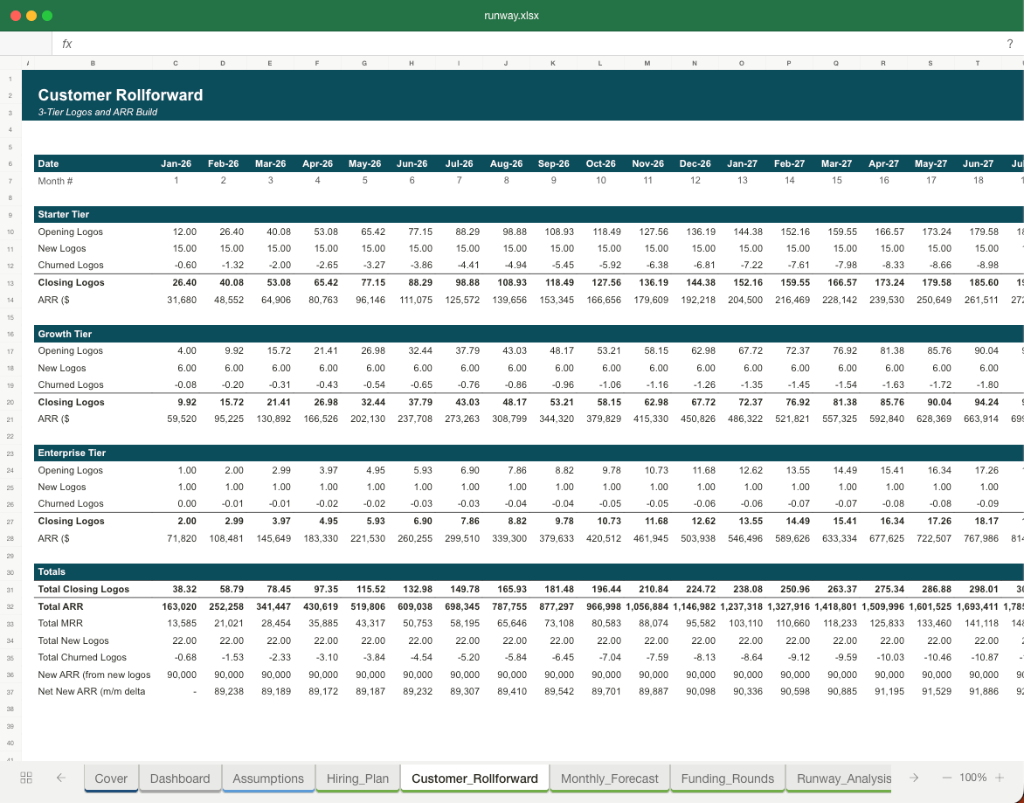
Outputs are driven by live formulas, so the workbook updates from its assumptions instead of relying on hardcoded results.
All assumptions in one tab
Inputs are clearly marked in the Assumptions tab and separated from calculations, making it clear what to change and what to leave intact.
Statements always balancing
For integrated-statement models, the balance sheet, cash flow, and supporting schedules tie through properly.
Distinct schedules for clarity
Debt, working capital, taxes, and cash flow can get messy quickly. We group calculations in clear schedules, not across disconnected tabs.
No hidden macros or external links
There are no unexplained external workbook links or macros to undermine auditability or portability.
Changes flow through the model
Update a key driver and see the impact carry through the forecast, financing, and return outputs. We never use hardcoded numbers in formulas.
About Fundid
https:
How to build a detailed financial model for Fundid
A complete walkthrough of the business, drivers, and assumptions behind the downloadable Fundid model - distilled from its pitch deck and publicly available information.
Product & value proposition
Three-pronged platform:
- Grant Match Program - aggregated grant marketplace matching business owners to available grants; free entry point / customer acquisition funnel.
- Business Building Card - credit-building business charge card with BNPL "micro-loan bucket" allowing users to convert monthly expenses into micro-loans to improve cash flow; no personal guarantee implied. Card has gamified limit increases and no fees.
- Micro-lending - moves higher-value expenses into micro-loans, improving SMB cash flow.
Long-term vision: leverage transaction + credit data to build a proprietary "Fundid Business Health Score" for bespoke lending products.
Market
- U.S. SMB estimated revenue pool across lending and deposits: ~$90B–$100B
- Total U.S. small and medium business revenues: $40T across 26.5M SMBs
- Market size if women-owned businesses (WOBs) achieved equity with 42% of revenues: $17.2T
- Revenue from 13M U.S. WOBs: $1.9T
- 75% of U.S. businesses are micro-businesses (fewer than 9 employees)
- Addressable financial services pool: $90B–$100B (lending + deposits for SMB segment)
Revenue model
Two disclosed revenue streams:
- Interchange - revenue from card swipe fees when members use the Fundid Business Building Card (standard card interchange ~1–2% of spend). No specific rate disclosed.
- Business Loans / Micro-lending - interest income or fee income on micro-loans originated through the card's BNPL bucket.
Additional implied streams (not explicitly stated):
- Potential premium/subscription tier for grant matching (not confirmed in deck)
- Data/partnership revenue at scale (mentioned directionally in vision slide 9, no specifics)
Traction & metrics
All from slide 8, marketing started May 2021:
| Metric | Value |
|---|---|
| Grant Match Program sign-ups per day | 170–190 |
| Total Grant Match Program users | 7,057 |
| Total surveys completed | 2,000+ |
| New surveys per day | 60–80 |
| Business Building Card waitlist total | 1,560+ |
| Avg new card waitlist sign-ups per day | 60–90 |
| Monthly website impressions | 56K |
| Monthly website users | 9–10K |
Note: No revenue, no card spend, no loan volume, no paying customers disclosed. Product is in pre-launch / waitlist phase.
Competition / moat
- Competitive framing: intersection of Business Cards (incumbents: Amex, Chase Ink, Brex, Ramp) and Buy Now Pay Later / micro-lending. Venn diagram positions Fundid at the overlap.
- Moat arguments stated: proprietary grant matching as low-CAC acquisition funnel; credit-building card targeting underserved WOBs and micro-businesses; future "Fundid Business Health Score" as proprietary credit data asset.
- Named competitors: Not explicitly listed.
Team & funding ask / use of funds
Team:
- Stefanie Sample - Founder & CEO; serial entrepreneur 13 years, marketing/growth consultant to 30+ startups; advisory board First Interstate Bank, YPO.
- Cameron Peake - Strategy & Operations; Co-founder & CEO Azlo, Innovation @ BBVA, Co-Founder Wharton Fintech.
- Matthew Browning - Banking Ops; COO Snap Finance, CEO/President Sterne Agee Bank, President Target Bank.
- Millicent Tracy - Compliance & Risk; SVP Payments Wells Fargo, Park Place Fintech.
- Camellia George - Banking Technology; Co-founder & CTO Koxa, Head of Product Venmo, Head of Product Ninth Wave.
- Mylee Vignes - Product; SVP Head of Growth Products & Innovation Snap Finance.
Recommended financial model
- Archetype + why: Fintech / marketplace + card lending 3-statement model with two modules: (1) a SaaS-style user funnel for the grant marketplace (free users → card applicants → activated cardholders) driving CAC math, and (2) a card/lending P&L (interchange revenue + net interest income on micro-loans). Closest public analog: neobank / SMB card P&L (think Brex or Ramp at early stage). A simple 3-statement model with monthly granularity in Year 1–2 is the right level given pre-revenue stage.
- Forecast horizon & granularity: 3 years; monthly in Year 1 (pre-card launch through ramp), quarterly in Years 2–3.
- Key drivers & assumptions:
*User funnel / acquisition:*
- Grant marketplace daily sign-ups: 170–190; stabilises then grows as paid marketing turns on post-raise.
- Conversion: grant user → card waitlist: ~20–25% based on waitlist/user ratio at time of deck (1,560 waitlist / 7,057 users ≈ 22%).
- Card activation rate from waitlist: 60–70% (typical fintech waitlist-to-activation).
- Monthly active cardholders ramp: starts near zero at launch; model from scratch using funnel.
*Card economics:*
- Average monthly card spend per cardholder: $2,000–$5,000 (SMB card benchmarks; no deck data).
- Interchange yield: 1.5–2.0% of spend (standard Visa/MC business card).
- Micro-loan "bucket" utilisation rate: 30–40% of cardholders move expenses to micro-loans.
- Average micro-loan balance per user: $1,000–$3,000.
- Net interest margin on micro-loans: 8–15% annualised (positioned as low-cost vs. credit cards at 17–20%).
- Net credit loss rate: 3–6% (early-stage SMB micro-lending; no historical data).
*Cost structure:*
- CAC (blended, grant funnel): $20–$50 per grant user; $150–$300 per activated cardholder (low acquisition cost is core thesis).
- Card program costs (processing, BIN sponsorship, fraud): 0.5–0.8% of spend.
- Headcount: scale from current ~6 team + ops hires post-raise.
- Compliance / banking / regulatory: material fixed cost given banking ops team.
- Scenarios (Base / Bull / Bear - which variables flex):
- Base: Grant sign-ups hold at 170–190/day; 20% convert to cardholders; card spend at $3K/month/user; 35% micro-loan utilisation; credit losses 4%.
- Bull: Sign-ups accelerate post-marketing spend; higher conversion (30%); spend per cardholder $5K+; lower losses 2–3%.
- Bear: Conversion drops to 10%; card activation stalls (waitlist doesn't convert); credit losses spike 8%+; interchange revenue insufficient to cover fixed costs.
- Required sheets / outputs:
- `Assumptions` - all drivers in one place, switchable by scenario.
- `User Funnel` - monthly grant users → card applicants → activated cardholders → churned.
- `Revenue Build` - interchange P&L + micro-loan interest income.
- `Cost Build` - CAC, card program opex, headcount, compliance.
- `Income Statement` - monthly IS, then annual summary.
- `Balance Sheet` - loan book, card receivables, cash.
- `Cash Flow` - operating CF, funding draws, runway.
- `Dashboard` - KPI summary (cardholders, GMV spend, loan book, revenue, burn, runway).
Frequently asked
Is the Fundid financial model free?+
Yes. The Fundid model is a free Excel (.xlsx) download with live formulas. Sign up with your email and the workbook is yours to keep, review, and edit.
What's included in the model?+
A 5-year monthly forecast with P&L, cash flow and runway, valuation (exit multiple plus a DCF cross-check), MOIC/IRR returns, and unit economics, with live formulas throughout.
How was this model built?+
It was built from Fundid's pitch deck and publicly available information, then structured to investment-banking standards as a fully editable Excel model.
Can I change the assumptions?+
Yes. You can change assumptions and the live formulas will recalculate in the downloadable Excel model.
Have more financial modelling questions? Contact us

Created by ex-finance professionals
Hey, I’m Alex and I created Finamodel.
Over my years in the finance industry I kept building the same models over and over again. Same structure, same assumptions, different logo. So I started building frameworks to turn them into clean, reusable templates.
Every model here is one I’d actually use for a client, and I personally vet each one before it goes up.
I’m not an expert in every industry, but I’ve built enough models to know what belongs in one. And when something is completely foreign to me, I reach out to my network for experts to work on our models with us.
Having a template library on hand cuts a first build from hours to minutes.
Need help finding your model? You’ll find me in the Finamodel app!
Other Fintech Startup Financial Models
Browse another startup in the same category.
Acin
SaaS and data subscription network for operational risk management at Tier 1 financial institutions

Ageras Group
B2B SME ecosystem - marketplace connecting SMEs with accountants + cloud accounting/payroll software + embedded financial services (lending, factoring, banking)

Airbase
Unified non-payroll spend management platform (corporate cards, AP/bill pay, expense reimbursement, approval workflows) for mid-market companies.

Altruist
Vertically integrated all-in-one platform for registered investment advisors (RIAs) - combining custodial, portfolio management, practice management, and client acquisition tools.
Amenitiz
All-in-one hotel management SaaS platform ("Shopify for hotels") for independent hoteliers - PMS, booking engine, channel manager, website builder, payments, and AI-driven revenue management.

Anrok
SaaS sales tax compliance platform - nexus monitoring, calculation, registration, filing, and remittance - built specifically for SaaS companies.
Arrival
Arrival is an EV manufacturer of commercial vans and buses using proprietary Microfactories and vertically integrated components, going public via SPAC merger with CIIG Merger Corp.

AtoB
AtoB is building financial infrastructure for commercial fleets, starting with a no-fee Visa fleet card for fuel and expanding into payroll, BNPL, and international.