 IQM Financial Model
Hardware/Deep-tech Startup Financials (Free Excel Download)
IQM builds and sells on-premise superconducting quantum computers directly to enterprise and research customers.

professionals from Deloitte
Used by professionals from






About this model
IQM builds on-premise superconducting quantum computers for enterprise and research customers. Its commercial path relies on delivering high-value systems and research partnerships, where technical milestones, system performance, installation readiness, and customer confidence matter before a hardware order can convert into recognised revenue.
Quantum systems have long sales and delivery cycles. Revenue can combine system sales, service contracts, research arrangements, and grants, while engineering, cryogenic hardware, manufacturing, and customer installation consume capital well before a repeatable volume business emerges.
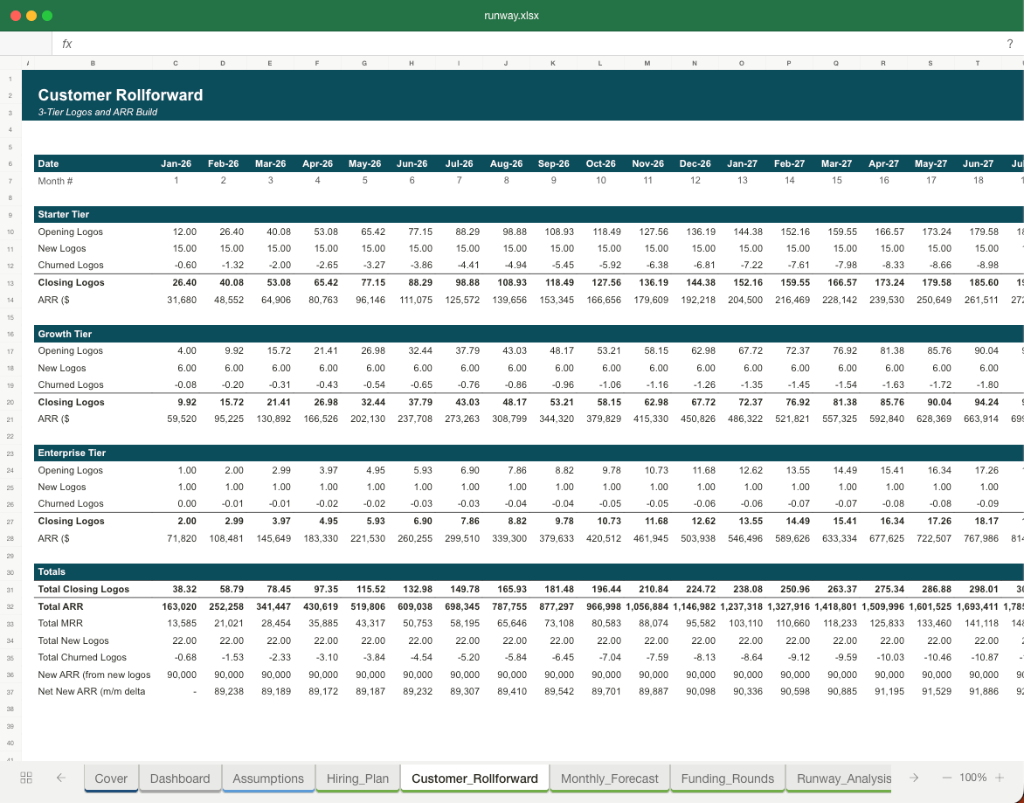
Model qualified opportunities, systems sold, ASP, delivery milestones, service contracts, grants, and installation timing. Include R&D, manufacturing, specialist components, facilities, field engineering, and support costs. Technical performance, sales-cycle length, system margin, grant timing, delivery capacity, service attach, and repeat orders should drive scenarios.
A turnkey financial model
Live formulas, no hardcoded values
Outputs are driven by live formulas, so the workbook updates from its assumptions instead of relying on hardcoded results.
All assumptions in one tab
Inputs are clearly marked in the Assumptions tab and separated from calculations, making it clear what to change and what to leave intact.
Statements always balancing
For integrated-statement models, the balance sheet, cash flow, and supporting schedules tie through properly.
Distinct schedules for clarity
Debt, working capital, taxes, and cash flow can get messy quickly. We group calculations in clear schedules, not across disconnected tabs.
No hidden macros or external links
There are no unexplained external workbook links or macros to undermine auditability or portability.
Changes flow through the model
Update a key driver and see the impact carry through the forecast, financing, and return outputs. We never use hardcoded numbers in formulas.
About IQM
meetiqm.com
How to build a detailed financial model for IQM
A complete walkthrough of the business, drivers, and assumptions behind the downloadable IQM model - distilled from its pitch deck and publicly available information.
Product & value proposition
- Builds fully integrated, on-premise superconducting quantum computing systems (QPUs).
- Three proprietary technology pillars:
- Application-specific processors (QuASICs) via hardware-software co-design; digital-analog quantum computing shortcut to quantum advantage without requiring millions of qubits.
- Quantum electronics: cryogenic + room-temperature control electronics.
- Unique chip technology: faster reset (QCR, 10x speedup, unconditional, no RF fields), faster readout (multichannel driving), faster gates (tunable coupler + N-junction qubits). Both reset and readout technologies are patent-protected and suitable for licensing.
- Modular design - hardware can be upgraded to a more powerful QPU without full replacement.
- Claims to be the only provider delivering superconducting hardware to customer premises.
Market
- TAM (2029): €2.5 billion - total quantum computing market (hardware + software + cloud).
- SAM (2029): €1 billion - on-premise quantum computers (Europe & parts of Asia & US).
- SOM (2029): €0.5 billion - serviceable obtainable market.
- Market structured as stacked hardware/software/cloud; hardware layer grows from ~€0.1bn (2020) toward ~€1bn (2028) per chart axes.
- Series A investment point marked at ~2024 on the market-size timeline.
- No CAGR explicitly stated; implied ~25–30% CAGR from chart visual.
Revenue model
- Primary: Sale of fully integrated on-premise quantum computing hardware systems.
- Benchmark ASP: €41m per system (cited IBM system for Germany as reference).
- Modular upgrade path creates potential for follow-on revenue from existing customers.
- Secondary (future): Cloud computing access - explicitly positioned as post-hardware-market entry.
- IP licensing potential: reset and readout chip technologies described as "protected technology suitable for licensing".
- Sales channel: Direct, own salesforce only (product requires specialist technical expertise).
- Sales cycle: 6–12 months.
- Lead generation: industry events, content marketing, IQM Business Club (30+ multinational participants).
Traction & metrics
- Seed funding: €11.45m - described as "largest seed investment in the history of Finland".
- Headcount: ~75 staff as of Oct 2020 (chart apex ~75, split ~60 Finland / ~15 Germany); separately cited as "70+ exceptional experts in two countries in less than 18 months".
- Scaled from 0 to ~75 staff in ~15 months (Jul 2019 → Oct 2020).
- IQM Business Club: 30+ multinational participants.
- Published research: 640+ scientific articles, 27,000+ citations, IQM h-index 81.
- Customers: 0 disclosed (pre-revenue, Series A stage).
- Seed funding goals reached in 1/3 of expected time.
Unit economics
- ASP benchmark: €41m per system; all other unit economics not in deck.
- Hardware COGS (dilution refrigerators, chip fab, control electronics) will be substantial - Not in deck.
Competition / moat
- Competitive context: IBM, Google, Intel, Microsoft, Honeywell named as global players in ecosystem slide; no explicit competitive matrix in deck.
- Claimed moat:
- Only European provider of on-premise superconducting QC systems.
- Proprietary chip technologies (QCR reset, multichannel readout) with patent protection.
- Application-specific (QuASIC) approach vs. universal-qubit competitors - claimed shortcut to quantum advantage.
- World-class team: ex-Microsoft Quantum, Delft, ETH Zurich; 6+ patent families from Chief Scientist.
- Deep European ecosystem relationships; proximity to enterprise customers (Airbus, Bayer, BASF, Siemens, etc.) who prefer on-premise over US cloud.
Team & funding ask / use of funds
- CEO & Co-Founder: Dr Jan Goetz - Marie-Curie Fellow, 10+ years quantum computing experience.
- COO & Co-Founder: Dr Juha Vartiainen - 13 years product development, scaled prior company 30→80 people.
- CTO & Co-Founder: Dr Kuan Yen Tan - ex-Microsoft Quantum, 2,500+ citations, fabricated 17-qubit processor for Intel.
- Chief Scientist & Co-Founder: Prof Mikko Möttönen - Aalto University professor, 100+ articles, 6+ patent families, €10m+ public funding raised.
- CEO IQM Germany: Prof Enrique Solano - ~250 published articles, founded quantum centers in Bilbao and Shanghai.
- Funding ask: Series A - amount not stated in deck.
- Use of funds: Delivery of 2nd generation 54-qubit quantum supremacy machines by 2023; no detailed use-of-funds breakdown in deck.
- Prior seed: €11.45m (2019).
Recommended financial model
- Archetype + why: Capital-equipment project revenue model (akin to large industrial / scientific instrument). IQM is pre-revenue, selling high-ASP hardware (€41m/unit benchmark) on 6–12 month sales cycles to a small number of enterprise and institutional customers. The right model is a unit-economics + project pipeline P&L - not a SaaS ARR model, not a marketplace GMV model. Forecast unit sales × ASP, back out estimated COGS (hardware BOM + fab + integration), and layer in opex (headcount-driven R&D + sales). A supplemental 3-statement model is needed for Series A diligence (burn rate, cash runway, balance sheet).
- Forecast horizon & granularity: 5 years (2021–2025), quarterly for Years 1–2 (to track deal pipeline and burn), annual for Years 3–5. A 10-year horizon with a terminal value may be appropriate for DCF if investors request it.
- Key drivers & assumptions:
| Driver | Value |
|---|---|
| Benchmark system ASP | €41m |
| Sales cycle length | 6–12 months |
| Target market (SAM 2029) | €1bn on-premise |
| SOM (2029) | €0.5bn |
| Headcount at Series A (Oct 2020) | ~75 |
| Units sold Y1 (2021) | 0–1 |
| Units sold Y2 (2022) | 1–2 |
| Units sold Y3 (2023) | 2–4 |
| Units sold Y4–Y5 | 4–8 / 8–15 |
| ASP trajectory | Flat to modest decline (-5% to -10%/yr) |
| Hardware COGS % of revenue | 40–60% |
| Gross margin | 40–60% |
| R&D opex (% revenue, early years) | 60–80% of opex |
| Annual burn (2021) | €10–15m |
| Series A raise | €30–50m |
| IP licensing revenue | Excluded from base case |
| Cloud revenue | Excluded from 5-yr forecast |
- Scenarios (Base / Bull / Bear - which variables flex):
- Base: 1 unit in 2022, 3 in 2023, 6 in 2024, 10 in 2025. ASP flat at €41m. Gross margin 45%.
- Bull: Faster sales conversion (2 units 2022, 5 in 2023), ASP holds, government/defence contracts accelerate pipeline. IP licensing deal adds €2–5m/yr from 2024.
- Bear: Delays to 54-qubit product push first delivery to 2024. Competitive pressure from IBM/Google cloud offerings reduces pipeline. Higher than expected COGS (chip yield issues). Series A delayed or smaller than needed → bridge required.
- Required sheets / outputs:
- Assumptions & drivers (all tagged DECK/ASSUMED)
- Unit sales pipeline (quarterly: deal stages → signed → delivered → recognised)
- Revenue build (units × ASP by product generation; upgrade revenue from Y3+)
- P&L (Revenue, COGS, Gross Profit, R&D, S&M, G&A, EBITDA, EBIT)
- Headcount plan (by function: engineering/fab, sales, G&A)
- Cash flow & runway (monthly burn, cash balance, Series A proceeds)
- Balance sheet (simplified; key items: cash, PP&E for fab equipment, deferred revenue on long-cycle contracts)
- Scenario toggle (Base / Bull / Bear on units and ASP)
- Valuation summary (revenue multiple range; DCF optional)
Frequently asked
Is the IQM financial model free?+
Yes. The IQM model is a free Excel (.xlsx) download with live formulas. Sign up with your email and the workbook is yours to keep, review, and edit.
What's included in the model?+
A 5-year monthly forecast with P&L, cash flow and runway, valuation (exit multiple plus a DCF cross-check), MOIC/IRR returns, and unit economics, with live formulas throughout.
How was this model built?+
It was built from IQM's pitch deck and publicly available information, then structured to investment-banking standards as a fully editable Excel model.
Can I change the assumptions?+
Yes. You can change assumptions and the live formulas will recalculate in the downloadable Excel model.
Have more financial modelling questions? Contact us

Created by ex-finance professionals
Hey, I’m Alex and I created Finamodel.
Over my years in the finance industry I kept building the same models over and over again. Same structure, same assumptions, different logo. So I started building frameworks to turn them into clean, reusable templates.
Every model here is one I’d actually use for a client, and I personally vet each one before it goes up.
I’m not an expert in every industry, but I’ve built enough models to know what belongs in one. And when something is completely foreign to me, I reach out to my network for experts to work on our models with us.
Having a template library on hand cuts a first build from hours to minutes.
Need help finding your model? You’ll find me in the Finamodel app!
Other Hardware/Deep-tech Startup Financial Models
Browse another startup in the same category.

ANYbotics
ANYbotics builds and sells autonomous legged inspection robots (ANYmal) for industrial facilities, targeting oil & gas, chemicals, power, offshore, mining, and manufacturing sectors.
Awake Security
Awake Security - AI-driven Network Detection & Response (NDR) platform for the hybrid cloud, positioning as the "intent detection" layer of the SOC visibility triad.

Beem
AR communications platform that overlays full-body "hologram" video of a person into the recipient's physical space via smartphone or web.

Blue White Robotics
Autonomous robotics platform converting existing farm equipment to self-driving tractors for permanent-crop growers, sold as Robots-as-a-Service.

Cambridge GaN Devices
Fabless semiconductor startup commercialising self-protected GaN power transistors (HiGaN) that replace silicon and standard GaN with higher efficiency and no external protection circuitry.

Canix
Cannabis-focused ERP (inventory tracking, compliance automation, sales management, yield forecasting) sold as SaaS to cannabis cultivators, manufacturers, and distributors.
Chobani
Chobani is the US market leader in Greek yogurt; TPG invested $671M in April 2014 for a 35% stake via a structured second lien + equity deal
Cipher Skin
Wearable sensor mesh platform that collects dense multi-modal data from human bodies and industrial objects to predict structural and functional failure before it occurs.