JOJobox Financial Model
Marketplace Startup Financials (Free Excel Download)
Operating system + managed marketplace for home-service field professionals ("Pros"), replacing fragmented lead generators and back-office tools with a single app.



professionals from Deloitte
Used by professionals from






About this model
Jobox is an operating system and managed marketplace for home-service professionals. Its app combines workflow tools, scheduling, CRM, payments, invoicing, and a matching layer that dispatches external job leads to vetted professionals based on location, skills, and availability.
The platform reported more than 5,000 active professionals, over $1 billion of transactions processed, coverage in 39 states, and a job matched every three minutes. Marketplace-dispatched jobs generate a net commission of roughly 20%, while payments and software create potential additional economics.
The model builds GMV from professional cohorts, jobs per professional, average job value, and state expansion, then applies the marketplace take rate. Payment-processing margin can sit as a secondary revenue layer. Matching quality, job fulfillment, pro retention, lead-source economics, and dispatch operations determine marketplace contribution margin.
A turnkey financial model
Live formulas, no hardcoded values
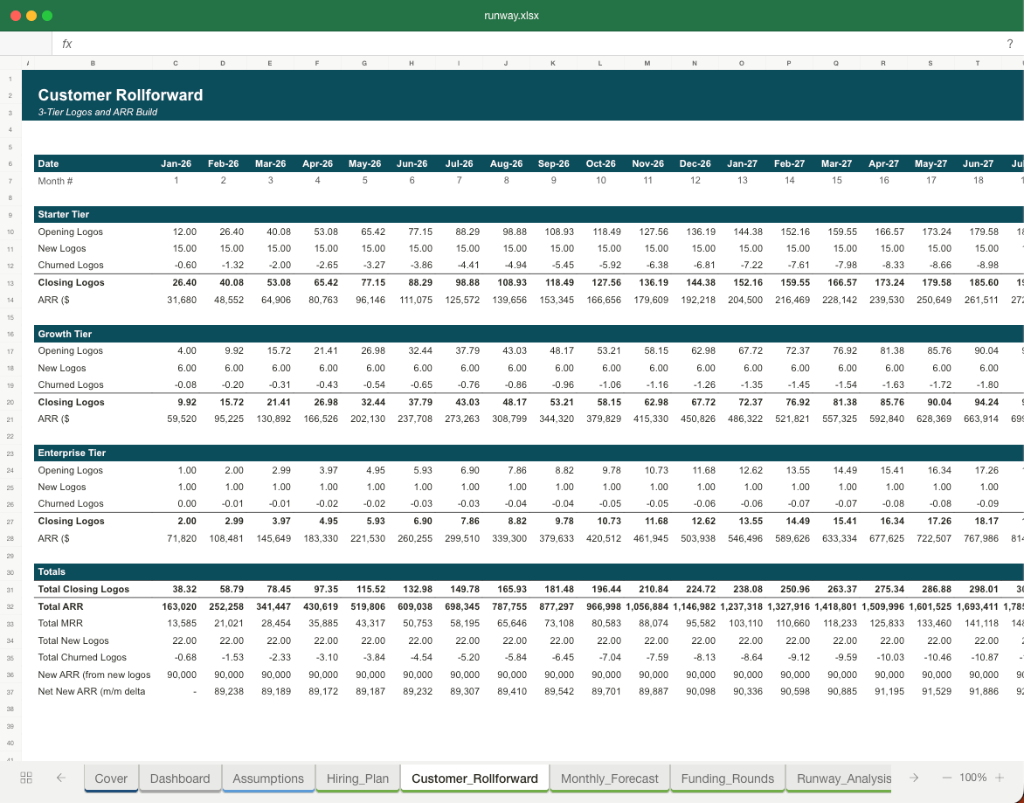
Outputs are driven by live formulas, so the workbook updates from its assumptions instead of relying on hardcoded results.
All assumptions in one tab
Inputs are clearly marked in the Assumptions tab and separated from calculations, making it clear what to change and what to leave intact.
Statements always balancing
For integrated-statement models, the balance sheet, cash flow, and supporting schedules tie through properly.
Distinct schedules for clarity
Debt, working capital, taxes, and cash flow can get messy quickly. We group calculations in clear schedules, not across disconnected tabs.
No hidden macros or external links
There are no unexplained external workbook links or macros to undermine auditability or portability.
Changes flow through the model
Update a key driver and see the impact carry through the forecast, financing, and return outputs. We never use hardcoded numbers in formulas.
About Jobox
jobox.io
How to build a detailed financial model for Jobox
A complete walkthrough of the business, drivers, and assumptions behind the downloadable Jobox model - distilled from its pitch deck and publicly available information.
Product & value proposition
Three integrated product pillars:
- Workflow Tools - dedicated work phone number, in-app messaging and call recording, job scheduling/CRM, calendar integration, skillset management, auto-generated business profile.
- Integrated Fintech - payment processing (card, Apple Pay, Android Pay, tap/dip), invoicing, estimates, receipts with remote customer e-signature, auto-generated reports, inventory tracking.
- Managed Marketplace - Jobox aggregates job leads from external lead generators/on-demand platforms via API, matches jobs to Pros in real-time based on location, skillset, availability, then dispatches via mobile. Pros are vetted and get a public micro-site profile. Back-office dispatch dashboard for enterprise clients.
Core value proposition to Pros: free access to the platform; removes reliance on middlemen who previously kept ~70% of the job value. Jobs sent to Pros' wallets within 24 hours.
Market
- TAM: >$500B home services market, representing 3% of the U.S. workforce (source cited: IAC 2020 Report).
Revenue model
The deck shows Jobox takes a commission cut from jobs dispatched through the managed marketplace. Back-office dispatch UI explicitly shows: "Audrey's cut 60% + $2.50 / My cut 40% - $2.50 / NET COMMISSION 20%". This implies:
- Jobox charges ~20% net commission on gross job value for marketplace-dispatched jobs.
- The Pro receives ~60% and pays a flat per-job fee; Jobox retains ~40% gross before passing back the Pro's share.
- Marketplace jobs appear free to Pros for discovery (stated "we send jobs to our pros for free") - revenue comes from the enterprise/platform side or from the spread.
- Fintech / payments: deck mentions "our own IP for Fraud, Disputes, wallet tiers and money holds" suggesting potential interchange or payment-processing margin; not quantified.
- SaaS / subscription: Not explicitly stated in deck; workflow tools described as free to Pros.
Channels: API integrations with existing lead generators and on-demand platforms (Yelp, Minute Key, Pop-A-Lock, Amazon).
Traction & metrics
- 5,000+ Pros actively using Jobox to find and manage jobs in the US.
- $1B+ in total transactions processed.
- 39 states covered.
- 1 job matched every 3 minutes on the platform.
- No revenue figures, MoM/YoY growth rates, or cohort data shown in deck.
Unit economics
- Commission rate: ~20% net on dispatched job GMV.
- Example job value visible in deck: $220 (ignition repair) and $478.09 (residential lock change); $388 (home lockout + lock replacement); $120 (locksmith service).
- Implied average job value: ~$200–$350 based on sample jobs visible in deck; no average stated.
Competition / moat
- Incumbents identified: Lead generators and on-demand marketplaces that keep ~70% of job value.
- Jobox moat claims: Real-time matching algorithm (location + skillset + availability), full-stack platform (workflow + fintech + marketplace in one app), Pro vetting/compliance, branded public Pro micro-sites, API integrations with existing lead platforms.
- No competitive matrix or named competitors shown beyond the generic "lead generators & on-demand marketplaces" category.
Team & funding ask / use of funds
- Team: Not shown (no team slide in deck).
- Contact: hi@jobox.ai.
Recommended financial model
- Archetype + why: Marketplace GMV + take-rate model with a SaaS/fintech revenue overlay. Jobox's primary P&L driver is GMV flowing through the managed marketplace × net commission (~20%). Secondary revenue streams (payment processing spread, potential future SaaS subscription) are smaller and less defined. This is structurally closest to a two-sided marketplace model (Thumbtack, Handy, ServiceTitan-adjacent) - model GMV by state/vertical, apply take rate, layer in fintech economics.
- Forecast horizon & granularity: 3 years monthly (Year 1–2 monthly, Year 3 quarterly). Monthly granularity needed to track Pro cohort growth, job volume ramp, and GMV acceleration given the "1 job per 3 minutes" cadence already visible.
- Key drivers & assumptions:
| Driver | Seed value |
|---|---|
| Active Pros on platform | 5,000+ |
| States covered | 39 |
| Total GMV processed (cumulative) | >$1B |
| Net commission rate (marketplace) | ~20% |
| Jobs per Pro per month | 8–15 jobs/mo; based on "1 job/3 min" platform-wide divided by 5,000 Pros, implies ~290 jobs/day platform-wide ≈ 58 jobs/active Pro/mo at full utilization; likely lower per-Pro with part-time usage |
| Average job value (AJV) | ~$250; inferred from sample jobs in deck ($120–$478) |
| Monthly GMV per Pro | AJV × jobs/mo/Pro |
| Monthly net revenue per Pro | GMV per Pro × 20% take rate |
| Pro growth rate (MoM) | 5–10% MoM in base case; early-stage marketplace growth |
| Pro churn rate (monthly) | 3–5% monthly; field-service gig platforms typically see moderate churn |
| Enterprise/lead source partners | 3–5 anchor partners (Yelp, Minute Key, Pop-A-Lock, Amazon implied) at launch; growing |
| Payment processing margin | 0.5–1.5% of GMV; interchange-based; not quantified in deck |
| COGS (platform ops, matching infra, support) | 30–40% of net revenue in early years |
| S&M (Pro acquisition) | $50–$150 CAC per Pro; not disclosed |
| Headcount / fixed opex | derived from funding raise size (unknown); placeholder $1–2M annual burn |
- Scenarios (Base / Bull / Bear):
- Base: 5,000 → 15,000 Pros over 3 years; AJV $250; 8 jobs/Pro/mo; 20% take rate.
- Bull: Faster enterprise partner onboarding drives 25,000 Pros; AJV rises to $300 with higher-value verticals; fintech revenue unlocked.
- Bear: Pro churn accelerates (field workers are price-sensitive); lead partners internalize dispatch, reducing job flow; AJV compresses to $180.
- Flex variables: Pro count, jobs/Pro/mo, AJV, take rate, churn, enterprise partner ramp.
- Required sheets / outputs:
- Assumptions - all drivers centralized, color-coded inputs.
- GMV Build - Pros (opening/additions/churn/closing) × jobs/mo × AJV = monthly GMV; by year.
- Revenue - GMV × take rate (marketplace commission) + payment processing margin.
- P&L (Income Statement) - Revenue → Gross Profit (after platform COGS) → EBITDA (after S&M, R&D, G&A).
- Pro Cohort Table - monthly cohorts, retention curve, LTV build.
- Unit Economics Summary - CAC, LTV, LTV/CAC, payback period.
- Scenario Toggle - Base / Bull / Bear with switchable assumption set.
- Dashboard - GMV, net revenue, active Pros, jobs/day, take-rate waterfall.
Frequently asked
Is the Jobox financial model free?+
Yes. The Jobox model is a free Excel (.xlsx) download with live formulas. Sign up with your email and the workbook is yours to keep, review, and edit.
What's included in the model?+
A 5-year monthly forecast with P&L, cash flow and runway, valuation (exit multiple plus a DCF cross-check), MOIC/IRR returns, and unit economics, with live formulas throughout.
How was this model built?+
It was built from Jobox's pitch deck and publicly available information, then structured to investment-banking standards as a fully editable Excel model.
Can I change the assumptions?+
Yes. You can change assumptions and the live formulas will recalculate in the downloadable Excel model.
Have more financial modelling questions? Contact us

Created by ex-finance professionals
Hey, I’m Alex and I created Finamodel.
Over my years in the finance industry I kept building the same models over and over again. Same structure, same assumptions, different logo. So I started building frameworks to turn them into clean, reusable templates.
Every model here is one I’d actually use for a client, and I personally vet each one before it goes up.
I’m not an expert in every industry, but I’ve built enough models to know what belongs in one. And when something is completely foreign to me, I reach out to my network for experts to work on our models with us.
Having a template library on hand cuts a first build from hours to minutes.
Need help finding your model? You’ll find me in the Finamodel app!
Other Marketplace Startup Financial Models
Browse another startup in the same category.

Acquco
Amazon brand aggregator - acquires third-party Amazon seller businesses at attractive multiples, then scales them via proprietary growth playbooks and technology.
Arive
Premium q-commerce app delivering lifestyle and branded products in under 30 minutes across German cities.

Audience Town
Vertical data and advertising platform targeting home movers across the entire home journey - pre-move through post-move.

AudioMob
Non-intrusive in-game audio ad platform bridging music/brand advertisers to mobile game publishers.

Authoritive
Two-way messaging platform that turns creator expertise into scalable, push-delivered learning experiences via SMS/WhatsApp.

Avo
Building amenity and office perk platform delivering same-day grocery/pantry/goods to residential and commercial tenants via a white-label marketplace.
beehiiv
Newsletter platform for creators to build, grow, and monetize email audiences - SaaS subscription + native ad network revenue.
Borzo
Global same-day logistics marketplace connecting B2B merchants with crowdsourced couriers for last-mile delivery