KEKeyway Financial Model
Marketplace Startup Financials (Free Excel Download)
Tech-enabled CRE transaction platform that buys commercial properties from SMB owners, packages them into portfolios, and sells to institutional investors.



professionals from Deloitte
Used by professionals from






About this model
Keyway is a commercial-real-estate transaction platform that buys smaller properties from business owners, packages them into portfolios, and sells to institutional investors. Sellers receive a faster, standardized process, while the company uses technology for sourcing, underwriting, and digital closing.
The business is a principal in the transaction rather than a pure marketplace: it acquires properties, holds them through packaging, and seeks profit from resale, financing, and potentially recurring asset-management economics. The deck refers to high margins and recurring revenue, but does not disclose fee rates or transaction volumes.
The model tracks property acquisitions, average value, buy-side discount, hold period, portfolio assembly, and exit price to build transaction spread. Assets under management and recurring management fees are modeled separately. Capital deployment, debt funding, underwriting losses, and institutional investor demand are the decisive sensitivities.
A turnkey financial model
Live formulas, no hardcoded values
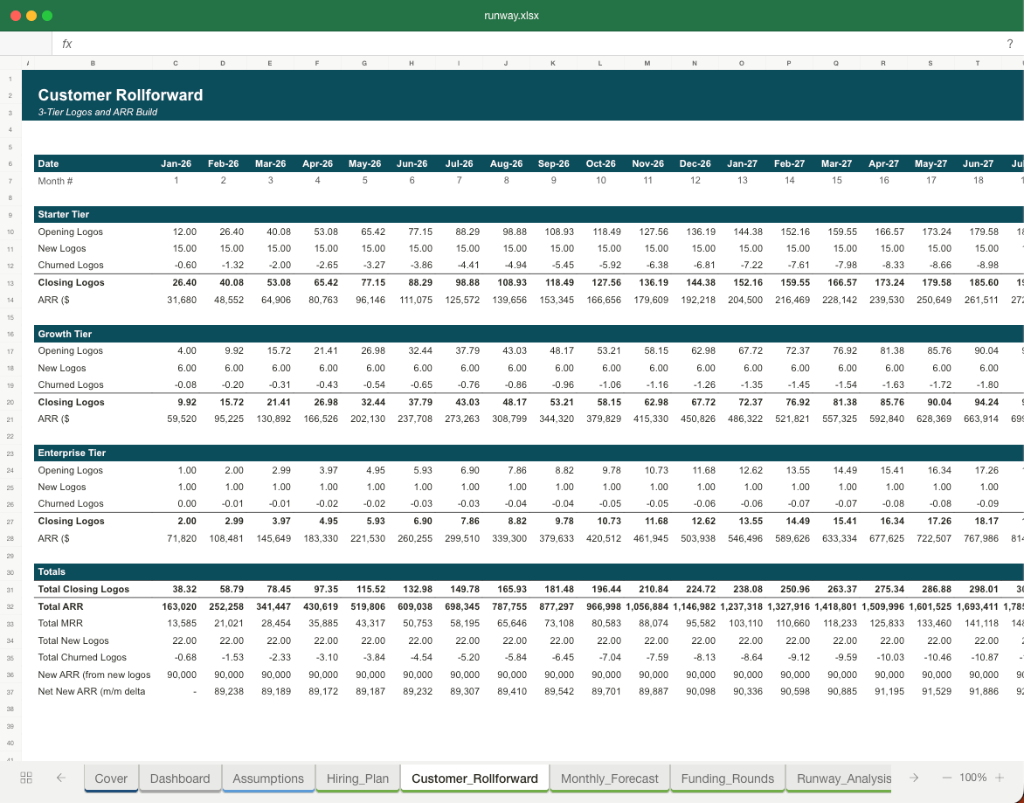
Outputs are driven by live formulas, so the workbook updates from its assumptions instead of relying on hardcoded results.
All assumptions in one tab
Inputs are clearly marked in the Assumptions tab and separated from calculations, making it clear what to change and what to leave intact.
Statements always balancing
For integrated-statement models, the balance sheet, cash flow, and supporting schedules tie through properly.
Distinct schedules for clarity
Debt, working capital, taxes, and cash flow can get messy quickly. We group calculations in clear schedules, not across disconnected tabs.
No hidden macros or external links
There are no unexplained external workbook links or macros to undermine auditability or portability.
Changes flow through the model
Update a key driver and see the impact carry through the forecast, financing, and return outputs. We never use hardcoded numbers in formulas.
About Keyway

How to build a detailed financial model for Keyway
A complete walkthrough of the business, drivers, and assumptions behind the downloadable Keyway model - distilled from its pitch deck and publicly available information.
Product & value proposition
- Keyway buys commercial real estate from small and medium business owners (sub $10M properties) directly, offering a guaranteed, fast, low-cost close.
- Process for sellers: submit business info → receive price + standard contract → single-visit DD → close with no contingencies.
- Claims 90% reduction in transaction time vs. traditional process; zero fees to seller.
- On the investor side: Keyway aggregates acquired single properties into portfolios sold to institutional investors as asset-backed, high-yield investments.
- Tech stack: AI/ML for sourcing and underwriting, digital tools for application & closing, UX layer.
- Traditional process pain points cited: ~20 showings over 3 months, 20% fall-through at LOI, 20% fall-through at financing, months-long timeline, high % fees.
Market
- $5T+ in commercial real estate properties in stock in target market (SMB CRE).
- $300B+ in yearly mid-market CRE transactions.
- Sub $10M deal size is the defined segment.
- No SAM, SOM, or market growth rate provided.
Revenue model
- Buy-side spread: Keyway acquires properties from SMB sellers at a negotiated price (likely at a discount to market given guaranteed/fast close value prop), then resells or holds.
- Investor-side: Aggregates properties into portfolios sold to institutional investors. Revenue likely from: (a) origination/transaction fee on investor placement, and/or (b) asset management fee on AUM, and/or (c) appreciation spread on portfolio sale.
- Deck states "High margins, Recurring revenues" for Keyway - implying management fees or yield-spread income, not just one-time transaction fees.
- No fee rates, take rates, or spread figures disclosed. "No fees" claim applies to sellers only.
Traction & metrics
- Transaction volume chart covers 2021–2024 with growing bar chart, but all values are redacted as "$X" - no actual numbers visible.
- No customer count, deal count, ARR, revenue, or GMV figures disclosed anywhere in the deck.
Unit economics
- "High margins" claimed - no margin % given.
- Transaction time reduced by 90% vs. traditional process - relevant to throughput capacity but not a unit economic figure.
- Before/after transaction cost comparison shown on slide 7 as "X months & X% → X month & X%" - all values redacted.
- No CAC, LTV, payback period, or spread data disclosed.
Competition / moat
- Traditional CRE brokers implied as the incumbent (multi-month process, high fees, multiple showings).
- Moat claimed: AI/ML underwriting, proprietary UX, digital closing tools, guaranteed close offer.
- No named competitors or differentiation matrix shown.
Team & funding ask / use of funds
- Co-Founder & CEO: Matías Recchia - Harvard Business School, McKinsey, iguanafiz.
- Co-Founder & COO: Sebastian Wilner - Harvard Business School, Google.
- Senior team alumni: Goldman Sachs, Jamestown, Google, Brookfield, J.P. Morgan, Capital One, Wells Fargo, Rappi, D.R. Horton, Mercado Libre, Bloomberg, Delivery Hero.
Recommended financial model
- Archetype + why: CRE principal/marketplace hybrid - Transaction Volume + Spread P&L model with an AUM / recurring management fee overlay. Keyway acts as principal buyer (acquires properties), so the model must track: (1) acquisition cost per property, (2) hold period, (3) sale price to investors, and (4) portfolio AUM under management. This is not a pure SaaS or marketplace; it is closer to a specialty finance / PropTech principal model, similar to an iBuyer P&L.
- Forecast horizon & granularity: 4 years annual (2021–2024 per deck roadmap), monthly for Year 1–2 to track deal pipeline ramp.
- Key drivers & assumptions:
- Number of properties acquired per month
- Average property value (sub $10M);
- Buy-side discount to market / acquisition spread
- Hold period before portfolio sale to investors
- Investor-side take rate (origination fee or spread)
- AUM management fee on retained portfolios
- Transaction cost per deal (legal, DD, diligence)
- Gross margin on each transaction]
- CAC for sellers
- Headcount ramp (underwriters, deal managers, tech)
- OpEx: platform build + maintenance, G&A
- Scenarios (Base / Bull / Bear - which variables flex):
- Base: ~10 deals/month by end Y3, $3M avg deal size, 7% buy-side spread, 1.5% investor fee
- Bull: 20 deals/month by Y3, higher avg deal size ($5M), faster hold period, institutional investor demand strong
- Bear: deal ramp slower (regulatory, capital constraints), spread compression, hold period extends (capital tied up), recession-driven CRE volume decline
- Required sheets / outputs:
- Assumptions dashboard (all drivers in one place)
- Deal pipeline (monthly acquisition count × avg deal size = transaction volume)
- Revenue build (buy-side spread revenue + investor-side fee revenue + management fee income)
- Cost of acquisition (per-deal transaction costs, holding costs)
- Gross profit by revenue stream
- OpEx (headcount, tech, G&A)
- EBITDA / operating P&L
- Balance sheet sketch (properties held on balance sheet during hold period - capital intensity)
- Capital requirements (how much equity/debt needed to fund property acquisitions)
- Transaction volume chart (2021–2024, matching slide 9 format)
- Scenario toggle
Frequently asked
Is the Keyway financial model free?+
Yes. The Keyway model is a free Excel (.xlsx) download with live formulas. Sign up with your email and the workbook is yours to keep, review, and edit.
What's included in the model?+
A 5-year monthly forecast with P&L, cash flow and runway, valuation (exit multiple plus a DCF cross-check), MOIC/IRR returns, and unit economics, with live formulas throughout.
How was this model built?+
It was built from Keyway's pitch deck and publicly available information, then structured to investment-banking standards as a fully editable Excel model.
Can I change the assumptions?+
Yes. You can change assumptions and the live formulas will recalculate in the downloadable Excel model.
Have more financial modelling questions? Contact us

Created by ex-finance professionals
Hey, I’m Alex and I created Finamodel.
Over my years in the finance industry I kept building the same models over and over again. Same structure, same assumptions, different logo. So I started building frameworks to turn them into clean, reusable templates.
Every model here is one I’d actually use for a client, and I personally vet each one before it goes up.
I’m not an expert in every industry, but I’ve built enough models to know what belongs in one. And when something is completely foreign to me, I reach out to my network for experts to work on our models with us.
Having a template library on hand cuts a first build from hours to minutes.
Need help finding your model? You’ll find me in the Finamodel app!
Other Marketplace Startup Financial Models
Browse another startup in the same category.

Acquco
Amazon brand aggregator - acquires third-party Amazon seller businesses at attractive multiples, then scales them via proprietary growth playbooks and technology.
Arive
Premium q-commerce app delivering lifestyle and branded products in under 30 minutes across German cities.

Audience Town
Vertical data and advertising platform targeting home movers across the entire home journey - pre-move through post-move.

AudioMob
Non-intrusive in-game audio ad platform bridging music/brand advertisers to mobile game publishers.

Authoritive
Two-way messaging platform that turns creator expertise into scalable, push-delivered learning experiences via SMS/WhatsApp.

Avo
Building amenity and office perk platform delivering same-day grocery/pantry/goods to residential and commercial tenants via a white-label marketplace.
beehiiv
Newsletter platform for creators to build, grow, and monetize email audiences - SaaS subscription + native ad network revenue.
Borzo
Global same-day logistics marketplace connecting B2B merchants with crowdsourced couriers for last-mile delivery