 Lunchbox Financial Model
Marketplace Startup Financials (Free Excel Download)
White-label digital ordering OS for restaurants - web, app, kiosk, and backend in one platform.



professionals from Deloitte
Used by professionals from






About this model
Lunchbox is a white-label digital ordering operating system for restaurants, combining web, mobile app, kiosk, loyalty, marketing, customer data, and order management. It aims to replace the fragmented stack of ordering and engagement vendors with one branded platform.
Restaurants pay flat monthly fees per location and channel, with listed pricing of $200 for web, $300 for app, and $500 per kiosk device, plus setup fees. The roadmap also includes a lower-take-rate restaurant marketplace, payment processing, and vertical expansion such as liquor ordering.
The model is location-led SaaS with a gated marketplace layer. Restaurant brands, locations live, channel mix, implementation timing, and ARPU build recurring revenue, while digital order GMV and take rate can begin after the marketplace reaches scale. Onboarding capacity, churn, payment margin, and sales productivity determine the operating case.
A turnkey financial model
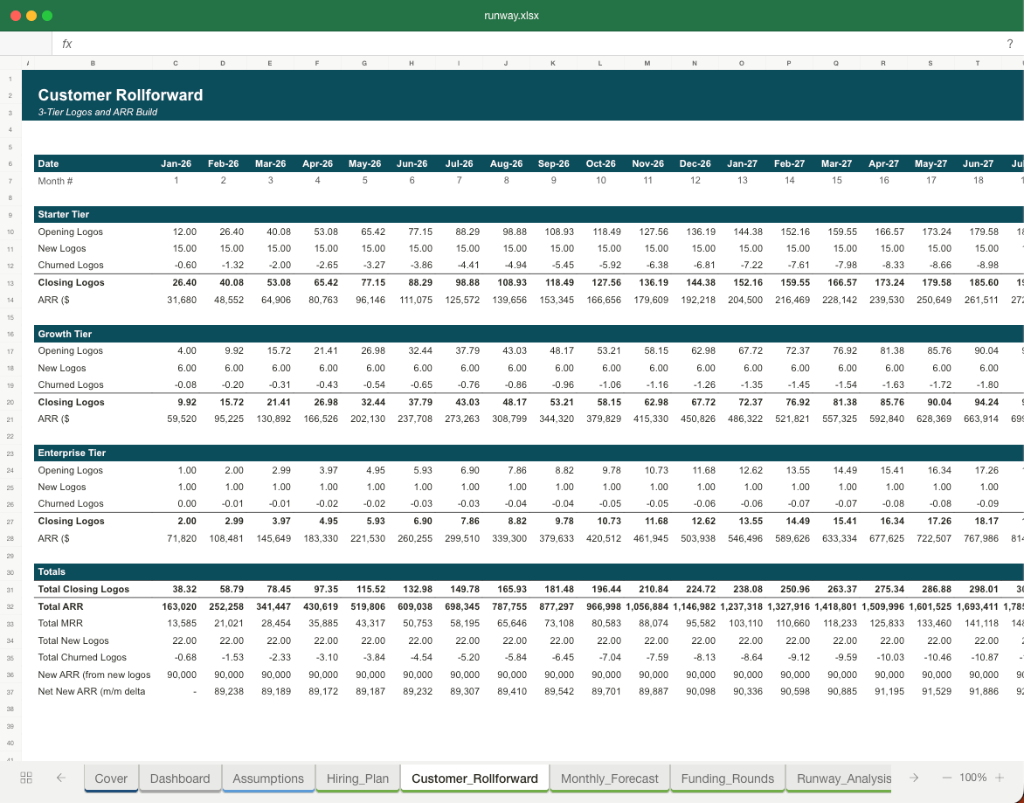
Live formulas, no hardcoded values
Outputs are driven by live formulas, so the workbook updates from its assumptions instead of relying on hardcoded results.
All assumptions in one tab
Inputs are clearly marked in the Assumptions tab and separated from calculations, making it clear what to change and what to leave intact.
Statements always balancing
For integrated-statement models, the balance sheet, cash flow, and supporting schedules tie through properly.
Distinct schedules for clarity
Debt, working capital, taxes, and cash flow can get messy quickly. We group calculations in clear schedules, not across disconnected tabs.
No hidden macros or external links
There are no unexplained external workbook links or macros to undermine auditability or portability.
Changes flow through the model
Update a key driver and see the impact carry through the forecast, financing, and return outputs. We never use hardcoded numbers in formulas.
About Lunchbox
lunchbox.io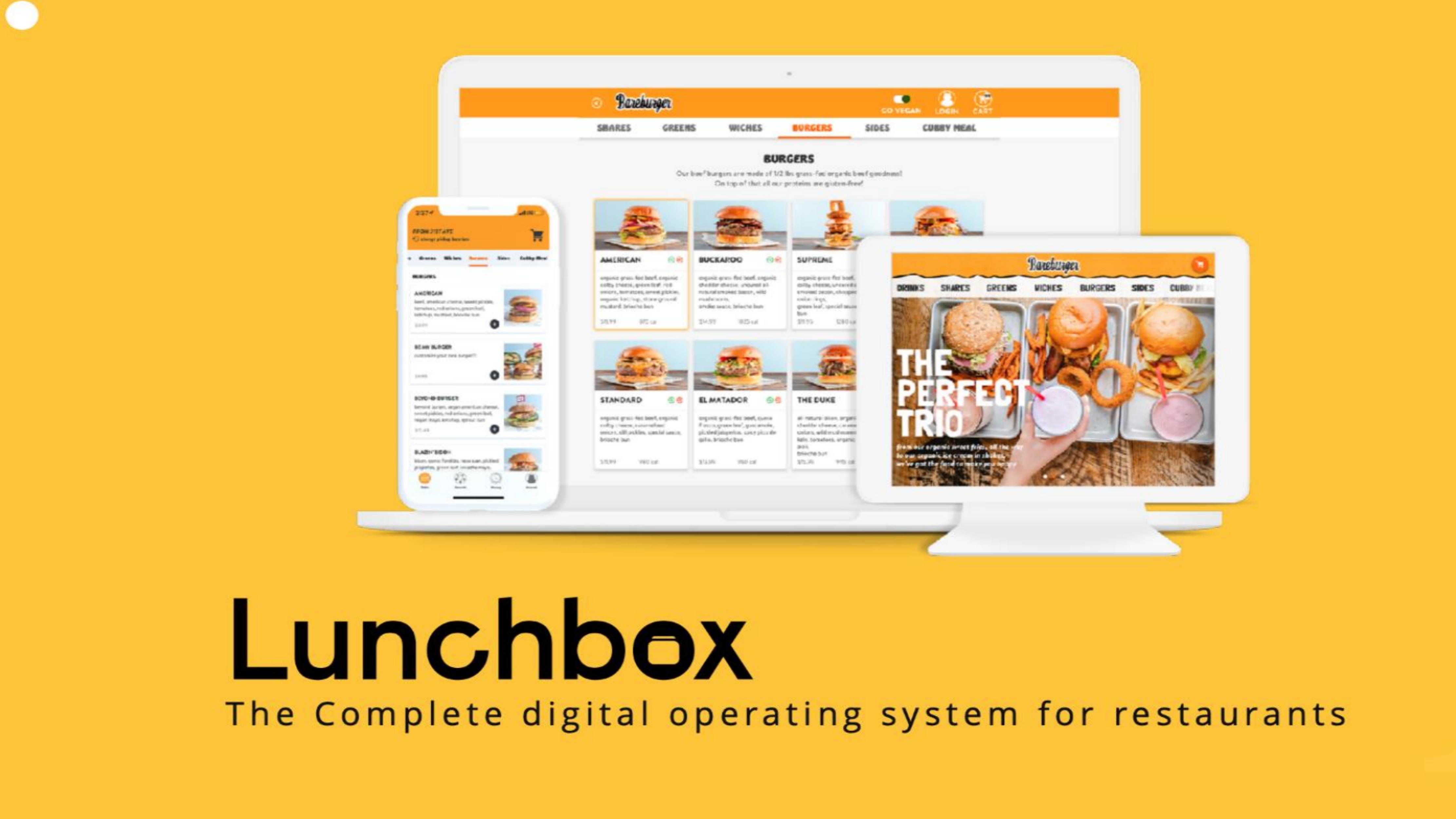
How to build a detailed financial model for Lunchbox
A complete walkthrough of the business, drivers, and assumptions behind the downloadable Lunchbox model - distilled from its pitch deck and publicly available information.
Product & value proposition
Lunchbox replaces the fragmented 3–7 vendor stack restaurants currently use (Olo for ordering, LevelUp for mobile, Ziosk for kiosk, Relay for dispatch, Fuzz Studio for UI/UX, Punnch for loyalty) with a single integrated platform.
Channels supported: web ordering, mobile app, kiosk, text ordering, Facebook ordering, Amazon Alexa ordering.
Backend features: loyalty engine, email/SMS marketing automation, customer data & segmentation, dynamic ad serving, SMTP relay, order management, discount codes, menu builder, and a multi-location admin dashboard.
Vertical expansion teased: liquor/spirits ordering with age-gate identity validation.
Positioning: "The Shopify for Restaurants" - branded white-label, no Lunchbox branding visible to end consumers.
Market
Deck presents an addressable market across five revenue segments - Core Restaurant SaaS, Marketplace, Wine/Spirits/Beer, CC Processing Revenue, Services - growing at 22% CAGR.
| Year | Core SaaS ($M) | Marketplace ($M) | Wine/Beer/Spirits ($M) | CC Processing ($M) | Services ($M) | Total TAM |
|---|---|---|---|---|---|---|
| 2019 | 1,808 | 135 | - | - | - | $1.9B |
| 2020 | 3,311 | 331 | 248 | 99 | 331 | $3.8B |
| 2021 | 4,313 | 862 | 323 | 215 | 862 | $5.5B |
Sources cited: Pymnts, Vox, Grubhub, Aaron Allen.
Note: 2019 donut appears to show only two segments; later years show five - the segmentation methodology changes across years. SAM and SOM not broken out.
Revenue model
Three product tiers, flat-fee SaaS per restaurant location per month:
| Channel | Monthly Fee | One-time Setup Fee | Notes |
|---|---|---|---|
| App | $300/restaurant/mo | $300/restaurant | Onboarding: 5 weeks |
| Web | $200/restaurant/mo | $200/restaurant | Onboarding: 5 weeks |
| In-Store (Kiosk) | $500/device/mo + 5% | $200/device | Onboarding: 10 weeks |
Additional future revenue streams:
- Marketplace take rate: 3–5% (vs. Grubhub/UberEats at ~25%); launch milestone: 1,000 live locations in NYC, ETA Q3 2020.
- Liquor vertical: premium product ordering with delivery.
- CC processing fees (named as a revenue segment on market slide).
- Marketing/data services revenue.
Comparison claimed: Lunchbox all-in onboarding = $35K and monthly = $35K vs. fragmented stack onboarding = $1.2MM and monthly = $156K.
Traction & metrics
- Live: Over 55 locations.
- Named live clients: Bareburger, 16 Handles, Sticky's Finger Joint.
- Signed (waiting for POS integration): ~12 brands including Westville, Milk, Chip, Liv Salad, Sarabeth's, Jane, The Doughnut Project, Spot, The Little Beet, Garden Catering, Docks, Fuku.
- In Talks: ~20 brands including Clean Juice, Zaxby's, Bluestone Lane, Eat Clean Bro, Baked by Melissa, Black Tap, Torchy's, Junzi, Le Pain Quotidien, Corelife, Melt Shop, CostaVida, Luke's.
- Technology partners (integrated/referral): Toast, Tattle, Stripe, Square, Clover, Zenreach.
- No revenue figures, GMV, or ARR stated in deck.
Unit economics
From deck pricing (not a stated margin analysis):
- App: $300/location/mo recurring + $300 setup → implied ARPU $300/mo per restaurant
- Web: $200/location/mo recurring + $200 setup
- Kiosk: $500/device/mo + 5% transaction fee + $200 setup
- Implied savings vs. competition: $1,300/mo/unit vs. LevelUp (App); $350/mo/unit vs. GoParrot (Web); $850/mo/unit vs. Bite Kiosk (In-Store).
Competition / moat
Feature comparison matrix positions Lunchbox as the only player with App + Web + Kiosk + No Upfront Cost + White-Label + Omni-channel Loyalty + UI/UX capability in one product, at lowest relative cost (1x vs. Olo 3x, LevelUp 7x, Ziosk 4x).
Competitive positioning scatter: Lunchbox positioned as affordable + multi-channel; competitors (Fuzz, Presto, LevelUp, Ziosk, Toast, Brandibble) mapped as either expensive or single-channel or both.
Moat claims:
- Integrated platform vs. fragmented competitor stack.
- White-label (restaurants keep brand equity, own customer data).
- Own customer data - restaurants lose data on 3P platforms.
- Marketplace network effect (future): launch at 1,000 locations creates flywheel.
- AI/AR: 3D menus and micro-suggestion upsell capability.
Valuation comp: OLO raised $1.5M seed (est. $5M valuation) → $7M three years later (est. $15M) → $80M+ over 6 rounds, est. current valuation $500M. Cited as trajectory comp.
Team & funding ask / use of funds
Team:
- Andrew Boryk - Co-Founder
- Nabeel Alamgir - Co-Founder
- Mikhael Foenko - Developer
- Randall Lee - Developer
- Mo Afzal - Developer
- Jared DeGrassi - Developer
- Hadi Rashid - Customer Success
- Yvan Pan - Developer
- Prior employers: Google, Apple, Johnson & Johnson, ConEdison, Merrill Lynch, Bareburger
- "20+ years in technology and restaurant industry; worked together on two previous startups"
Advisors: Choi Solomon (CEO, 16 Handles), Alex Beltrani (CEO, Tattle), Jason Anello (CMO, Aurify Brands), Andrew Gluck (VC/Investor).
Recommended financial model
- Archetype + why: Multi-revenue SaaS + marketplace P&L. Core engine is a location-count-driven SaaS ARR model (flat fee per restaurant per channel) layered with a marketplace GMV model (take-rate revenue) and optional vertical revenue lines (liquor, CC processing, services). Restaurant SaaS is the right base because revenue is a direct function of locations live × ARPU by channel mix. Marketplace must be gated on the 1,000-location milestone.
- Forecast horizon & granularity: Monthly for Year 1–2 (operational detail, onboarding cadence); annual summary for Years 3–5. Five-year total.
- Key drivers & assumptions:
| Driver | Value / Source |
|---|---|
| Starting live locations | 55 |
| Net new locations per month (ramp) | 10–20/mo in Y1, accelerating - based on signed pipeline depth |
| App ARPU | $300/location/mo |
| Web ARPU | $200/location/mo |
| Kiosk ARPU | $500/device/mo + 5% GMV |
| Setup fee - App | $300/restaurant (one-time) |
| Setup fee - Web | $200/restaurant (one-time) |
| Setup fee - Kiosk | $200/device (one-time) |
| Channel mix (App/Web/Kiosk) | 50/35/15 initially - App skews highest given current client base |
| Average devices per kiosk client | 2–3 devices/location |
| Churn rate (monthly) | 1.5–2.5% - B2B restaurant SaaS; high setup friction limits churn |
| Onboarding weeks (App/Web/Kiosk) | 5/5/10 weeks; delays new location revenue recognition |
| Marketplace go-live | triggered at 1,000 locations, modelled as Q3 2020 |
| Marketplace take rate | 3–5% of GMV; use 4% base |
| Marketplace GMV per restaurant | $30K–$60K/restaurant/year (NYC fast-casual volume) |
| Gross margin - SaaS | 65–75% - platform + support cost; no data in deck |
| Gross margin - Marketplace | 70–80% - primarily payment processing net of delivery costs |
| Sales & marketing | 25–35% of revenue in Y1–2, declining as referral partnerships (Toast, Stripe, Square, Clover) reduce paid CAC |
| CAC | $2,000–$5,000/restaurant - B2B outbound + partnership channel |
| Payback period | 7–12 months at $300/mo ARPU with 65% gross margin |
| Headcount | 10 FTEs today (8 named + 2 implied); engineering-heavy; grow 2–4 hires/quarter |
- Scenarios (Base / Bull / Bear):
- Base: 10 net new locations/mo; marketplace live Q3 2020 at 4% take rate; SaaS ARPU flat; 1.5% monthly churn.
- Bull: 20+ net new locations/mo driven by signed pipeline converting fast; marketplace live Q2 2020; upsell to kiosk accelerates blended ARPU.
- Bear: Slow pipeline conversion (signed clients delay POS integrations); marketplace pushed to 2021; 3% monthly churn; no kiosk uptake.
- Flex variables: location growth rate, churn, marketplace launch timing, take rate, channel mix.
- Required sheets / outputs:
- Assumptions & Toggles (scenario selector, all drivers)
- Location Roll (cohort-based: new locations by month, onboarding lag, cumulative active)
- Revenue Build - SaaS (locations × ARPU by channel; setup fees as one-time)
- Revenue Build - Marketplace (GMV model: locations × GMV/restaurant × take rate; gated by milestone)
- Revenue Build - Other (CC processing, liquor, services - placeholder if no deck data)
- P&L (revenue, gross profit by stream, opex by department, EBITDA)
- Headcount Plan
- Cash Flow & Runway
- KPI Dashboard (locations live, MRR, ARR, blended ARPU, churn, marketplace GMV)
Frequently asked
Is the Lunchbox financial model free?+
Yes. The Lunchbox model is a free Excel (.xlsx) download with live formulas. Sign up with your email and the workbook is yours to keep, review, and edit.
What's included in the model?+
A 5-year monthly forecast with P&L, cash flow and runway, valuation (exit multiple plus a DCF cross-check), MOIC/IRR returns, and unit economics, with live formulas throughout.
How was this model built?+
It was built from Lunchbox's pitch deck and publicly available information, then structured to investment-banking standards as a fully editable Excel model.
Can I change the assumptions?+
Yes. You can change assumptions and the live formulas will recalculate in the downloadable Excel model.
Have more financial modelling questions? Contact us

Created by ex-finance professionals
Hey, I’m Alex and I created Finamodel.
Over my years in the finance industry I kept building the same models over and over again. Same structure, same assumptions, different logo. So I started building frameworks to turn them into clean, reusable templates.
Every model here is one I’d actually use for a client, and I personally vet each one before it goes up.
I’m not an expert in every industry, but I’ve built enough models to know what belongs in one. And when something is completely foreign to me, I reach out to my network for experts to work on our models with us.
Having a template library on hand cuts a first build from hours to minutes.
Need help finding your model? You’ll find me in the Finamodel app!
Other Marketplace Startup Financial Models
Browse another startup in the same category.

Acquco
Amazon brand aggregator - acquires third-party Amazon seller businesses at attractive multiples, then scales them via proprietary growth playbooks and technology.
Arive
Premium q-commerce app delivering lifestyle and branded products in under 30 minutes across German cities.

Audience Town
Vertical data and advertising platform targeting home movers across the entire home journey - pre-move through post-move.

AudioMob
Non-intrusive in-game audio ad platform bridging music/brand advertisers to mobile game publishers.

Authoritive
Two-way messaging platform that turns creator expertise into scalable, push-delivered learning experiences via SMS/WhatsApp.

Avo
Building amenity and office perk platform delivering same-day grocery/pantry/goods to residential and commercial tenants via a white-label marketplace.
beehiiv
Newsletter platform for creators to build, grow, and monetize email audiences - SaaS subscription + native ad network revenue.
Borzo
Global same-day logistics marketplace connecting B2B merchants with crowdsourced couriers for last-mile delivery