Mambu Financial Model
Fintech Startup Financials (Free Excel Download)
Cloud-native SaaS core banking platform enabling financial institutions to launch and scale banking products without legacy infrastructure.



professionals from Deloitte
Used by professionals from






About this model
Mambu is a cloud-native core banking platform that lets financial institutions launch and scale banking products without legacy infrastructure. Its modular software supports banks and fintechs building deposits, lending, and other financial services.
The company sells enterprise technology rather than directly acquiring bank customers. Multi-year client relationships, product deployments, and expanding usage create a recurring revenue profile with implementation work at the beginning of each account lifecycle.
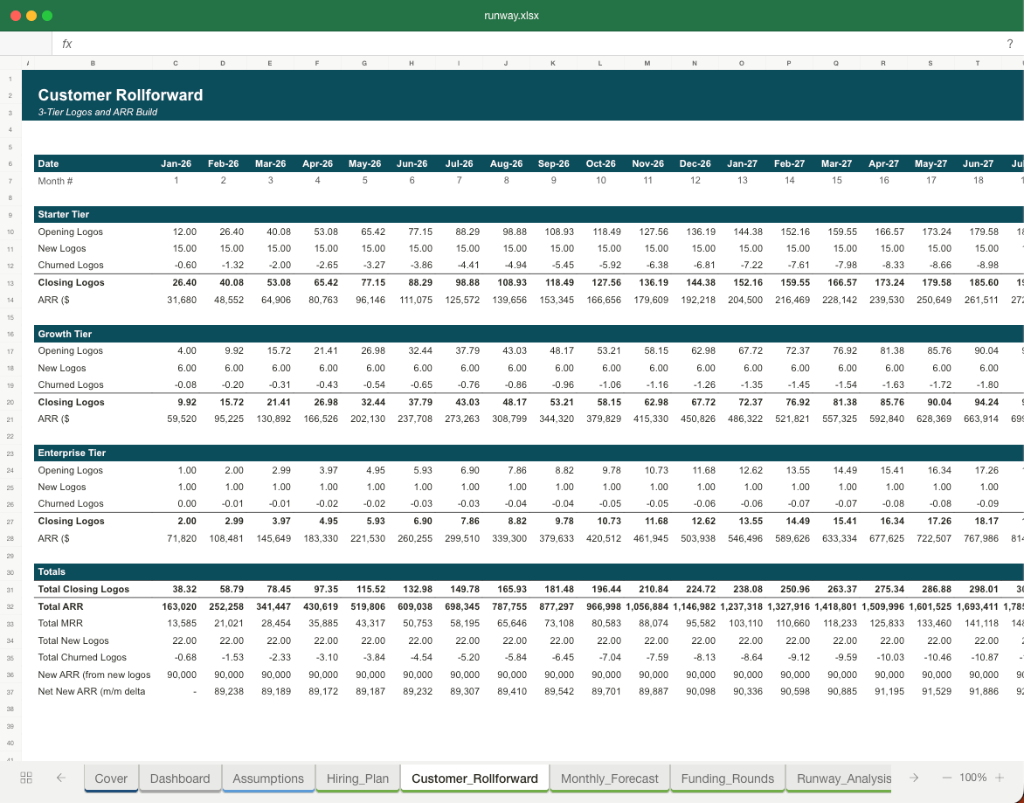
The model should forecast enterprise logos, contract value, deployment timing, product modules, expansion, and churn. Usage or end-account volume can provide an additional revenue lever, while professional services should be separated from recurring ARR to keep gross-margin and retention analysis clean.
A turnkey financial model
Live formulas, no hardcoded values
Outputs are driven by live formulas, so the workbook updates from its assumptions instead of relying on hardcoded results.
All assumptions in one tab
Inputs are clearly marked in the Assumptions tab and separated from calculations, making it clear what to change and what to leave intact.
Statements always balancing
For integrated-statement models, the balance sheet, cash flow, and supporting schedules tie through properly.
Distinct schedules for clarity
Debt, working capital, taxes, and cash flow can get messy quickly. We group calculations in clear schedules, not across disconnected tabs.
No hidden macros or external links
There are no unexplained external workbook links or macros to undermine auditability or portability.
Changes flow through the model
Update a key driver and see the impact carry through the forecast, financing, and return outputs. We never use hardcoded numbers in formulas.
About Mambu
mambu.com
How to build a detailed financial model for Mambu
A complete walkthrough of the business, drivers, and assumptions behind the downloadable Mambu model - distilled from its pitch deck and publicly available information.
Product & value proposition
Mambu sells a composable, cloud-native core banking platform with four layers:
- Cloud banking engines - fully configuration-based, multi-cloud, ISO & SOC certified, supporting a wide range of banking products.
- Integration platform - middleware connecting legacy systems to new infrastructure; APIs, webhooks, streaming APIs, Mambu Integration Bus, Configuration as Code.
- Fintech ecosystem - pre-built connectors to partners (Marqeta, nCino, Salesforce, TransferWise, Backbase, Experian, etc.).
- SaaS delivery model - fully managed, continuous delivery, agile enablement options.
Value proposition vs. legacy core banking: composable architecture, configure vs. customize, open real-time APIs, continuous delivery, infinite scalability, flexible contracts, self-service empowerment.
Key customers referencing the product: N26, Globe, League Data, FIBR, MACH, ank.
Market
No explicit TAM/SAM/SOM dollar figures in deck.
Market context provided:
- Cloud software market share trending from negligible pre-2015 to majority by 2020–25 (stacked-column chart shown but no axis values readable at this resolution).
- 70% of banks reviewing a potential update of their core banking platform.
- 65% of surveyed banks exploring next-generation platforms.
- ~75% of banks planned to accelerate digital transformations post-Covid (74% said "more urgent", 21% "no change", 5% "lower priority").
- #1 IT investment priority for banks is core banking systems.
- 69% of bank IT spend goes toward maintaining IT infrastructure.
Revenue model
Not explicitly stated in deck. Based on positioning as a SaaS platform:
- Primary revenue is recurring SaaS subscription fees - likely per-seat, per-product-configuration, or platform-tier pricing common to enterprise core banking vendors.
- Secondary revenue may include usage-based components (API call volume, number of end-user accounts on platform) and professional services / implementation fees.
- Sales motion is enterprise direct sales with system integrator / consulting partnerships (PwC, KPMG, Accenture, NTT DATA listed as partners).
Traction & metrics
All from slide 3:
- 52 million end users on the platform.
- 200+ customers in 60+ countries.
- 30,000 product configurations.
- 130 million API calls per day.
No revenue figures, ARR, growth rates, NRR, or churn data shown in deck.
Competition / moat
Not addressed directly in deck. Implicit moat arguments:
- Composable architecture vs. monolithic legacy systems (Temenos, FIS, Fiserv - not named but implied).
- Rich fintech ecosystem with 40+ pre-built partner integrations reduces switching cost and implementation time.
- Configuration-based (not code-based) customization reduces time-to-market for bank clients.
- ISO & SOC certifications, multi-cloud, regulatory compliance across 60+ markets - high barrier to replicate.
Team & funding ask / use of funds
Recommended financial model
- Archetype + why: Enterprise SaaS ARR model. Mambu is a B2B SaaS platform with multi-year contracts, a recurring revenue base, and expansion driven by customer seat/product-count growth. The model should track ARR by customer cohort, with logo count and revenue-per-customer as the primary drivers.
- Forecast horizon & granularity: 5-year annual (Year 1–5), with Year 1 monthly for liquidity visibility. No short-term cashflow model needed given SaaS prepay structure (assumed).
- Key drivers & assumptions:
| Driver | Value / Source |
|---|---|
| Starting customer count | 200+ |
| Starting end-user base | 52m |
| New logo additions per year | 30–50 net new logos/yr; rationale: 200+ customers across 60+ markets implies several years of build-up; growth-stage SaaS at this scale typically adds 15–25% logo growth |
| Average ACV per customer | $300k–$600k; rationale: enterprise core banking SaaS with 52m end-users across 200+ FIs implies large contracts; public comps (Temenos, Thought Machine) imply $200k–$1m+ ACVs |
| Revenue expansion (NRR) | 110–120%; rationale: platform pricing tied to configurations/API volume naturally expands with bank growth; typical for infrastructure SaaS |
| Gross margin | 65–75%; rationale: multi-cloud SaaS with hosting costs, but high margin once implementation services are excluded |
| Churn (logo) | 5–8% annually; rationale: core banking replacement is extremely sticky (high switching cost), but long implementation cycles mean some attrition during onboarding |
| Implementation / professional services revenue | 15–20% of total revenue; declining as % over time as platform matures |
| S&M as % revenue | 25–35%; enterprise sales with SI channel partners |
| R&D as % revenue | 20–25%; cloud-native platform with continuous delivery model |
| G&A as % revenue | 10–12% |
- Scenarios (Base / Bull / Bear - which variables flex):
- Base: 20% logo growth, 115% NRR, 70% gross margin.
- Bull: 30% logo growth, 120% NRR (faster configuration/API expansion), 73% gross margin (scale leverage). Driven by accelerated core banking upgrade cycle.
- Bear: 10% logo growth, 105% NRR (slower bank digital transformation), 65% gross margin (higher cloud/support costs). Driven by prolonged enterprise sales cycles or macro slowdown in bank IT spend.
- Required sheets / outputs:
- Assumptions - all drivers in one editable block.
- ARR Bridge - opening ARR → new logo ARR → expansion ARR → churn ARR → closing ARR (annual).
- Income Statement - revenue (subscription + services), gross profit, EBITDA, operating income (5-year).
- Headcount & Opex - S&M, R&D, G&A by function.
- Monthly P&L (Year 1) - for operating liquidity view.
- KPI Dashboard - logo count, ARR, ARR/customer, NRR, gross margin %, Rule of 40.
- Scenario toggle - Base / Bull / Bear switcher feeding all sheets.
Frequently asked
Is the Mambu financial model free?+
Yes. The Mambu model is a free Excel (.xlsx) download with live formulas. Sign up with your email and the workbook is yours to keep, review, and edit.
What's included in the model?+
A 5-year monthly forecast with P&L, cash flow and runway, valuation (exit multiple plus a DCF cross-check), MOIC/IRR returns, and unit economics, with live formulas throughout.
How was this model built?+
It was built from Mambu's pitch deck and publicly available information, then structured to investment-banking standards as a fully editable Excel model.
Can I change the assumptions?+
Yes. You can change assumptions and the live formulas will recalculate in the downloadable Excel model.
Have more financial modelling questions? Contact us

Created by ex-finance professionals
Hey, I’m Alex and I created Finamodel.
Over my years in the finance industry I kept building the same models over and over again. Same structure, same assumptions, different logo. So I started building frameworks to turn them into clean, reusable templates.
Every model here is one I’d actually use for a client, and I personally vet each one before it goes up.
I’m not an expert in every industry, but I’ve built enough models to know what belongs in one. And when something is completely foreign to me, I reach out to my network for experts to work on our models with us.
Having a template library on hand cuts a first build from hours to minutes.
Need help finding your model? You’ll find me in the Finamodel app!
Other Fintech Startup Financial Models
Browse another startup in the same category.
Acin
SaaS and data subscription network for operational risk management at Tier 1 financial institutions

Ageras Group
B2B SME ecosystem - marketplace connecting SMEs with accountants + cloud accounting/payroll software + embedded financial services (lending, factoring, banking)

Airbase
Unified non-payroll spend management platform (corporate cards, AP/bill pay, expense reimbursement, approval workflows) for mid-market companies.

Altruist
Vertically integrated all-in-one platform for registered investment advisors (RIAs) - combining custodial, portfolio management, practice management, and client acquisition tools.
Amenitiz
All-in-one hotel management SaaS platform ("Shopify for hotels") for independent hoteliers - PMS, booking engine, channel manager, website builder, payments, and AI-driven revenue management.

Anrok
SaaS sales tax compliance platform - nexus monitoring, calculation, registration, filing, and remittance - built specifically for SaaS companies.
Arrival
Arrival is an EV manufacturer of commercial vans and buses using proprietary Microfactories and vertically integrated components, going public via SPAC merger with CIIG Merger Corp.

AtoB
AtoB is building financial infrastructure for commercial fleets, starting with a no-fee Visa fleet card for fuel and expanding into payroll, BNPL, and international.