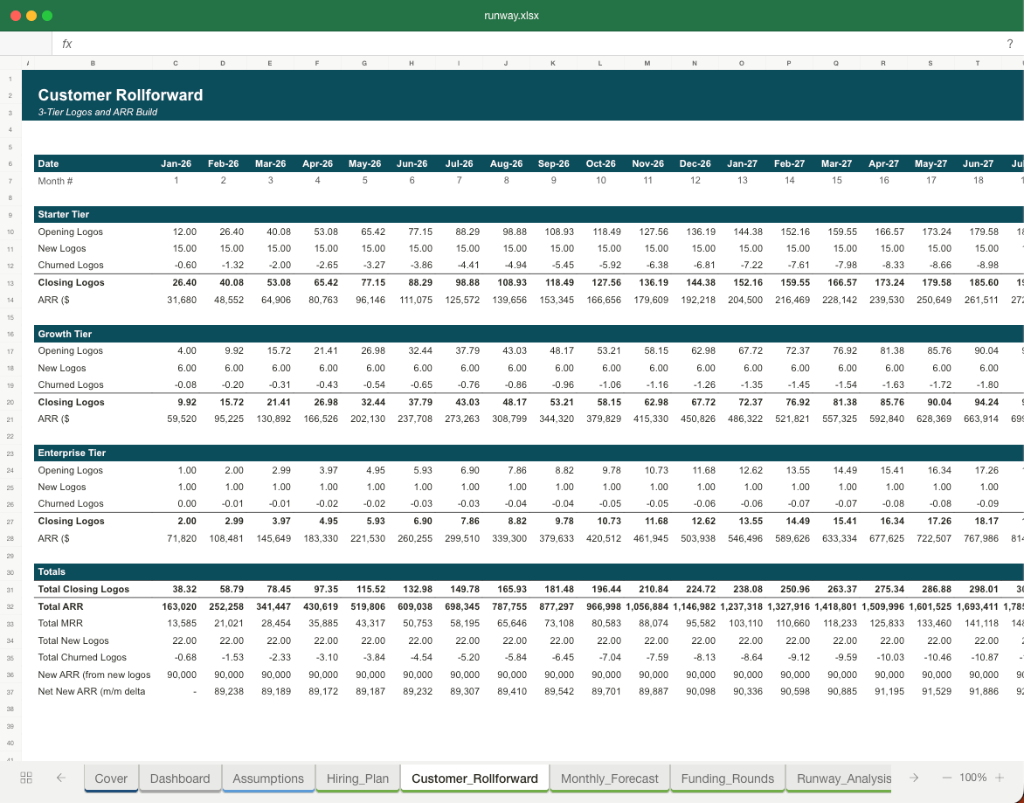
 Moderna Financial Model
Biotech/Pharma Startup Financials (Free Excel Download)
mRNA-based drug platform company using messenger RNA as programmable "software" to instruct cells to produce therapeutic proteins.



professionals from Deloitte
Used by professionals from






About this model
Moderna’s mRNA platform treats messenger RNA as programmable therapeutic software: the coding region changes by drug while common formulation elements can be reused within a modality. This supports rapid development, cell-free manufacturing, and difficult targets across vaccines, oncology, and localised therapies.
Precommercial revenue came from pharma partnership upfronts and technical milestones, reimbursed R&D and clinical milestones, and government grants. Partners included Merck, AstraZeneca, the Gates Foundation, Alexion, and Vertex. The deck does not disclose royalties or consumer product sales, so the model should focus on pipeline and collaboration economics.
By May 2017, Moderna had 12 nominated development candidates and five Phase I trials. Cumulative partnership upfronts and milestones reached $740 million, total cash sources $1.946 billion, and Q1 2017 cash $1.22 billion. The model should forecast programmes, R&D burn, milestones, grants, manufacturing capex, and cash runway.
A turnkey financial model
Live formulas, no hardcoded values
Outputs are driven by live formulas, so the workbook updates from its assumptions instead of relying on hardcoded results.
All assumptions in one tab
Inputs are clearly marked in the Assumptions tab and separated from calculations, making it clear what to change and what to leave intact.
Statements always balancing
For integrated-statement models, the balance sheet, cash flow, and supporting schedules tie through properly.
Distinct schedules for clarity
Debt, working capital, taxes, and cash flow can get messy quickly. We group calculations in clear schedules, not across disconnected tabs.
No hidden macros or external links
There are no unexplained external workbook links or macros to undermine auditability or portability.
Changes flow through the model
Update a key driver and see the impact carry through the forecast, financing, and return outputs. We never use hardcoded numbers in formulas.
About Moderna
modernatx.com
How to build a detailed financial model for Moderna
A complete walkthrough of the business, drivers, and assumptions behind the downloadable Moderna model - distilled from its pitch deck and publicly available information.
Product & value proposition
- Core technology: mRNA is treated as programmable "software of life" - only the coding region (ORF) changes per drug; formulation, 5' and 3' regions are identical across programs within a modality.
- Key advantages over small molecules and biologics: (1) product abundance - hundreds of previously undruggable intracellular and membrane-bound targets; (2) speed - idea to DC nomination in 7–12 months; (3) lower COGS potential - cell-free manufacturing, single manufacturing infrastructure serves entire pipeline.
- Platform generates "modalities" (therapeutic toolkits): Prophylactic Vaccines, Therapeutic Vaccines, Intratumoral I/O, Localized Therapeutics - plus research-stage modalities (Secreted, Liver Intracellular, Lung).
- Research engine: >1,000 novel mRNA deliveries per month; supports parallel multi-arm partner trials.
Market
- Total pharma/biotech global revenues (2017E): ~$1 trillion for small molecules + biologics combined.
- Small molecules: $165bn (1994) → $425bn (2004) → $600bn (2014).
- Biologics: $10bn (1994) → $55bn (2004) → $180bn (2014).
- Source: Evaluate Ltd., 01-Nov-2016.
- No SAM or SOM figures provided; no mRNA-specific market sizing given.
- Addressable indication breadth illustrated via bubble chart (bubble = market opportunity): prophylactic vaccines (low biology risk), therapeutic/personalized vaccines, intratumoral oncology, localized cardio, secreted therapeutics, liver intracellular, and longer-term CNS/ophthalmology - no dollar figures per segment.
- CMV annual US cost: $2bn (Cannon et al., BMC, 2005).
Revenue model
Three revenue streams - all B2B / institutional; no consumer product sales:
- Partnership upfronts & technical milestones - large pharma/biotech pays Moderna upfront + milestones for access to modalities/programs. Partners as of May 2017: Merck ($65mm prophylactic vx + $200mm therapeutic vx), AstraZeneca ($370mm intratumoral I/O + localized), Bill & Melinda Gates Foundation ($100mm potential, secreted), Alexion ($100mm, liver intracellular), Vertex ($20mm, lung).
- Reimbursement & product milestones - R&D cost reimbursement and clinical/regulatory milestone payments from partners.
- Government grants - DARPA, BARDA (non-dilutive).
No royalty or commercial revenue stream disclosed; deck is pre-commercialization.
Traction & metrics
Pipeline breadth:
- 12 development candidates (DCs) nominated; 5 in clinical trials (Phase I) as of May 2017; 2 additional INDs opened by FDA; 5 DCs in pre-clinical.
- DC count at year-end: 0 (2012) → 1 (2014) → 7 (2015) → 12 (today).
- Drugs in clinical trials: 0 (2012–2014) → 1 (2015) → 5 (today).
Financing sources (cumulative through 2016): | Line | Founding–2012 | 2013 | 2014 | 2015 | 2016 | Total | | -- | -- | -- | -- | -- | -- | -- | | Partnership upfronts & tech milestones | - | $240mm | $100mm | $110mm | $290mm | $740mm | | Reimbursement & product milestones | - | $2mm | $6mm | $12mm | $36mm | $56mm | | Equity issuance | $39mm | $110mm | $471mm | $56mm | $474mm | $1,150mm | | Total sources of cash | $39mm | $352mm | $577mm | $178mm | $800mm | $1,946mm | | Potential total grant | - | $22mm | - | - | $225mm | $247mm | | Grand total potential | $39mm | $374mm | $577mm | $178mm | $1,025mm | $2,193mm | | Year-end cash | $22mm | $330mm | $796mm | $802mm | $1,307mm | - |
Cash position: $1.22bn at end of Q1 2017; >$200mm of grants available.
Cash burn / outflows: | Line | Founding–2012 | 2013 | 2014 | 2015 | 2016E | 2017E Budget | | -- | -- | -- | -- | -- | -- | -- | | R&D | $(8mm) | $(24mm) | $(61mm) | $(124mm) | $(225mm) | - | | G&A | $(7mm) | $(13mm) | $(18mm) | $(20mm) | $(32mm) | - | | CapEx | $(2mm) | $(4mm) | $(17mm) | $(28mm) | $(39mm) | - | | Gross outflows (OpEx + CapEx) | $(17mm) | $(41mm) | $(96mm) | $(172mm) | $(296mm) | >($300mm) | | Year-end cash | $22mm | $330mm | $796mm | $802mm | $1,307mm | ~$1,000mm |
Team: 500 employees, including 300+ scientists and engineers on platform R&D. Platform investment: $100mm annual investment in mRNA platform.
Clinical data (H10N8 flu vaccine, mRNA-1440): 100% seroprotection (HAI ≥1:40) in 23/23 subjects at 100µg dose; 87% MN seroprotection; 0% in placebo.
Competition / moat
- Moat framing: platform de-risking (if mRNA works once, it works many times); proprietary integrated platform (chemistry, bioinformatics, mRNA engineering, formulation, process, raw materials).
- vs. small molecules: conventional drug discovery increasingly risky (low-hanging targets gone; N=1 per molecule).
- vs. recombinant biologics: mRNA can reach intracellular and membrane-bound proteins that biologics cannot.
- No named competitors identified in the deck; competition discussed only in abstract vs. incumbent modalities.
- IP / defensibility: forward-looking statements mention IP enforcement capability; no patent specifics disclosed.
Team & funding ask / use of funds
- Team: 500 people total; 300+ scientists/engineers on platform; industry-leading talent stated as a key asset.
- Leadership named in deck: implied Tal Zaks (CMO, named in publication credit on slide 22); Giuseppe Ciaramella (also named in publication); no CEO/CFO slide.
- Funding ask: Not explicitly stated (no "Use of Proceeds" slide; no round size or valuation disclosed).
- Implied use of funds: sustain $300mm+ annual cash burn (2017E); scale manufacturing (Norwood GMP site); advance 12 DCs through clinic; build platform.
- Existing investors / grants: DARPA, BARDA, Bill & Melinda Gates Foundation (non-dilutive). Equity investors not named.
Recommended financial model
- Archetype + why: Pre-revenue biotech pipeline / cash-burn model with milestone revenue waterfall. Moderna has no product sales; revenue is entirely event-driven (partner milestones, grants). The correct archetype is a biotech pipeline cash-burn + milestone revenue model - not a standard 3-statement operating model. Model tracks: (a) milestone payments by program/partner triggered by clinical events, (b) cash runway vs. burn escalation, (c) optionality value of pipeline programs reaching NDA/commercialization in the 5–10 year window.
- Forecast horizon & granularity: 2017–2027 (10 years); annual for milestones and burn; semi-annual or quarterly for cash runway to show when next capital raise is needed. 2017E budget is the anchor year.
- Key drivers & assumptions:
*Revenue / Inflows:*
- R&D reimbursement growth rate: $36mm (2016) → scale with partnership count; assume ~15–20% annual growth
- Partnership milestone payments per program per stage (IND, Ph I, Ph II, NDA, approval): provides total upfronts by partner but no per-stage breakdown; assume clinical milestone tranches typical for mid-pharma deals ($10–50mm per Ph I readout)
- New partnership probability and upfront size: 2–3 new partners per year at $50–200mm upfront
- Grant income: ~$47mm/year average (2016: $225mm was exceptional/BARDA); normalize to $30–50mm/year
*Outflows / Burn:*
- R&D spend: $225mm (2016E); 2017E >$300mm gross outflows stated; assume ~$275mm R&D component of that growing 20–25% annually as pipeline expands
- G&A: $32mm (2016E); grow ~15% annually
- CapEx: $39mm (2016E); ramp to ~$60–80mm by 2019 for Norwood GMP scale-up, then normalise
- Net burn: ~($260mm) in 2016; 2017E >($300mm)
*Cash & Runway:*
- Starting cash: $1,220mm (Q1 2017)
- Runway at current burn: ~4 years without additional fundraising
- Runway toggle: model equity raise triggers (e.g., when cash falls below $500mm floor)
*Pipeline progression (binary event schedule):*
- mRNA-1440, mRNA-1851: Phase I ongoing (Dec 2015, May 2016) → Ph II readout assumed 2018–2019
- mRNA-1325 (Zika): Ph I started Dec 2016 → readout 2018; DARPA/BARDA grant-funded
- mRNA-1647 (CMV): IND filing 2017 → Ph I start 2017–2018
- mRNA-4157 (PCV, Merck): IND filed → Ph I 2017–2018
- mRNA AZD-8601 (VEGF-A, AZ): Ph I started Jan 2017 → readout 2018–2019
- Assume 1 NDA filing in the 5-year window (most likely mRNA-1647 CMV or mRNA-1325 pandemic vaccine given urgency)
- Scenarios (Base / Bull / Bear):
- *Base:* 2 programs reach Ph II, 1 reaches NDA by 2027; burn grows 20%/year; 1 new equity raise ($500mm) in 2020; year-end cash never falls below $300mm.
- *Bull:* 4 programs reach Ph II, 2 reach NDA; 2–3 additional major partnership deals ($200mm+ each); IPO 2018–2019 raises $600mm+.
- *Bear:* 1–2 Phase I failures trigger partner pullback; burn continues; cash runway exhausted by 2021 without additional raise; no NDA before 2028.
- Key flexed variables: program success rate, partnership upfront size, R&D burn rate, timing to NDA.
- Required sheets / outputs:
- Assumptions - all drivers in one place, toggleable by scenario
- Pipeline tracker - 12 DCs by program, stage gate, milestone trigger, partner, milestone amount
- P&L / Burn statement - annual R&D, G&A, CapEx, net cash burn (mirrors slide 37 structure)
- Cash flow & runway - starting cash, inflows (milestones + grants + equity), outflows, year-end cash; runway in months
- Milestone waterfall - probability-weighted milestone revenue by program by year (expected value)
- Sensitivity table - burn rate × milestone timing; runway months as output
- Summary dashboard - year-end cash, active programs in clinic, cumulative milestones received, runway
Frequently asked
Is the Moderna financial model free?+
Yes. The Moderna model is a free Excel (.xlsx) download with live formulas. Sign up with your email and the workbook is yours to keep, review, and edit.
What's included in the model?+
A 5-year monthly forecast with P&L, cash flow and runway, valuation (exit multiple plus a DCF cross-check), MOIC/IRR returns, and unit economics, with live formulas throughout.
How was this model built?+
It was built from Moderna's pitch deck and publicly available information, then structured to investment-banking standards as a fully editable Excel model.
Can I change the assumptions?+
Yes. You can change assumptions and the live formulas will recalculate in the downloadable Excel model.
Have more financial modelling questions? Contact us

Created by ex-finance professionals
Hey, I’m Alex and I created Finamodel.
Over my years in the finance industry I kept building the same models over and over again. Same structure, same assumptions, different logo. So I started building frameworks to turn them into clean, reusable templates.
Every model here is one I’d actually use for a client, and I personally vet each one before it goes up.
I’m not an expert in every industry, but I’ve built enough models to know what belongs in one. And when something is completely foreign to me, I reach out to my network for experts to work on our models with us.
Having a template library on hand cuts a first build from hours to minutes.
Need help finding your model? You’ll find me in the Finamodel app!
Other Biotech/Pharma Startup Financial Models
Browse another startup in the same category.

Ada Health
AI-powered symptom assessment app and clinical decision-support platform for consumers and healthcare partners.
Affini-T
Engineered T cell therapies targeting oncogenic driver mutations (KRAS, p53) in hard-to-treat solid tumors

Alto Pharmacy
Alto Pharmacy is a tech-enabled, same-day prescription delivery pharmacy disrupting the $450B US pharmacy market via a direct-to-patient courier model and provider-facing software platform.

Aphea.Bio
Aphea.Bio is a Belgian ag-biotech company developing and commercialising microbial biologicals (biostimulants, biofungicides, bioherbicides, bioinsecticides) for row crops, targeting yield improvement and reduced synthetic input use.

Aurion Biotech
Cell therapy company developing an injectable corneal endothelial cell treatment to restore vision in patients with corneal endothelial disease.

Beckley Psytech
Clinical-stage psychedelic drug development platform advancing a pipeline of psychedelic compounds (psilocybin, 5-MeO-DMT, NCEs) as licensed pharmaceutical medicines for neuropsychiatric disorders.

BrightInsight
Regulated digital health platform-as-a-service for biopharma and medtech companies to build, launch, and maintain compliant connected-drug and medical-device software products.
Carrum Health
Value-based care marketplace connecting self-insured employers to top-tier surgical and oncology Centers of Excellence (COEs) via all-inclusive bundled payments.