 Nexthink Financial Model
Crypto/Web3 Startup Financials (Free Excel Download)
SaaS platform that gives IT departments real-time endpoint telemetry, employee sentiment data, and automated remediation to manage Digital Employee Experience (DEX).



professionals from Deloitte
Used by professionals from






About this model
Nexthink is an enterprise SaaS platform for digital employee experience. IT teams use real-time endpoint telemetry, employee sentiment, and automated remediation to understand how workplace technology performs for employees and to identify problems before they become widespread support issues.
The October 2020 deck reads as a late-stage global company rather than an early product launch, with customers across pharmaceutical, healthcare, media, and financial-services sectors. Its commercial unit is the endpoint: larger customers can expand from analysis into Engage, Act, and Integrate modules.
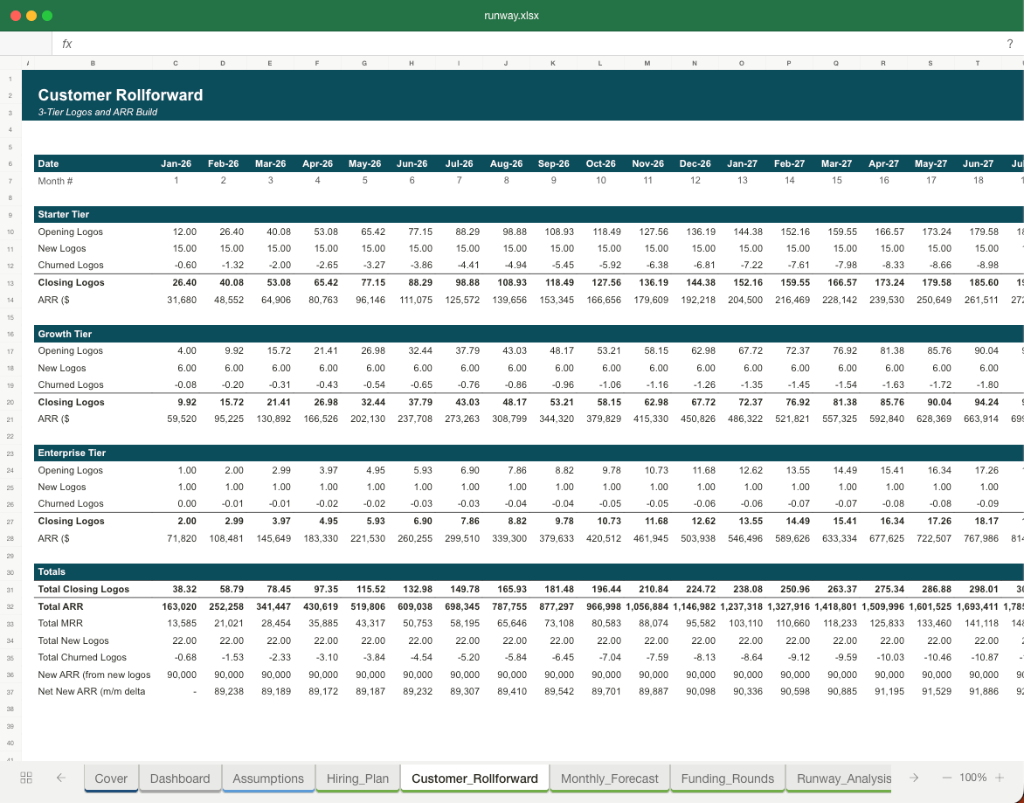
Build ARR bottom up from enterprise customers, endpoints per customer, and price per endpoint. Add module adoption, renewal, and expansion to derive net revenue retention, then model sales capacity, implementation, support, and cloud delivery costs. New-logo growth, endpoint expansion, module attach rate, and churn should be the scenario variables.
A turnkey financial model
Live formulas, no hardcoded values
Outputs are driven by live formulas, so the workbook updates from its assumptions instead of relying on hardcoded results.
All assumptions in one tab
Inputs are clearly marked in the Assumptions tab and separated from calculations, making it clear what to change and what to leave intact.
Statements always balancing
For integrated-statement models, the balance sheet, cash flow, and supporting schedules tie through properly.
Distinct schedules for clarity
Debt, working capital, taxes, and cash flow can get messy quickly. We group calculations in clear schedules, not across disconnected tabs.
No hidden macros or external links
There are no unexplained external workbook links or macros to undermine auditability or portability.
Changes flow through the model
Update a key driver and see the impact carry through the forecast, financing, and return outputs. We never use hardcoded numbers in formulas.
About Nexthink
nexthink.com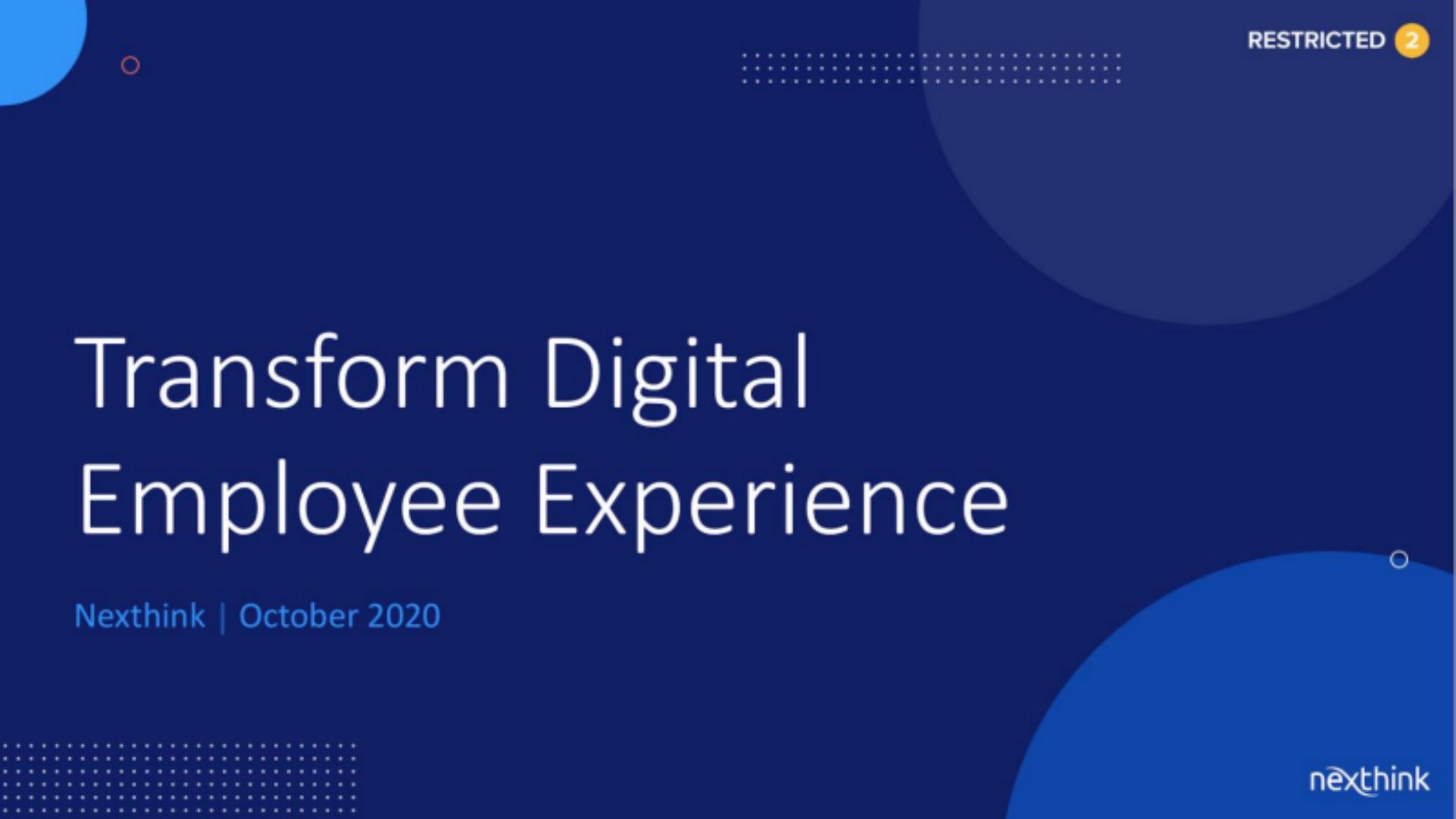
How to build a detailed financial model for Nexthink
A complete walkthrough of the business, drivers, and assumptions behind the downloadable Nexthink model - distilled from its pitch deck and publicly available information.
Product & value proposition
Nexthink Experience is a cloud SaaS platform that unifies four capabilities:
- Analyze - real-time endpoint telemetry & experience scoring.
- Engage - in-context employee sentiment surveys.
- Act - automated self-heal / self-service remediation.
- Integrate - data feeds into ITSM, CMDB, chatbots, and IT analytics tools.
Core value: IT teams gain a single, employee-centric view combining hard technical metrics with sentiment data - enabling proactive rather than reactive IT service delivery.
Market
- Device install base (TAM proxy): 777M business devices (desk-based, notebook, ultramobile) in 2019. Source: Gartner.
- Market TAM: $11.7B in 2019. Source: Nexthink's own estimate based on Gartner device count × $15 avg. price per endpoint.
- Demand-side tailwind: By 2025, 70% of digital business initiatives will require I&O leaders to report on DEX business metrics, up from <15% at time of deck (2020). Source: Gartner.
Revenue model
- Pricing unit: Per-endpoint / per-device subscription.
- Delivery: SaaS (cloud); the deck describes "Modern Cloud Foundation" with 24×7 availability and massive scalability.
- Packaging: Modular product suite - Monitor, Score, Optimize (Analyze tier) + Engage + Act + Integrate - sold as bundled platform. 100+ use-case content packs in "Nexthink Library."
- Channels: Direct enterprise sales to CIO / VP EUC / App Owner / IT Specialist buyers. No channel or marketplace model mentioned.
Traction & metrics
No revenue, ARR, customer count, growth rate, or NRR figures are disclosed in the deck. Customer impact proof points only:
| Metric | Customer | Source |
|---|---|---|
| 62% reduction in root-cause analysis time | US Pharmaceutical | - |
| Employee NPS improved from -60 to +12 (+72 pts) in <6 months | US Pharmaceutical | - |
| 440 days of lost productivity avoided from one outage | Global Manufacturer | - |
| $900K cost avoidance on hardware refresh cycle | US Healthcare | - |
| 10% increase in employee experience score in 2 months | Global Manufacturer | - |
| 37% incident reduction | US Media Company | - |
No logo slide, customer count, ARR, or growth figures in deck.
Competition / moat
Competitive gap framed (slide 04):
- IT Service Management (e.g., ServiceNow) - automates workflow but doesn't reduce incidents or measure experience.
- Client Management tools - no real-time analytics, not integrated with user feedback.
- APM / Network Monitoring - focused on apps not context, no user feedback integration.
- Sporadic email surveys - low response rate, not integrated with hard data.
Nexthink's claimed moat: Only platform unifying real-time endpoint telemetry + employee sentiment + automated remediation in one employee-centric view.
No named competitors referenced directly. No patent, data-network-effect, or switching-cost argument made explicitly.
Team & funding ask / use of funds
Leadership team (named):
- Pedro Bados - Co-founder & CEO
- Jeffrey Mitchell - Chief Revenue Officer
- Sacha Herrmann - CFO
- Bernd Leger - CMO
- Samuele Ganter - Chief Product Officer
- Vendant Sampath - CTO
- Yassine Zaid - Chief Strategy Officer
- Meg Donovan - Chief People Officer
- Mary Beth Vasallo - VP, North America
- Jon Cairns - VP, Technical Services
- Heather Moses - VP, Corporate Marketing
- Board advisors: René Bonvanie (Palo Alto Networks), Patrick Morley (Carbon Black)
Recommended financial model
- Archetype + why: Enterprise SaaS ARR model, endpoint-seat-based. Nexthink is a per-endpoint subscription SaaS platform sold to large enterprises. The natural model is a bottom-up ARR build: number of customers × avg. endpoints per customer × price per endpoint = ARR. Recurring SaaS with module-level upsell (Analyze → +Engage → +Act → +Integrate) makes an NRR / net expansion driver important.
- Forecast horizon & granularity: 5-year annual model (2020–2025), with Year 1 split monthly for cash-flow visibility. Monthly useful because enterprise SaaS has lumpy contract timing.
- Key drivers & assumptions:
| Driver | Value |
|---|---|
| TAM (2019 baseline) | $11.7B |
| Total addressable device install base | 777M units |
| Implied avg. price per endpoint/year | $15 |
| Starting ARR (2020) | Unknown |
| New logo adds per year | Unknown |
| Avg. endpoints per enterprise customer | 10,000–50,000 |
| Avg. ACV per customer (at $15/endpoint) | $150K–$750K |
| Net Revenue Retention (NRR) | 115% |
| Gross margin | 70–75% |
| S&M as % of revenue | 40–50% |
| R&D as % of revenue | 20–25% |
| G&A as % of revenue | 8–12% |
| Churn (logo) | 5–8% annually |
| TAM penetration by 2025 | 1–5% |
| Market CAGR (DEX software) | 20–25% |
- Scenarios (Base / Bull / Bear - which variables flex):
- Base: Steady logo growth (~30–40% YoY new customers), NRR 115%, $15/endpoint maintained.
- Bull: Faster enterprise adoption post-COVID WFH wave, NRR 125%+, ACV expansion as modules stack.
- Bear: Longer sales cycles, pricing pressure below $15/endpoint in competitive displacement, NRR at 105%.
- Primary flex levers: new logo growth rate, NRR, avg. ACV, and gross margin trajectory as cloud scales.
- Required sheets / outputs:
- Assumptions - all drivers with / tags, scenario toggles.
- ARR Waterfall - beginning ARR + new ARR + expansion − churn = ending ARR; by year (monthly in Y1).
- Revenue & P&L - ARR → recognized revenue, COGS, gross profit, opex (S&M, R&D, G&A), EBITDA.
- Headcount Plan - Sales, CS, Engineering, G&A; drives opex from the bottom up.
- Cash Flow - operating cash flow, capex, free cash flow; burn / runway if pre-profitability.
- TAM penetration bridge - device install base → addressable endpoints → penetrated endpoints over time.
- Valuation - ARR multiple comps (DEX/ITOM SaaS peers); optional DCF on terminal FCF.
- Dashboard - ARR, NRR, logo count, gross margin, FCF margin, Rule of 40.
Frequently asked
Is the Nexthink financial model free?+
Yes. The Nexthink model is a free Excel (.xlsx) download with live formulas. Sign up with your email and the workbook is yours to keep, review, and edit.
What's included in the model?+
A 5-year monthly forecast with P&L, cash flow and runway, valuation (exit multiple plus a DCF cross-check), MOIC/IRR returns, and unit economics, with live formulas throughout.
How was this model built?+
It was built from Nexthink's pitch deck and publicly available information, then structured to investment-banking standards as a fully editable Excel model.
Can I change the assumptions?+
Yes. You can change assumptions and the live formulas will recalculate in the downloadable Excel model.
Have more financial modelling questions? Contact us

Created by ex-finance professionals
Hey, I’m Alex and I created Finamodel.
Over my years in the finance industry I kept building the same models over and over again. Same structure, same assumptions, different logo. So I started building frameworks to turn them into clean, reusable templates.
Every model here is one I’d actually use for a client, and I personally vet each one before it goes up.
I’m not an expert in every industry, but I’ve built enough models to know what belongs in one. And when something is completely foreign to me, I reach out to my network for experts to work on our models with us.
Having a template library on hand cuts a first build from hours to minutes.
Need help finding your model? You’ll find me in the Finamodel app!
Other Crypto/Web3 Startup Financial Models
Browse another startup in the same category.

0x Labs
0x Labs builds open exchange infrastructure (protocol, API, consumer app) for on-chain token trading across multiple blockchains.

1inch Network
DeFi aggregation protocol that routes crypto swaps across 100+ liquidity sources to deliver best rates and lowest gas fees.

Aether
Synthetic biology platform that builds searchable protein indexes to engineer novel molecular assemblers for high-value industrial products.
Alto
Self-directed IRA platform enabling retail investors to invest in alternative assets (private equity, debt, real estate, crypto) via tax-advantaged retirement savings.
Auki Labs
Decentralized peer-to-peer spatial positioning SDK for social AR - building the infrastructure layer to replace GPS and enable a persistent AR metaverse.
Awesome People Ventures Fund 2
Awesome People Ventures is a community-driven, decentralized early-stage Web3 VC fund raising Fund II.

Axelar
Cross-chain blockchain overlay network enabling universal transfer of assets, transactions, and state across all blockchain ecosystems.
BRD
BRD is a non-custodial crypto wallet app (consumer) and blockchain infrastructure API platform (enterprise) targeting mass-market crypto adoption.