PAPareto Financial Model
Marketplace Startup Financials (Free Excel Download)
On-demand data enrichment platform that combines NLP-driven automation with human expert review to deliver custom data lists to professionals.



professionals from Deloitte
Used by professionals from






About this model
Pareto is an on-demand data-enrichment service that combines natural-language automation with human expert review. Customers request curated lead lists, research, contact enrichment, or spreadsheet work through a simple interface, and the platform uses APIs and operators to deliver the result.
It offers recurring subscriptions for regularly scheduled tasks and project pricing for one-off or high-volume requests. The deck reported $43,000 of monthly recurring revenue, 38% average monthly revenue growth, no paid marketing spend, and a 17x LTV-to-CAC ratio.
The model separates contracted recurring tasks from project revenue. Subscriber additions, task frequency, weekly price, renewal, and expansion build MRR, while project count and average project value add transactional income. Lead generation, expert-review capacity, data-provider costs, automation rate, and gross margin determine operating leverage.
A turnkey financial model
Live formulas, no hardcoded values
Outputs are driven by live formulas, so the workbook updates from its assumptions instead of relying on hardcoded results.
All assumptions in one tab
Inputs are clearly marked in the Assumptions tab and separated from calculations, making it clear what to change and what to leave intact.
Statements always balancing
For integrated-statement models, the balance sheet, cash flow, and supporting schedules tie through properly.
Distinct schedules for clarity
Debt, working capital, taxes, and cash flow can get messy quickly. We group calculations in clear schedules, not across disconnected tabs.
No hidden macros or external links
There are no unexplained external workbook links or macros to undermine auditability or portability.
Changes flow through the model
Update a key driver and see the impact carry through the forecast, financing, and return outputs. We never use hardcoded numbers in formulas.
About Pareto
pareto.co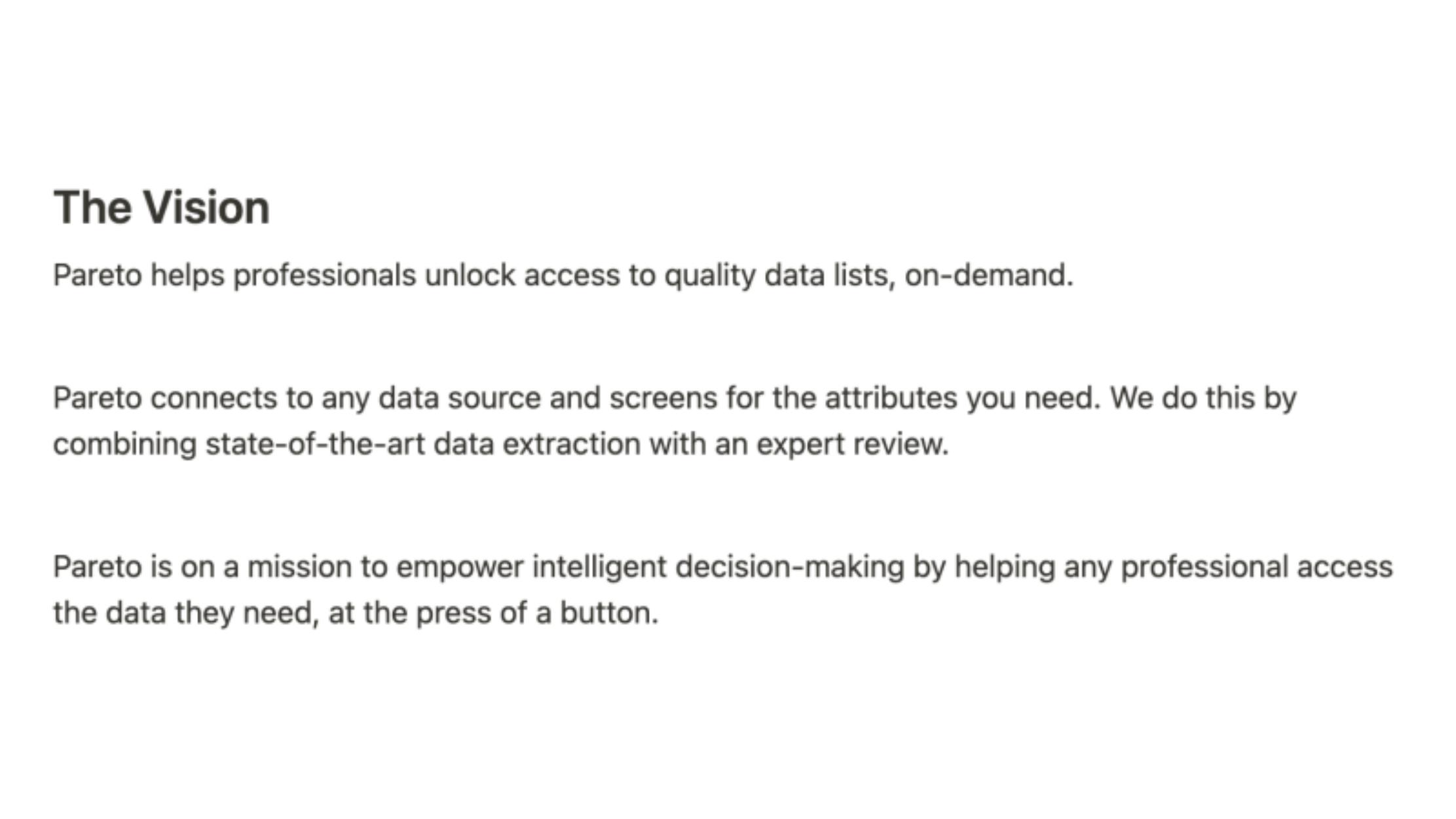
How to build a detailed financial model for Pareto
A complete walkthrough of the business, drivers, and assumptions behind the downloadable Pareto model - distilled from its pitch deck and publicly available information.
Product & value proposition
- Email-based natural language interface: customers send a plain-English request (e.g. "Find 100 Seattle medical businesses with >$1M ARR paying for Google local ads") and receive a curated data list.
- Backend: GPT-3 / Codex NLP classifies the task, calls third-party data APIs, then an expert human workforce reviews and enriches results.
- Delivers: B2B lead lists, contact enrichment, market research, spreadsheet filtering - any structured data extraction task.
- Key differentiation: zero-setup for the customer vs. weeks-long onboarding for competing tools; human QA layer vs. raw API output.
- Workforce described as majority women-led, trained for data tasks - framed as cost and quality advantage.
Market
- 60% of professionals spend 30% of their time on manual data collection and processing tasks (McKinsey, cited by deck).
- 2M sales and marketing professionals in the U.S. earning ~$60K/year on average.
- Implied TAM: $1.8B/month in potential addressable subscription revenue (company's own calculation based on above).
Revenue model
- Two pricing modes:
- Subscription ("subscribe and save"): recurring tasks delivered on a cadence. Example from slide 3: 100 businesses/week for $300 (crossed out) → $240/week per subscriber.
- Project-based: one-off or surge requests (e.g. enriching 40,000 contacts). Price computed per task based on data type, quantity, quality, and timeline.
- Channel: outbound email + LinkedIn, self-serve. $0 spent on paid marketing at time of deck.
- Long-term target: shift mix toward recurring subscriptions.
Traction & metrics
- Monthly revenue: $43K MRR at time of deck.
- MoM revenue growth: 38% average.
- Current outbound: 200 fresh leads/day targeted via email + LinkedIn.
- Planned outbound: 1,500 leads/day (post-raise scale target).
- LTV/CAC ratio: 17x.
- Paid marketing spend: $0.
- Named customers/social proof: Humbl, Five One Labs, Enya.ai/FeverIQ, Launch House, Modern Fertility.
Unit economics
- LTV/CAC ratio: 17x.
- Implied strong unit economics given 17x ratio and $0 paid marketing spend, but underlying figures not disclosed.
Competition / moat
- Not explicitly named in deck.
- Implicit competitive framing: existing alternatives are (a) data enrichment tools with limited attributes + weeks of setup, (b) contractors requiring 10-page SOPs and constant supervision, (c) repetitive manual internal review.
- Moat claims: NLP/AI interface lowers friction to zero; human-in-the-loop QA layer delivers higher accuracy; proprietary trained workforce as structural cost advantage.
Team & funding ask / use of funds
- Phoebe Yao, Founder & CEO: Thiel Fellow, Stanford CS dropout, ex-Microsoft Research (HCI), ex-Oxford Internet Institute (Social Computing).
- Adrian Villa, VP Engineering: ex-CTO Meccamico, ex-Head Eng RedLibre, Management @ HEC Paris, CS @ Stanford.
- Team described as global, majority women-led workforce.
- Pre-seed: $600K raised November 2020 from Foothill Ventures, SoGal Ventures, founders of DoNotPay and Lime.
- Current ask: larger seed round; use of funds = growth and hiring.
- Target 18-month path to Series A.
Recommended financial model
- Archetype + why: Subscription + transactional revenue model (hybrid MRR + project revenue). Business has a growing recurring base ($240/week subscriptions) plus lumpy project work. The 38% MoM growth and LTV/CAC of 17x make a subscription-led growth model appropriate, with a separate project/one-off revenue stream and a labor cost driver (the expert workforce scales with volume).
- Forecast horizon & granularity: 36 months monthly (seed-stage, pre-Series A; need to show 18-month path to Series A milestones and 3-year trajectory for investors).
- Key drivers & assumptions:
- Starting MRR: $43K
- MoM revenue growth rate: 38% - apply for 3–6 months post-raise then step down
- Post-raise growth deceleration: step down from 38% to ~15% MoM by month 18 as growth normalizes; rationale: hypergrowth rates at small base rarely sustain 3 years
- Revenue mix - subscription vs. project split: 60% subscription / 40% project at outset, shifting to 75/25 by year 3; rationale: stated long-term goal is recurring
- Subscription price: $240/week (~$1,040/month) per customer; blended ASP used given no customer-count disclosure
- LTV/CAC ratio: 17x
- CAC (absolute): ~$150–300 given $0 paid spend and outbound-only motion; rationale: outbound-only at early stage typically cheap but not free (time cost)
- Gross margin: 50–65%; rationale: data-as-a-service with human labor component - labor cost is direct COGS, typical for this model type
- Labor/COGS as % of revenue: 35–50%; scales roughly linearly with task volume
- Headcount plan: seed funds growth + hiring; model 2–3 new hires per quarter post-raise
- Outbound leads/day: 200 current → 1,500 planned; ramp over 6 months post-raise
- Lead-to-customer conversion rate: 2–5%; rationale: outbound B2B SaaS typical range
- Churn rate: 5–8% monthly; rationale: no data in deck; early-stage B2B data services with weekly cadence likely has moderate churn
- Seed raise amount: $1–2M; rationale: pre-seed was $600K, described as "larger" seed round
- Scenarios (Base / Bull / Bear - which variables flex):
- Base: 38% MoM → decelerates to 15% by month 18; 60/40 sub/project mix; 55% gross margin.
- Bull: growth holds at 25%+ for 12 months (outbound 1,500 leads/day hits faster); churn <5%; gross margin expands to 65% via automation.
- Bear: growth decelerates faster (to 10% by month 12); churn 10%+; project revenue lumpy/unreliable; gross margin 45% (labor costs sticky).
- Required sheets / outputs:
- Assumptions - all drivers, toggleable by scenario
- Revenue build - subscriber count, MRR, project revenue, total revenue
- COGS & gross margin - labor cost schedule, per-task economics
- Opex - headcount plan, sales/marketing, G&A
- P&L (Income Statement)
- Cash flow & runway - months to zero, Series A gate
- Unit economics summary - LTV, CAC, payback, LTV/CAC by cohort month
- Dashboard - MRR, ARR, gross margin %, runway, key milestones
Frequently asked
Is the Pareto financial model free?+
Yes. The Pareto model is a free Excel (.xlsx) download with live formulas. Sign up with your email and the workbook is yours to keep, review, and edit.
What's included in the model?+
A 5-year monthly forecast with P&L, cash flow and runway, valuation (exit multiple plus a DCF cross-check), MOIC/IRR returns, and unit economics, with live formulas throughout.
How was this model built?+
It was built from Pareto's pitch deck and publicly available information, then structured to investment-banking standards as a fully editable Excel model.
Can I change the assumptions?+
Yes. You can change assumptions and the live formulas will recalculate in the downloadable Excel model.
Have more financial modelling questions? Contact us

Created by ex-finance professionals
Hey, I’m Alex and I created Finamodel.
Over my years in the finance industry I kept building the same models over and over again. Same structure, same assumptions, different logo. So I started building frameworks to turn them into clean, reusable templates.
Every model here is one I’d actually use for a client, and I personally vet each one before it goes up.
I’m not an expert in every industry, but I’ve built enough models to know what belongs in one. And when something is completely foreign to me, I reach out to my network for experts to work on our models with us.
Having a template library on hand cuts a first build from hours to minutes.
Need help finding your model? You’ll find me in the Finamodel app!
Other Marketplace Startup Financial Models
Browse another startup in the same category.

Acquco
Amazon brand aggregator - acquires third-party Amazon seller businesses at attractive multiples, then scales them via proprietary growth playbooks and technology.
Arive
Premium q-commerce app delivering lifestyle and branded products in under 30 minutes across German cities.

Audience Town
Vertical data and advertising platform targeting home movers across the entire home journey - pre-move through post-move.

AudioMob
Non-intrusive in-game audio ad platform bridging music/brand advertisers to mobile game publishers.

Authoritive
Two-way messaging platform that turns creator expertise into scalable, push-delivered learning experiences via SMS/WhatsApp.

Avo
Building amenity and office perk platform delivering same-day grocery/pantry/goods to residential and commercial tenants via a white-label marketplace.
beehiiv
Newsletter platform for creators to build, grow, and monetize email audiences - SaaS subscription + native ad network revenue.
Borzo
Global same-day logistics marketplace connecting B2B merchants with crowdsourced couriers for last-mile delivery


