PAPasqal Financial Model
Hardware/Deep-tech Startup Financials (Free Excel Download)
European quantum computing hardware company building neutral-atom Quantum Processing Units (QPUs) for HPC and enterprise use cases.


professionals from Deloitte
Used by professionals from






About this model
Pasqal builds neutral-atom quantum processing units for HPC and enterprise applications. Its European quantum-hardware business depends on technical milestones, partnerships, and high-value systems, with potential revenue from installed QPUs, cloud access, research projects, and service arrangements.
The company faces a long path from technical performance to commercial scale. Customers need evidence that systems solve useful workloads, while manufacturing, specialised components, installation, and R&D consume capital before recurring deployment volume is established.
Model qualified opportunities, QPU sales, ASP, cloud access, service revenue, grants, and deployment timing. Include R&D, manufacturing, facilities, specialist components, installation, field engineering, and support. Performance milestones, partnership conversion, delivery capacity, system margin, grants, cloud utilisation, and repeat orders should drive scenarios.
A turnkey financial model
Live formulas, no hardcoded values
Outputs are driven by live formulas, so the workbook updates from its assumptions instead of relying on hardcoded results.
All assumptions in one tab
Inputs are clearly marked in the Assumptions tab and separated from calculations, making it clear what to change and what to leave intact.
Statements always balancing
For integrated-statement models, the balance sheet, cash flow, and supporting schedules tie through properly.
Distinct schedules for clarity
Debt, working capital, taxes, and cash flow can get messy quickly. We group calculations in clear schedules, not across disconnected tabs.
No hidden macros or external links
There are no unexplained external workbook links or macros to undermine auditability or portability.
Changes flow through the model
Update a key driver and see the impact carry through the forecast, financing, and return outputs. We never use hardcoded numbers in formulas.
About Pasqal
pasqal.io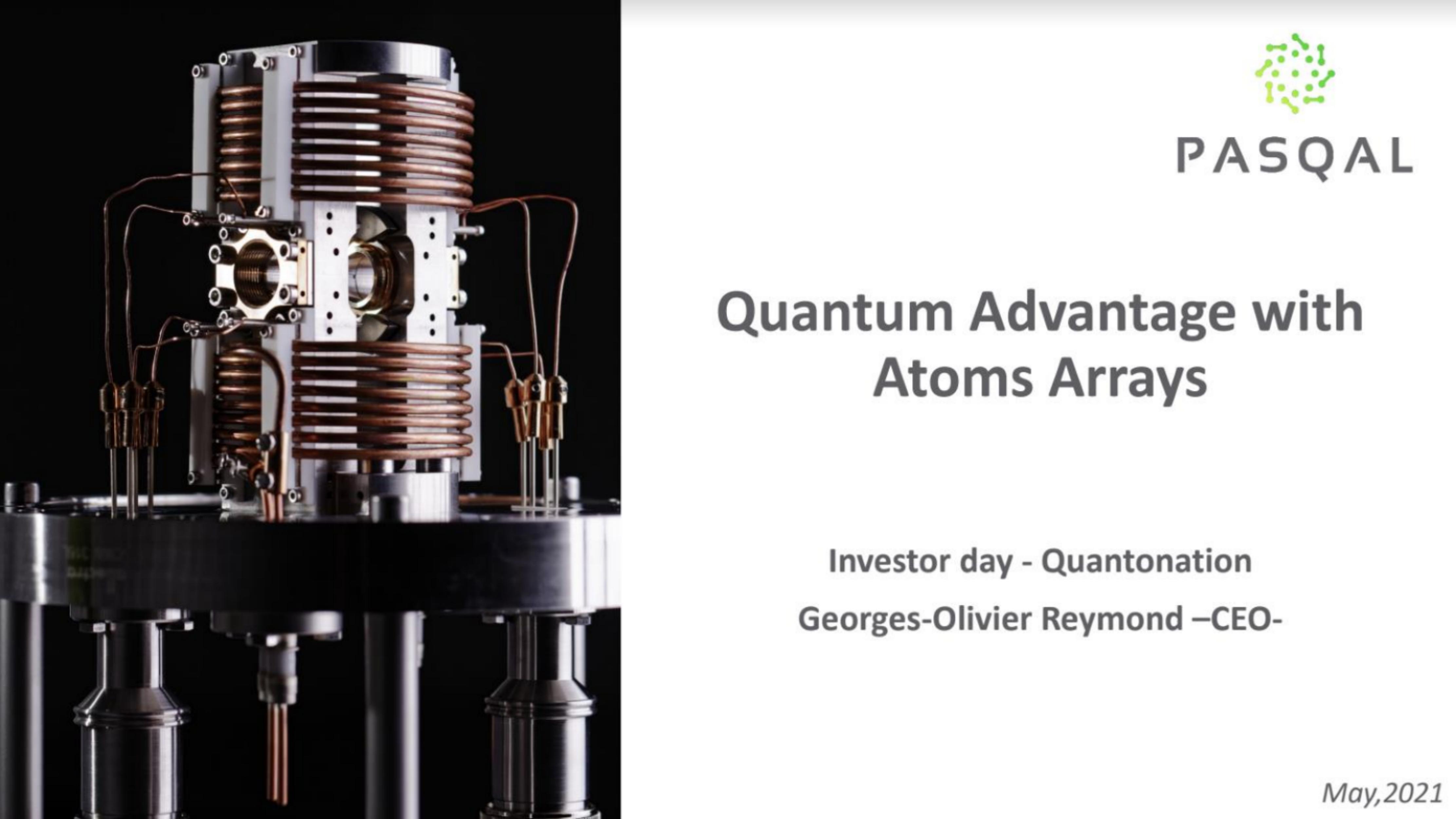
How to build a detailed financial model for Pasqal
A complete walkthrough of the business, drivers, and assumptions behind the downloadable Pasqal model - distilled from its pitch deck and publicly available information.
Product & value proposition
- Neutral-atom QPUs using trapped Rubidium atoms in arrays of optical tweezers
- 100–1,000 qubit systems; 100 qubits available end-2021, 1,000 qubits on cloud end-2023
- Two control modes: Analogue (better near-term performance, not universal) and Digital (universal, comparable to other platforms)
- Full-stack offer: hardware, quantum software (Pulser library, open-source), cloud services, and application layer
- Supports 1D, 2D, 3D geometries; high connectivity advantage vs. other qubit platforms
- QPU physical specs: 330 cm wide, 200 cm tall, <750 kg, <10 kW power, standard Ethernet interface, no cooling required - designed for HPC centre deployment
Revenue model
Two access modes described:
- On-premise QPU sales/deployment - QPUs installed at HPC centres or client premises (TGCC France, Jülich Germany named as early adopters)
- Cloud access / QCaaS - Online platform accessible to end-users and ISV partners; cloud launch end-Q1 2022
Partnership model (Co-Design):
- Multi-phase engagement (~6 months/phase): framing → algorithm development & emulation → hardware implementation
- Partners pay for Proofs of Concept and joint studies involving PASQAL engineers
- Named paying/engaged partners: EDF, GENCI, Jülich, CINECA, Qu&Co, Multiverse Computing, Qubit Pharmaceuticals, Rahko
No pricing figures (€/qubit-hour, PoC fees, hardware price) disclosed in deck.
Traction & metrics
- 100 qubits available end-2021 on in-house prototype
- 1,000 qubit target on cloud by end-2023
- Cloud access planned end-Q1 2022
- On-premise QPUs at two European HPC facilities (TGCC, Jülich) by early 2023
- QAOA emulation run on 84 real instances (EDF data), 15 qubits
- Approximation ratio chart (slide 14): convergence from ~0.72–0.80 at depth 1 to ~0.95–0.99 at depth 7 across two graph types
- Quantum advantage demonstrated for MIS problem at 1,000 qubits (published: Serret et al., Phys. Rev. A 102, 2020)
- No revenue, ARR, customer count, or bookings figures disclosed.
Competition / moat
Not explicitly named competitors. Moat framed as:
- Qubit count leadership: "unrivalled performance (qubit number, connectivity, quantum volume)"
- Analogue control mode enables near-term practical use cases ahead of universal quantum computers
- Academic lineage: Paris-Saclay / CNRS world-leading quantum science hub
- Ecosystem lock-in: HPC centre integrations (GENCI, Jülich, CINECA), ISV partnerships, open-source Pulser SDK for developer adoption
- Published peer-reviewed results demonstrating quantum advantage (Scholl et al. 2020, Serret et al. 2020)
Team & funding ask / use of funds
- CEO: Georges-Olivier Reymond
- No other team members named in slides.
- No funding ask, round size, valuation, or use-of-funds slide in the deck. Presented to Quantonation (quantum-focused VC), suggesting active fundraise but no terms disclosed.
Recommended financial model
- Archetype + why: Hardware + SaaS/QCaaS hybrid - specifically a contract/services revenue + recurring cloud subscription model. Revenue has two distinct streams: (1) lump-sum or milestone-based hardware/PoC contracts, (2) recurring cloud access fees as QPU capacity scales. This is analogous to an HPC/infrastructure vendor model (think: usage-based cloud + hardware deployment) rather than a pure SaaS. A 3-statement operating model with revenue segmented by stream is most appropriate.
- Forecast horizon & granularity: 5 years (2021–2026), quarterly for years 1–2, annual for years 3–5. Reflects long PoC cycles (~6 months/phase) and hardware deployment lead times.
- Key drivers & assumptions:
| Driver | Value / Source |
|---|---|
| Qubit count - 2021 | 100 |
| Qubit count - 2023 | 1,000 |
| Qubit count CAGR 2023–2026 | ~3x per 2 years (neutral-atom roadmap); reach ~10,000 by 2026 |
| Cloud launch date | End Q1 2022 |
| On-premise deployments - 2023 | 2 (TGCC + Jülich) |
| On-premise deployments growth | +2–4 HPC sites/year from 2024; each site = multi-year contract |
| PoC engagement duration | 6 months/phase |
| PoC contract value | €150K–€500K/engagement (pre-commercial quantum pricing for Fortune 500/HPC); no deck data |
| Active PoC partners (2021) | ~5–7 named (EDF, Multiverse, Qu&Co, Rahko, Qubit Pharma, GENCI, Jülich) |
| Cloud pricing (QCaaS) | Usage-based, €/qubit-hour or subscription tier; €50K–€500K ACV for enterprise |
| Gross margin - hardware | 30–50% (deep-tech hardware; scale improves margin) |
| Gross margin - cloud/services | 60–75% at scale; lower early due to optics/laser infrastructure COGS |
| R&D as % of revenue | 60–80% years 1–3 (pre-revenue scaling); declines to 30–40% by 2025–2026 |
| Headcount | ~20–40 FTEs in 2021 (typical European quantum startup at this stage); scale to 150+ by 2026 |
| Funding assumption | Series A €15–30M in 2021/22 to fund hardware scale-up and cloud build-out (context: Quantonation investor day, pre-revenue) |
- Scenarios (Base / Bull / Bear - which variables flex):
- Base: 2 on-premise QPU deals/year from 2023; cloud revenue ramps from 2022; 1,000 qubit milestone hit on schedule 2023
- Bull: Faster qubit scaling (3,000+ by 2023); 3–5 HPC deals/year; pharmaceutical/energy verticals adopt early; cloud ASP higher
- Bear: Qubit scaling delayed 12–18 months; PoC pipeline stays thin; cloud launch slips; competition from IBM/IonQ/Google crowds market
- Required sheets / outputs:
- Assumptions - all drivers, toggleable scenario switch
- Revenue build - two streams: (a) PoC/hardware contracts (volume × ACV), (b) cloud/QCaaS (seats or usage, ramp curve)
- P&L - revenue, COGS by stream, gross profit, R&D, S&M, G&A, EBITDA, net income
- Headcount plan - engineering, hardware, software, commercial
- Cash & runway - burn rate, funding tranches, months of runway
- KPI dashboard - qubit count progression, active PoC partners, on-premise deployments, cloud ARR
- Sensitivity table - qubit scaling speed × on-premise deal velocity
Frequently asked
Is the Pasqal financial model free?+
Yes. The Pasqal model is a free Excel (.xlsx) download with live formulas. Sign up with your email and the workbook is yours to keep, review, and edit.
What's included in the model?+
A 5-year monthly forecast with P&L, cash flow and runway, valuation (exit multiple plus a DCF cross-check), MOIC/IRR returns, and unit economics, with live formulas throughout.
How was this model built?+
It was built from Pasqal's pitch deck and publicly available information, then structured to investment-banking standards as a fully editable Excel model.
Can I change the assumptions?+
Yes. You can change assumptions and the live formulas will recalculate in the downloadable Excel model.
Have more financial modelling questions? Contact us

Created by ex-finance professionals
Hey, I’m Alex and I created Finamodel.
Over my years in the finance industry I kept building the same models over and over again. Same structure, same assumptions, different logo. So I started building frameworks to turn them into clean, reusable templates.
Every model here is one I’d actually use for a client, and I personally vet each one before it goes up.
I’m not an expert in every industry, but I’ve built enough models to know what belongs in one. And when something is completely foreign to me, I reach out to my network for experts to work on our models with us.
Having a template library on hand cuts a first build from hours to minutes.
Need help finding your model? You’ll find me in the Finamodel app!
Other Hardware/Deep-tech Startup Financial Models
Browse another startup in the same category.

ANYbotics
ANYbotics builds and sells autonomous legged inspection robots (ANYmal) for industrial facilities, targeting oil & gas, chemicals, power, offshore, mining, and manufacturing sectors.
Awake Security
Awake Security - AI-driven Network Detection & Response (NDR) platform for the hybrid cloud, positioning as the "intent detection" layer of the SOC visibility triad.

Beem
AR communications platform that overlays full-body "hologram" video of a person into the recipient's physical space via smartphone or web.

Blue White Robotics
Autonomous robotics platform converting existing farm equipment to self-driving tractors for permanent-crop growers, sold as Robots-as-a-Service.

Cambridge GaN Devices
Fabless semiconductor startup commercialising self-protected GaN power transistors (HiGaN) that replace silicon and standard GaN with higher efficiency and no external protection circuitry.

Canix
Cannabis-focused ERP (inventory tracking, compliance automation, sales management, yield forecasting) sold as SaaS to cannabis cultivators, manufacturers, and distributors.
Chobani
Chobani is the US market leader in Greek yogurt; TPG invested $671M in April 2014 for a 35% stake via a structured second lien + equity deal
Cipher Skin
Wearable sensor mesh platform that collects dense multi-modal data from human bodies and industrial objects to predict structural and functional failure before it occurs.


