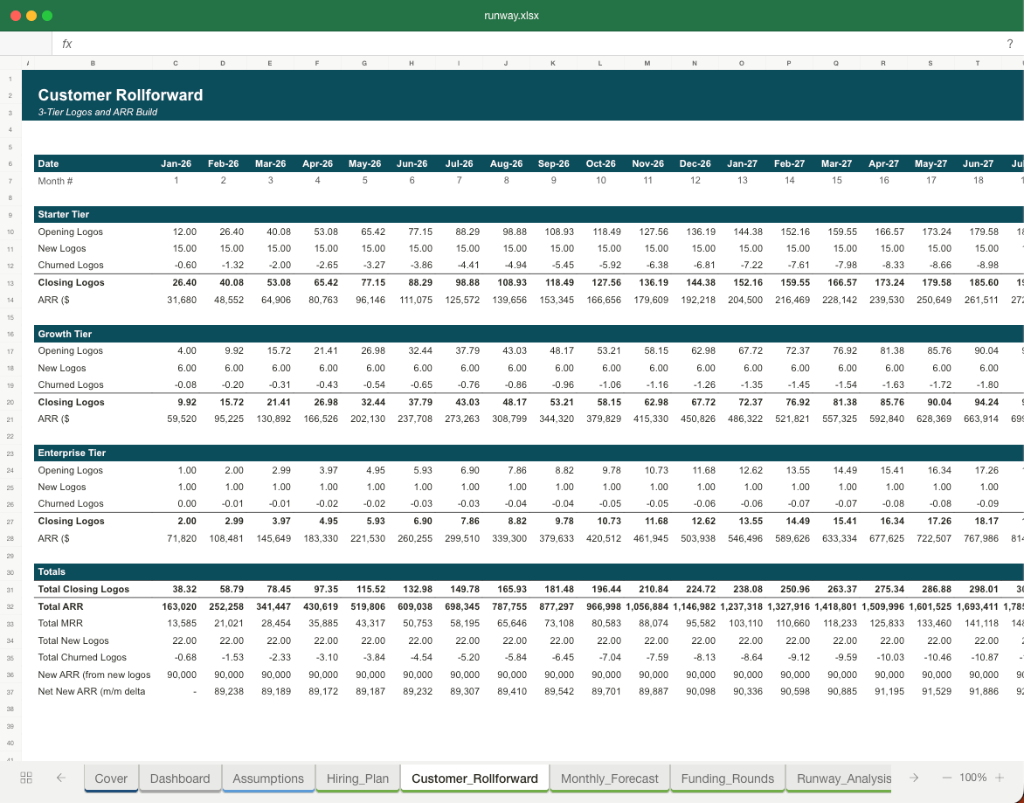
 Payhawk Financial Model
Fintech Startup Financials (Free Excel Download)
Integrated spend management platform combining corporate cards, bill payments, expenses, and pre-accounting for mid-market and enterprise companies [DECK]



professionals from Deloitte
Used by professionals from






About this model
Payhawk is an integrated spend-management platform for mid-market and enterprise companies, combining corporate cards, bill payments, expenses, and pre-accounting workflows. It gives finance teams a central control layer for employee and supplier spending.
The company earns both subscription MRR and transaction-linked revenue from interchange, FX, and transfer fees. Its software-led positioning and high early cohort expansion make it distinct from businesses dependent only on card economics.
The model should build cohort-based subscription ARR from customers, plan mix, and expansion, then add card and payment volume with net interchange, FX, and fee yields. Gross retention, net revenue retention, payment costs, and enterprise implementation capacity are the main forecast sensitivities.
A turnkey financial model
Live formulas, no hardcoded values
Outputs are driven by live formulas, so the workbook updates from its assumptions instead of relying on hardcoded results.
All assumptions in one tab
Inputs are clearly marked in the Assumptions tab and separated from calculations, making it clear what to change and what to leave intact.
Statements always balancing
For integrated-statement models, the balance sheet, cash flow, and supporting schedules tie through properly.
Distinct schedules for clarity
Debt, working capital, taxes, and cash flow can get messy quickly. We group calculations in clear schedules, not across disconnected tabs.
No hidden macros or external links
There are no unexplained external workbook links or macros to undermine auditability or portability.
Changes flow through the model
Update a key driver and see the impact carry through the forecast, financing, and return outputs. We never use hardcoded numbers in formulas.
About Payhawk
payhawk.com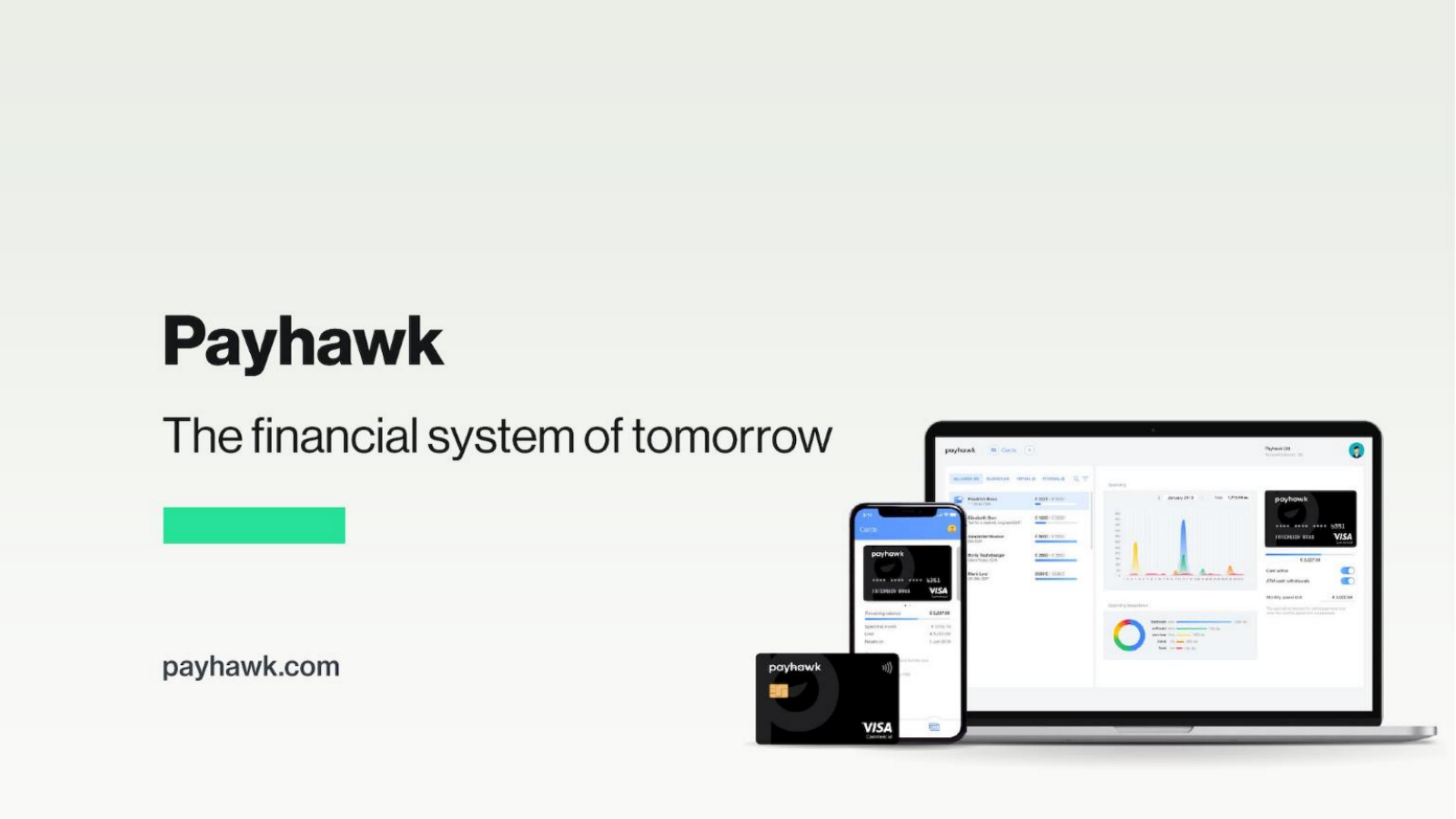
How to build a detailed financial model for Payhawk
A complete walkthrough of the business, drivers, and assumptions behind the downloadable Payhawk model - distilled from its pitch deck and publicly available information.
Product & value proposition
- Unified platform connecting corporate cards, bill payments, cash/employee reimbursements, and pre-accounting into one system
- Sits between existing bank accounts and ERP systems (SAP, Dynamics, Oracle, NetSuite, Sage, Xero, QuickBooks); plug-and-play, no bank or ERP migration required
- Eliminates manual reconciliation; claims to cut finance team operational work by 50–70%
- Global card issuing: debit cards + deposit accounts in Europe; credit cards in N. America, Australia, Asia, S. America; credit cards in Europe flagged as Q1'22
- OCR in 60+ languages for automated invoice data extraction
- Multi-currency spending with 0.9% FX markup on non-EUR/GBP/USD transactions; SEPA and Faster Payments for bill pay
- Connects to 3,000+ banks via direct integration, providing virtual accounts and dedicated IBANs
- Security: PCI DSS Level 1, ISO 27001, SOC2, SSO/SAML, geofencing, four-eyes payments
- Real-time spend controls: per-card limits, allowed MCC categories, merchant blocks, day/time restrictions
Revenue model
Three revenue streams, all described qualitatively - actuals redacted in deck:
- Subscription (SaaS MRR): Monthly software fee per customer; described as high relative to fintech peers because Payhawk is positioned as a software layer, not a payments company
- Interchange & Fees: Earn 100% on interchange via Visa Corporate BINs (high interchange tier); FX markup fees on non-base-currency spend; transfer fees
- Services: Mentioned as third revenue line in P&L structure; nature not specified
Revenue per customer compounds rapidly with expansion (additional entities, more cards, higher transaction volume, new modules) - illustrated by cohort data showing NRR well above 100% from Q0.
Pricing not disclosed. Sales cycle: 2–3 months for high-growth companies (Series A+, revenue $5M+); 3–4 months for enterprise/multinationals (500+ employees, $50M+ revenue).
Traction & metrics
Cohort Revenue Retention (Slide 10 - image confirmed):
| Cohort | Q0 | Q1 | Q2 | Q3 | Q4 | Q5 | Q6 | Q7 |
|---|---|---|---|---|---|---|---|---|
| 2019 Q4 | 100% | 197% | 220% | 274% | 357% | 376% | 404% | 437% |
| 2020 Q1 | 100% | 157% | 187% | 357% | 671% | 541% | 707% | - |
| 2020 Q2 | 100% | 197% | 193% | 217% | 286% | 332% | - | - |
| 2020 Q3 | 100% | 197% | 219% | 223% | 235% | - | - | - |
| 2020 Q4 | 100% | 263% | 284% | 344% | - | - | - | - |
| 2021 Q1 | 100% | 432% | 298% | - | - | - | - | - |
| 2021 Q2 | 100% | 220% | - | - | - | - | - | - |
| 2021 Q3 | 100% | - | - | - | - | - | - | - |
| Avg | 100% | 238% | 234% | 283% | 387% | 416% | 556% | 437% |
Note: Cohort base includes MRR + interchange + fees.
- NRR is strongly negative churn: Q1 average 238%, implying very rapid expansion revenue
- Customers described as ranging from 2 to 10,000 employees; product active in 22 countries at time of early product
- Named customers include MacPaw, By Miles, zenloop, Nexo, Gtmhub, Sellics (growth segment) and Lotto24, ATU, Viking Life-Saving Equipment, novum Bank, Luxair, TBI Bank, Candelas (enterprise)
- Customer count not disclosed; revenue absolute figures redacted in all financial slides
Unit economics
Unit economics slide (Slide 11) has all values redacted ("x"). Qualitative commentary only:
- Revenue per customer = Subscription MRR + Interchange MRR
- One-off setup costs: KYB/KYC check + card issue & shipping
- Monthly recurring COGS: Issuer & Visa scheme fees; Google image processing/storage; merchant fees (payment gateway)
- "Relatively high gross profit in the fintech space" due to SaaS pricing power and multi-vendor card/processor deals
- Gross profit disclosed to exist for both month 1 and subsequent months, with month 1 lower (setup cost drag) - no figures
- LTV significantly increases with product maturity while CAC decreases (directional claim only)
- CAC and LTV line items appear in P&L forecast table but all values are redacted
Competition / moat
Competitors named: Revolut Business, Tide, Starling, Penta, Qonto, Monzo (banking/current accounts); Expensify, Pleo, Soldo, Spendesk, Mooncard, Moss (spend/expense); Bill.com, Libeo, Melio, Roger, Regate, Pennylane, ReceiptBank (bill pay); Barclays, SAP Concur (legacy)
Stated moat:
- Horizontal issuing strategy via multiple processors/issuers (vs. single-vendor dependency of competitors)
- Enterprise-grade ERP integrations (SAP, Dynamics, Oracle) that neobanks and SME-focused peers don't support
- No IT resources required for deployment - CFO-led, not IT-led
- Multi-entity, multi-country architecture (competitors are single-country point solutions)
- Expansion revenue model - customers grow revenue automatically as they scale
Team & funding ask / use of funds
Team (Slide 2):
- Hristo Borisov - CEO; ex-Telerik Director of Product (11+ years); managed 180-person product org and $30M budget
- Boyko Karadzhov - CTO; ex-Telerik; US patent pending for AI co-invented with Hristo
- Konstantin Djengozov - CFO; ex-Telerik; co-managed $30M budget
- Telerik was acquired for $263.5M; 80% of dev team is ex-Telerik
Key hires: Desiree Schildt (Head of Growth), Thomas Westerhoven (Head of Sales), Inigo Navas (Commercial Director, Spain), Manuel Holzer (Commercial Director, Germany)
Investors: QED Investors (Yusuf Özdalga), Earlybird (Roland Manger), Vassil Terziev (Telerik co-founder, Eleven), Mark Antipof (ex-Visa CCO), Keith Robinson (Sage CSO)
Offices: London, Berlin, Barcelona, Sofia
Recommended financial model
Archetype + why: SaaS + Payments hybrid P&L with cohort-based expansion revenue. Payhawk has two fundamentally different revenue engines - a SaaS subscription (predictable MRR per customer) and a transaction-volume-driven revenue layer (interchange, FX, transfer fees). The cohort data shows NRR of 238%+ at Q1, meaning expansion revenue dwarfs new logo MRR; a pure SaaS ARR model would understate revenue trajectory. The P&L structure shown (Slide 12) is a standard 3-statement-lite with CoS split between card/issuer costs and infrastructure, plus full OPEX breakdown and EBITDA. Recommend a cohort-driven SaaS + payments P&L with a 3-statement output.
Forecast horizon & granularity:
- FY19 Actual, FY20 Actual as anchors (values unknown but column structure confirmed)
- FY21–FY23 Forecast horizon
- Monthly granularity for cohort build, quarterly roll-up for P&L summary
- Model should follow the deck's FY19–FY23 structure to match pitch narrative
Key drivers & assumptions:
*Customer acquisition:*
- New customers per quarter
- Customer mix: % high-growth SME ($5M+ revenue) vs. enterprise ($50M+)
- Sales cycle: 2–3 months SME, 3–4 months enterprise
*Revenue per customer:*
- Subscription MRR per customer by segment
- Average monthly card spend per customer (drives interchange)
- Interchange rate: Visa Corporate BIN - Europe ~0.3–0.5% of spend; other regions vary
- FX revenue: 0.9% markup on non-EUR/GBP/USD spend
- Services revenue: small line;
*Cohort expansion / NRR:*
- Quarter-on-quarter revenue expansion per cohort
- NRR stabilises after Q4
*Gross margin:*
- Setup CoS: KYB/KYC (one-off) + card issue and shipping (one-off)
- Recurring CoS: Issuer + Visa scheme fees; cloud/OCR processing; payment gateway
-
*Headcount:*
- Primarily R&D and G&A in Sofia (lower cost), commercial in UK/Germany/Spain
-
*CAC:*
- Fully loaded CAC tracked in P&L but all values redacted
-
*EBITDA margin trajectory:*
- Deck implies heavy investment phase through FY21, moving toward profitability by FY22–23
Scenarios (Base / Bull / Bear):
| Variable | Bear | Base | Bull |
|---|---|---|---|
| New customers/quarter growth | Flat/slow | Moderate (deck trend) | Accelerated (upmarket push) |
| NRR (cohort expansion) | 150% avg Q1 | 238% (deck avg) | 300%+ |
| Interchange rate | Low (0.2%) | Mid (0.35%) | High (0.5%) |
| ADS (avg deal size) | SME-heavy | 70/30 SME/enterprise | Enterprise-heavy |
| Gross margin | 55% | 65% | 75% |
| Headcount growth | Aggressive | Moderate | Lean |
Required sheets / outputs:
- Assumptions - all drivers in one place with/ tags
- Cohort Engine - quarterly cohort build (logo count × revenue per cohort quarter)
- Revenue Bridge - new MRR + expansion MRR + interchange + FX + services
- P&L - follows Slide 12 structure: Revenue → CoS → Gross Profit → OPEX (headcount, marketing, facility/admin, IT, travel, services, financial, other) → EBITDA
- Unit Economics - CAC, LTV, LTV:CAC, payback period
- Scenario toggle - dropdown selecting Bear/Base/Bull
- Dashboard - KPI cards: ARR, NRR, Gross Margin, EBITDA, Customer Count, LTV:CAC
Frequently asked
Is the Payhawk financial model free?+
Yes. The Payhawk model is a free Excel (.xlsx) download with live formulas. Sign up with your email and the workbook is yours to keep, review, and edit.
What's included in the model?+
A 5-year monthly forecast with P&L, cash flow and runway, valuation (exit multiple plus a DCF cross-check), MOIC/IRR returns, and unit economics, with live formulas throughout.
How was this model built?+
It was built from Payhawk's pitch deck and publicly available information, then structured to investment-banking standards as a fully editable Excel model.
Can I change the assumptions?+
Yes. You can change assumptions and the live formulas will recalculate in the downloadable Excel model.
Have more financial modelling questions? Contact us

Created by ex-finance professionals
Hey, I’m Alex and I created Finamodel.
Over my years in the finance industry I kept building the same models over and over again. Same structure, same assumptions, different logo. So I started building frameworks to turn them into clean, reusable templates.
Every model here is one I’d actually use for a client, and I personally vet each one before it goes up.
I’m not an expert in every industry, but I’ve built enough models to know what belongs in one. And when something is completely foreign to me, I reach out to my network for experts to work on our models with us.
Having a template library on hand cuts a first build from hours to minutes.
Need help finding your model? You’ll find me in the Finamodel app!
Other Fintech Startup Financial Models
Browse another startup in the same category.
Acin
SaaS and data subscription network for operational risk management at Tier 1 financial institutions

Ageras Group
B2B SME ecosystem - marketplace connecting SMEs with accountants + cloud accounting/payroll software + embedded financial services (lending, factoring, banking)

Airbase
Unified non-payroll spend management platform (corporate cards, AP/bill pay, expense reimbursement, approval workflows) for mid-market companies.

Altruist
Vertically integrated all-in-one platform for registered investment advisors (RIAs) - combining custodial, portfolio management, practice management, and client acquisition tools.
Amenitiz
All-in-one hotel management SaaS platform ("Shopify for hotels") for independent hoteliers - PMS, booking engine, channel manager, website builder, payments, and AI-driven revenue management.

Anrok
SaaS sales tax compliance platform - nexus monitoring, calculation, registration, filing, and remittance - built specifically for SaaS companies.
Arrival
Arrival is an EV manufacturer of commercial vans and buses using proprietary Microfactories and vertically integrated components, going public via SPAC merger with CIIG Merger Corp.

AtoB
AtoB is building financial infrastructure for commercial fleets, starting with a no-fee Visa fleet card for fuel and expanding into payroll, BNPL, and international.