 Pearpop Financial Model
Marketplace Startup Financials (Free Excel Download)
Tech-enabled influencer marketing marketplace connecting brands with creators across TikTok, Instagram, and Twitter via performance-based "Challenges" and "Ovations."



professionals from Deloitte
Used by professionals from






About this model
Pearpop is an influencer-marketing marketplace where brands run performance-based campaigns with creators across TikTok, Instagram, and Twitter. Brands set campaign budgets and payout rules, while creators submit content and are paid based on views, engagements, or other verified outcomes.
The company had paid more than $10 million to creators and built a supply base of more than 200,000 creators, including many with fewer than one million followers. Pearpop earns a take rate on campaign spending; its future Ovations product may add a loyalty or software layer.
The model builds GMV from active brands, campaign budgets, campaign frequency, creator participation, and performance pricing, then applies a platform margin. Creator payouts, campaign operations, trust and safety, and sales costs sit beneath revenue. Repeat brand spend, creator liquidity, and take rate are the key drivers of marketplace scale.
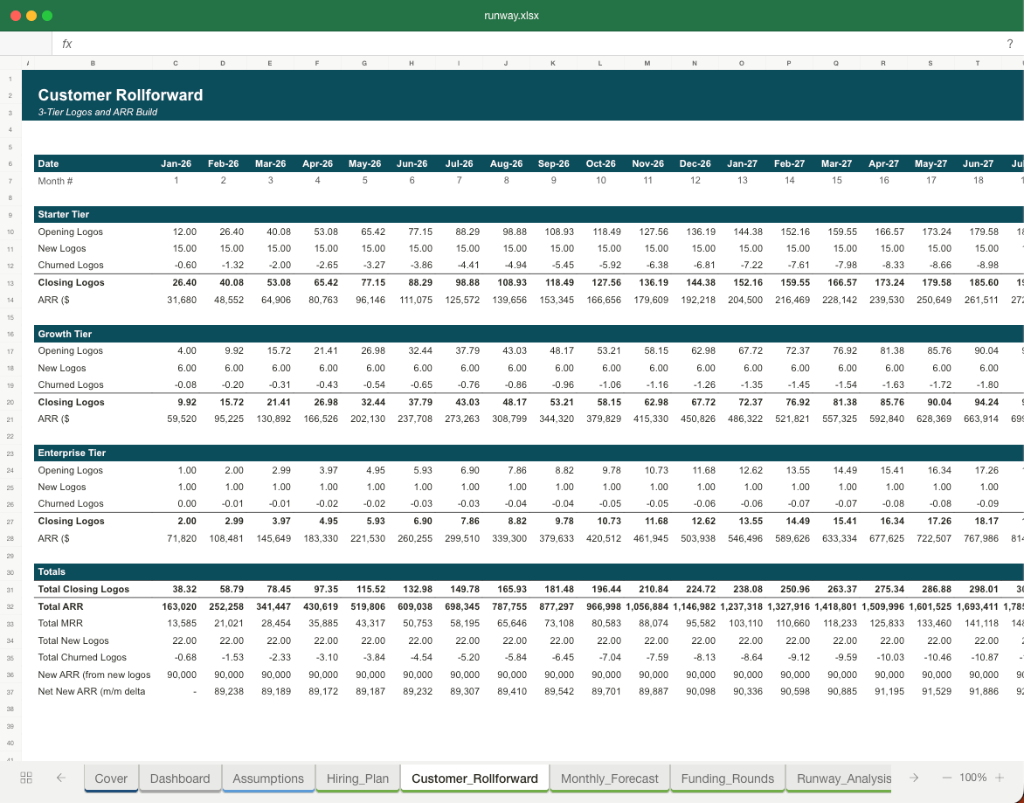
A turnkey financial model
Live formulas, no hardcoded values
Outputs are driven by live formulas, so the workbook updates from its assumptions instead of relying on hardcoded results.
All assumptions in one tab
Inputs are clearly marked in the Assumptions tab and separated from calculations, making it clear what to change and what to leave intact.
Statements always balancing
For integrated-statement models, the balance sheet, cash flow, and supporting schedules tie through properly.
Distinct schedules for clarity
Debt, working capital, taxes, and cash flow can get messy quickly. We group calculations in clear schedules, not across disconnected tabs.
No hidden macros or external links
There are no unexplained external workbook links or macros to undermine auditability or portability.
Changes flow through the model
Update a key driver and see the impact carry through the forecast, financing, and return outputs. We never use hardcoded numbers in formulas.
About Pearpop
pearpop.com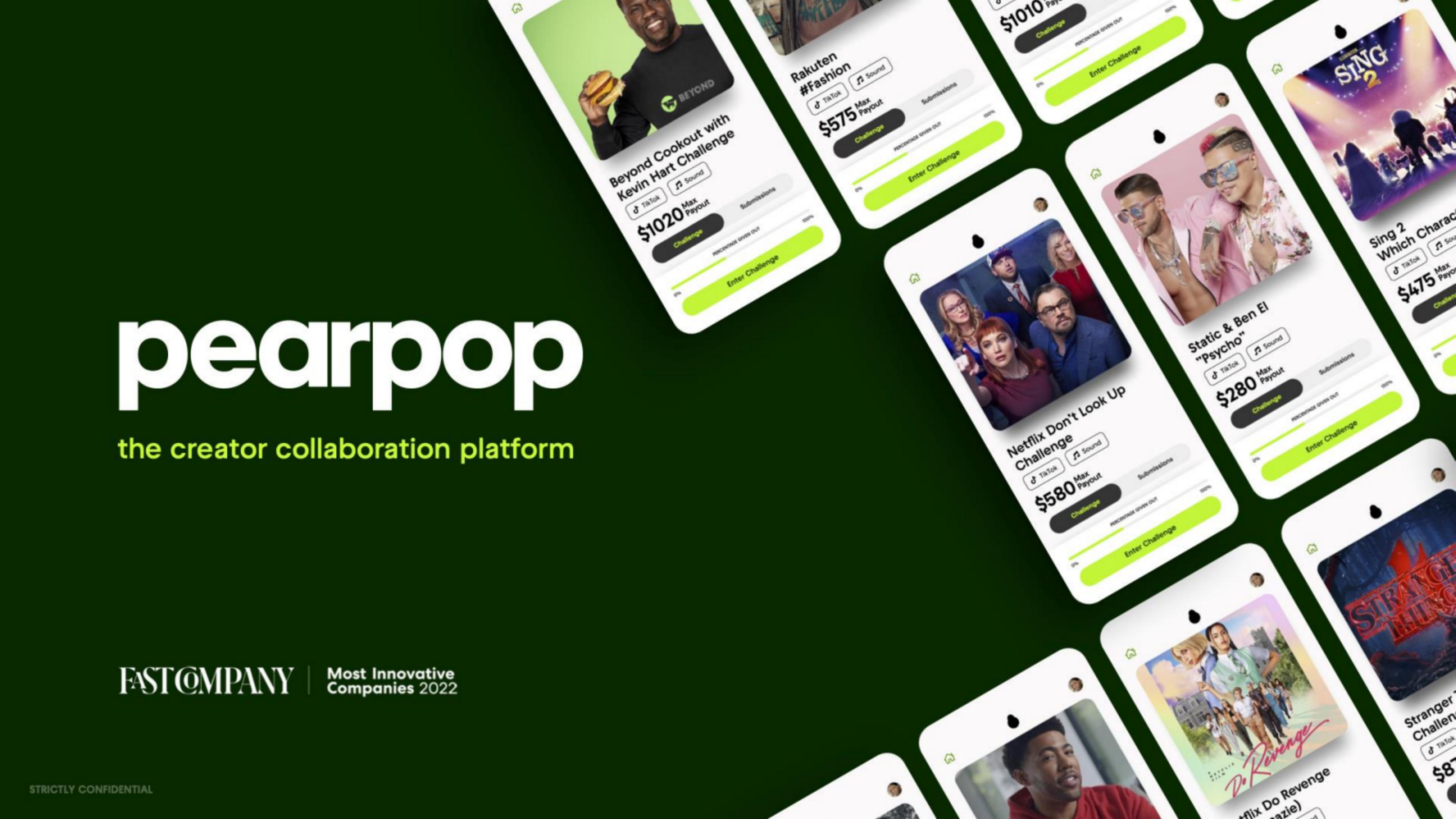
How to build a detailed financial model for Pearpop
A complete walkthrough of the business, drivers, and assumptions behind the downloadable Pearpop model - distilled from its pitch deck and publicly available information.
Product & value proposition
Two core product lines:
Pearpop Challenges (launched 2021): Brands post a campaign brief with a total budget and max payout per creator. Creators on TikTok/Instagram/Twitter submit content; brand pays on a CPM, CPV, or CPA basis for verified views and engagements. Pearpop verifies all creators ("Pearpop Verified™") and monitors submissions for brand safety.
Ovations (next evolution): A loyalty/advocacy layer where brands activate their own existing customer base. Customers who have purchased a product are invited to create content; tiered achievement rewards (discounts, product credits, streaming access) unlock at view milestones (10K / 25K / 50K views). Positioned as UGC at scale with a qualified-buyer gate.
Web3 / Passport Protocol: Briefly mentioned as a future data layer to create "predictable and measurable value on and off platforms, on and off chain". Early-stage; no revenue mechanics disclosed.
Market
- US Influencer Marketing spend: $4.6B by 2023.
- Market adoption: 93% of marketers use influencer marketing.
- No SAM or SOM figures given; no global TAM cited.
Revenue model
- Take rate on campaign spend: Brands set a total budget; creators are paid on performance (CPV, CPM, CPA). Pearpop's take rate / margin on top of creator payouts is not disclosed.
- CPV benchmark visible in deck: $0.0131 CPV on a Stranger Things 4 TikTok challenge with $45,000 total budget and 152K+ views. This is the brand-facing cost per view, not Pearpop's net revenue.
- Ovation tier: Unclear if separate SaaS fee or same take-rate model; no pricing disclosed.
Traction & metrics
- $10M+ paid out to creators (cumulative, all-time).
- 71% of payouts went to creators with fewer than 1M followers.
- 200,000+ creators on platform.
Campaign-level data points (illustrative, from case study slides):
| Campaign | Platform | Total Budget | CPV | Submissions | Views |
|---|---|---|---|---|---|
| Stranger Things 4 (Netflix) | TikTok | $45,000 | $0.0131 | 176 | 152,430+ |
| Starbucks Happy Moment | Not shown | - | 125 | 8,827,684 | |
| Nike ZoomX Vaporfly | Instagram/Reel | Not shown | - | 117 | 9,818,636 |
| Proactiv 3 Step Acne System | Instagram/Reel | Not shown | - | 93 | 6,962,204 |
| Squid Games Season 2 | Instagram/Reel | Not shown | - | Not shown | 10,235,435 |
- No revenue, GMV, growth rate, customer count, or retention data disclosed.
- No ARR, MRR, or cohort data in deck.
Unit economics
Known data point that informs unit economics:
- CPV = $0.0131 (brand-paid, Stranger Things campaign). If Pearpop's take rate is ~20–30%, implied net revenue per view ~$0.003–$0.004.
- Creator payout ratio: 71% to sub-1M-follower creators implies mid/long-tail skew, which typically means lower per-creator payouts but higher volume.
Competition / moat
No explicit competitive slide in deck.
Moat claims made:
- Performance-based pricing (CPV/CPM/CPA vs. flat fee on follower count) - differentiates from traditional influencer agencies.
- "Pearpop Verified™" creator vetting + brand safety monitoring.
- Ovation product creates a proprietary qualified-buyer audience layer (existing customers only) - not replicable by generic influencer platforms.
- Web3 "Passport Protocol" - positioning as future data infrastructure for creator identity/value across chains.
- Fast Company Most Innovative Companies 2022 recognition.
Team & funding ask / use of funds
Founders:
- Cole Mason - CEO & Co-Founder; Forbes 30 Under 30.
- Guy Oseary - Co-Founder; Maverick Management / Untitled Entertainment (manager of Madonna, U2, etc.; major entertainment industry network).
Leadership team:
- Alex Morrison - CMO (ex-Grey, R/GA)
- Rebecka Marcucci - Head of Product & Ops (ex-Tinder, Accenture)
- Sam Christie - Head of Sales (ex-TikTok, OMP)
- Adam Maltais - Head of Growth (ex-Shopify)
- Arik Betesh - General Counsel (ex-Netflix)
- Will Price - Head of Engineering (ex-Topcoder)
- Nate Lu - Head of Design (ex-AXS)
Recommended financial model
Archetype + why: Marketplace GMV / take-rate revenue model, with a campaign-volume driver tree. Pearpop is not SaaS (no subscription ARR visible); it is a two-sided marketplace where brands spend budgets and Pearpop earns a take rate on campaign GMV. Secondary layer: if Ovation becomes a SaaS subscription for enterprise brands, a separate ARR module would be needed. For now, GMV-driven marketplace model is the right frame.
Forecast horizon & granularity:
- 3 years (2023–2025), monthly in Year 1, quarterly in Years 2–3.
- Rationale: early-stage marketplace with no disclosed revenue; monthly granularity needed to model campaign ramp and creator supply growth.
Key drivers & assumptions:
*Supply side (creators):*
- Starting creator count: 200,000.
- Monthly creator growth rate: 5% MoM in Y1 tapering to 2% by Y3.
- Active creator utilization rate (% submitting to at least 1 challenge/month): 10% in Y1, growing to 20% by Y3.
*Demand side (brands / campaigns):*
- Average campaign budget: $45,000.
- New campaigns per month:.
- Campaign duration:.
*Economics:*
- Gross CPV (brand-facing): $0.0131.
- Pearpop take rate on campaign GMV: 25%.
- Creator payout ratio: 75% of campaign budget paid to creators.
- Gross margin on net revenue: 70–75%.
*Ovation product (Year 2+ module):*
- Brand enterprise SaaS fee or incremental take rate:.
Scenarios (Base / Bull / Bear - which variables flex):
- Base: Creator growth 5% → 2% MoM; campaign volume grows 8% MoM Y1; take rate 25%; avg budget $45K.
- Bull: Creator growth accelerates to 8% MoM; Ovation launches commercially in 2023 with 20 enterprise clients; Web3 Passport generates new data licensing revenue stream.
- Bear: Creator growth slows to 2% MoM; avg campaign budget compresses to $25K; brands pull back on influencer spend (macro); take rate pressure to 18% from competition.
Required sheets / outputs:
- Assumptions - all driver inputs, color-coded vs..
- Supply Model - creator count, active creators, submissions per campaign.
- Demand Model - campaign volume, avg budget, GMV.
- Revenue & Take Rate - GMV × take rate = net revenue; creator payouts as cost line.
- P&L - net revenue, gross profit (ex-creator payouts), opex (headcount by function, S&M, tech), EBITDA.
- Headcount Plan - 8 leadership roles visible; build out by department.
- Cash & Runway - given raise unknown, model as sensitivity on funding amount.
- Dashboard - GMV, Net Revenue, Active Creators, Campaigns/Month, Gross Margin %.
- Scenarios tab - Base / Bull / Bear toggle.
Frequently asked
Is the Pearpop financial model free?+
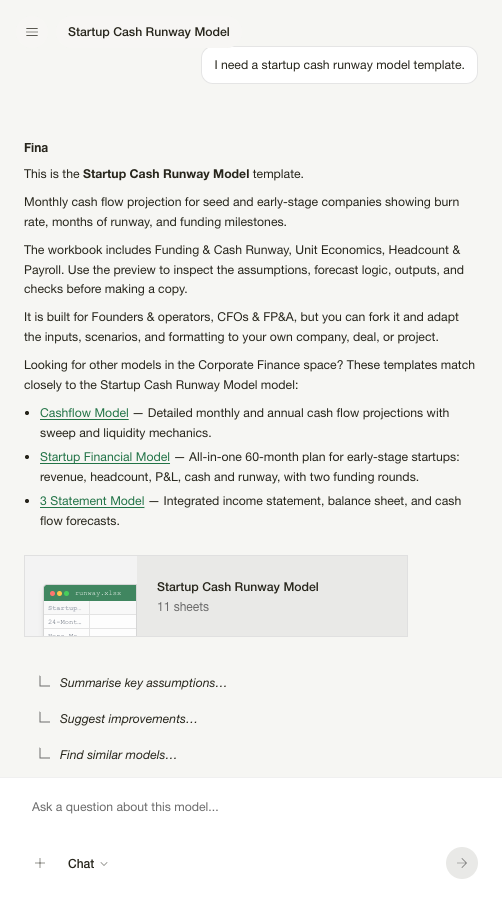
Yes. The Pearpop model is a free Excel (.xlsx) download with live formulas. Sign up with your email and the workbook is yours to keep, review, and edit.
What's included in the model?+
A 5-year monthly forecast with P&L, cash flow and runway, valuation (exit multiple plus a DCF cross-check), MOIC/IRR returns, and unit economics, with live formulas throughout.
How was this model built?+
It was built from Pearpop's pitch deck and publicly available information, then structured to investment-banking standards as a fully editable Excel model.
Can I change the assumptions?+
Yes. You can change assumptions and the live formulas will recalculate in the downloadable Excel model.
Have more financial modelling questions? Contact us

Created by ex-finance professionals
Hey, I’m Alex and I created Finamodel.
Over my years in the finance industry I kept building the same models over and over again. Same structure, same assumptions, different logo. So I started building frameworks to turn them into clean, reusable templates.
Every model here is one I’d actually use for a client, and I personally vet each one before it goes up.
I’m not an expert in every industry, but I’ve built enough models to know what belongs in one. And when something is completely foreign to me, I reach out to my network for experts to work on our models with us.
Having a template library on hand cuts a first build from hours to minutes.
Need help finding your model? You’ll find me in the Finamodel app!
Other Marketplace Startup Financial Models
Browse another startup in the same category.

Acquco
Amazon brand aggregator - acquires third-party Amazon seller businesses at attractive multiples, then scales them via proprietary growth playbooks and technology.
Arive
Premium q-commerce app delivering lifestyle and branded products in under 30 minutes across German cities.

Audience Town
Vertical data and advertising platform targeting home movers across the entire home journey - pre-move through post-move.

AudioMob
Non-intrusive in-game audio ad platform bridging music/brand advertisers to mobile game publishers.

Authoritive
Two-way messaging platform that turns creator expertise into scalable, push-delivered learning experiences via SMS/WhatsApp.

Avo
Building amenity and office perk platform delivering same-day grocery/pantry/goods to residential and commercial tenants via a white-label marketplace.
beehiiv
Newsletter platform for creators to build, grow, and monetize email audiences - SaaS subscription + native ad network revenue.
Borzo
Global same-day logistics marketplace connecting B2B merchants with crowdsourced couriers for last-mile delivery