 Personetics Financial Model
Fintech Startup Financials (Free Excel Download)
B2B SaaS platform sold to financial institutions that delivers AI-driven data enrichment, personalized customer engagement, and automated financial wellness programs ("Self-Driving Finance").



professionals from Deloitte
Used by professionals from






About this model
Personetics sells AI-driven data enrichment, personalised engagement, and automated financial-wellness programmes to financial institutions. Its Self-Driving Finance platform helps banks turn transaction data into timely, relevant customer actions.
The company serves large institutions through enterprise deployments that can expand with modules, end users, and transaction data. Professional services support implementation, but the long-term value lies in a recurring platform relationship embedded in bank channels.
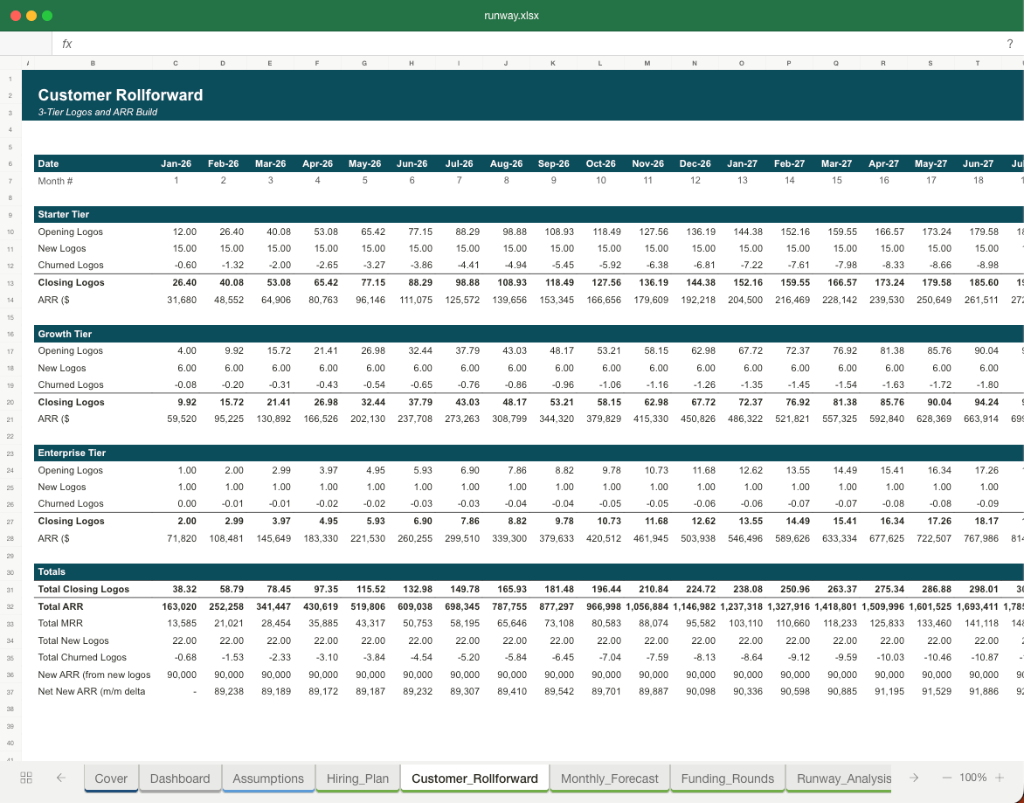
The model should forecast bank logos, contracted ARR, live end-user volume, module adoption, expansion, and churn. Separate implementation and professional-services revenue from licence revenue, while deployment lag, sales-cycle length, and customer concentration are kept visible in the enterprise SaaS forecast.
A turnkey financial model
Live formulas, no hardcoded values
Outputs are driven by live formulas, so the workbook updates from its assumptions instead of relying on hardcoded results.
All assumptions in one tab
Inputs are clearly marked in the Assumptions tab and separated from calculations, making it clear what to change and what to leave intact.
Statements always balancing
For integrated-statement models, the balance sheet, cash flow, and supporting schedules tie through properly.
Distinct schedules for clarity
Debt, working capital, taxes, and cash flow can get messy quickly. We group calculations in clear schedules, not across disconnected tabs.
No hidden macros or external links
There are no unexplained external workbook links or macros to undermine auditability or portability.
Changes flow through the model
Update a key driver and see the impact carry through the forecast, financing, and return outputs. We never use hardcoded numbers in formulas.
About Personetics
personetics.com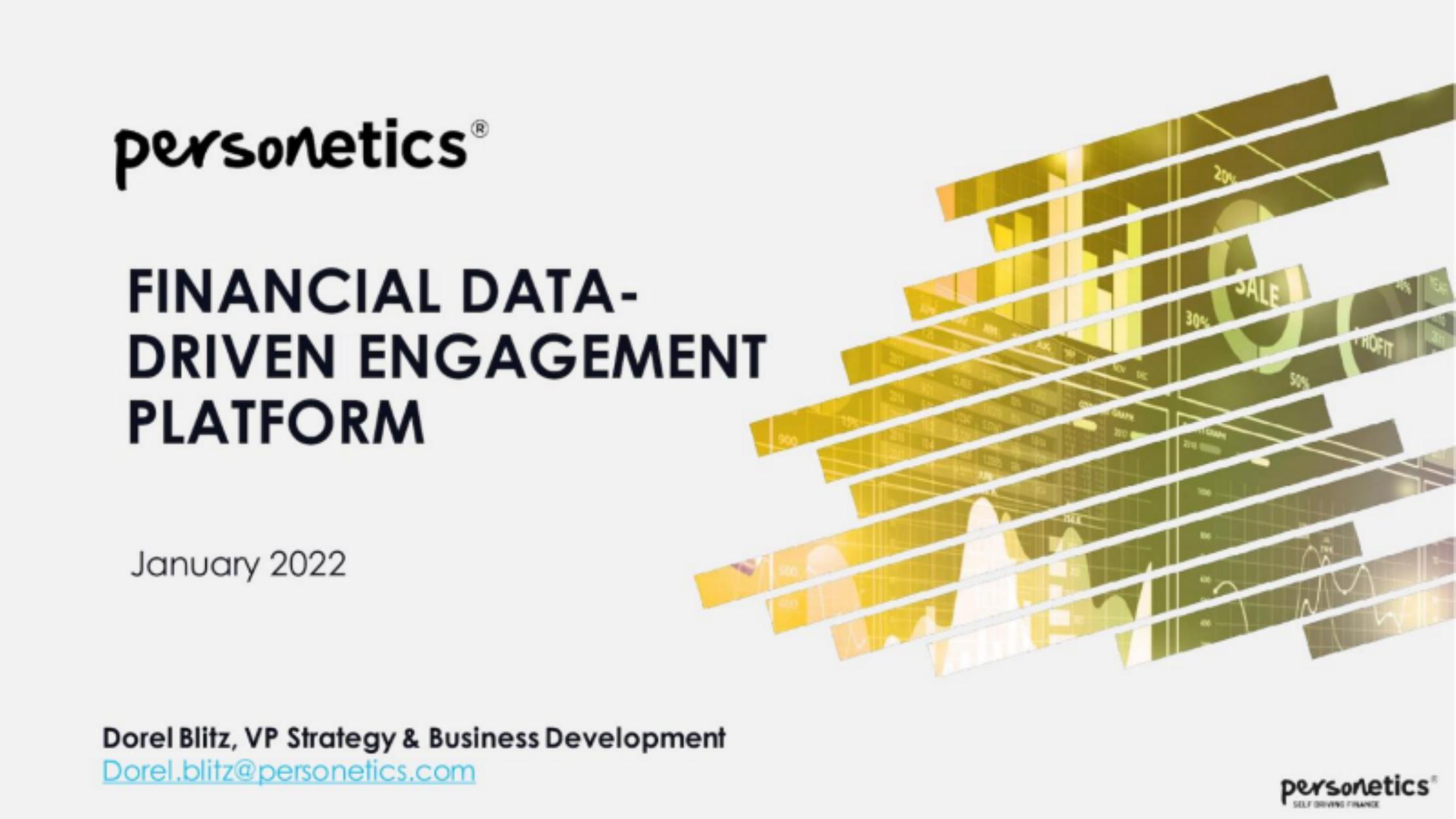
How to build a detailed financial model for Personetics
A complete walkthrough of the business, drivers, and assumptions behind the downloadable Personetics model - distilled from its pitch deck and publicly available information.
Product & value proposition
Four-module platform sold to banks and financial institutions:
- Data Enrichment Services - transaction enrichment, customer financial map.
- Customer Engagement (Retail, SME, Wealth Management) - insights library, engagement builder.
- Financial Wellness Automation - automated savings programs ("Pay Yourself First", "Start Saving Today").
- Open Finance - cloud data connector aggregating external account/insurance/wealth data.
Value prop to FIs: increase digital engagement, drive cross-sell/up-sell, grow deposits, improve NPS, reduce churn - all within months rather than years. Positioned as the "personalization layer" on top of banks' existing core processors and digital interfaces.
Deployment options span retail banking, SME, and wealth management.
Market
No explicit TAM/SAM/SOM figures in deck.
Market context provided:
- 2018: 12–14% of banks with assets >$10bn had implemented AI in front office.
- 2020: Retail banking moved from "early adopter" to "early majority" stage of AI adoption (Celent).
- 2024 tipping point: Celent expects AI implementation in bank front offices to hit 50%.
- PwC 2020 Banking Executive Survey: "Customer-Centric Business Model" rated "very important" by ~70%+ of respondents but "very prepared" by <10% - large readiness gap.
Revenue model
Not explicitly stated in deck. Inferred structure:
- B2B enterprise SaaS license: annual subscription or multi-year platform license sold to financial institutions; pricing likely scales with number of end-customers/users on the bank's platform, modules deployed, or AUM/transaction volume. Common in banking middleware.
- Professional services / implementation fees: typical for enterprise FI deployments.
- Revenue-share or usage-based component on automated savings program flows is plausible but not stated.
Channels: direct enterprise sales (VP Strategy & Business Development contact shown); no reseller/channel partner model mentioned.
Traction & metrics
All as of January 2022 deck date:
- ~80 bank clients
- Working with 6 of the top 12 banks in North America/Europe
- 120MM+ customers served worldwide
- 58B+ customer transactions analyzed
- 9B+ personalized customer interactions delivered
- 4.5+ star average customer (end-user) rating
- ~300 employees
- Incorporated 2011; 11 years in operation
Notable clients shown: RBC, Intesa Sanpaolo, Santander, AXA Banque, BNP Paribas, Openbank, Akbank, TMRW (UOB digital), US Bank, Metro Bank, BMO, Citi, Ally, Hyundai Card, Wells Fargo, Huntington, KBC, UOB, Banamex, Bank Hapoalim, Isracard.
No ARR, revenue, growth rate, or financial metrics disclosed.
Unit economics
- 35% increase in digital engagement (frequency/time spent)
- 15–20% new accounts & balances growth (savings accounts)
- 10% YoY digital sales growth (personal loans)
- +7 NPS points; 4.4/5 customer rating
- 17% CTR on advice/product recommendations
- 5–8% improvement in retention rate for engaged customers
These are outcomes delivered to the bank client, not Personetics' own unit economics.
Competition / moat
Competitive positioning:
- Competes for bank customer engagement against: incumbent banks building in-house (ING, BofA, Chase, HSBC), neobanks/fintechs (Chime, Revolut, SoFi, Robinhood), retailers/big tech (PayPal, Google, Alibaba, Amazon Pay).
- Personetics is positioned as enabling tool for incumbent FIs to compete with these challengers.
Moat claimed:
- "Global leader" positioning with 11 years of proprietary transaction data and ML models.
- Celent: "deployed quickly and surgically at many large banks" - speed-to-value moat.
- Installed base at 6 of top 12 NA/EU banks; 120M+ end users creates data flywheel.
- Recognized by KPMG Fintech 100, Frost & Sullivan Best Practices Award 2019.
No direct named software competitors (e.g., Moven, Meniga, Strands, Finn.ai) called out explicitly.
Team & funding ask / use of funds
- Contact shown: Dorel Blitz, VP Strategy & Business Development.
- Founders / CEO not named in deck.
- Investors: Viola Ventures, Sequoia Capital, Lightspeed Ventures, Nyca Partners, Warburg Pincus PE, Thoma Bravo PE. Presence of two large PE firms (Warburg Pincus, Thoma Bravo) suggests late-stage / growth equity rounds.
- No funding ask, round size, valuation, or use of funds stated. This appears to be a sales/partnership deck rather than a fundraising pitch.
Recommended financial model
- Archetype + why: Enterprise SaaS ARR model with seat/usage-based scaling. Personetics sells multi-year platform licenses to banks; revenue is recurring and client count is the primary driver. A 3-statement SaaS model (ARR bridge → P&L → cash flow) is appropriate. Secondary module: professional services revenue line (non-recurring, lower margin).
- Forecast horizon & granularity: 5 years (2022–2026), annual columns; monthly granularity for Year 1 only (useful for cash burn / hiring ramp visibility). Given the late-stage profile (~80 clients, PE-backed), a quarterly bridge may be more useful than monthly beyond Y1.
- Key drivers & assumptions:
| Driver | Value | Source |
|---|---|---|
| Starting bank client count | ~80 | - |
| End-customers per bank (avg) | ~1.5M | 120MM / 80 banks ≈ 1.5M; highly skewed toward large-bank clients |
| New bank logos per year | 15–20 | Based on ~80 over ~10 years active selling; growth stage |
| Net revenue retention (NRR) | 110–120% | SaaS enterprise fintech median; expansion via module add-ons |
| Annual contract value (ACV) per bank | $500K–$3M | Wide range reflecting Tier 1 vs. regional banks; no pricing disclosed |
| Blended ACV | $1M | Rough midpoint; must be stress-tested against disclosed revenue if available |
| Professional services % of ARR | 15–25% | Typical for complex enterprise fintech implementations |
| Gross margin (software) | 70–75% | Enterprise SaaS with cloud hosting; lower than pure SaaS due to data processing at scale |
| Gross margin (services) | 20–30% | Implementation/consulting labor-intensive |
| S&M % of revenue | 25–35% | Enterprise motion with long sales cycles |
| R&D % of revenue | 20–30% | Competitive AI/ML product requires heavy eng investment |
| G&A % of revenue | 8–12% | Multi-office global ops overhead |
| Headcount (current) | ~300 | - |
| Revenue per employee (implied) | ~$200–300K target; typical for late-stage SaaS at this scale | |
| Churn rate (client-level) | 3–5% annual | Sticky enterprise contracts with large FIs; high switching cost |
- Scenarios (Base / Bull / Bear - which variables flex):
- Base: 15 net new bank logos/year, 110% NRR, blended ACV $1M, stable gross margin.
- Bull: 20+ logos/year, NRR 120%+ (module upsell), ACV expansion toward $1.5M as Tier 1 banks expand; 75%+ gross margin.
- Bear: Logo growth slows to 8–10/year (macro bank IT freeze), NRR 105%, ACV compression from competitive pressure; gross margin pressure from cloud cost inflation.
- Required sheets / outputs:
- Assumptions - all drivers with/ tags.
- ARR Bridge - opening ARR, new logos, expansion, churn, closing ARR.
- Revenue - ARR + professional services split.
- P&L - gross margin by segment, S&M, R&D, G&A, EBITDA.
- Headcount - by function, tied to revenue growth.
- Cash Flow - simplified (no balance sheet required unless debt structure known).
- Scenario toggle - Base / Bull / Bear on key drivers.
- KPI Dashboard - ARR, NRR, client count, revenue per client, EBITDA margin.
Frequently asked
Is the Personetics financial model free?+
Yes. The Personetics model is a free Excel (.xlsx) download with live formulas. Sign up with your email and the workbook is yours to keep, review, and edit.
What's included in the model?+
A 5-year monthly forecast with P&L, cash flow and runway, valuation (exit multiple plus a DCF cross-check), MOIC/IRR returns, and unit economics, with live formulas throughout.
How was this model built?+
It was built from Personetics's pitch deck and publicly available information, then structured to investment-banking standards as a fully editable Excel model.
Can I change the assumptions?+
Yes. You can change assumptions and the live formulas will recalculate in the downloadable Excel model.
Have more financial modelling questions? Contact us

Created by ex-finance professionals
Hey, I’m Alex and I created Finamodel.
Over my years in the finance industry I kept building the same models over and over again. Same structure, same assumptions, different logo. So I started building frameworks to turn them into clean, reusable templates.
Every model here is one I’d actually use for a client, and I personally vet each one before it goes up.
I’m not an expert in every industry, but I’ve built enough models to know what belongs in one. And when something is completely foreign to me, I reach out to my network for experts to work on our models with us.
Having a template library on hand cuts a first build from hours to minutes.
Need help finding your model? You’ll find me in the Finamodel app!
Other Fintech Startup Financial Models
Browse another startup in the same category.
Acin
SaaS and data subscription network for operational risk management at Tier 1 financial institutions

Ageras Group
B2B SME ecosystem - marketplace connecting SMEs with accountants + cloud accounting/payroll software + embedded financial services (lending, factoring, banking)

Airbase
Unified non-payroll spend management platform (corporate cards, AP/bill pay, expense reimbursement, approval workflows) for mid-market companies.

Altruist
Vertically integrated all-in-one platform for registered investment advisors (RIAs) - combining custodial, portfolio management, practice management, and client acquisition tools.
Amenitiz
All-in-one hotel management SaaS platform ("Shopify for hotels") for independent hoteliers - PMS, booking engine, channel manager, website builder, payments, and AI-driven revenue management.

Anrok
SaaS sales tax compliance platform - nexus monitoring, calculation, registration, filing, and remittance - built specifically for SaaS companies.
Arrival
Arrival is an EV manufacturer of commercial vans and buses using proprietary Microfactories and vertically integrated components, going public via SPAC merger with CIIG Merger Corp.

AtoB
AtoB is building financial infrastructure for commercial fleets, starting with a no-fee Visa fleet card for fuel and expanding into payroll, BNPL, and international.