 Poshmark Financial Model
Marketplace Startup Financials (Free Excel Download)
Mobile-first peer-to-peer fashion marketplace enabling individuals and boutiques to buy and sell clothing via smartphone



professionals from Deloitte
Used by professionals from






About this model
Poshmark is a mobile-first peer-to-peer fashion marketplace where individuals and boutiques list, discover, buy, and sell clothing through a social feed. The platform handles payment, customer service, shipping coordination, and dispute resolution, reducing friction for both sides of the transaction.
The early model charged no listing fee, took 20% of each completed sale, and added a $9.95 shipping charge. The deck illustrated that $100 million of GMV could produce $20–30 million of gross revenue once commission and shipping are combined.
The model starts with seller supply, listings, buyer conversion, average item value, and repeat purchasing to build GMV. A 20% take rate and shipping revenue determine gross revenue, while shipping, payment processing, support, and returns reduce margin. Marketplace liquidity, social engagement, and repeat transactions drive scale.
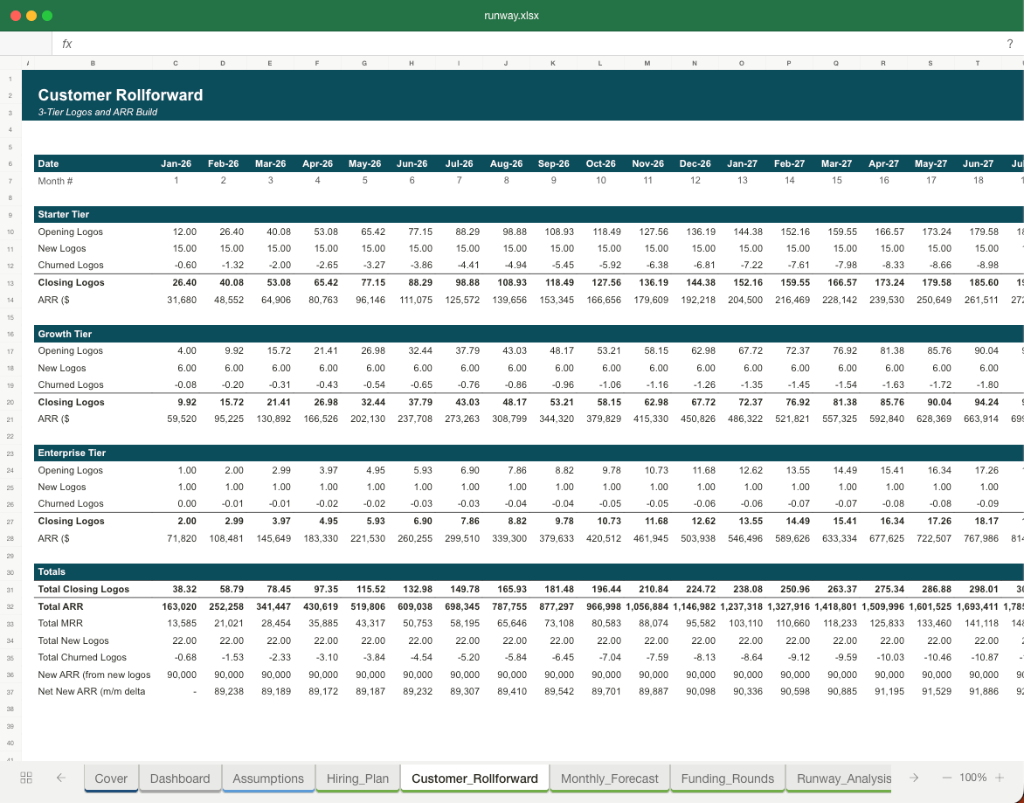
A turnkey financial model
Live formulas, no hardcoded values
Outputs are driven by live formulas, so the workbook updates from its assumptions instead of relying on hardcoded results.
All assumptions in one tab
Inputs are clearly marked in the Assumptions tab and separated from calculations, making it clear what to change and what to leave intact.
Statements always balancing
For integrated-statement models, the balance sheet, cash flow, and supporting schedules tie through properly.
Distinct schedules for clarity
Debt, working capital, taxes, and cash flow can get messy quickly. We group calculations in clear schedules, not across disconnected tabs.
No hidden macros or external links
There are no unexplained external workbook links or macros to undermine auditability or portability.
Changes flow through the model
Update a key driver and see the impact carry through the forecast, financing, and return outputs. We never use hardcoded numbers in formulas.
About Poshmark
poshmark.com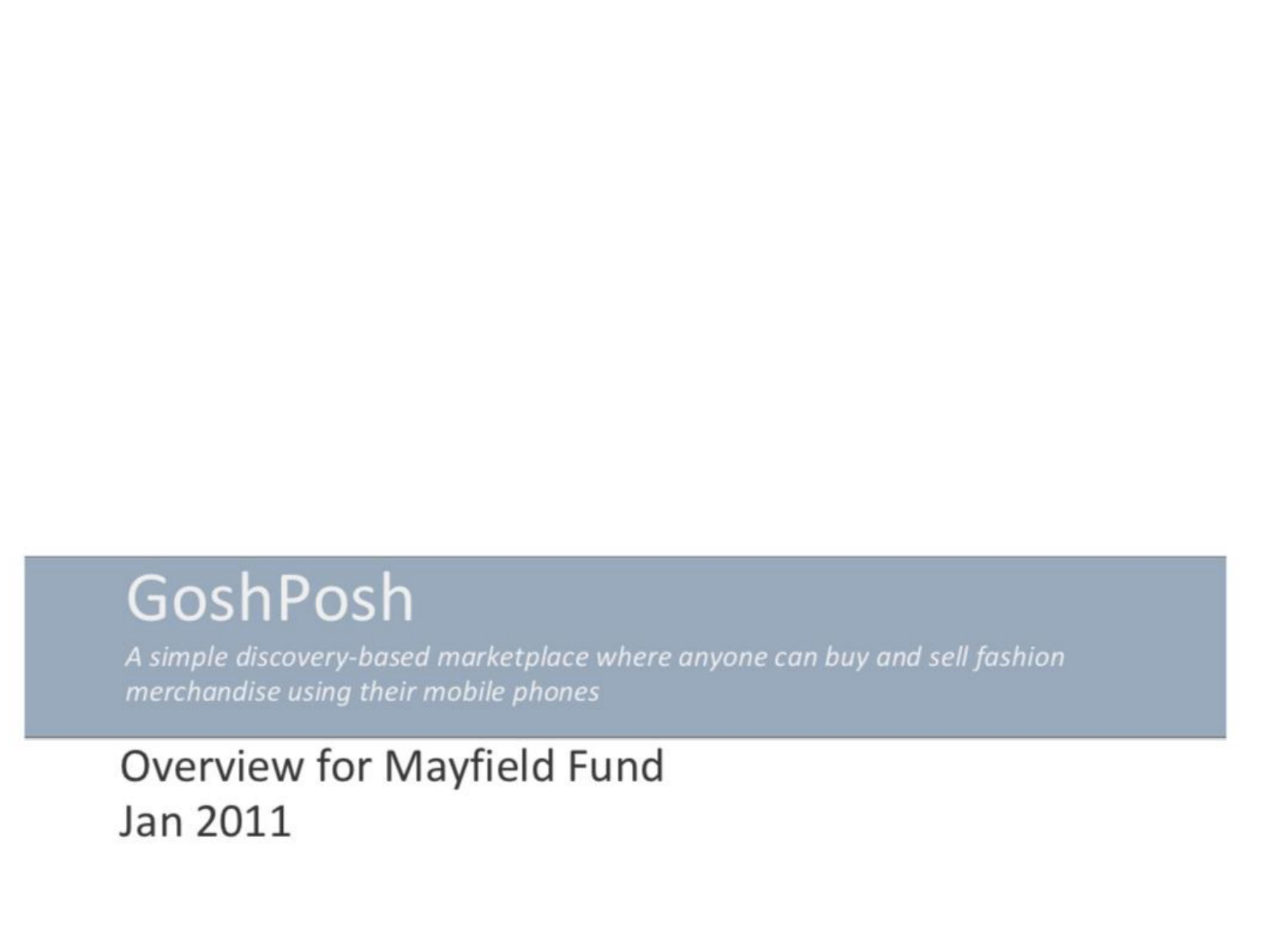
How to build a detailed financial model for Poshmark
A complete walkthrough of the business, drivers, and assumptions behind the downloadable Poshmark model - distilled from its pitch deck and publicly available information.
Product & value proposition
- Mobile-first listing: sellers photograph items with iPhone; app converts photo into fashion-quality image
- Discovery-led buying: buyers browse via social feed (follow people, not search keywords)
- Full transaction intermediation: GoshPosh (pre-launch brand name) handles payment, customer service, and dispute resolution
- Target sellers: individual women with unwanted closet items + independent boutiques needing online outlet
- Target buyers: women seeking fashion discovery, not utility search
- Seller seeding strategy: Power Sellers, Independent Boutiques, Fashion Bloggers as initial supply
Market
- Overall US Apparel Market: $200B (2010), 3% growth in 2010, 2% projected growth to 2015
- Online Apparel Market: $27B (2009 figure), 17% growth (2009), 10% projected growth to 2015
- eBay Apparel Market (proxy for resale): $2B (2010), 7% growth in 2010, 6% projected to 2015
- eBay fashion buyers: 10M buyers, $2B GMV (2010)
- eBay fashion mobile: 13 items/min sold via mobile apps worldwide
- eBay active listings: 2M used fashion listings
- Independent boutiques in US: ~80,000, generating $80B gross revenue
- Plato's Closet (largest teen resale chain): 300 stores, 1M+ sq ft retail
- SAM / SOM: Not explicitly defined; implied SOM is the $2B eBay fashion market; long-run GMV target of $1B
Revenue model
- No listing fees
- 20% transaction fee on each completed sale (applied to item price)
- $9.95 flat shipping fee per transaction (covers shipping, packaging, and partial return shipping)
- Illustrative unit economics stated in deck: $100M GMV → $20M–$30M gross revenue (implied blended take rate ~20–30% of GMV including shipping)
- Shipping is a bundled cost/revenue item; margin on shipping not disclosed
- Future potential revenue streams (implied): boutique services, fulfillment tiers (slide 12 comparison table shows Chegg/consignment model as highest-service benchmark)
Traction & metrics
- Roadmap: iPhone Beta targeted Q3 2011; transaction model validation targeted Q4 2011
Unit economics
- Buyer segmentation at scale:
- Occasional Buyers (65% of base): 2 items/year
- Casual Buyers (30%): 5 items/year
- Power Buyers (5%): 8 items/year
- Target spend increase to $300–$500/year/user (aspirational, not current)
- Shipping cost structure: $9.95 fee described as covering shipping + packaging + part of return shipping; net margin on shipping not disclosed
Competition / moat
- Direct competitors cited: eBay, Craigslist (high friction, search-based, not mobile-first)
- Adjacent / partial competitors: ThredUp, Glyde, Chegg/Consignment, StubHub
- Moat / differentiation:
- Mobile-first image creation lowers seller friction vs. eBay listing process
- Discovery-based feed vs. keyword search (social commerce angle)
- Full transaction intermediation (payment, CS, dispute resolution) vs. Craigslist self-service
- Virtuous cycle: recruit seed users → listings → shares → new users
Team & funding ask / use of funds
- Context: Presenting to Mayfield Fund, Jan 2011 - implies seed or Series A raise, amount not stated.
- Milestones implying capital needs: team formation Q1 2011, operations set-up Q2 2011, hire Operations Head Q1 2012
Recommended financial model
- Archetype + why: Marketplace GMV model with take-rate revenue. GoshPosh is a two-sided marketplace; the primary KPI is GMV, with revenue derived via a fixed take-rate (20%) plus a flat shipping fee ($9.95/transaction). This is structurally identical to eBay/Poshmark/StubHub - model GMV first, apply blended take-rate to get net revenue, then layer COGS (shipping costs) and opex.
- Forecast horizon & granularity: Monthly for Year 1 (2011 launch through Dec 2011); quarterly for Years 2–3 (2012–2013). Deck roadmap is quarterly through Q1 2012 - align to that cadence then extend.
- Key drivers & assumptions:
| Driver | Value | Source |
|---|---|---|
| Transaction fee rate | 20% of item sale price | - |
| Shipping fee per transaction | $9.95 | - |
| Long-run transacting user target | 2–3M | - |
| Long-run GMV target | $1B | - |
| Implied avg. transaction value at scale | ~$333–500 (GMV / users × frequency) | derived from $1B / 2–3M users ÷ blended 3–4 items/year |
| Buyer mix - Occasional (65%) / Casual (30%) / Power (5%) | as stated | - |
| Items/year - Occasional: 2, Casual: 5, Power: 8 | as stated | - |
| Avg item price (AOV) | $75 | mid-range women's resale; consistent with $100M GMV illustration on slide 13 and eBay fashion avg |
| Monthly active user (MAU) growth ramp | 0 at launch → seed users Q3 2011; model S-curve | pre-revenue; viral + direct seeding |
| Seller-to-buyer ratio | 1:3 | typical two-sided fashion marketplace; deck emphasizes buyer recruitment |
| Shipping cost to company per transaction | $8.00 | $9.95 fee described as covering shipping + packaging + partial return; slight net positive or breakeven |
| S&M as % of revenue (early) | 40–60% | marketplace cold-start; seeding boutiques, bloggers, paid acquisition |
| S&M as % of revenue (mature) | 15–20% | flywheel reduces paid spend over time |
| Headcount ramp | ~5 FTEs 2011 → 15–20 by end 2012 | seed-stage tech startup; Operations Head hire flagged Q1 2012 |
| Avg fully-loaded cost per employee | $120K/year | Bay Area tech, 2011 |
- Scenarios (Base / Bull / Bear - which variables flex):
- Base: S-curve user growth; 20% take-rate; $75 AOV; shipping at cost; reach $100M GMV by Year 3
- Bull: Faster boutique onboarding drives supply; higher AOV ($100+); early power-buyer cohort dominates mix; $1B GMV path by Year 5
- Bear: Cold-start failure → slow user growth; eBay inertia persists; AOV lower ($50); shipping margin negative; GMV <$30M by Year 3
- Primary flex variables: transacting users (ramp speed), AOV, shipping unit economics, S&M efficiency (CAC payback)
- Required sheets / outputs:
- Assumptions - all drivers in one place; color-coded inputs
- GMV Build - monthly transacting buyers × items/year × AOV by segment (Occasional / Casual / Power)
- Revenue - GMV × 20% take-rate + (transactions × $9.95 shipping fee)
- Shipping P&L - shipping revenue vs. shipping cost; net shipping margin
- Income Statement - revenue, COGS (shipping cost + payment processing ~2–3% of GMV), gross profit, S&M, G&A, R&D, EBITDA
- Headcount & Opex - FTE ramp by function (Eng, Ops, Marketing, G&A)
- Cash / Runway - monthly burn, implied funding requirements vs. milestones (Q1 2012 critical usage targets)
- Scenario Toggle - Base / Bull / Bear switch feeding GMV Build
- KPI Dashboard - GMV, take-rate revenue, transactions, avg AOV, shipping margin, burn rate
Frequently asked
Is the Poshmark financial model free?+
Yes. The Poshmark model is a free Excel (.xlsx) download with live formulas. Sign up with your email and the workbook is yours to keep, review, and edit.
What's included in the model?+
A 5-year monthly forecast with P&L, cash flow and runway, valuation (exit multiple plus a DCF cross-check), MOIC/IRR returns, and unit economics, with live formulas throughout.
How was this model built?+
It was built from Poshmark's pitch deck and publicly available information, then structured to investment-banking standards as a fully editable Excel model.
Can I change the assumptions?+
Yes. You can change assumptions and the live formulas will recalculate in the downloadable Excel model.
Have more financial modelling questions? Contact us

Created by ex-finance professionals
Hey, I’m Alex and I created Finamodel.
Over my years in the finance industry I kept building the same models over and over again. Same structure, same assumptions, different logo. So I started building frameworks to turn them into clean, reusable templates.
Every model here is one I’d actually use for a client, and I personally vet each one before it goes up.
I’m not an expert in every industry, but I’ve built enough models to know what belongs in one. And when something is completely foreign to me, I reach out to my network for experts to work on our models with us.
Having a template library on hand cuts a first build from hours to minutes.
Need help finding your model? You’ll find me in the Finamodel app!
Other Marketplace Startup Financial Models
Browse another startup in the same category.

Acquco
Amazon brand aggregator - acquires third-party Amazon seller businesses at attractive multiples, then scales them via proprietary growth playbooks and technology.
Arive
Premium q-commerce app delivering lifestyle and branded products in under 30 minutes across German cities.

Audience Town
Vertical data and advertising platform targeting home movers across the entire home journey - pre-move through post-move.

AudioMob
Non-intrusive in-game audio ad platform bridging music/brand advertisers to mobile game publishers.

Authoritive
Two-way messaging platform that turns creator expertise into scalable, push-delivered learning experiences via SMS/WhatsApp.

Avo
Building amenity and office perk platform delivering same-day grocery/pantry/goods to residential and commercial tenants via a white-label marketplace.
beehiiv
Newsletter platform for creators to build, grow, and monetize email audiences - SaaS subscription + native ad network revenue.
Borzo
Global same-day logistics marketplace connecting B2B merchants with crowdsourced couriers for last-mile delivery