PRProductfy Financial Model
Fintech Startup Financials (Free Excel Download)
API-first embedded finance / BaaS platform enabling non-bank companies to launch financial products (cards, accounts, ACH, credit) in weeks.



professionals from Deloitte
Used by professionals from






About this model
Productfy is an API-first embedded-finance platform that lets non-bank companies launch cards, accounts, ACH, and credit products in weeks. It gives product teams a single infrastructure layer instead of requiring separate bank, KYC, and payments integrations.
The company combines per-unit fees for account opening, identity checks, and payments with platform pricing based on active users. Interchange and sponsorship economics add another revenue layer as customers put card products into market.
The model should forecast platform customers, monthly active end users, accounts opened, verification events, ACH volume, card spend, and associated fee yields. Subscription-like MAU revenue, usage fees, and interchange must be kept separate, with bank-partner and compliance costs deducted by product.
A turnkey financial model
Live formulas, no hardcoded values
Outputs are driven by live formulas, so the workbook updates from its assumptions instead of relying on hardcoded results.
All assumptions in one tab
Inputs are clearly marked in the Assumptions tab and separated from calculations, making it clear what to change and what to leave intact.
Statements always balancing
For integrated-statement models, the balance sheet, cash flow, and supporting schedules tie through properly.
Distinct schedules for clarity
Debt, working capital, taxes, and cash flow can get messy quickly. We group calculations in clear schedules, not across disconnected tabs.
No hidden macros or external links
There are no unexplained external workbook links or macros to undermine auditability or portability.
Changes flow through the model
Update a key driver and see the impact carry through the forecast, financing, and return outputs. We never use hardcoded numbers in formulas.
About Productfy
productfy.io
How to build a detailed financial model for Productfy
A complete walkthrough of the business, drivers, and assumptions behind the downloadable Productfy model - distilled from its pitch deck and publicly available information.
Product & value proposition
- Embedded finance platform that lets any company embed financial features (debit/credit card issuance, deposit accounts, ACH, KYC/KYB, data aggregation, credit builder) via UI widgets, GraphQL APIs, and SDKs.
- "FinTech-in-a-Box": unified due diligence, built-in compliance templates, multiple bank sponsors (Stearns Bank NA named), and a marketplace of strategic data/processor partners (Marqeta, Equifax, Envestnet Yodlee).
- Key time-to-market claim: launch in as little as 3 weeks vs. DIY 16–18 months.
- Proprietary omnipurpose general ledger on HADR (High Availability Disaster Recovery) platform with event-sourcing architecture.
- Strategic investors: Point72 Ventures, 500 Startups.
Revenue model
Three monetization streams:
- Per-unit fees (transaction-based):
- ACH volume fees
- Instant Account Verification (IAV) fees
- KYC fees
- Bank account opening fees
- Per-MAU platform fees:
- Monthly platform/subscription fee per active user
- Data aggregation fees
- Interchange / sponsorship fees (BPS):
- Card interchange revenue (basis points on spend)
- Sponsorship fees from bank/network partners
GTM motion: "Land and Expand" - start clients on Money Movement (MM), expand to MM + Banking, then MM + Banking + Cards. Channels: direct outbound to competitor clients, direct outbound to fintechs via leads DB, strategic partner channels.
Future "escape velocity" revenue lines: international remittances, servicing infrastructure, elastic banking infrastructure, investments, bank white labeling, payment network, enablement services.
Competition / moat
Competitive positioning:
- Slide 05 frames three weak incumbent archetypes: (1) Technology Only - no bank sponsor, incomplete; (2) Bank Expose APIs - charter limits functionality, can't achieve AWS scale; (3) Thin Veneer on Top of Bank - single charter, high friction and cost.
- Productfy's claimed moat: multi-bank-sponsor model for breadth + redundancy; unified compliance/due diligence layer; marketplace of strategic vendors; proprietary event-sourcing general ledger; AWS-style self-service onboarding.
- Slide 10 references "Our Competitors" section but no named competitors or comparison table is legible in text extraction; no specific competitor names appear in OCR.
Team & funding ask / use of funds
- Founder / CEO: Duy Vo (duy.vo@productfy.io).
- No other named team members in the deck.
- Ask: $15M Series A.
- Use of funds - milestones stated:
- Commercial and Personal Debit and Credit Card Issuance
- Program Management for KYC, KYB, Credit, Deposit Accounts, and Credit Builder
- Money Transmittal License and Elastic Banking Infrastructure
- World-Class DevX and Self-Service Onboarding
- No explicit use-of-funds percentage split (engineering vs. sales vs. compliance) disclosed.
Recommended financial model
- Archetype + why: B2B SaaS + usage-based / transaction revenue model (sometimes called "platform + consumption"). Productfy has three blended revenue streams - a recurring per-MAU platform fee (SaaS-like), transaction/volume-based fees (usage-based), and interchange BPS (payment economics). The right model captures all three, with a client cohort build-up driving MAU × fee rate + ACH/IAV/KYC volume × unit price + card spend × interchange rate. This is structurally identical to how Marqeta and Galileo are modeled.
- Forecast horizon & granularity: 5-year model (Year 1–5), monthly for Year 1–2, quarterly for Year 3–5. Series A capital implies 18–24 month runway planning is the immediate need.
- Key drivers & assumptions:
*Client acquisition*
- New B2B clients signed per quarter
- Average client ramp time to full utilization
- Client segments: B2C fintech vs. B2B/SMB financial OS (slides 11–12 show two distinct journeys) - model separately
*Per-MAU revenue*
- MAUs per client
- Monthly platform fee per MAU
*Per-unit / transaction revenue*
- ACH transactions per MAU per month
- ACH fee per transaction
- IAV per new user
- KYC checks per new user
*Interchange revenue*
- Card-enabled MAUs as % of total MAUs
- Monthly card spend per active cardholder
- Interchange rate net to Productfy
*COGS / gross margin*
- Bank sponsor fees + partner pass-through costs
- Compliance/program management headcount
*Opex*
- Engineering / DevX headcount ramp
- Sales & GTM
- G&A / compliance / legal
- Scenarios (Base / Bull / Bear - which variables flex):
- Base: 4 new clients/quarter, 1,500 avg MAU/client at steady state, 50% card attach rate
- Bull: faster enterprise client wins (competitor client poaching per GTM slide), higher MAU/client (10,000+), interchange rate at top of range
- Bear: slower client ramp, regulatory/MTL delays push card revenue out 12 months, lower MAU/client (500), higher bank-sponsor COGS
- Required sheets / outputs:
- Assumptions - all drivers in one tab, flagged vs.
- Client Cohort Build - quarterly client additions × MAU ramp curve
- Revenue Schedule - three streams (platform fee, per-unit, interchange) summed by month/quarter
- P&L (Income Statement) - Revenue → Gross Profit → EBITDA → Net Income
- Headcount Plan - by function (Eng, Sales, Compliance, G&A)
- Cash / Runway - $15M raise, monthly cash burn, months to zero
- Scenario Toggle - Base / Bull / Bear switchable via single input cell
- Dashboard - KPI summary: clients, MAUs, ARR, gross margin %, cash runway
Frequently asked
Is the Productfy financial model free?+
Yes. The Productfy model is a free Excel (.xlsx) download with live formulas. Sign up with your email and the workbook is yours to keep, review, and edit.
What's included in the model?+
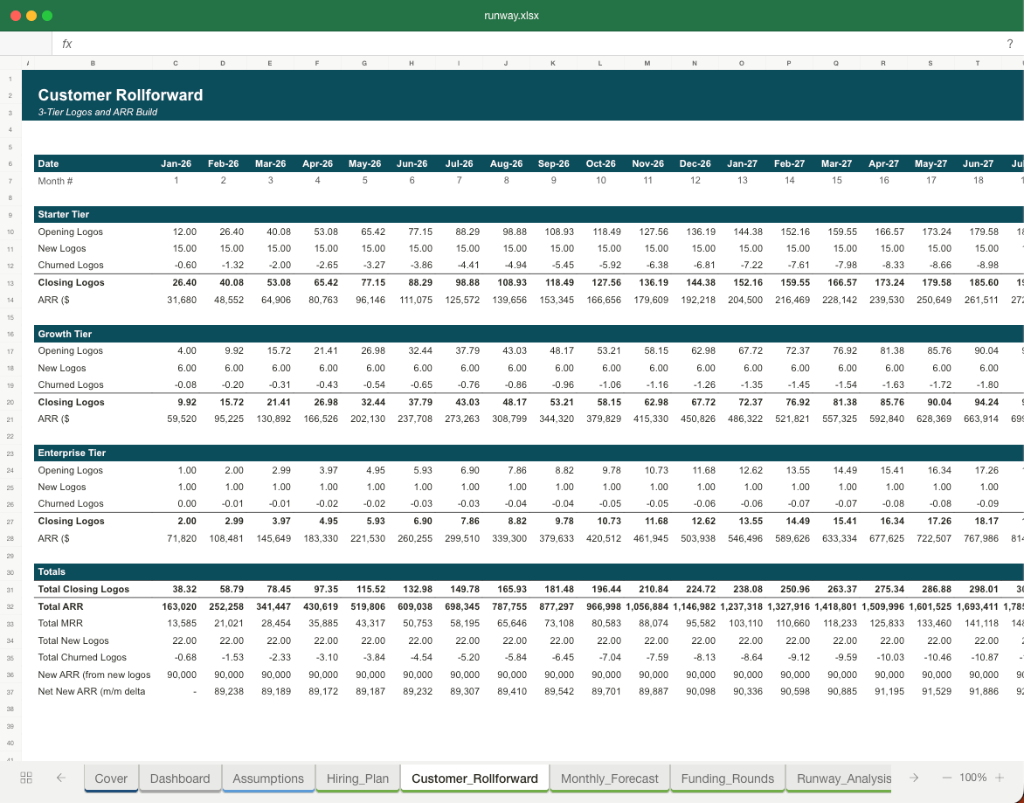
A 5-year monthly forecast with P&L, cash flow and runway, valuation (exit multiple plus a DCF cross-check), MOIC/IRR returns, and unit economics, with live formulas throughout.
How was this model built?+
It was built from Productfy's pitch deck and publicly available information, then structured to investment-banking standards as a fully editable Excel model.
Can I change the assumptions?+
Yes. You can change assumptions and the live formulas will recalculate in the downloadable Excel model.
Have more financial modelling questions? Contact us

Created by ex-finance professionals
Hey, I’m Alex and I created Finamodel.
Over my years in the finance industry I kept building the same models over and over again. Same structure, same assumptions, different logo. So I started building frameworks to turn them into clean, reusable templates.
Every model here is one I’d actually use for a client, and I personally vet each one before it goes up.
I’m not an expert in every industry, but I’ve built enough models to know what belongs in one. And when something is completely foreign to me, I reach out to my network for experts to work on our models with us.
Having a template library on hand cuts a first build from hours to minutes.
Need help finding your model? You’ll find me in the Finamodel app!
Other Fintech Startup Financial Models
Browse another startup in the same category.
Acin
SaaS and data subscription network for operational risk management at Tier 1 financial institutions

Ageras Group
B2B SME ecosystem - marketplace connecting SMEs with accountants + cloud accounting/payroll software + embedded financial services (lending, factoring, banking)

Airbase
Unified non-payroll spend management platform (corporate cards, AP/bill pay, expense reimbursement, approval workflows) for mid-market companies.

Altruist
Vertically integrated all-in-one platform for registered investment advisors (RIAs) - combining custodial, portfolio management, practice management, and client acquisition tools.
Amenitiz
All-in-one hotel management SaaS platform ("Shopify for hotels") for independent hoteliers - PMS, booking engine, channel manager, website builder, payments, and AI-driven revenue management.

Anrok
SaaS sales tax compliance platform - nexus monitoring, calculation, registration, filing, and remittance - built specifically for SaaS companies.
Arrival
Arrival is an EV manufacturer of commercial vans and buses using proprietary Microfactories and vertically integrated components, going public via SPAC merger with CIIG Merger Corp.

AtoB
AtoB is building financial infrastructure for commercial fleets, starting with a no-fee Visa fleet card for fuel and expanding into payroll, BNPL, and international.