 Rasgo Financial Model
AI/ML Startup Financials (Free Excel Download)
ML feature store platform that lets data scientists transform, share, and serve features to production models - built natively on top of cloud data warehouses (Snowflake, BigQuery, Redshift).



professionals from Deloitte
Used by professionals from






About this model
Rasgo provides a feature store built natively on cloud data warehouses including Snowflake, BigQuery, and Redshift. Data teams can transform, share, version, serve, and monitor production features without maintaining a separate warehouse.
The platform claims a 140-times reduction in feature-compute cost, 17-times faster queries, and a 30-minute Snowflake deployment. It had five paying clients, 70,000 downloads of its open-source pyrasgo library, 13 employees, and $25.1 million raised after 11 months.
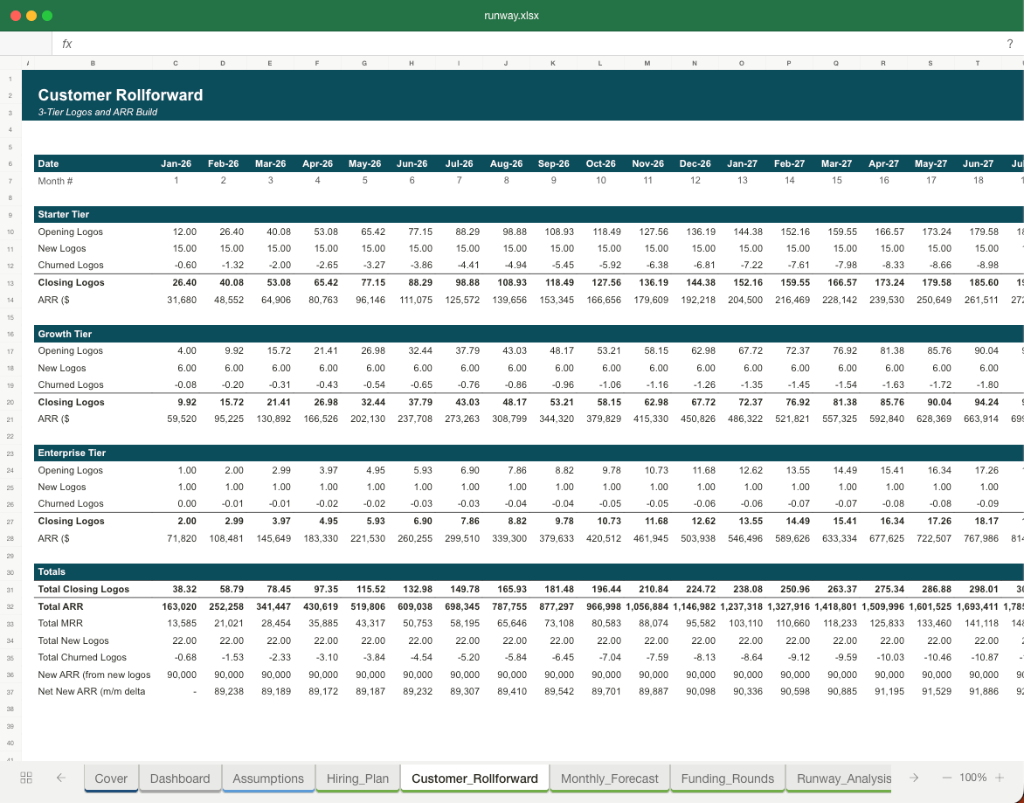
The model converts open-source users and enterprise sales opportunities into subscription ARR, then tracks contract expansion, churn, warehouse usage, delivery costs, and gross margin. It layers sales capacity, engineering and customer-success hiring, operating cash flow, cash burn, and runway.
A turnkey financial model
Live formulas, no hardcoded values
Outputs are driven by live formulas, so the workbook updates from its assumptions instead of relying on hardcoded results.
All assumptions in one tab
Inputs are clearly marked in the Assumptions tab and separated from calculations, making it clear what to change and what to leave intact.
Statements always balancing
For integrated-statement models, the balance sheet, cash flow, and supporting schedules tie through properly.
Distinct schedules for clarity
Debt, working capital, taxes, and cash flow can get messy quickly. We group calculations in clear schedules, not across disconnected tabs.
No hidden macros or external links
There are no unexplained external workbook links or macros to undermine auditability or portability.
Changes flow through the model
Update a key driver and see the impact carry through the forecast, financing, and return outputs. We never use hardcoded numbers in formulas.
About Rasgo
rasgo.com
How to build a detailed financial model for Rasgo
A complete walkthrough of the business, drivers, and assumptions behind the downloadable Rasgo model - distilled from its pitch deck and publicly available information.
Product & value proposition
- Feature store that sits on top of existing cloud data warehouses (ELT architecture, not a separate warehouse).
- Three core workflow pillars:
- TRANSFORM: Profile data, calculate feature importance, apply transforms via click or code using the Rasgo transform library.
- SHARE: Version/track features, enable discovery and reuse across data science teams, expose lineage to business stakeholders.
- SERVE: Promote features to production in a single click/command; monitor data drift; integrate natively with MLOps and data pipelines.
- Open-source Python library (`pyrasgo`) as a community/top-of-funnel entry point.
- Key technical differentiators: 140X reduction in cost to compute; 17X+ faster feature query performance; 30-minute Snowflake deployment; dev features immediately production-ready.
Revenue model
Not explicitly stated in deck. Inferred from context:
- Enterprise SaaS subscription, likely seat-based or consumption-based, given the enterprise customer profile (Fortune 500 companies, energy firms, financial trading firms). Rationale: all named customers are large enterprises; the product integrates into existing cloud data warehouses suggesting per-seat or usage-tier pricing is standard in this space.
- Open-source `pyrasgo` library (70k downloads) likely serves as a PLG (product-led growth) funnel into paid enterprise contracts. Rationale: common pattern for ML infrastructure tools (dbt, Great Expectations, etc.).
- Distribution channel: direct enterprise sales (CEO background in GTM at Platfora, Kinetica, Domino Data Lab, Confluent).
Traction & metrics
All from slide 2 - "11 Month Highlights":
- Investment: $25.1M total raised (Insight Partners & Unusual Ventures)
- Team growth: 330% - grew from 3 to 13 employees
- Paying clients: 5 paying clients secured
- Open-source downloads: 70k pyrasgo downloads
- Product validation: 400+ user interviews; won head-to-head battles vs. competition
Named enterprise clients/validators:
- AES (energy - Head of Data Science + Analytics quoted)
- Farmer's Fridge
- Guardant (health)
- Stanley Black & Decker
- An unnamed F500 manufacturing company
- An unnamed financial trading firm (Christian Peressin, Managing Partner)
- Snowflake Technology Alliance partnership (Director of Technology Alliances quoted)
No revenue figures (ARR, MRR, ACV) disclosed.
Competition / moat
Competitive landscape:
- Positioned as disrupting legacy ETL/ELT tooling: Alteryx, Informatica, Trifacta, Paxata (data engineering side) and fragmented data science tooling (Apache Spark, pandas, scikit-learn).
- Integrated with (not competing against) cloud data warehouses: Snowflake, BigQuery, Redshift; and workflow tools: dbt, Apache Airflow.
Moat claims:
- ELT-native architecture eliminates duplicate data warehouse - cited 140X cost reduction, 17X query speed.
- Feature versioning, experiment time travel, lineage tracking - stickiness through institutional ML knowledge lock-in.
- OSS community (pyrasgo, 70k downloads) as distribution moat.
- Snowflake Technology Alliance validation and co-sell potential.
Team & funding ask / use of funds
Founders:
- Jared Parker - CEO; GTM leadership background at Platfora, Kinetica, Domino Data Lab, Confluent. Owns marketing, sales, alliances, finance, ops.
- Patrick Dougherty - CTO; MS in Analytics; data scientist by trade; built data science practice at Slalom from ground up. Owns product and engineering.
Funding: $25.1M total raised. No current ask amount, round size, or use-of-funds breakdown disclosed in deck.
Recommended financial model
- Archetype + why: Enterprise SaaS ARR model with a PLG (product-led growth) conversion layer. The business has a dual-motion: open-source `pyrasgo` downloads drive organic awareness → direct enterprise sales convert to paid contracts. Revenue is almost certainly ACV/ARR-based subscription given the enterprise customer base. SaaS ARR model is the right archetype.
- Forecast horizon & granularity: 3 years (Year 1–3), monthly for Year 1, quarterly for Years 2–3. Early-stage company with only 5 paying clients - monthly granularity matters for cash planning in Year 1.
- Key drivers & assumptions:
- New logos per quarter: 5 paying clients in ~11 months as baseline; initial ramp of 1–2 new enterprise logos/quarter, accelerating to 3–5 by Year 2. Rationale: small direct sales team, enterprise sales cycles typically 3–6 months.
- Average Contract Value (ACV): $60k–$120k/year per enterprise client. Rationale: early-stage B2B ML infrastructure; F500 names suggest ability to command 6-figure deals, but 5-client base implies pricing is still being established; comparable tools (Tecton, Feast enterprise) typically price in this range.
- Net Revenue Retention (NRR): 110–120%. Rationale: feature store becomes deeply embedded in ML pipelines; expansion natural as more data science teams onboard; no churn data in deck but enterprise ML tooling typically has high retention once embedded.
- Gross logo churn: 5–10% annually. Rationale: early-stage product risk; no deck evidence of churn direction.
- Gross margin: 70–80%. Rationale: SaaS software with cloud infrastructure costs; ELT-native architecture (no separate compute to run) should yield high margins vs. managed compute alternatives.
- Headcount / S&M: 13 employees at time of deck; S&M grows in line with new logo targets; assume 2–3 quota-carrying AEs in Year 1 at ~$150k OTE each.
- R&D spend: ~40–50% of OpEx in Year 1 given early product stage and CTO-led team.
- PLG conversion rate (OSS → paid): 0.1–0.3% of OSS downloads convert to a paid trial/pipeline. Rationale: 70k downloads → 5 paying clients is roughly 0.007% at deck date, but many downloads are likely individual hobbyists; enterprise conversion funnel is separate from raw download count.
- Cash burn / runway: derive from OpEx build; $25.1M raised suggests significant runway, but headcount growth (330% in 11 months) implies aggressive burn.
- Scenarios (Base / Bull / Bear - which variables flex):
- Bull: New logo adds 4–5/quarter by Year 2; ACV scales to $150k+; NRR reaches 125%; Snowflake co-sell accelerates pipeline.
- Base: New logo adds 2–3/quarter by Year 2; ACV $80k; NRR 115%.
- Bear: Sales cycles elongate; only 1–2 new logos/quarter; ACV stays at $50–60k; churn 10%.
- Flex variables: new logo adds, ACV, NRR, gross margin.
- Required sheets / outputs:
- Assumptions - all drivers with scenario toggles.
- ARR Bridge - beginning ARR, new ARR, expansion ARR, churned ARR, ending ARR.
- P&L (Income Statement) - Revenue, COGS, Gross Profit, S&M, R&D, G&A, EBITDA, Net Income.
- Headcount Plan - by department (S&M, R&D, G&A), with loaded cost.
- Cash Flow & Runway - cash burn, months of runway given current raise.
- KPI Summary - ARR, logo count, ACV, NRR, gross margin, burn multiple, CAC payback.
- Dashboard - charts: ARR bridge waterfall, ARR vs. headcount, logo growth, gross margin %.
Frequently asked
Is the Rasgo financial model free?+
Yes. The Rasgo model is a free Excel (.xlsx) download with live formulas. Sign up with your email and the workbook is yours to keep, review, and edit.
What's included in the model?+
A 5-year monthly forecast with P&L, cash flow and runway, valuation (exit multiple plus a DCF cross-check), MOIC/IRR returns, and unit economics, with live formulas throughout.
How was this model built?+
It was built from Rasgo's pitch deck and publicly available information, then structured to investment-banking standards as a fully editable Excel model.
Can I change the assumptions?+
Yes. You can change assumptions and the live formulas will recalculate in the downloadable Excel model.
Have more financial modelling questions? Contact us

Created by ex-finance professionals
Hey, I’m Alex and I created Finamodel.
Over my years in the finance industry I kept building the same models over and over again. Same structure, same assumptions, different logo. So I started building frameworks to turn them into clean, reusable templates.
Every model here is one I’d actually use for a client, and I personally vet each one before it goes up.
I’m not an expert in every industry, but I’ve built enough models to know what belongs in one. And when something is completely foreign to me, I reach out to my network for experts to work on our models with us.
Having a template library on hand cuts a first build from hours to minutes.
Need help finding your model? You’ll find me in the Finamodel app!
Other AI/ML Startup Financial Models
Browse another startup in the same category.

AI Rudder
AI Rudder provides multi-lingual conversational AI for B2C customer engagement - automating outbound and inbound voice/chat interactions at scale.

Aisera
AI Service Experience platform that automates IT, HR, and customer service workflows via conversational AI and automation.

Amberscript
AI + human hybrid transcription and subtitling platform targeting B2B customers in Europe

Apheris
Privacy-preserving federated ML platform enabling enterprises to train AI on distributed data without sharing raw data.

Arcane
AI copilot for marketing teams that automates data analysis, reporting, and repeatable tasks via a chat interface and scheduled workflows.

Artisan
AI-powered "digital workers" (branded Artisans) that autonomously perform role-specific tasks - starting with outbound sales - and are delivered as SaaS subscriptions.

Artisan Series A
AI-native B2B SaaS platform consolidating the enterprise software stack with human-like "Artisan" AI employees that automate role-specific workflows

Bigblue
Tech-enabled e-commerce fulfillment platform for European D2C brands - "Amazon-standard" delivery without Amazon.