 Realtime Financial Model
Hardware/Deep-tech Startup Financials (Free Excel Download)
AI-powered motion-planning software and hardware that automates robot programming, enabling faster and cheaper industrial automation deployment.



professionals from Deloitte
Used by professionals from






About this model
Realtime provides AI motion-planning software and hardware for industrial robot programming. It aims to reduce the time and cost of deploying automation in factories, where conventional robot programming can require specialist skills, long integration work, and repeated adjustment for each production environment.
Its commercial model can combine deployment services, hardware, and recurring software. Customer value depends on whether robot cells can be commissioned faster and kept productive, so implementation capacity and measured labour or throughput improvement matter as much as the initial software contract.
Model deployments, robot cells, software ARR, hardware sales, implementation, expansion, renewals, and churn. Include engineering, installation, support, cloud delivery, hardware procurement, and sales costs. Deployment speed, cells per customer, software attach, gross margin, implementation capacity, productivity proof, and retention should drive scenarios.
A turnkey financial model
Live formulas, no hardcoded values
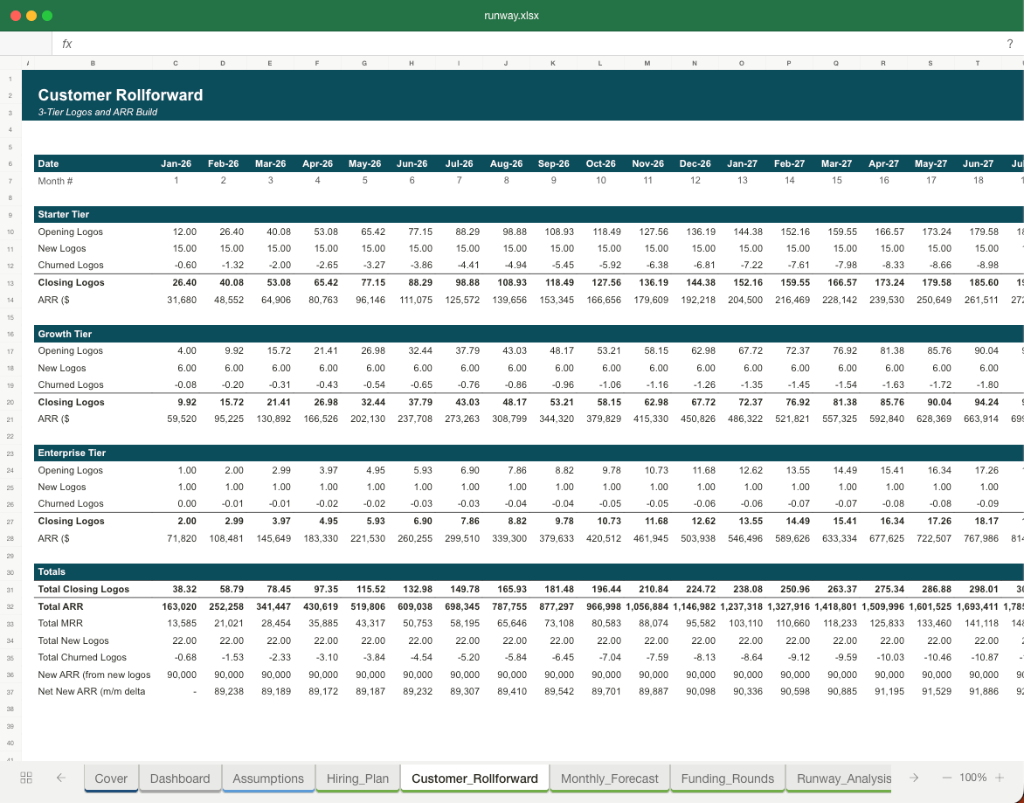
Outputs are driven by live formulas, so the workbook updates from its assumptions instead of relying on hardcoded results.
All assumptions in one tab
Inputs are clearly marked in the Assumptions tab and separated from calculations, making it clear what to change and what to leave intact.
Statements always balancing
For integrated-statement models, the balance sheet, cash flow, and supporting schedules tie through properly.
Distinct schedules for clarity
Debt, working capital, taxes, and cash flow can get messy quickly. We group calculations in clear schedules, not across disconnected tabs.
No hidden macros or external links
There are no unexplained external workbook links or macros to undermine auditability or portability.
Changes flow through the model
Update a key driver and see the impact carry through the forecast, financing, and return outputs. We never use hardcoded numbers in formulas.
About Realtime
realtimeboard.com
How to build a detailed financial model for Realtime
A complete walkthrough of the business, drivers, and assumptions behind the downloadable Realtime model - distilled from its pitch deck and publicly available information.
Product & value proposition
Three product lines:
- Realtime Controller - specialized edge-computing hardware; automates motion plans for up to 16 robots; removes brand-specific programming.
- RapidPlan - AI core software; choreographs multi-robot movement; user changes cell specs on-the-fly in clicks; optimize–simulate–deploy workflow.
- RapidSense - spatial perception module; live 3D machine vision; detects and reacts to anomalies in real time.
Key value claims:
- Reduces automation costs by 40%.
- 82% reduction in engineering/programming time vs. conventional (Valiant TMS case study, slide 12).
- Deploy in hours vs. weeks.
- Enables industrial robots to work collaboratively with humans (speed-and-separation safety, no fencing).
- Plug-and-play with all major robot brands (Fanuc, Kawasaki, Yaskawa, Mitsubishi, Siemens).
Market
- Total claimed TAM: $173B by 2025, comprising four verticals:
- Logistics (automated material handling): $56B
- Safe Collaboration (safe unstructured robotics): $85B
- Automotive (multi-robot factory floor): $20B
- Digital Simulation (digital twin software programming): $12B
- Sources cited: McKinsey, IFR Report 2019, Mordor Intelligence, LogisticsIQ, WRR 2020.
Revenue model
- Stated model: "Flexible RaaS model". No per-unit pricing, contract term, or subscription fee disclosed.
- Channel: Partner-led (anchor partners Yaskawa, Siemens, Mitsubishi Electric per vertical - slide 10); direct enterprise deals (Ford, Valiant TMS).
- Products generating revenue: Realtime Controller (hardware), RapidPlan (software license/SaaS), RapidSense (sensor module), Virtual Realtime Controller (digital simulation vertical).
- Average robot lifetime cost context: $350K per robot; programming can be 50% of that (~$175K addressable per robot installation).
Traction & metrics
- $31M raised to date
- 60 employees worldwide, 47 in engineering
- Founded 2017
- 17 unique invention disclosures; 3 awarded patents; 28 national patent applications pending; 2 PCT applications pending
- Customer proof points: Ford (robotics research partnership); Valiant TMS (80%+ reduction in offline programming, slide 11; 82% engineering time reduction on multi-robot chassis welding, slide 12); Siemens (joint value proposition, slide 11).
Competition / moat
Competitive positioning:
- vs. Conventional robots (fenced): rigid, stop-on-intrusion, large footprint - not suitable for collaborative use.
- vs. Today's cobots (power-and-force limited): slow, small payload, stop-on-contact - not suitable for industrial applications.
- Realtime's differentiation: speed-and-separation safety; robots plan around humans without stopping; uses 2D+3D sensors; enables industrial robots in collaborative settings.
IP moat: 17 invention disclosures, 3 awarded patents, 28 national + 2 PCT pending. Ecosystem moat: strategic partnerships with all major robot OEMs (Fanuc, Kawasaki, Yaskawa, Siemens, Mitsubishi Electric); strategic investors include Hyundai, Toyota AI Ventures, OMRON, SAIC, Mitsubishi Electric.
Team & funding ask / use of funds
- Team: CEO & President, CCO, CFO, VP Engineering, VP Systems, Dir. Product (6 named executives, faces shown).
- Total raised to date: $31M.
Recommended financial model
- Archetype + why: Enterprise software/hardware subscription with RaaS recurring revenue. Realtime sells a controller (one-time hardware) + RapidPlan/RapidSense software on a recurring license or RaaS fee per robot cell. Best modeled as a B2B SaaS / usage-based ARR model with a hardware attach layer - tracking robot cells deployed, software ARR per cell, and hardware revenue separately. A simple 3-statement is warranted given growth stage and need to model burn vs. milestones.
- Forecast horizon & granularity: 5 years (2024–2028); quarterly for Year 1–2, annual for Year 3–5. Standard for growth-stage hardware/software company seeking institutional capital.
- Key drivers & assumptions:
- Robot cells deployed (cumulative) - primary volume driver; start from current pilot/customer base (unknown - not in deck; assume ~10–20 cells as placeholder)
- Annual software license / RaaS fee per robot cell - $15K–$30K/year per cell (comparable to industrial automation software; no pricing in deck)
- Hardware (Realtime Controller) revenue per cell - one-time $20K–$40K (edge compute unit; no pricing in deck)
- Channel mix: partner-led vs. direct - 70% partner, 30% direct; partners likely take 20–30% margin
- Average contract value / ACV - $50K–$150K per deployment (multi-robot cell with hardware + software)
- Gross margin on software - 70–80% (asset-light software; no own manufacturing)
- Gross margin on hardware - 30–45% (edge compute; outsourced manufacturing)
- Blended gross margin - ~55–65% depending on hardware/software mix
- Headcount growth - track from 60 employees; engineering-heavy (47/60 = 78%); model as % of revenue/opex
- R&D as % of revenue - 40–50% in early years, declining to 25% at scale (deep-tech company)
- S&M as % of revenue - 20–30% (partner-led reduces direct sales cost)
- G&A as % of revenue - 10–15%
- Average robot lifetime cost - $350K; programming = ~50% (~$175K); Realtime claims 40% cost reduction - use as ROI justification in model commentary
- TAM penetration - model to ~0.1–0.5% of $173B TAM by Year 5 as sanity check
- Scenarios (Base / Bull / Bear - which variables flex):
- Base: Partner ramp takes 18–24 months; 2–3 new verticals generating revenue by Year 3; software margin expands
- Bull: Faster partner pull-through (Siemens/Yaskawa scale deployments); Safe Collaboration vertical opens large greenfield; hardware commoditizes but software ARR compounds
- Bear: Long enterprise sales cycles; RaaS adoption slower than expected; hardware margin compressed; burn rate extends runway requirements
- Required sheets / outputs:
- Assumptions - all drivers, pricing, growth rates
- Income Statement - revenue by segment (hardware vs. software/RaaS), COGS, gross margin, opex by function, EBITDA
- Balance Sheet - simplified (cash, AR, hardware inventory, IP/intangibles, debt if any)
- Cash Flow - operating + capex (minimal for asset-light); runway/cash-out date
- Robot Cells Model - cohort build-up: new cells deployed per quarter, cumulative base, ARR per cohort
- ARR Bridge - new ARR, expansion, churn, net ARR
- Unit Economics - ACV, gross margin per cell, implied LTV; CAC once headcount/sales data available
- Valuation - ARR multiple comps (industrial automation software peers); DCF optional
- Dashboard - KPIs: robot cells deployed, ARR, gross margin %, burn rate, runway
Frequently asked
Is the Realtime financial model free?+
Yes. The Realtime model is a free Excel (.xlsx) download with live formulas. Sign up with your email and the workbook is yours to keep, review, and edit.
What's included in the model?+
A 5-year monthly forecast with P&L, cash flow and runway, valuation (exit multiple plus a DCF cross-check), MOIC/IRR returns, and unit economics, with live formulas throughout.
How was this model built?+
It was built from Realtime's pitch deck and publicly available information, then structured to investment-banking standards as a fully editable Excel model.
Can I change the assumptions?+
Yes. You can change assumptions and the live formulas will recalculate in the downloadable Excel model.
Have more financial modelling questions? Contact us

Created by ex-finance professionals
Hey, I’m Alex and I created Finamodel.
Over my years in the finance industry I kept building the same models over and over again. Same structure, same assumptions, different logo. So I started building frameworks to turn them into clean, reusable templates.
Every model here is one I’d actually use for a client, and I personally vet each one before it goes up.
I’m not an expert in every industry, but I’ve built enough models to know what belongs in one. And when something is completely foreign to me, I reach out to my network for experts to work on our models with us.
Having a template library on hand cuts a first build from hours to minutes.
Need help finding your model? You’ll find me in the Finamodel app!
Other Hardware/Deep-tech Startup Financial Models
Browse another startup in the same category.

ANYbotics
ANYbotics builds and sells autonomous legged inspection robots (ANYmal) for industrial facilities, targeting oil & gas, chemicals, power, offshore, mining, and manufacturing sectors.
Awake Security
Awake Security - AI-driven Network Detection & Response (NDR) platform for the hybrid cloud, positioning as the "intent detection" layer of the SOC visibility triad.

Beem
AR communications platform that overlays full-body "hologram" video of a person into the recipient's physical space via smartphone or web.

Blue White Robotics
Autonomous robotics platform converting existing farm equipment to self-driving tractors for permanent-crop growers, sold as Robots-as-a-Service.

Cambridge GaN Devices
Fabless semiconductor startup commercialising self-protected GaN power transistors (HiGaN) that replace silicon and standard GaN with higher efficiency and no external protection circuitry.

Canix
Cannabis-focused ERP (inventory tracking, compliance automation, sales management, yield forecasting) sold as SaaS to cannabis cultivators, manufacturers, and distributors.
Chobani
Chobani is the US market leader in Greek yogurt; TPG invested $671M in April 2014 for a 35% stake via a structured second lien + equity deal
Cipher Skin
Wearable sensor mesh platform that collects dense multi-modal data from human bodies and industrial objects to predict structural and functional failure before it occurs.