 SIMBA Chain Financial Model
Crypto/Web3 Startup Financials (Free Excel Download)
SIMBA Chain is a no-code/low-code blockchain API development platform that lets enterprises build, deploy, and manage smart-contract-backed applications across multiple blockchains without deep blockchain expertise.



professionals from Deloitte
Used by professionals from






About this model
SIMBA Chain is a no-code and low-code blockchain API platform that lets organisations build, deploy, and manage smart-contract applications without deep blockchain engineering. It supports multichain development and sells enterprise tooling rather than asking every customer to assemble its own blockchain stack.
The US-headquartered company was raising a Series A and also had government-contract and education-licensing opportunities, including some international presence. This gives it a mixed enterprise revenue base: recurring platform subscriptions can sit alongside implementation, public-sector projects, and education-related licensing.
Model enterprise customers, developers, subscription tiers, API consumption, implementation projects, government contracts, and education licences separately. Forecast expansion and churn by customer segment, then include cloud infrastructure, solution engineering, support, sales, and compliance costs. New client wins, deployment scale, usage growth, public-sector timing, and retention should be the scenario variables.
A turnkey financial model
Live formulas, no hardcoded values
Outputs are driven by live formulas, so the workbook updates from its assumptions instead of relying on hardcoded results.
All assumptions in one tab
Inputs are clearly marked in the Assumptions tab and separated from calculations, making it clear what to change and what to leave intact.
Statements always balancing
For integrated-statement models, the balance sheet, cash flow, and supporting schedules tie through properly.
Distinct schedules for clarity
Debt, working capital, taxes, and cash flow can get messy quickly. We group calculations in clear schedules, not across disconnected tabs.
No hidden macros or external links
There are no unexplained external workbook links or macros to undermine auditability or portability.
Changes flow through the model
Update a key driver and see the impact carry through the forecast, financing, and return outputs. We never use hardcoded numbers in formulas.
About SIMBA Chain
simbachain.com
How to build a detailed financial model for SIMBA Chain
A complete walkthrough of the business, drivers, and assumptions behind the downloadable SIMBA Chain model - distilled from its pitch deck and publicly available information.
Product & value proposition
- No-code/low-code smart contract designer (SCD) and API auto-generator
- Point SIMBA at any Web3 smart contract (with code or ABI) and it generates an enterprise-grade REST API - described as "MuleSoft for Web3"
- Chain-agnostic: supports 9 blockchains (Ethereum, RSK, Hyperledger Fabric, Consensys Quorum, Binance, Hyperledger Burrow, Stellar, Avalanche, Hyperledger Sawtooth) and 5 data stores
- Graph search layer for data insights
- Use-case verticals: government/defence supply chain, NFTs/digital assets, education (LMS), enterprise supply chain
- Positioning differentiator vs. Alchemy: SIMBA deploys a contract in 4 steps vs. 16 steps
Market
- Blockchain market 2020: ~$3B; projected 2025: ~$40B
- CAGR: 67.3%
- TAM: compared to "Internet '98" scale - no $ figure given
- SAM: $30 billion
- SOM: $7 billion
- SOM breakdown (today): Government $5B by 2025; Blockchain Education Software $48M; NFT Marketplace $2B
- Future SOM labelled "TOMORROW": same three segments plus "100s more applications built on SIMBA's platform"
Revenue model
- Platform/API subscriptions for enterprise and government clients
- Government contracts (US Air Force, Navy, Army, DoE, NAVAIR, USMC) - likely fixed-price or T&M government contracts
- Education licensing: 21 universities signed to recurring revenue contracts
- NFT marketplace and digital-asset services (frontend AND backend opportunity mentioned)
- No specific pricing tiers, ARR figure, or contract values disclosed in the deck
Traction & metrics
- 360% revenue growth in 2020
- 5,000+ users and growing
- 21 universities signed to recurring revenue contracts
- Customers/logos shown: University of Notre Dame, Boeing, US Marines, Queens College, CGI, Toks (200+ restaurant chain), US Air Force, Zuckerberg Media, UNC Charlotte, The Ohio State University, Navy, ManTech, LSU, NAVAIR, ITAMCO, US Army, Morgan State University, Flinders University, US Department of Energy, Portland State University
- Awards: 2019 Best New Tech in Indiana; 2019 TechCrunch Disrupt Top Pick; 2020 First Air Force Olympics Gold Medal; 2020 Tibbetts Award (past winners: Qualcomm, 23andMe)
- NFT deals with Notre Dame athletics, Club Brugge, West Ham United
- Car-title asset verification noted: 75% of titles require manual investigation - quantified pain point
Competition / moat
Competitors named: Alchemy, Consensys Codefi, Stezy, SettleMint, Kaleido
Moat claims:
- Government vertical: "leading blockchain provider, way ahead of anyone else"
- Education vertical: no competition as a blockchain teaching tool for non-coders
- Feature differentiation: Low-code UI + multi-chain deployment + smart-contract API auto-generation + graph search data relationships + enterprise-class integration - deck claims SIMBA is alone in combining all five
- Deep tech requires ~2 years from world-class team to replicate; substantial head start
- Chain portability creates switching cost: "easy to migrate to more cost-effective blockchains" is pitched as a benefit but also creates platform stickiness
Team & funding ask / use of funds
Team:
- Bryan Ritchie, CEO - serial entrepreneur, 380 startups, 17 exits
- Ian Taylor, CTO & Co-Founder - blockchain development expert
- Joe Matz, COO - 25+ years at Microsoft
- Joel Neidig, President of Govt Ops & Co-Founder - prior exit to Siemens
- Andrew Harrison, VP Engineering
- Neil Halpern, VP Solutions Architecture - Boeing, Expeditors Int'l background
- Matthew Shroyer, VP Legal & HR
Board: Phil Koen (ex-CEO Equinix/Savvis/Intermedia), Michael Lempres (ex-CLO Coinbase), Steve O'Hara (Valley Capital)
Investors (existing): KKR founders and managing directors (George Roberts, Henry Kravis, Rob Lewin, Dave Welch, Herald Chen); Notre Dame Pit Road Fund; Stanford Law School Venture Fund; Dick Kramlich (NEA); Chris Schaepe (Lightspeed); William R. Hearst III; Israel Englander (Millennium); Ken Goldman (Hillspire/Eric Schmidt); Travis Schlenk (Atlanta Hawks); John Giannandrea (Apple SVP AI); Jon Edwards (SpaceX VP Engineering); many others
Funding ask: "A Series" fund raise. Specific raise amount and use of funds not disclosed in the deck.
Recommended financial model
Archetype + why: Multi-segment SaaS/contract revenue model with three distinct streams:
- Government contracts - likely milestone/T&M or annual contract value (ACV); relatively large, lumpy deals
- Enterprise/commercial SaaS - recurring platform subscription (API access); seat- or usage-based
- Education SaaS - per-institution annual recurring contract (lowest ACV, most predictable)
An NFT/marketplace revenue line should be a toggle given the 2021 NFT boom context (high uncertainty).
Forecast horizon & granularity:
- 5-year annual model (2021–2025), with Year 1 split monthly for cash-flow visibility
- Granularity: segment revenues modelled separately (Government, Enterprise, Education, NFT/Other)
Key drivers & assumptions:
Revenue drivers:
- 2020 revenue growth: 360% YoY
- Forward growth rate:
- Government segment as % of revenue:
- University contract ACV:
- Enterprise ACV:
- Platform users: 5,000+ total; conversion to paying customer assumption
- NFT revenue:
- Net revenue retention:
Cost drivers:
- R&D/engineering:
- S&M:
- G&A:
- Gross margin:
- Blended gross margin:
Scenarios (Base / Bull / Bear - which variables flex):
- Base: 150% revenue growth in Year 1; government wins 2–3 new large contracts; education scales to 50 universities by Year 3; enterprise commercial ramps slowly
- Bull: Government spend accelerates (DoD blockchain mandates); NFT/digital-asset line becomes material; Series A capital enables aggressive S&M hiring; net revenue retention >120%
- Bear: Government budget cycles slow contract renewals; NFT market collapses (high probability post-2022); enterprise sales cycles elongate; platform competition intensifies from Alchemy/Consensys
Required sheets / outputs:
- Assumptions - all drivers, segment toggles (Gov't / Enterprise / Education / NFT)
- Revenue Build - by segment: contracts × ACV × growth; MRR/ARR waterfall
- Income Statement - 5-year annual + Year 1 monthly
- Headcount Plan - engineering, sales, G&A
- Cash Flow & Runway - critical for Series A sizing; how much runway does the raise buy?
- KPI Dashboard - ARR, net revenue retention, logo count by segment, gross margin %, burn multiple
- Scenario toggle (Base / Bull / Bear)
Frequently asked
Is the SIMBA Chain financial model free?+
Yes. The SIMBA Chain model is a free Excel (.xlsx) download with live formulas. Sign up with your email and the workbook is yours to keep, review, and edit.
What's included in the model?+
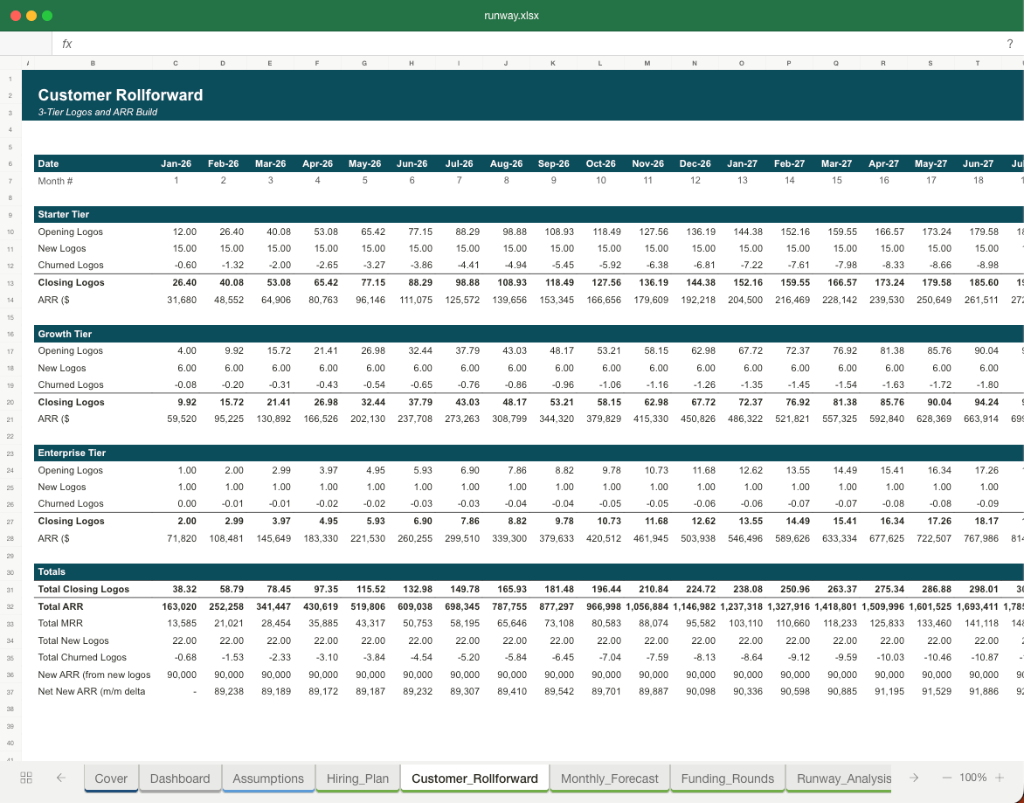
A 5-year monthly forecast with P&L, cash flow and runway, valuation (exit multiple plus a DCF cross-check), MOIC/IRR returns, and unit economics, with live formulas throughout.
How was this model built?+
It was built from SIMBA Chain's pitch deck and publicly available information, then structured to investment-banking standards as a fully editable Excel model.
Can I change the assumptions?+
Yes. You can change assumptions and the live formulas will recalculate in the downloadable Excel model.
Have more financial modelling questions? Contact us

Created by ex-finance professionals
Hey, I’m Alex and I created Finamodel.
Over my years in the finance industry I kept building the same models over and over again. Same structure, same assumptions, different logo. So I started building frameworks to turn them into clean, reusable templates.
Every model here is one I’d actually use for a client, and I personally vet each one before it goes up.
I’m not an expert in every industry, but I’ve built enough models to know what belongs in one. And when something is completely foreign to me, I reach out to my network for experts to work on our models with us.
Having a template library on hand cuts a first build from hours to minutes.
Need help finding your model? You’ll find me in the Finamodel app!
Other Crypto/Web3 Startup Financial Models
Browse another startup in the same category.
0x Labs
0x Labs builds open exchange infrastructure (protocol, API, consumer app) for on-chain token trading across multiple blockchains.

1inch Network
DeFi aggregation protocol that routes crypto swaps across 100+ liquidity sources to deliver best rates and lowest gas fees.

Aether
Synthetic biology platform that builds searchable protein indexes to engineer novel molecular assemblers for high-value industrial products.
Alto
Self-directed IRA platform enabling retail investors to invest in alternative assets (private equity, debt, real estate, crypto) via tax-advantaged retirement savings.
Auki Labs
Decentralized peer-to-peer spatial positioning SDK for social AR - building the infrastructure layer to replace GPS and enable a persistent AR metaverse.
Awesome People Ventures Fund 2
Awesome People Ventures is a community-driven, decentralized early-stage Web3 VC fund raising Fund II.

Axelar
Cross-chain blockchain overlay network enabling universal transfer of assets, transactions, and state across all blockchain ecosystems.
BRD
BRD is a non-custodial crypto wallet app (consumer) and blockchain infrastructure API platform (enterprise) targeting mass-market crypto adoption.